

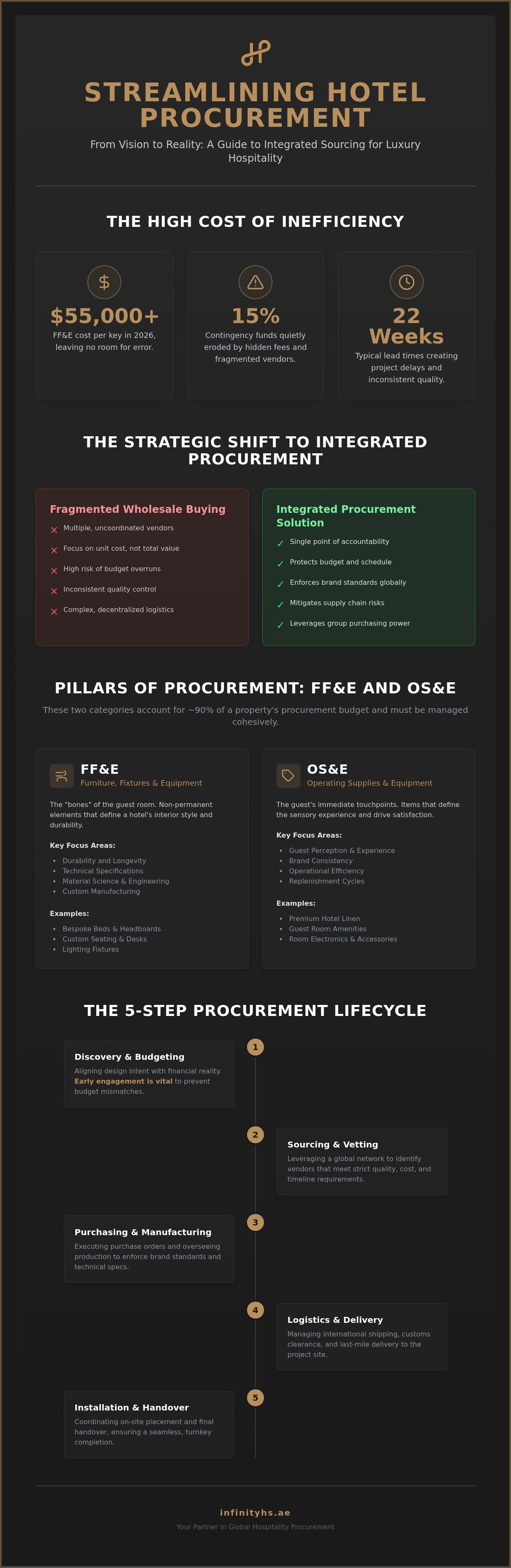
With luxury hotel FF&E costs reaching upwards of $55,000 per key in 2026, the margin for error in your supply chain has effectively vanished. You've likely felt the frustration of fragmented vendors and hidden logistics fees that quietly erode your 15% contingency funds. It's a recurring challenge where the vision for a high-end guest experience often struggles against the reality of 22-week lead times and inconsistent product quality across international borders.
Adopting sophisticated hospitality procurement solutions is no longer just a back-office function; it's a strategic necessity for maintaining brand integrity in a competitive market. This guide reveals how to streamline hotel openings and renovations through integrated sourcing that ensures operational excellence and predictable timelines. We'll explore the shift toward turnkey methodologies and how a global footprint combined with meticulous local accountability can transform your next project into a seamless, high-quality success from the first guest touchpoint to the final room delivery.
Key Takeaways
- Identify the strategic difference between simple wholesale purchasing and integrated hospitality procurement solutions that protect project margins.
- Explore how the alignment of FF&E and OS&E categories creates a cohesive brand narrative and a superior guest experience.
- Gain insights into the GCC advantage, leveraging global sourcing networks with local accountability to ensure precision in quality control.
- Learn why early-stage engagement in the five-step procurement lifecycle is vital for avoiding the common pitfalls of design-budget mismatches.
- Discover the logistical benefits of a turnkey approach for high-impact items, including premium electronics, leather accessories, and housekeeping trolleys.
What are Hospitality Procurement Solutions?
Hospitality procurement solutions are the professional architecture behind every successful hotel launch. They represent the systematic sourcing, purchasing, and logistics management of all physical assets required to bring a property to life. Unlike basic wholesale buying, which often focuses on transactional unit costs, strategic procurement is a holistic discipline. It bridges the gap between design intent and operational reality. A dedicated partner acts as the owner's advocate, protecting the budget and ensuring the project remains on schedule through meticulous oversight.
To better understand the scale and execution of these services, watch this overview of professional procurement in action:
This strategic approach often involves participation in a Group Purchasing Organization (GPO) to leverage collective volume. By doing so, procurement specialists secure preferential pricing and priority manufacturing slots that individual properties could not obtain alone. The ultimate goal is a turnkey solution. This model centralizes accountability, moving the burden of supply chain management from the hotel operator to an expert facilitator.
The Complexity of Modern Hotel Openings
A luxury hotel opening is an exercise in managing thousands of unique SKUs simultaneously. From the heavy furniture in the lobby to the leather accessories in the guest suites, every detail must arrive on time. Fragmented sourcing is the leading cause of budget overruns. When vendors are managed in isolation, quality control suffers and logistics costs skyrocket. A global partner provides the visibility needed to prevent these "opening day disasters," ensuring that every item arrives according to the pre-approved schedule.
The Value Proposition of Professional Procurement
Professional procurement offers a clear path to cost efficiency through established global networks. It isn't just about finding the lowest price; it's about enforcing brand standards at every level. This ensures that housekeeping trolleys and room electronics meet the exact specifications defined by the brand. Risk mitigation is equally vital. Procurement experts manage the intricacies of international shipping, customs, and last-mile delivery. They provide the security that operators need to focus on guest service rather than tracking lost shipments.
The Pillars of Procurement: Understanding FF&E and OS&E
Successful hotel developers recognize that physical assets are categorized into two primary streams: FF&E and OS&E. Together, these categories account for approximately 90% of a property's procurement budget. While they serve different operational roles, they must be managed as a unified ecosystem to ensure brand consistency. Fragmenting these pillars often leads to a disjointed guest experience where the quality of the furniture doesn't match the quality of the service items. Integrated hospitality procurement solutions eliminate this risk by aligning every purchase with the overarching design vision.
FF&E: Furniture, Fixtures, and Equipment
FF&E encompasses the non-permanent elements that define a hotel interior. This includes bespoke beds, lighting, desks, and custom seating. Because these items face constant use in high-traffic environments, durability is paramount. Professional procurement focuses on technical specifications that exceed residential standards. This involves custom manufacturing where every joint and fabric choice is scrutinized for longevity. FF&E elements are the "bones" of the guest room, and their procurement requires a deep understanding of engineering and material science.
OS&E: Operating Supplies and Equipment
OS&E represents the guest's immediate touchpoints. These are the items that define the sensory experience of a stay. You can explore our range of premium hotel linen to see how textile quality impacts guest perception. This category also includes amenities and room electronics. These items drive guest satisfaction scores and repeat bookings. The challenge here is volume; managing recurring orders for thousands of rooms requires a robust logistical framework that ensures availability without overstocking.
The synergy between these pillars is what creates a cohesive guest experience. If the FF&E is luxury-tier but the OS&E feels budget, the brand promise is broken. A strategic partner ensures that the weight of the duvet matches the aesthetic of the bespoke bed frame. This level of meticulousness prevents the fragmented guest experience that often results from siloed purchasing. Quality control begins at the manufacturing source, not at the hotel loading dock. On-site presence during production is a non-negotiable standard for excellence.
Adhering to hospitality procurement best practices ensures that design intent translates perfectly into the final product. If you're planning a renovation or a new opening, it's wise to discuss your specific project requirements with a specialist early in the design phase. This early collaboration allows for value engineering that protects the aesthetic without compromising the budget.
Global Sourcing with Local Reliability: The GCC Advantage
The Middle East hospitality sector is currently defined by unprecedented velocity, with over 104,000 hotel rooms under construction across the region. This rapid development cycle demands a specialized approach to hospitality procurement solutions that balances global reach with immediate local accountability. In a market where project timelines are compressed and guest expectations are exceptionally high, relying on distant vendors without a regional presence is a significant risk. Success in this environment requires a partner that maintains a physical footprint in key hubs like the UAE, China, and the UK to ensure quality control at every stage of the supply chain.
Local reliability isn't just about proximity; it's about managing the final stages of the procurement journey. Having dedicated warehousing within the GCC allows for the consolidation of shipments, providing a buffer against global shipping fluctuations. This infrastructure facilitates precise last-mile delivery, ensuring that items arrive at the property exactly when the installation teams are ready. For a deeper look at regional strategies, you can read our guide on Navigating Hospitality Procurement in the GCC. This localized oversight is a core component of any comprehensive guide to hospitality procurement, as it directly impacts the project's final delivery date.
The China-Dubai Sourcing Corridor
China remains the primary manufacturing engine for bespoke FF&E, but managing production from afar often leads to quality discrepancies. An on-the-ground presence in manufacturing hubs is essential for conducting mid-production audits and pre-shipment inspections. This ensures that every piece of furniture meets the rigorous technical specifications required for luxury properties. Once cleared, these goods flow through Dubai, which serves as the central logistics hub for the region. This corridor allows for the efficient sourcing of bespoke items that must also comply with strict GCC fire and safety regulations, such as Civil Defense certifications for upholstery and electronics.
Sustainability in Modern Procurement
Sustainability has shifted from a voluntary initiative to a mandatory requirement for luxury Middle Eastern resorts. With 92% of business travelers prioritizing eco-friendly options, procurement partners must now source products that align with "Green Key" or similar environmental certifications. A primary example is the integration of LUFTER PHYTOGREEN amenities, which provide a sustainable OS&E solution without compromising the guest's sensory experience. Modern hospitality procurement solutions now prioritize suppliers who demonstrate transparent ethical labor practices and a reduced carbon footprint, ensuring that the hotel's operational supplies contribute to long-term ESG goals.
The 5-Step Procurement Lifecycle for Hotel Projects
The hospitality procurement lifecycle is a methodical progression that transforms an architectural vision into a functional, guest-ready environment through a series of disciplined stages. Engaging with hospitality procurement solutions during the conceptual design phase is critical to prevent the design-budget mismatches that frequently derail large-scale developments. When specialists are involved early, they provide value engineering and realistic lead-time projections that protect the project's financial health. Modern lifecycles also leverage digital procurement platforms, providing owners with real-time transparency into order statuses and manufacturing milestones across the globe.
Phase 1 & 2: Budgeting and Sourcing
Strategic budgeting represents the first step, where design intent is aligned with financial reality. This phase goes beyond simple cost estimation; it involves a deep analysis of material specifications to ensure longevity in high-traffic areas. Once the budget is established, global sourcing begins. This involves identifying vendors capable of meeting both the high-quality standards and the massive volume requirements of a luxury property. A rigorous bidding and comparison process follows, where multiple suppliers are evaluated not just on price, but on their historical reliability and compliance with international standards. This ensures that the owner receives the best possible value without sacrificing the aesthetic integrity of the hotel.
Phase 3, 4 & 5: Production, Logistics, and Installation
The latter half of the lifecycle focuses on execution and meticulous oversight. Production management includes scheduled factory audits to verify that every item meets the pre-approved technical specifications. Logistics management then takes center stage, focusing on consolidating shipments from various global origins into centralized regional hubs. This strategy significantly reduces logistics surcharges and minimizes the project's carbon footprint by optimizing container space. The final phase is on-site installation, a turnkey process where the procurement partner manages the white-glove placement of all FF&E and OS&E. This ensures the property is fully staged and operational, allowing the management team to focus exclusively on the guest arrival experience.
Managing these five stages internally can overwhelm even the most experienced hotel operators. To ensure your project remains on schedule and within budget, you should request a consultation with our procurement specialists to review your upcoming project timeline.
Why Turnkey Procurement is the Logical Choice for 2026
The evolution of the hospitality industry in 2026 has fundamentally changed the nature of purchasing. We've moved beyond the era of simply "buying products" and entered an age where owners are "procuring solutions." This shift is driven by the realization that a hotel's success isn't just about the sum of its parts, but how those parts are integrated. Comprehensive hospitality procurement solutions provide a bridge between diverse product categories, ensuring that the guest experience remains seamless and the owner's investment is protected. It's a move toward a more sophisticated model where logistics, quality, and design are managed as a single, cohesive unit.
Efficiency gains are most apparent when a project utilizes a single point of contact for varied requirements. Managing separate vendors for leather accessories, house-keeping trolleys, and room electronics creates a logistical bottleneck that modern operators can't afford. By consolidating these needs under one strategic partner, the risk of miscommunication is minimized. This approach ensures that the aesthetic of a leather desk set perfectly complements the technical specifications of the guest room electronics, creating a harmonious environment for the modern traveler. It's about precision in every detail.
Centralised Accountability
Partnering with Infinity Hotel Supplies
With over 12 years of specialized experience in the Middle East market, Infinity Hotel Supplies understands the unique pressures of regional hospitality development. Our global footprint, with offices in the UAE, China, and the UK, serves as a critical differentiator. This network allows us to provide on-the-ground quality control at the source while offering local accountability in the GCC. We bridge the gap between international manufacturing excellence and local operational needs. It's a business-like composure that prioritizes trust and long-term collaboration. We don't just supply items; we facilitate high-end experiences through meticulous project management.
Professional procurement allows hotel operators to focus on what they do best: providing world-class hospitality. By removing the complexities of supply chain management, we empower teams to dedicate their energy to the guest experience. The supply chain should be invisible to the guest, yet its excellence should be felt in every touchpoint. If you're ready to secure your project's success and streamline your operations, Contact Infinity Hotel Supplies for a Turnkey Procurement Consultation.
Securing Your Vision for 2026 and Beyond
The hospitality landscape of 2026 requires more than just sourcing; it demands a strategic partnership that bridges the gap between architectural ambition and operational reality. By integrating FF&E and OS&E through a single, accountable partner, you eliminate the fragmentation that often leads to delays and budget overruns. Methodical lifecycle management ensures that every guest touchpoint is delivered with precision and care, protecting your investment from the design phase through to the final installation.
Since 2014, Infinity Hotel Supplies has served as a trusted turnkey specialist for leading hotel brands across the GCC. With established global offices in the UAE, China, and the UK, we provide the localized reliability and international reach necessary for sophisticated hospitality procurement solutions. Our team manages the finer details of the supply chain so your management team can focus on delivering exceptional guest service. Partner with Infinity for your next hospitality project and experience the security of a seasoned global ally. We look forward to facilitating your next high-end guest experience with meticulous dedication.
Frequently Asked Questions
What is the difference between FF&E and OS&E in hotel procurement?
FF&E refers to Furniture, Fixtures, and Equipment, which are non-permanent items like beds, lighting, and desks, while OS&E stands for Operating Supplies and Equipment, covering guest touchpoints like linens and amenities. FF&E generally requires technical shop drawings and long-lead custom manufacturing. OS&E focuses on high-volume, recurring operational items that define the daily guest experience and require robust inventory management.
How far in advance should I engage a procurement company for a new hotel?
Engagement should ideally begin during the conceptual design phase, typically 18 to 24 months before the scheduled opening. This early involvement allows for accurate strategic budgeting and value engineering before design specifications are finalized. It also secures manufacturing slots for custom items, which is vital as lead times for overseas casegoods currently range from 16 to 22 weeks.
Can a procurement firm help with custom furniture designs?
A procurement partner facilitates the transition from a designer's aesthetic sketch to a manufacturer's technical shop drawing for bespoke production. They ensure that custom pieces meet both the visual intent and the rigorous durability standards required for high-traffic hospitality environments. This process includes managing the creation of prototypes and conducting factory audits to verify that material specifications match the approved samples.
How do hospitality procurement solutions help in cost-saving?
Hospitality procurement solutions drive cost efficiency by leveraging collective buying power and optimizing international logistics to reduce hidden surcharges. Centralized purchasing through established global networks allows owners to access preferential pricing and priority production that individual properties cannot obtain alone. Strategic consolidation of shipments also minimizes warehousing fees and reduces the carbon footprint, directly protecting the project's bottom line.
What are the risks of managing procurement in-house for a large resort?
The primary risks include fragmented supply chains, lack of specialized logistics expertise, and significant budget overruns due to unmanaged shipping costs. In-house teams often lack the global footprint required to conduct on-site factory audits or manage complex customs clearance for thousands of unique SKUs. This often results in critical delays and inconsistent quality that can jeopardize the property's opening date and brand reputation.
Does Infinity Hotel Supplies provide quality control at the factory level?
Infinity Hotel Supplies conducts comprehensive quality control inspections at the manufacturing source before any goods are authorized for shipment. Our on-the-ground teams in China and the UK perform mid-production audits and final pre-shipment inspections to ensure every item matches the pre-approved technical specifications. This meticulous oversight prevents the arrival of defective goods and ensures compliance with all regional fire and safety regulations.
What regions do your hospitality procurement services cover?
Our hospitality procurement solutions primarily serve the GCC region, including the UAE, Saudi Arabia, Qatar, and Oman, supported by our global offices in the UK and China. This strategic footprint allows us to manage complex international supply chains while providing local accountability and last-mile delivery. We specialize in navigating the specific regulatory requirements and rapid development cycles unique to the Middle Eastern hospitality market.
How do you ensure sustainable sourcing for hotel amenities?
We ensure sustainability by vetting suppliers against strict ESG criteria and offering eco-certified product lines such as LUFTER PHYTOGREEN. Our procurement process prioritizes manufacturers who demonstrate transparent ethical labor practices and utilize recycled or biodegradable materials. This approach helps hotel operators achieve "Green Key" certifications while satisfying the increasing guest demand for environmentally responsible luxury experiences without compromising on quality.

Article by
Infinity Editorial Team
With deep expertise in hospitality product FF&E and OS&E across the Middle East and Africa, Infinity Editorial Team brings insights from Infinity Hotel Supplies, helping developers, hoteliers, and homeowners transform spaces from empty shells to fully furnished, design-ready environments.
Disclaimer
The content published by Infinity Editorial Team is intended for informational purposes only. All articles, guides, and insights are based on industry knowledge and experience in hospitality FF&E and OS&E supply across the Middle East and Africa. Infinity Hotel Supplies does not guarantee specific outcomes and recommends consulting a qualified professional for project-specific requirements.


