

A strong case for a new hotel supplier isn’t always about a lower quote. It may be about a better fit for the hotel’s documented requirements and day-to-day operation. Getting buy-in for a new hotel supplier from management can be difficult when established relationships feel safer and a change seems likely to add cost or disruption. Those concerns deserve clear answers, supported by evidence.
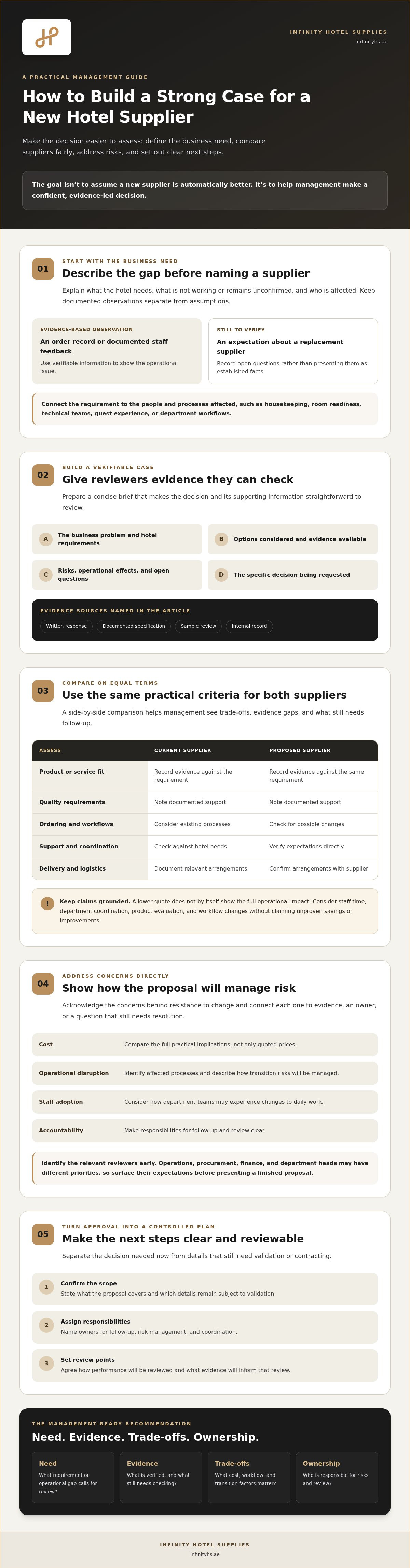
A credible approval case compares the current and proposed suppliers against the same practical criteria. Look beyond quoted prices to product requirements, scope, operational impact, transition risks, and how performance will be reviewed. Consistent criteria help management assess the trade-offs instead of relying on competing impressions.
This article explains how to build that case, address financial and implementation concerns, and present a concise recommendation. You’ll learn how to define shared evaluation criteria, document the expected impact, and propose manageable next steps with clear owners and review measures. The goal isn’t to assume a new supplier is automatically better. It’s to help management make a confident, evidence-led decision.
Key Takeaways
- Frame supplier approval as a decision management can assess, with a defined business need, evidence, risks, and next steps.
- Build a concise business case using verifiable evidence and consistent criteria for the incumbent and proposed supplier.
- Use a side-by-side comparison to identify evidence gaps and assign follow-up owners before making a recommendation.
- For getting buy-in for a new hotel supplier from management, address concerns about disruption, cost, staff adoption, and accountability directly.
- Turn approval into a controlled plan by confirming scope, assigning responsibilities, and setting review points.
Why Getting Buy-In for a New Hotel Supplier Starts with the Business Need
A supplier recommendation names a preferred vendor. A decision management can assess explains why a change may be needed, what evidence supports it, which risks need managing, and what approval is requested. That distinction is central to getting buy-in for a new hotel supplier from management. The aim isn’t to dismiss an established relationship. It’s to determine whether the current arrangement still meets the hotel’s documented requirements.
Define buy-in as informed agreement on the business need, the evidence, who owns each risk, and the next steps. Depending on the hotel’s structure, reviewers may include operations, procurement, finance, and department heads who use the products or services. Their priorities can differ: operations may focus on continuity, finance on cost control, and department teams on product quality and practical use. Applying stakeholder management principles means identifying these expectations early, rather than presenting a finished proposal with unanswered concerns.
For a hotel in the GCC, Middle East, or Africa, assess the actual sourcing context instead of relying on broad assumptions about the region. Confirm the hotel’s requirements for continuity, guest experience, coordination, and supplier communication. If several departments are involved, a supplier with relevant product categories may be worth assessing for coordination fit. Test that possibility against evidence and the hotel’s needs.
Clarify the hotel problem before naming a supplier
Describe the issue in operational terms. For example, document recurring product discrepancies, repeated ordering steps across departments, or a requirement the current supplier cannot confirm. Separate observations from assumptions: an order record or documented staff feedback is evidence; an unverified expectation about a replacement supplier is not. Note what still needs checking.
Then connect the gap to the people and processes affected. A linen requirement may involve housekeeping and room readiness; room electronics may affect the technical team and guest experience. These are illustrative links, not claims about a specific hotel. Making the connection clear helps management understand why the issue matters beyond the department that raised it.
Understand what management needs to approve
Before preparing the case, ask who makes the decision, which approval route applies, and what documentation reviewers expect. Confirm the outcomes that matter most, such as continuity, quality, coordination, or financial control. Surface concerns about disruption, dependence on one supplier, and accountability for follow-up.
Getting buy-in for a new hotel supplier from management becomes more practical when the proposal separates the decision needed now from details that remain subject to validation or contracting. This helps reviewers assess the business need without treating unresolved questions as settled facts.
Build a Hotel Supplier Business Case with Evidence Management Can Verify
A persuasive proposal makes the decision straightforward to review, rather than burying it in supplier claims. Prepare a concise brief that states the problem, the hotel’s requirements, the options considered, the available evidence, the risks, and the specific decision requested. Compare the incumbent and proposed supplier against the same criteria, and identify the source of each finding, such as a written response, documented specification, sample review, or internal record.
This structure supports getting buy-in for a new hotel supplier from management because reviewers can distinguish verified information from promises and open questions. It also stops a lower quoted price from overshadowing operational implications, such as staff time for ordering, department coordination, product evaluation, and workflow changes. Describe these effects without claiming savings or performance improvements that haven’t been demonstrated.
Choose comparison criteria that reflect hotel operations
Set criteria around the actual requirement: product or service fit, documented quality requirements, ordering needs, support expectations, and compatibility with established workflows. Include the departments affected and assess whether a change could alter their daily processes. For regional sourcing, verify delivery arrangements, logistics, and relevant market details directly with the supplier. Don’t treat an unconfirmed capability as established fact.
For example, a hotel assessing linen can compare supplier information with its own specifications, sample reviews, and operational requirements. Product-category descriptions can help define what to evaluate, but the hotel should confirm product-specific details before relying on them in its decision.
Make the evidence easy to review
Use a simple evidence register. Record the source, assessment method, and person responsible for validating each item. Where available, review documented specifications, references, samples, and written answers. Mark gaps clearly instead of filling them with assumptions.
| Evidence status | How to record it | Example |
|---|---|---|
| Confirmed fact | Document the source and date reviewed | Requirement recorded in the hotel’s specification |
| Supplier-submitted claim | Attribute it to the supplier and note supporting material | Written response describing ordering arrangements |
| Assumption | Label it clearly; don’t score it as proven | Staff may need a different ordering process |
| Requires validation | Name the check and responsible reviewer | Confirm delivery arrangements with the supplier |
Use the same assessment method for both suppliers, then summarize unresolved issues and name their owners. Request any additional product or operational information directly from suppliers and assess it against the hotel’s documented criteria.
Compare the New Hotel Supplier with the Incumbent Without Overlooking Risk
A fair comparison gives management a stronger basis for decision-making than a case focused only on the incumbent’s shortcomings. Assess both suppliers against the same hotel requirements, using evidence rather than impressions. A proposed supplier’s advantage is substantiated only when supporting information has been reviewed. A statement in a proposal remains a claim until the hotel validates it.
| Criteria | Incumbent evidence | Proposed-supplier evidence | Gap or risk | Follow-up owner |
|---|---|---|---|---|
| Product or service fit | Current specifications, records, or team feedback | Written details, samples, or documented specifications | Unconfirmed requirements or differences | Relevant department head |
| Ordering process | Existing steps and known dependencies | Supplier’s written explanation of the process | Workflow changes or unclear responsibilities | Operations or procurement |
| Continuity and support | Documented arrangements and internal records | Written scope and transition assumptions | Open questions about support or contingency | Named project owner |
Adapt the criteria to the purchase. Don’t rate a supplier as stronger simply because its evidence is more detailed. Note differences in evidence quality and validate like for like. This disciplined approach helps management weigh trade-offs without overstating benefits or dismissing the incumbent’s established performance.
Assess continuity and implementation exposure
Map the teams, processes, and guest-facing activities a change could affect. Depending on the hotel’s setup, a change involving room products may affect ordering, storage, housekeeping routines, or room readiness. Ask both suppliers to clarify responsibilities, support scope, and transition assumptions in writing. Before requesting approval, record contingency steps, unresolved risks, and who will address each one.
Include staff adoption in the review. Identify which teams may need to learn a new ordering or handling process, and what information they’ll need before a change begins. Don’t assume a transition will be seamless because the proposed supplier’s offer appears suitable on paper.
Match the supplier’s scope to the hotel’s needs
Check whether the proposal covers one product category or requirements across several departments. A broader catalogue may offer a coordination opportunity, but it doesn’t prove product fit, quality, or service performance. Evaluate each relevant category against its own requirements and verify unresolved details directly.
If amenities form part of the decision, consult a hotel amenities supplier selection guide to structure the review. Treat supplier product or service information as evidence to assess, not as a substitute for confirming the hotel’s requirements and operational needs.
Address Management’s Objections with a Controlled Hotel Supplier Proposal
Management may support the business need and still question the change. Address those concerns directly: what could be disrupted, how evidence was checked, how staff will adapt, what the financial case includes, and who will be accountable. A controlled proposal doesn’t promise a smooth transition or guaranteed savings. It explains how the hotel will test assumptions, manage exposure, and review results.
Respond to cost and value concerns without unsupported promises
Compare suppliers on a like-for-like basis. Use cost inputs the hotel can verify and include relevant operational impacts, such as changes to ordering steps or staff responsibilities. State exclusions and assumptions so management can see what the comparison does and doesn’t cover. Describe possible value as a hypothesis until the hotel measures it against agreed evidence.
If a limited pilot is operationally feasible and management approves it, define the scope before starting. Specify what will be tested, which teams will take part, what criteria will be reviewed, and who will assess the findings. A pilot is an evaluation step, not proof that a wider supplier change will deliver the same outcome.
Make accountability and adoption visible
Name an internal owner for supplier communication, staff updates, and issue escalation. Identify which departments must review samples, specifications, or proposed workflows, and give each reviewer a clear responsibility. This makes adoption part of the approval plan instead of leaving teams to work it out later.
Use this preparation sequence before requesting a decision:
- 1. Confirm requirements: Check the proposed scope against the hotel’s current, documented needs.
- 2. Validate claims: Separate confirmed details from supplier statements that still need review.
- 3. Map risks: Record possible disruption, staff adoption needs, dependencies, and contingency steps.
- 4. Assign owners: Name who will communicate, coordinate departmental reviews, and track open issues.
- 5. Request a decision: State what management is being asked to approve now and what remains subject to verification or contracting.
This sequence helps with getting buy-in for a new hotel supplier from management because it turns objections into specific questions, checks, and responsibilities. If the proposal lacks confirmed evidence, say so and make validation a condition of the next step. Clear limits build credibility and help management distinguish an informed recommendation from an untested promise.
Prepare a focused proposal that links the hotel’s requirements with evidence, risk controls, and clear ownership.
Turn Supplier Approval into Clear Next Steps for the Hotel Team
Approval should give the hotel team a clear mandate, not leave them to interpret what management agreed. Record the decision, approved scope, evidence reviewed, outstanding questions, accountable owners, and any conditions attached to approval. Set a review point that fits the hotel’s process, such as an implementation milestone or scheduled performance review.
Separate decisions management can make now from details that still need verification or contracting. Management may approve further evaluation, a proposed category scope, or a conditional next step. Product specifications, delivery arrangements, responsibilities, and contract terms should remain open until the relevant teams confirm them. This clarity supports getting buy-in for a new hotel supplier from management while ensuring unverified details aren’t treated as settled.
Create an approval record the team can act on
Keep the record concise and practical. Include the selected scope and rationale, the evidence used, unresolved questions, and the person responsible for each follow-up. If approval depends on a condition, state how the team will resolve it and what evidence will confirm completion. This creates a clear handover from management’s decision to the teams responsible for the next steps.
- Document approval: Capture what management has agreed to and any conditions.
- Confirm scope: Specify the product category or requirements covered by the decision.
- Validate open details: Confirm unresolved specifications, arrangements, or responsibilities.
- Assign owners: Name the people responsible for supplier communication and internal reviews.
- Set review points: Agree on a suitable date or milestone to assess progress against the hotel’s criteria.
Explore supplier fit through a focused conversation
Before approaching suppliers, prepare the hotel’s category needs, operating context, and evaluation criteria. Ask each supplier to respond to specific requirements and identify details that need confirmation. Infinity Hotel Supplies may be evaluated alongside other potential suppliers against the same documented criteria. Its product categories include hotel linen, room electronics, amenities, uniforms, accessories, and FF&E and OS&E solutions, but range alone doesn’t establish fit or performance.
For broader planning, review hospitality procurement approaches and the role of OS&E in hotel operations. Use those topics to inform internal discussions, then verify supplier-specific details directly. Keep the decision grounded in the hotel’s needs, available evidence, and approval process.
Prepare the requirements and questions your team needs to assess supplier fit with confidence.
Make the Next Supplier Decision with Confidence
Getting buy-in for a new hotel supplier from management starts with a clear business need, not a preferred vendor. Build the case with evidence management can verify, compare the incumbent and proposed supplier against shared criteria, and make transition risks, open questions, and accountability visible.
Approval should lead to practical action. Record the agreed scope and conditions, assign owners to validate outstanding details, and set review points that fit the hotel’s process. This gives the team a clear path forward without treating assumptions or supplier claims as proven outcomes.
Infinity Hotel Supplies may be one option to assess against your documented requirements. Founded in 2014, the company has offices in the UAE, China, and the United Kingdom. Its hotel supply categories include linen, room electronics, amenities, FF&E, and OS&E. Evaluate relevant products and details alongside other options before deciding what best fits your operation.
Frequently Asked Questions
How do I get management to approve a new hotel supplier?
Start with the hotel’s operational need, then present a concise comparison of the incumbent and proposed supplier against shared criteria. For getting buy-in for a new hotel supplier from management, show the evidence behind your recommendation, identify assumptions and transition risks, and explain which departments may be affected. State the decision you’re requesting, address likely objections in advance, and assign an owner to follow up on unanswered questions.
What should a hotel supplier business case include?
A hotel supplier business case should outline the business need, required scope, comparison criteria, evidence for each option, operational implications, risks, responsibilities, and decision requested. State which details are confirmed and which still need verification. Include relevant effects on departments, ordering workflows, or guest-facing operations. Keep the brief concise enough for management to review, while providing enough detail for the responsible teams to act on the decision.
How can I compare a new hotel supplier with our current supplier?
Use the same requirements and assessment method for both suppliers, then record the evidence side by side. Compare scope, product or service fit, available quality documentation, support expectations, operational impact, and transition needs. Label missing information as a gap rather than treating it as proof for or against either supplier. This gives management a fair view of the trade-offs and helps reviewers see what requires follow-up.
How do I address management’s concerns about changing hotel suppliers?
Ask decision-makers to name their main concerns, then respond with relevant evidence and a practical way to manage each issue. Cover continuity, staff adoption, accountability, unresolved details, and possible effects on hotel operations. If a controlled trial is feasible, propose a limited pilot with a defined scope and review criteria. Avoid promising disruption-free implementation unless the hotel and supplier have evidence to support that claim.
Should a hotel run a pilot before approving a new supplier?
A pilot can help evaluate a supplier when the product category and hotel operations make a limited trial practical. Before starting, define its scope, participating teams, review measures, responsibilities, and review date. A pilot isn’t suitable for every decision and doesn’t replace due diligence or required management approval. Ask affected departments and the supplier to confirm feasibility, including what the trial can and cannot demonstrate.
Which hotel departments should be involved in approving a new supplier?
Involve the teams affected by the proposed products or services, and include procurement or finance if the hotel’s approval process requires them. Operations, housekeeping, and other end users may need to assess workflow and product fit. Approval structures vary among hotels and hotel groups across the GCC, Middle East, and Africa, so confirm decision rights internally. Assign one person to consolidate evidence, questions, and feedback.
How can I present a supplier proposal when savings are not yet proven?
Be clear about what the hotel can verify and what it can’t yet quantify. Compare like-for-like scope, document known costs and operational considerations, and label possible benefits as hypotheses rather than proven savings. Note the missing information, identify who will obtain it, and agree how the hotel could measure outcomes later. A transparent proposal helps management judge the opportunity without relying on unsupported financial promises.
Contact Infinity Hotel Supplies to discuss your hotel’s sourcing requirements and assess whether its product range fits your documented needs.

Article by
Infinity Editorial Team
With deep expertise in hospitality product FF&E and OS&E across the Middle East and Africa, Infinity Editorial Team brings insights from Infinity Hotel Supplies, helping developers, hoteliers, and homeowners transform spaces from empty shells to fully furnished, design-ready environments.
Disclaimer
The content published by Infinity Editorial Team is intended for informational purposes only. All articles, guides, and insights are based on industry knowledge and experience in hospitality FF&E and OS&E supply across the Middle East and Africa. Infinity Hotel Supplies does not guarantee specific outcomes and recommends consulting a qualified professional for project-specific requirements.


