

What if the same bedding is approved in one room and replaced in another, even though both show similar wear? Without shared criteria, hotel bedding lifecycle management can turn into inconsistent decisions and replenishment gaps that are harder to plan for.
Hotel teams know bedding has to meet several needs at once: guest comfort, a consistent room standard and reliable day-to-day operations. The challenge is turning those priorities into a process everyone can follow, from the first specification to the final retirement decision.
This guide sets out a practical framework for managing that full cycle. You’ll learn how to align linen specifications with guest expectations, assess condition consistently, monitor stock and plan replenishment before shortages become urgent. It also covers how to consider reuse and responsible retirement, while checking that any proposed recovery route is suitable and available locally.
The result is a more deliberate approach: one documented process that helps teams make clear bedding decisions, support continuity across rooms and inform future sourcing.
Key Takeaways
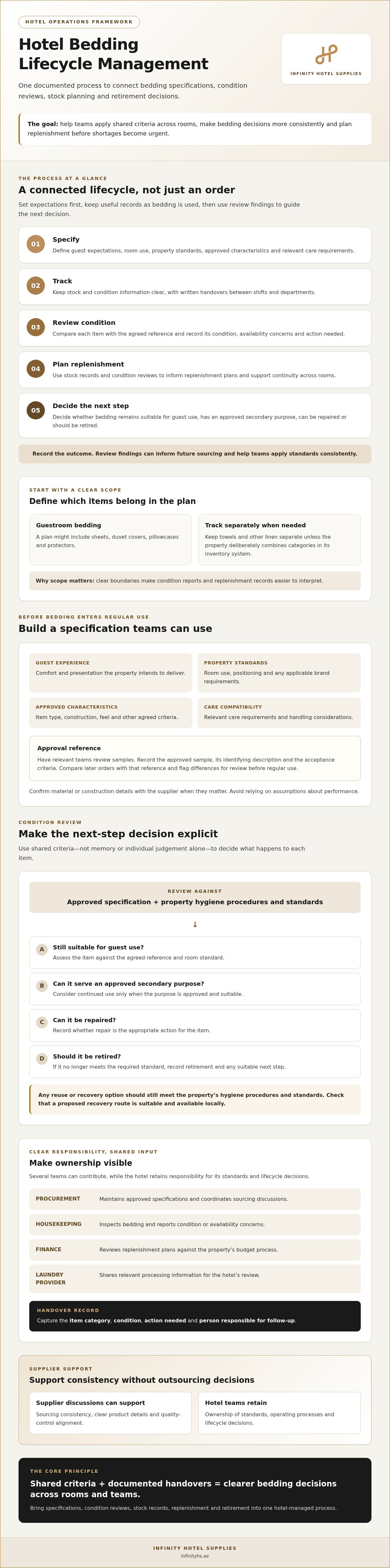
- Use hotel bedding lifecycle management to connect specifications, condition reviews, replenishment and retirement in one documented process.
- Set linen specifications around guest expectations, property standards and practical care requirements rather than relying on a one-size-fits-all choice.
- Give teams consistent criteria for recording stock, inspecting bedding and deciding what action each item needs.
- Assess whether bedding remains suitable for guest use, can serve an approved secondary purpose, can be repaired or should be retired.
- Use supplier discussions to support sourcing consistency and quality-control alignment, while keeping lifecycle decisions and operations hotel-managed.
What Hotel Bedding Lifecycle Management Covers and Why It Matters
Hotel bedding lifecycle management is the coordinated process of specifying, tracking, reviewing, replenishing and retiring bedding throughout its use in a property. It covers more than placing orders. The hotel sets expectations for each item, monitors its condition and stock, and records what happens when it no longer meets guest-use standards.
Clear ownership makes the process more consistent. Procurement can document specifications and coordinate sourcing; housekeeping can report condition and availability; finance can review replenishment plans; and the laundry provider can share relevant handling or processing information. The hotel retains responsibility for its standards and decisions. Lifecycle management is not a purchasing function alone, and it does not mean outsourcing laundry operations.
This approach can also support circular economy principles by prompting teams to consider continued use, repair or an appropriate next step before retirement. Any reuse or recovery option should still meet the property’s hygiene procedures and standards.
For a practical look at linen inventory practices, watch this video:
Which bedding items belong in the lifecycle plan?
Define the scope first. A guestroom bedding plan might include sheets, duvet covers, pillowcases and protectors. Track towels and other linen separately unless the property deliberately combines categories in its inventory system. Clear boundaries make condition reports and replenishment records easier to interpret.
Who should own each lifecycle decision?
Name an accountable owner for specifications, condition reviews and replenishment records, even when several departments contribute. A simple responsibility map can clarify who recommends, approves and records each decision:
- Procurement: maintains approved specifications and coordinates sourcing discussions.
- Housekeeping: inspects bedding and reports condition or availability concerns.
- Finance: reviews replenishment plans against the property’s budget process.
- Laundry provider: shares relevant processing information for the hotel’s review.
Use written handovers to record the item category, condition, action needed and person responsible for follow-up. This helps shifts and departments apply the same standards instead of relying on memory or informal judgement.
How to Specify Hotel Bedding for Daily Use and Future Review
A useful bedding specification starts with the guest experience the property intends to deliver. Record expectations for comfort and presentation, the property’s positioning, and any applicable brand requirements. Then translate those expectations into clear, reviewable criteria for each item. The same fabric, construction or feel may not suit every property.
Documented specifications make later condition reviews more consistent. Staff can compare items against an agreed reference for type, construction, feel, care compatibility and approved sample, rather than relying on individual preference or memory.
How should a hotel build a usable bedding specification?
Keep the record practical enough for teams to use during approval, ordering and inspection. For each item, note its intended use, approved characteristics, relevant care requirements and property-specific standards. Where material or construction details matter, confirm them with the supplier rather than relying on assumptions about performance.
Before approval, have relevant teams review samples. Housekeeping can assess handling and day-to-day suitability, while procurement can check that the product description and sourcing details are clear. Record the approved sample, its identifying description and the acceptance criteria. When a later order arrives, teams can compare it with that reference and flag differences for review before the bedding enters regular use.
- List the required item types and intended room use.
- Describe approved characteristics, including feel and construction, in terms teams can assess.
- Record sample approval, care information and property-specific requirements.
- Set a process for documenting changes to the specification or approved source.
This discipline supports hotel bedding lifecycle management by connecting initial selection to future condition checks and replenishment decisions. The HORESTA report on the circularity of hotel textiles offers broader context on hotel textile use and supplier roles.
How can GCC and Middle East operating conditions inform selection?
Use local operating conditions as factors to assess, not as grounds for a universal fabric choice. Ask property teams how climate, occupancy patterns and the actual laundry process may affect comfort, handling and care compatibility. A hotel in the GCC, Middle East or Africa should base its specification on the needs of that property, rather than assuming a single regional requirement. A city property with changing occupancy patterns, for example, may need teams to consider use and handling differently from another hotel.
When comparing suppliers in the UAE or elsewhere in the region, prepare the property’s approved criteria and ask about current materials, specifications and sourcing options. Confirm product details directly with the supplier before making a selection.
How to Track Bedding Condition, Use and Replenishment
A consistent review process helps teams spot condition concerns, understand stock needs and explain decisions later. Build it around four steps, and apply the same criteria across rooms and review teams.
1. Record stock. Track bedding by item type and, where practical, by location or approved specification. Note what is available for guest use, in the laundry process or held in storage, using categories that match the hotel’s operations.
2. Inspect condition. Review items at a consistent point in the handling process. Check for visible wear, damage, changes in feel and whether the item remains suitable for guest use under property standards.
3. Classify the action. Record whether the item remains in guest use, needs further review, may be suitable for an approved secondary use, or should be removed from service. Follow the property’s hygiene procedures and escalation process.
4. Update replenishment needs. Use condition findings alongside stock records to identify gaps, recurring issues and upcoming requirements. This helps teams plan replenishment instead of treating every concern as an immediate order.
What should a bedding condition check record?
Keep the record brief but useful: include item identification, review date, observed condition and decision taken. Use written criteria for wear, damage, feel and guest-use suitability so staff in different rooms and shifts assess items consistently. If a case is unclear, refer it to the named reviewer instead of assuming all bedding has the same useful life.
Base each condition decision on the item’s recorded state and property standards, not an arbitrary replacement schedule applied to every piece.
Over time, records can reveal patterns. If the same item type repeatedly shows a particular kind of damage, teams can review handling, care processes or the specification with relevant internal staff and the supplier. Treat a pattern as a prompt for investigation, not proof of a single cause or a fixed replacement interval.
How can replenishment planning use PAR levels?
PAR levels help a property plan how much bedding it needs across rooms, laundry and storage. They support availability, but do not determine whether an individual item remains suitable for guest use. Keep stock planning and condition assessment connected, but treat them as distinct checks.
Before adjusting the replenishment plan, review recorded usage, stock discrepancies and operational changes that may affect demand. For the stock-level method, consult the hotel’s existing guide to linen PAR-level calculation. In hotel bedding lifecycle management, combining inventory records with condition findings gives teams a clearer basis for replenishment decisions without imposing a universal schedule.
How to Decide Whether Bedding Should Be Reused, Repaired or Retired
Removing bedding from guest use does not always mean it must be discarded. A consistent decision process helps the hotel protect guest standards while considering whether an item can remain in service, be repaired, serve an approved secondary purpose or be retired. Base each decision on recorded condition, the property’s hygiene procedures and its quality standards, not assumptions about how long a particular item should last.
When can bedding remain in guest use?
Keep an item in guest use only if it meets the hotel’s documented quality and hygiene criteria. Apply the same checks across comparable rooms, and record the outcome so another team member can understand why it stayed in service. Do not set a fixed service life without property records or product-specific evidence. Actual condition and suitability should guide the review.
What should happen when bedding leaves guest use?
First, determine whether the item meets the hotel’s requirements for repair or an approved internal secondary use. If considering donation or textile recovery, check the item’s condition and verify that a suitable local organisation or provider accepts it. Confirm the route before promising it. Record the retirement decision and update stock records so the item cannot be mistakenly returned to guest use.
Use a decision record to clarify the suitability check, who is responsible and which records need updating. The roles below are examples; each property should assign them according to its own procedures.
| Decision | Suitability check | Responsible owner | Record to update |
|---|---|---|---|
| Continue guest use | Meets documented quality and hygiene criteria | Housekeeping or designated reviewer | Condition review and item status |
| Repair | Repair is practical and permitted by property procedures | Designated hotel reviewer | Repair decision and follow-up status |
| Approved secondary use | Item meets internal policy and condition requirements for that use | Department responsible for the secondary use | Item status and assigned use |
| Retire from service | Item no longer meets guest-use or approved secondary-use criteria | Designated hotel owner | Retirement decision and stock record |
In hotel bedding lifecycle management, clear records connect condition reviews to reuse or retirement decisions and help prevent inconsistent handling between teams. Revisit the decision if the item’s condition changes or the proposed next use cannot be confirmed.
How a Hotel Supplier Can Support a More Consistent Bedding Lifecycle
A hotel owns its bedding lifecycle decisions: specify what each property needs, record stock and condition, review items against its standards, plan replenishment and retire bedding responsibly. A supplier can support the sourcing side through discussions about specification alignment and quality-control considerations. That support complements hotel operations; it does not replace the hotel’s responsibility for inspections, laundry processes or retirement decisions.
What information should a hotel prepare before discussing sourcing?
Clear records make sourcing discussions more focused. Before speaking with a supplier, gather:
- Approved specifications and any relevant sample or product descriptions.
- Current stock records and identified replenishment needs.
- Property requirements, including brand standards, intended use and care considerations.
- The markets or properties involved, especially if requirements differ by location.
- Questions about sourcing consistency and quality-control review.
For example, if two properties use different approved pillowcase specifications, note that distinction rather than treating the items as interchangeable. This gives the supplier useful context and helps the hotel assess whether sourcing aligns with its documented requirements. Keep decisions and operational records hotel-managed.
How can Infinity Hotel Supplies support hotel linen sourcing discussions?
Infinity Hotel Supplies is a Dubai-based hospitality supplier founded in 2014, with offices in the UAE, China and the UK. Hotel linen is a key offering, supported by global sourcing and quality-control capabilities. Hotel teams can discuss sourcing consistency and specification alignment with Infinity Hotel Supplies while retaining responsibility for how bedding is inspected, used and replenished at each property.
Before a discussion, prepare the property’s approved criteria and confirm current product details and sourcing options directly with the supplier. A clear brief keeps the conversation focused on the hotel’s needs without assuming one specification suits every property in the GCC, Middle East or Africa.
In hotel bedding lifecycle management, a supplier contributes to a hotel-led process rather than owning the full lifecycle. Keep specifications, stock records, review criteria and retirement decisions connected, and use sourcing discussions to support the approved plan.
Build a More Consistent Bedding Process
Strong hotel bedding lifecycle management connects clear specifications with condition reviews, accurate stock records and planned replenishment. It also gives teams a consistent basis for deciding whether bedding remains suitable for guest use, can be reused or repaired under hotel policy, or should be retired. Documented criteria and clear ownership help keep those decisions aligned.
A supplier can support sourcing consistency and quality-control discussions, while hotel teams retain responsibility for daily operations and lifecycle decisions. Infinity Hotel Supplies is based in Dubai and supplies hotel linen, with offices in the UAE, China and the UK.
Before discussing sourcing, gather your approved specifications, current stock records and replenishment priorities. A focused conversation can help your team assess how linen sourcing fits the property’s documented requirements.
With a clear process in place, your team can make considered bedding decisions and build consistency across the property.
Frequently Asked Questions
What does hotel bedding lifecycle management include?
Hotel bedding lifecycle management covers decisions from specification through use, condition review, replenishment and retirement. It includes setting approved requirements for items such as sheets and duvet covers, recording stock, checking condition against hotel standards, and deciding whether bedding remains in guest use or needs another action. A hotel should assign clear responsibility across relevant teams so the process stays consistent between rooms, shifts and properties.
How often should hotels inspect bedding?
Hotels should set an inspection schedule that fits their operating procedures, laundry flow and room turnover, then apply it consistently. There is no single interval that suits every property. Teams can also report concerns as they arise rather than waiting for a scheduled review. Record the review date, item condition and decision, then use those records to refine the schedule across properties in the GCC, Middle East or Africa.
How do hotels decide when bedding should be replaced?
Replace bedding when it no longer meets the property’s documented quality, hygiene or guest-use standards, or when an authorised review determines it should leave service. Check visible wear, damage, feel and suitability, and apply the same criteria to comparable items. A fixed age or use period should not replace an individual condition assessment unless the hotel has suitable product-specific evidence and records to support that policy.
Can retired hotel bedding be reused or recycled?
Possibly, if the item’s condition and the hotel’s policies support another use. A hotel may assess whether bedding can be repaired or assigned to an approved internal secondary use. Donation or textile recovery depends on condition and locally available organisations or providers, so confirm acceptance before selecting a route. Record the decision and update stock information to prevent items retired from guest use from being returned to rooms unintentionally.
How does PAR planning relate to bedding lifecycle management?
PAR planning helps hotels determine how much linen to keep available across guest rooms, laundry and storage, according to the property’s operating model. It supports stock availability and replenishment planning, but it cannot tell teams whether a specific sheet or duvet cover remains suitable for guest use. Combine stock records with condition reviews, and consider usage or operational changes before adjusting PAR levels at a property in the GCC or wider region.
What should hotels consider when sourcing bedding in the GCC?
Base bedding choices on each property’s guest expectations, brand requirements, climate, occupancy patterns and laundry processes. These operating conditions vary, so avoid assuming one fabric or construction is right for every hotel across the GCC, Middle East and Africa. Document the approved item characteristics and care requirements, review samples with relevant teams, and confirm product details with the supplier before placing or repeating an order.
What information should a hotel share with a linen supplier?
Share approved specifications, sample or product descriptions, current stock records and replenishment priorities. Include the properties or markets involved, relevant brand standards, intended use and care requirements. Clear details help a supplier discuss sourcing consistency and quality-control considerations without taking over hotel operations. Infinity Hotel Supplies, based in Dubai, supplies hotel linen and has offices in the UAE, China and the UK.
Discuss your hotel linen sourcing requirements with Infinity Hotel Supplies.

Article by
Infinity Editorial Team
With deep expertise in hospitality product FF&E and OS&E across the Middle East and Africa, Infinity Editorial Team brings insights from Infinity Hotel Supplies, helping developers, hoteliers, and homeowners transform spaces from empty shells to fully furnished, design-ready environments.
Disclaimer
The content published by Infinity Editorial Team is intended for informational purposes only. All articles, guides, and insights are based on industry knowledge and experience in hospitality FF&E and OS&E supply across the Middle East and Africa. Infinity Hotel Supplies does not guarantee specific outcomes and recommends consulting a qualified professional for project-specific requirements.


