

A three-set-per-room opening par is a useful starting point for bed linens and bath towels, but it is not a universal order quantity. Plan hotel opening supplies around room count, expected occupancy, laundry turnaround, replacement needs, and the property’s operating model. The goal is to have enough stock in use, in laundry, and in reserve without tying up space in unnecessary quantities.
It’s understandable to focus first on the total room count. The harder part is turning that figure into an itemised OS&E schedule, then aligning specifications, quantities, supplier quotes, and delivery timing. This guide explains how a procurement partner builds that schedule, compares like-for-like bids, calculates linen par levels and opening reserves, and plans front-office and public-area essentials. You’ll see which operating details shape the quantities, and how a structured plan helps teams prepare for opening with fewer gaps and surprises.
Key Takeaways
- Schedule furniture, equipment, and operating supplies in stages so specifications and delivery dates align with the opening plan.
- Compare supplier quotes against consistent item descriptions, specifications, pack sizes, and delivery terms, not unit price alone.
- Build opening quantities around occupancy, laundry turnaround, replenishment cycles, and separate reserves for replacements and delays.
- Plan front-office and public-area items around guest movement, daily operations, and practical storage locations.
- Use a department-based supply schedule to make gaps, ownership, and delivery priorities easier to manage before opening.
How early should hotel opening supplies be planned?
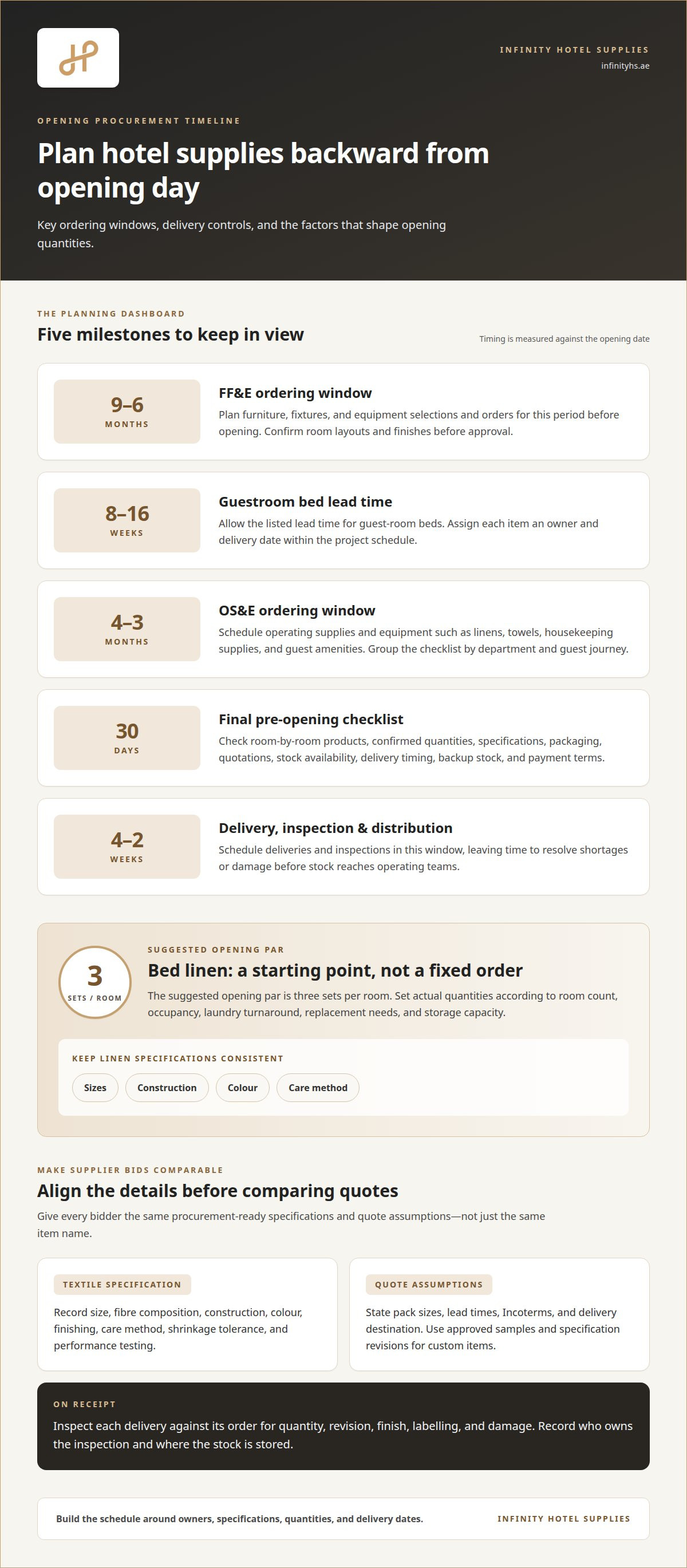
Plan these items from the project schedule, not the final weeks. Set department budgets and approve specifications early, then phase orders around production, delivery, inspection, and room setup. For guest-room beds, allow the listed lead time of 8-16 weeks. Furniture, bedding, electronics, amenities, and equipment each need an assigned owner and delivery date.
In hotel procurement, FF&E means furniture, fixtures, and equipment. Beds, tables, chairs, lighting fixtures, and wardrobes belong on its schedule. Plan FF&E orders for 9-6 months before opening, allowing time for selections and coordination. Confirm room layouts and finishes before approval, so furniture and accessories suit the intended guestroom design.
OS&E means operating supplies and equipment. It covers items such as linens, towels, housekeeping supplies, and guest amenities. Schedule OS&E orders for 4-3 months before opening. Group the checklist by department, then by guest journey: arrival, room use, bathroom, beverage service, and departure. This reveals overlooked accessories and clarifies each team’s budget.
Set guestroom linen quantities according to room count, occupancy, laundry turnaround, replacement needs, and storage capacity. A suggested opening par for bed linens is three sets per room. Keep the specification consistent across sizes, construction, colour, and care method so supplies meet room standards and operational needs. For bathroom amenities, estimate demand from occupancy and the restocking cycle, then add opening reserve stock.
Put room electronics and appliances on a room-by-room checklist. Match each item to the property’s standard and likely guest use, such as charging or preparing in-room beverages. Plan housekeeping equipment by task and storage location. Counting trolleys alone is not enough if teams lack practical space to refill or store supplies.
For guest technology, approve lock models, access-control configuration, and card format before production. Resolve chip or encoding requirements, artwork, personalisation, and data-handling responsibilities with the project team. Because these decisions connect room access credentials to door hardware and operating processes, include them on the opening schedule.
In the United States, applicable health, safety, and accessibility requirements depend on location, building, and product use. Before approving supplies, the project team should map relevant federal, state, and local requirements to each specification.
Plan task-based stock for housekeeping, laundry, and maintenance: cleaning tools, housekeeping trolleys, linen-handling supplies, laundry equipment, and maintenance tools. Assign each category to a department, storage location, and replenishment owner. This helps teams find essential supplies during opening operations.
How a professional team manages procurement stages, supplier quotes and pre-opening controls
Turn the opening date into a working procurement schedule that connects approved specifications, supplier orders, delivery lots, inspection, and departmental handover. Each line in the hotel opening supplies plan should name an owner and destination. This makes gaps visible before they affect room setup or service.
Schedule FF&E and OS&E as distinct procurement packages. Define budget boundaries by assigning each item a category owner and cost code. If installation or system integration changes a package, record who is responsible in the schedule. This gives kitchen items, lighting fixtures, and banquet supplies a clear budget home.
Supplier quotes are easier to compare when every bidder receives the same procurement-ready specification. For textiles, record size, fibre composition, construction, colour, finishing, care method, shrinkage tolerance, and performance testing. State pack sizes, lead times, Incoterms, and delivery destination in the schedule. For custom items, approved samples and specification revisions help control production differences.
Choose FF&E suppliers whose capabilities match the project specifications, delivery plan, and operational needs. Assess hospitality expertise, global sourcing, custom manufacturing, quality certifications, pricing, logistics, and after-sales service. Evaluate compliant base bids separately from alternatives, considering lifecycle, replacement, and storage alongside unit price.
For bulk sourcing, consolidate approved item descriptions and quantities into clear schedules. Group orders by department, delivery destination, and required delivery lot. This supports coordinated purchasing while keeping specifications and quote assumptions aligned. Distinguish items already placed from operating reserves and replacement stock.
Budgeting and scheduling start with the opening date, department needs, and approved quantities. The procurement team maps order milestones backward from delivery, then tracks approvals and dependencies. The procurement team schedules delivery, inspection, and distribution for 4-2 weeks before opening. This leaves a defined window to resolve shortages or damage before items reach operating teams.
Pre-opening controls include a final 30-day checklist covering room-by-room products, confirmed quantities, specifications, packaging, quotations, stock availability, delivery timing, backup stock, and payment terms. On receipt, teams inspect each delivery against its order for quantity, revision, finish, labelling, and damage. Acceptance records identify who owns the inspection and where stock is stored.
How a professional team calculates opening quantities and linen par levels
A quantity schedule should show the calculation behind each order, not just its final total. For towels, a 120-room hotel requiring four bath towels per room has a base setup of 480 towels. That figure covers the initial room placement; it does not, by itself, account for laundry circulation, replacements, or reserve stock.
Separate placed items, operating reserves, and replacement stock before checking the hotel’s handling process and choosing a par model. A simplified linen cycle may include one set in use, another in laundry, and another in storage. Whether this model fits depends on laundry turnaround and the storage plan.
For linen, the specification and quantity calculation work together. The schedule should identify each item by room type, size, unit, and intended use. A 10% linen buffer can account for shrinkage and staining. The team records that allowance separately from the base quantity, making its effect on inventory visible.
Other opening categories need their own assumptions. A 5% buffer is recommended for categories other than glassware, tableware, and linens. This allowance should remain distinct from any operating reserve, since a contingency buffer and stock needed for daily circulation serve different purposes.
Calculate consumable quantities from planned demand and coverage: daily consumption at expected demand multiplied by days of coverage, plus safety stock. Connect the estimate to the replenishment cycle and delivery interval. For example, if deliveries are weekly, a disruption that adds another week can change the reserve required.
Calculate uniform quantities by multiplying employees in position by sets per employee, then adding reserves for sizes and replacements. This is more reliable than basing the order on total headcount alone. The roster, roles, and size distribution all affect the quantities assigned to each uniform item.
Room mix and property type also affect totals. A resort with seasonal demand may need a different reserve profile from a business hotel with steadier occupancy. Restaurants, event spaces, and public areas add separate demand based on covers, service formats, washing capacity, and replenishment routines.
Record each quantity assumption beside the item code, unit, and department. Managers can then revise estimates when occupancy, laundry turnaround, or delivery frequency changes. The record should also show which items are placed, held for operations, or reserved for replacement, keeping opening inventory traceable.
Front-office and public-area supplies
Plan front-office and public-area supplies around the guest journey from arrival to departure. Luggage trolleys support arrivals and room transfers, while clear signage directs guests to reception, lifts, and public facilities. Queue management products help organise waiting areas. Give each category a distinct purpose and assign it to the responsible operating department.
At reception, list the supplies needed to welcome guests and complete routine transactions, such as desk stationery, forms, receipt rolls, and equipment accessories. Identify which items stay at the counter and which need replenishment from nearby storage. This distinction helps staff keep the workspace clear during busy arrivals.
- Arrival and luggage: Allocate luggage trolleys near the entrance or an attendant station, with a designated parking point that avoids blocking guest routes.
- Wayfinding: Map signs to entrances, reception, lifts, meeting rooms, and facilities, so guests can navigate without staff assistance.
- Queue flow: Position queue management products around the reception approach, keeping access to the desk and nearby pathways clear.
- Guest assistance: Organise concierge and front-office accessories by task, with frequently used items accessible to the relevant team.
- Public-area presentation: Assign supplies for shared spaces to the team responsible for inspection, replenishment, and upkeep.
Organise storage around how each department uses its inventory. Keep guest-facing items close to where they are used, and place reserve stock in a labelled back-of-house location. For example, reception stationery can go in a controlled desk cabinet, while spare signage stays together for quick placement when routes change.
Plan a clear handover from storage to replenishment for guest amenities. A designated stock location helps teams prepare items for guest rooms or service points without mixing them with front-desk supplies. Specify each amenity’s item, department, storage location, and replenishment owner to keep routine distribution organised.
During procurement, group items by department and operational purpose rather than treating public areas as one general category. Record each item’s destination, specification, quantity basis, and acceptance owner. A lobby sign, trolley, and reception accessory may follow different delivery schedules, but each needs a named destination and responsible team.
Before opening, walk the guest route from the entrance to reception and onward to lifts or shared facilities. Match each planned item to its physical location. This practical review can reveal missing signage, obstructed trolley parking, or storage too far from the department that needs it.
What supplies are needed to open a hotel?
A hotel opening list covers guest rooms, housekeeping, food and beverage, front office, and shared spaces. The exact mix depends on the property’s operating model. For example, a hotel with room service needs different service items from one without it. Assign every item to a department, destination, specification, and acceptance owner.
For guest rooms, include bedding, towels, bathroom amenities, room electronics, and guest accessories, along with any appliances required by the property’s standard. Record quantities by room type so suites and accessible rooms receive the right setup. Keep replacement stock separate from items placed in rooms to make the initial inventory easier to manage.
- Housekeeping: List cleaning tools, trolleys, linen-handling supplies, uniforms, and departmental stock. Plan storage and refill points alongside equipment, since teams need practical access during room servicing.
- Laundry: Match processing equipment to the daily linen load. One planning approach is to process the full daily load within one eight-hour shift, with a 20% peak-occupancy buffer.
- Food and beverage: Include tableware, glassware, kitchen smallwares, and utensils. Match kitchen items to the menu, equipment model, production volume, and cleaning process.
- Front office: Provide reception stationery, luggage trolleys, signage, and queue management products. Place each item near its operational point, with reserve stock in designated storage.
- Staff and maintenance: Plan uniforms from employee positions and sets per employee. Suggested minimum uniform stock is 2 sets per employee. Include maintenance tools and safety equipment by task.
For banquet operations, link tableware to event capacity and service plans. A 500-person ballroom example uses inventory equal to 1.3 times maximum capacity. A separate example for a 200-room hotel with 120 restaurant seats and 300 banquet places plans for 690 dinner plates. These figures illustrate different planning bases, not a universal order quantity.
Build the final checklist by department, then distinguish placed items, operating reserves, and replacement stock. Add pack sizes, delivery destinations, storage locations, and acceptance owners. For cleaning chemicals, account for surface compatibility, dilution, staff training, safety data, storage, and local labelling requirements. This turns the opening schedule into an operational plan, not just a product list.
Choose slippers based on style, material, thickness, sole type, and packaging, and customize them with a logo. A monthly amenity example is 4,200 sets for a 200-room hotel at 70% average occupancy.
Infinity Hotel Supplies
Hotel opening plans may include hotel linen, room electronics, amenities, or leather accessories. These categories help equip guestrooms and provide items for guests during their stay. Their role depends on the property’s room standards, guest experience, and operating model. A clear department list connects each category to the rooms or teams that need it.
Hotel Linen supports bed and bathroom setup. Define each linen item by its use, quantity basis, and specification. The room mix and laundry process shape opening requirements, while replacement stock separates immediate setup from ongoing operations. These details give the project team a clearer view of the items needed and the assumptions behind their quantities.
Include LOVO Premium Electronics in guestroom electronics schedules where they meet the hotel’s room standards. Assign each requirement to a room type and destination. Bulk Orders for Hotel Room Electronics suit schedules requiring larger quantities across rooms. Listing the approved item description and quantity basis helps teams coordinate equipment with room readiness.
Guest amenities are another distinct part of the room plan. Infinity Hotel Supplies offers bulk hotel amenities and custom hotel amenities. Organise requirements by room standard, expected use, and replenishment routine. This distinguishes guest-facing consumables from reusable accessories and gives departments a practical way to track opening stock.
Include Leather Accessories where the room concept calls for them. LUFTER PHYTOGREEN is another named offering that may suit a project’s product requirements. Keep each category separate in the schedule, with its own description and destination. This helps project teams coordinate different room needs without combining specifications or departmental ownership.
Align product requirements with room preparation by starting with a room schedule, approved standards, and estimated quantities. These details help define product requirements and show how linen, electronics, amenities, and accessories fit into the overall opening plan.
For a discussion about these requirements, contact Infinity Hotel Supplies.
Frequently Asked Questions
How can a professional procurement partner create a hotel OS&E list?
A procurement partner develops the list by translating the hotel’s operating concept into requirements each department can review. Department heads can identify special-use items, preferred locations, and handover needs before orders are finalised. A sample-room review can also expose missing accessories or conflicting specifications. The partner then tracks decisions and outstanding approvals, helping the project team resolve discrepancies before they affect room preparation or staff training.
How many sets of hotel linen should be purchased?
Required quantities depend on room setup and linen circulation, including the time items spend in use, in laundry, and ready for replacement. Count the actual bed configurations and linen pieces required for each room type rather than applying one room total to every room. Laundry turnaround and storage capacity then determine the reserve needed to maintain normal room operations.
What is the difference between FF&E and OS&E in a hotel opening?
The practical distinction affects who owns each purchase, how the budget records it, and when it needs to be ready. A bed is usually treated as a room asset, while guest-use items support daily operations. Agree on an owner for borderline items, such as electronics requiring installation or system integration. Recording the decision early helps prevent duplicate orders and gaps between construction handover and operating teams.
What is the hotel opening supplies checklist by department?
Build the checklist around each department’s readiness milestones, not just item names. For every line, track whether installation, assembly, inspection, or staff familiarisation is needed before use. A reception item may be delivered but still need placement; an operational item may require handover before staff can use it. This status view helps managers identify unresolved dependencies and distinguish delivered stock from supplies that are ready for opening.
How many linens, towels, and guest amenities should a new hotel order?
Calculate each category according to its own consumption pattern. Linen quantities follow bed configurations and laundry circulation; towel quantities also depend on room setup and replacement practices. For amenities, estimate use from occupied room-nights and the number of items provided per stay, then align stock coverage with replenishment timing. Track each amenity separately, since usage rates vary and mixed bundles can hide an early shortage.
What are the best hotel suppliers for furniture, fixtures, and equipment (FF&E)?
Choose FF&E suppliers whose capabilities match the project’s specifications, delivery plan, and operational needs. Assess hospitality expertise, global sourcing, custom manufacturing, quality certifications, pricing, logistics, and after-sales service.

Article by
Infinity Editorial Team
With deep expertise in hospitality product FF&E and OS&E across the Middle East and Africa, Infinity Editorial Team brings insights from Infinity Hotel Supplies, helping developers, hoteliers, and homeowners transform spaces from empty shells to fully furnished, design-ready environments.
Disclaimer
The content published by Infinity Editorial Team is intended for informational purposes only. All articles, guides, and insights are based on industry knowledge and experience in hospitality FF&E and OS&E supply across the Middle East and Africa. Infinity Hotel Supplies does not guarantee specific outcomes and recommends consulting a qualified professional for project-specific requirements.


