

A hotel bathroom mirror is a small fixture with a significant role in the guest experience. For a Riyadh project, choosing a commercial hotel LED magnifying vanity mirror supplier in Riyadh means considering more than appearance: the mirror’s size, shape, frame and lighting must suit the room and project requirements.
These details matter because a clear specification supports consistent room design and practical daily use. The right configuration depends on the vanity layout, intended lighting and features selected for the property.
This guide explains how mirror sizes, shapes and frames affect fit, and how lighting, anti-fog and dimming options can shape the guest experience. It also covers sourcing considerations for hotel projects in Saudi Arabia, helping you plan for a new development, renovation or multi-room supply.
Key Takeaways
- Match mirror dimensions, shape and frame to the vanity layout and the hotel’s design scheme before finalizing specifications.
- Compare lighting by color rendering and available color temperatures, including 3000K, 4000K, 5000K and 6000K options.
- Assess anti-fog and dimming functions according to bathroom conditions and the lighting experience intended for guests.
- Organize Saudi sourcing around consistent specifications for guest bathrooms and bedrooms, with model details aligned across the project.
- Consider how bulk hotel amenities, Hotel Linen, LOVO Premium Electronics and LUFTER PHYTOGREEN fit into broader hotel supply needs.
Mirror sizes, shapes, frames, and lighting options
For Riyadh hotel projects, specify each mirror for its vanity location, room type and lighting plan. A clear schedule connects design choices with installation requirements.
Mirror Sizes, Shapes, and Frames
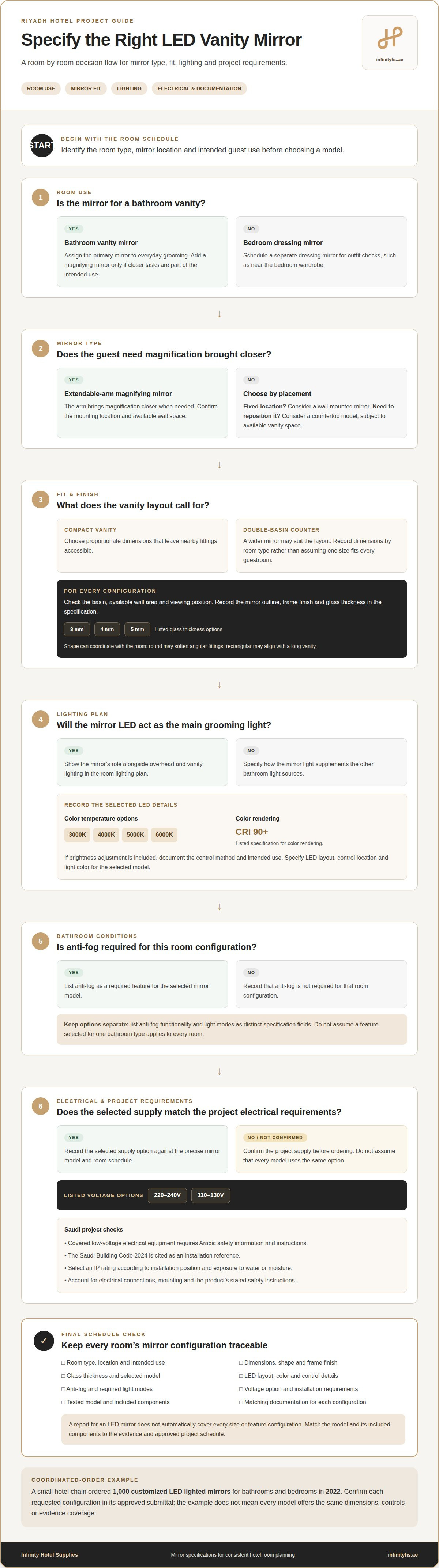
Set mirror dimensions in relation to the basin, available wall area and viewing position. A compact vanity, for example, needs a proportionate mirror that leaves nearby fittings accessible; a double-basin counter may call for a wider design. Record dimensions by room type instead of assuming one size suits every guestroom.
Shape and frame help define the fixture’s visual relationship with taps, cabinetry and other finishes. A round mirror can soften a room with angular fittings, while a rectangular profile may align with a long vanity. Include the chosen outline, frame finish and glass thickness in the specification; listed thickness options are 3 mm, 4 mm and 5 mm.
Light Color and Brightness Adjustments
LED specifications should identify both color rendering and color temperature. A listed mirror offers 3000K, 4000K, 5000K and 6000K options, while CRI 90+ is specified for color rendering. These details help the design team coordinate mirror lighting with the room’s finishes and intended appearance.
For hotels with several room categories, document the selected configuration for each. If the mirror includes brightness adjustment, record the control method and intended use. This keeps the fixture schedule precise without assuming all models have the same controls or light settings.
Vanity and Interior Lighting
Review mirror LEDs alongside the bathroom’s overhead and vanity lighting. A mirror used as the main grooming light has a different role from one that supplements ceiling illumination. Show how the light sources work together in the room lighting plan.
Specify the LED layout, control location, light color and brightness adjustment for the selected model. Coordinate these details with the mirror’s position and surrounding fixtures so the electrical schedule and interior finish plan share a consistent reference for repeated room types.
List anti-fog functionality and light modes as separate specification fields. The room schedule can identify whether each model includes anti-fog and which lighting modes are required. This keeps options distinct across the project and avoids assuming a feature selected for one bathroom type applies to every room.
Keep procurement records tied to the precise mirror configuration: a report for an LED mirror does not automatically cover every size and feature configuration, and the model identity and controlled components must remain within the evidence being relied upon. Record the tested model and included components against the schedule, especially where room categories use different options. The product attributes list operating voltage options of 220-240V/110-130V, so confirm the selected supply against the project’s electrical requirements before ordering.
Customization can also be handled at scale: a small hotel chain ordered 1,000 customized LED lighted mirrors for its bathrooms and bedrooms in 2022. Treat this as an example of a coordinated order, not proof that every model offers the same dimensions, controls or evidence coverage. Confirm each requested configuration in the approved submittal and retain the matching documentation through delivery and installation.
Saudi sourcing of bathroom vanities and LED mirrors
For Riyadh hotel projects, sourcing decisions connect mirror type, room use, electrical planning and delivery coordination. Define requirements by room category before finalizing the bathroom package.
Commercial Hotel Mirror Models
Commercial hotel options include wall-mounted mirrors, extendable-arm magnifying mirrors and countertop models. Wall-mounted units stay in a fixed position, extendable arms bring magnification closer when needed, and countertop mirrors can be repositioned on a vanity. Choose according to guest use, available surface space and mounting location.
For covered low-voltage electrical equipment, Saudi Arabia requires Arabic safety information and instructions. The Saudi Building Code 2024 is cited as an installation reference. These considerations help distinguish product information from the project’s separate electrical and installation planning.
Guest Room and Bathroom Applications
In a hotel bathroom, a primary vanity mirror supports everyday grooming, while a magnifying mirror is suited to closer tasks. A guest bedroom may need a separate dressing mirror for outfit checks. Assign each mirror a location and purpose in the room schedule to keep bathroom and bedroom requirements distinct.
For example, a standard guestroom could have a bathroom vanity mirror and a dressing mirror near the bedroom wardrobe. A suite might use a different arrangement to suit its vanity and dressing areas. This room-by-room approach aligns mirror quantities with the property’s actual layout.
Which certifications and electrical safety standards should hotel LED mirrors meet in Saudi Arabia? Covered low-voltage electrical equipment requires Arabic safety information and instructions, and the Saudi Building Code 2024 is an installation reference. The applicable considerations depend on the equipment and project installation.
What IP rating and bathroom safety features are recommended? Select an IP rating according to the mirror’s installation position and exposure to water or moisture. The bathroom plan should also account for electrical connections, mounting and the product’s stated safety instructions.
What are delivery times and installation services for hotel mirror orders in Riyadh? Delivery schedules depend on order quantity, selected models, production arrangements and transport. Installation timing depends on site readiness, electrical provisions and project scope, so include both milestones in the project schedule.
For commercial planning, Saudi Arabia’s standard VAT rate is 15% where applicable, according to the Zakat, Tax and Customs Authority. Keep applicable tax separate from the mirror specification and installation plan when organizing project documentation.
Hotel and hospitality mirror supply
Hotel mirror supply involves commercial terms, product evaluation and after-sales planning. For hospitality projects, organize these items around the room schedule and electrical scope.
Bulk Pricing, Samples, and Project Quotes
Bulk pricing and project quotations depend on the selected model, order quantity, configuration and delivery scope. A useful quote groups mirror requirements by room type and identifies quantities and differing specifications. This helps the hotel team compare equivalent packages rather than broad product descriptions.
Samples can help teams assess finish, controls and scale in a real vanity setting. Treat a sample as a review item and record approved changes before preparing the project order. For example, checking a sample against the guestroom finish board can show whether its frame suits the planned fittings.
For a hotel project quotation, include the room schedule, model requirements, quantities and delivery destination. Keep sample, quotation and final order references connected, especially when the project includes multiple mirror models.
Supplier Experience and Product Verification
Assess hospitality experience through relevant project examples, consistent model records and product information. A reference is most useful when it identifies the mirror application and resembles the hotel’s requirements. For instance, a bathroom installation reference offers more context than a general product image.
Review the applicable warranty and replacement-part arrangements in the product documentation. Available listing statements include a one-year product warranty and a separate electronic-component warranty of 1-2 years. These are distinct terms, so identify which applies to each selected model and record how spare parts and after-sales support are handled. This gives hotel operations teams a clear reference for maintenance planning.
To assess experience and quality, review hospitality project examples, model details and product records together. A reported hotel evaluation moved from 3.8 to 4.7 rating points after mirror installation, while 65% of customers in that case said they liked the mirrors. Treat such results as case-specific, not a forecast for another property.
For electrical coordination, include the mirror model and relevant product records in the project file. This links procurement decisions with the installation scope and gives hotel teams a usable reference after handover.
Anti-fog and dimming functions
Anti-fog and dimming functions address different needs in a hotel bathroom. Specify each separately, then coordinate its controls with the mirror and electrical plan.
An anti-fog function helps keep the mirror surface usable after a hot shower. In a typical heated design, an element behind the glass reduces condensation across a defined area. The specification can identify whether the clear viewing zone should center on the guest’s face or cover more of the mirror.
Coverage matters. A small heated zone may suit a compact grooming mirror, while a wider vanity mirror may need broader coverage. Distinguish the mirror’s overall dimensions from its anti-fog area in the project schedule, so the function suits the intended position rather than being assumed to cover the whole glass.
Dimming controls adjust brightness for different tasks and room settings. A guest might use stronger illumination for shaving or makeup, then lower the output for a softer evening environment. These are example uses, not preset modes; the selected control should match the mirror’s actual specification.
Control placement affects usability. A touch switch on the mirror keeps operation close to the light source, while a separate wall control may suit the room’s electrical layout. For a custom specification, record the control location, dimming method and whether anti-fog operates independently of the LEDs.
Independent operation can be useful in a hotel bathroom because guests may need one function without the other. For instance, the mirror light could be dimmed while anti-fog remains active after bathing. The electrical drawings and product schedule should show how each function is powered and controlled.
Define light modes clearly. A project may specify a grooming setting and a lower-brightness setting, then map each to its control action. Avoid using “mode” as a catch-all: state whether it changes brightness, light color or both. This keeps operation intuitive for guests.
Before finalizing a hotel order, group mirrors by room type and list each required function. A guest bathroom with frequent shower use may prioritize anti-fog coverage, while a dressing area may place greater emphasis on dimming. This links the specification to real room use without treating every mirror as identical.
Which suppliers in Riyadh offer commercial LED magnifying vanity mirrors for hotels?
Riyadh hotel projects can source through bathroom fixture distributors, lighting and electrical suppliers, or specialist mirror manufacturers. Each channel serves a different need: a bathroom supplier may coordinate vanity components, while a mirror specialist focuses on mirror configurations. The right route depends on project scope, product documentation and delivery arrangements.
A commercial hotel LED magnifying vanity mirror supplier in Riyadh should clearly define each proposed model. Specifications can identify magnification, mounting style, LED arrangement, controls and anti-fog function. Matching these details to the room schedule distinguishes a hotel project specification from a general decorative mirror listing.
For a new hotel or renovation, start with a model schedule by room type. Record the bathroom location, quantity, mounting method and electrical requirements for each entry. A repeated guestroom layout may use one standard model, while suites may need a separate configuration. Keeping these details together makes quotations and delivery planning easier to compare.
Product documentation is another practical consideration. Saudi sourcing may involve an importer or local manufacturer, depending on the supply route. Where Saber applies, the Saudi importer or local manufacturer should determine the process for the specific product and whether it is regulated or non-regulated. Keep the model identity consistent across product records and supporting evidence.
Installation planning also shapes which supplier channel fits. A lighting or electrical supplier may focus on electrical coordination, while a bathroom fixture distributor may align the mirror with vanity components. Wall-mounted models, for example, require mounting details coordinated with room drawings. Include site readiness and installation scope in the project schedule.
Use a concise comparison matrix to assess each proposed supply route. Include product model, magnification, lighting configuration, documentation, delivery scope and support terms. Compare like-for-like specifications rather than treating all LED magnifying mirrors as equivalent. This gives procurement teams a clear basis for reviewing options for Riyadh hospitality projects.
The commercial hotel LED magnifying vanity mirror supplier serving Riyadh should fit the project’s actual requirements, not just the product category. A specialist manufacturer may focus on mirror configurations, while a hotel supply distributor may coordinate several room categories. Before choosing a supply route, record how the proposed model, documentation and project logistics align with the hotel’s needs.
Supplier options include bathroom fixture distributors, lighting and electrical suppliers, and specialist mirror manufacturers. The section identifies supplier types rather than specific company names.
Infinity Hotel Supplies: Bulk hotel amenities supplier
Infinity Hotel Supplies serves hospitality operators planning guestroom requirements alongside a mirror project. Its offerings include Hotel Linen, LOVO Premium Electronics and LUFTER PHYTOGREEN, giving hotel teams additional supply categories to consider across the property.
For a hotel development or refurbishment, amenities and linens are part of the wider guestroom plan. Organize requirements by room category, noting which amenity and linen needs apply to each type. This keeps the product brief focused on the property’s room mix and gives teams a clear structure for their requirements.
Custom hotel amenities can support a property’s chosen presentation and guest experience. Begin with a concise brief identifying the required items, their intended room or guest use, and any presentation preferences. Clear requirements help align amenity selections with the property’s standards across planned rooms.
Hotel Linen is another relevant category for operators reviewing guestroom essentials. Organize linen requirements by room type and intended use, distinguishing standard rooms from suites or other accommodation categories. This keeps the brief focused on the property’s actual room mix.
For room technology requirements, LOVO Premium Electronics offers a relevant product category. Hotel teams can consider it alongside other guestroom planning decisions while keeping each category’s requirements distinct. Separating the electronics brief from bathroom mirror specifications maintains clarity across project documents.
LUFTER PHYTOGREEN is also among the offerings hotel operators can consider. Identify where it fits within the property’s requirements and how it relates to wider guestroom planning. A clear category-level brief keeps the discussion focused on the project’s needs without assuming particular product models or features.
For a Riyadh project, organize wider room requirements into a concise list before discussing supply needs. Separate amenity, linen, electronics and LUFTER PHYTOGREEN requirements, and note which room types each category serves. This helps distinguish related hotel supply needs from mirror specifications and supports a focused project discussion.
Infinity Hotel Supplies can support a project that includes these supply categories alongside bathroom planning. Share the relevant room requirements and product categories to focus the discussion on the property’s needs.
Contact Infinity Hotel Supplies to discuss your commercial hotel LED magnifying vanity mirror supplier Riyadh requirements.
Frequently Asked Questions
What hotel-grade LED magnifying mirror models are available in Riyadh?
Riyadh hotel projects can specify LED magnifying mirrors by mounting style, magnification, lighting controls and bathroom layout. A fixed vanity position may suit a wall-mounted model, while a guestroom dressing area may need a different placement. Identify the model and intended room use in the project schedule to keep specifications clear across guestroom types and procurement documents.
What magnification levels and mirror sizes are common for hotel vanity mirrors?
Magnification and size should suit guests’ grooming needs and the available vanity area; one level or dimension will not fit every hotel layout. For a compact basin, prioritize a mirror that preserves usable counter space. For a wider vanity, assess viewing area and placement alongside the main mirror. Document the chosen dimensions and magnification in the room specification to keep repeated rooms consistent.
Which certifications and electrical safety standards should hotel LED mirrors meet in Saudi Arabia?
For covered low-voltage equipment, provide Arabic safety information and instructions, and use the Saudi Building Code 2024 as an installation reference. The Saudi importer or local manufacturer should confirm the current Saber process for the exact product; the listed mirror also states EN1036-2 approval.

Article by
Infinity Editorial Team
With deep expertise in hospitality product FF&E and OS&E across the Middle East and Africa, Infinity Editorial Team brings insights from Infinity Hotel Supplies, helping developers, hoteliers, and homeowners transform spaces from empty shells to fully furnished, design-ready environments.
Disclaimer
The content published by Infinity Editorial Team is intended for informational purposes only. All articles, guides, and insights are based on industry knowledge and experience in hospitality FF&E and OS&E supply across the Middle East and Africa. Infinity Hotel Supplies does not guarantee specific outcomes and recommends consulting a qualified professional for project-specific requirements.


