

A room safe is a good fit when its locking system, construction and capacity suit the hotel’s guest rooms. For hotel operators evaluating a commercial hotel room safe supplier in Dubai, the decision also means matching product options to room layouts and the valuables guests may need to store.
It’s understandable to focus first on a safe’s size or price, but these details make more sense alongside how guests access it and how it will be used in daily operations. This guide covers common locking systems, construction details and factors that shape pricing, without assuming one model suits every property.
You’ll also find guidance on storage capacity, including considerations for rooms where guests may need space for a laptop, and an overview of options for commercial hotels in Dubai. Use these points to identify which specifications matter for your property and make a more informed purchasing decision.
Key Takeaways
- Compare locking systems by guest access, ease of use and how the hotel manages safe access.
- Assess value through product specifications and order requirements, rather than relying on a price alone.
- Use construction details as part of a broader review of a safe’s design and intended use.
- Match the safe’s external dimensions and storage layout to the items guests may need to secure.
- Explore how room electronics and other hotel supply categories can support a coordinated guest-room setup.
Electronic and Other Locking Systems
Safe locks affect guest access, staff procedures and what happens when a code is forgotten. Compare the locking method, automatic-locking behaviour and support included with the order.
Locking system options
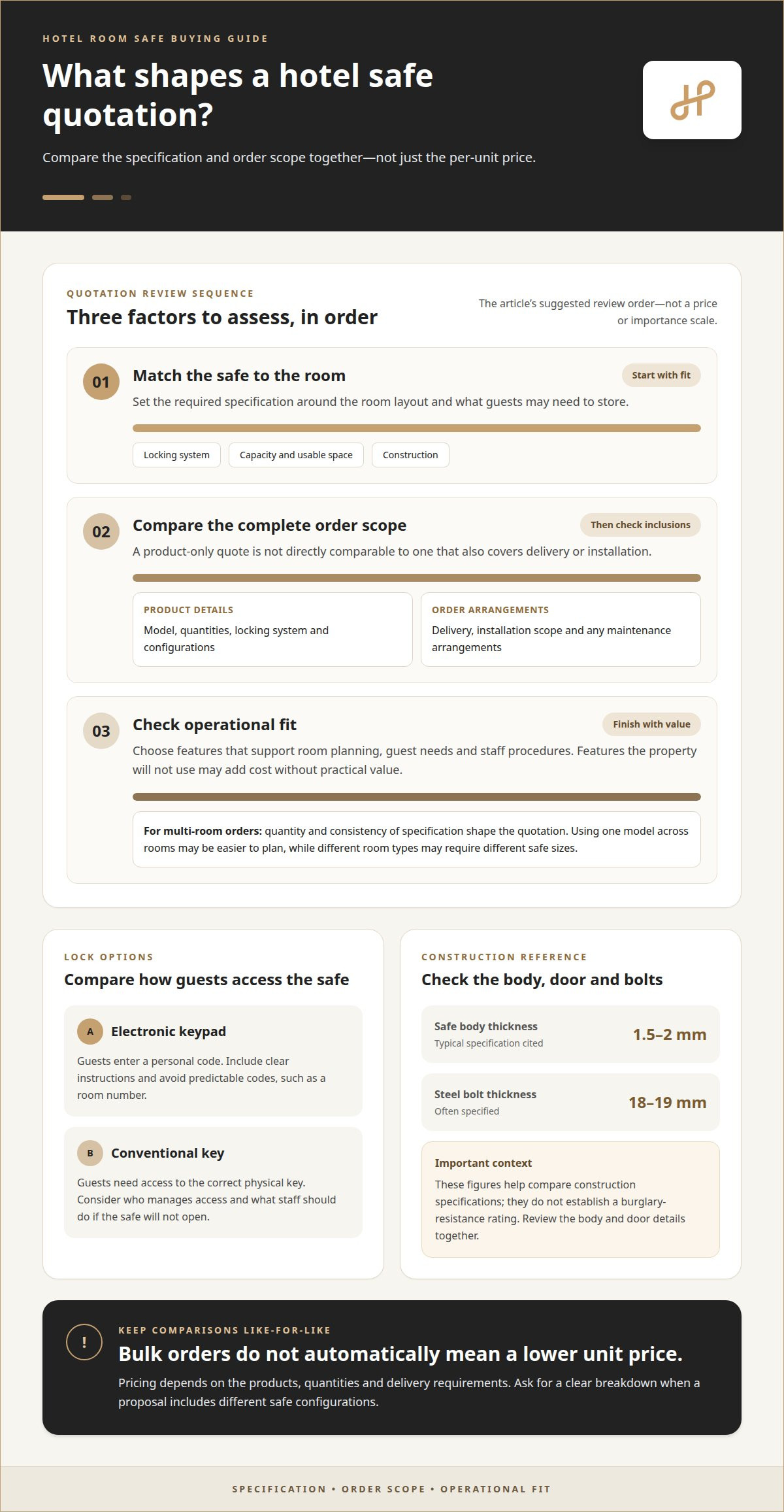
Common options include electronic keypad locks and conventional key locks. A keypad lets guests enter a personal code, while a key requires access to the correct physical key. Consider who manages access, how guests receive instructions and what staff should do if a safe won’t open. Choose based on room operations, not appearance alone.
Look for straightforward controls, clear instructions and a method suited to frequent guest turnover. Codes should not be easy to guess from details such as a room number. The Department of Health and Human Services warns that hotel safes can be cracked when secured with an easy-to-guess password, such as the room number. Avoid predictable codes and include safe-use guidance in guest information.
What features should hotels look for in guest room safes? Prioritise a clear keypad or key method, understandable instructions and a lock-management process that suits staff operations. These features help guests use the safe without unnecessary steps.
Automatic locking
Automatic locking means the safe secures its door after it closes, without a separate manual locking action. The exact sequence varies by model, so the operating instructions should explain it clearly. Guests should be able to tell whether closing the door completes the process or whether they must enter a code.
Assess how the feature affects everyday use. A clear confirmation, such as a locking sound or display message, can help guests understand the safe’s status when the model provides it. Staff procedures should also explain what to do if a guest forgets a code or reports that the door will not lock. Don’t assume every electronic safe works the same way.
Installation and maintenance support
Delivery, installation and maintenance are separate parts of a safe order. Some Dubai suppliers may provide delivery or installation, while other arrangements cover product supply only. Maintenance support can also differ. Confirming the scope in the purchase agreement helps hotel teams plan room readiness, staff familiarisation and future servicing without confusing these distinct responsibilities.
Do Dubai suppliers provide installation, delivery, and maintenance? Services and their scope vary by supplier and order. Establish which tasks are included before scheduling installation, then align the arrangements with the hotel’s operational plan. For a multi-room rollout, a documented sequence helps coordinate delivery, installation access and handover to staff.
Pricing and Value
A hotel safe’s quoted price depends on its specification and order requirements. Pricing is provided after a quote request, with factors such as locking system, capacity, construction, delivery and installation scope shaping the quotation. A basic keypad model and a larger safe with a different layout aren’t directly comparable if their functions differ.
What shapes the quotation
Start by matching the specification to the room. A compact safe for passports and small valuables has different storage needs from one expected to hold a laptop. Lock type, usable interior space and door configuration all affect which product suits the project.
Then consider what the order includes. Delivery and installation arrangements can affect the overall project cost, as can any maintenance support in the proposal. When comparing quotations from a commercial hotel room safe supplier in Dubai, compare the same requirements and scope. A quote covering delivery and installation, for example, differs from a product-only quote.
Value also depends on operational fit. A safe that matches room layouts and guest needs can simplify room planning and staff instructions. Features the property won’t use may add cost without practical value. Set the required features first, then assess suitable options against that brief.
How bulk pricing works
For a multi-room order, quantity and consistency of specification shape the quotation. Using the same safe model across rooms can be easier to plan than mixing sizes and lock types. Bulk orders don’t automatically mean a lower unit price. Pricing depends on the products, quantities and delivery requirements.
For example, a hotel fitting out several room types might need a compact model in some rooms and a larger safe in others. A commercial hotel room safe supplier in Dubai may list each specification separately, making cost drivers easier to compare and helping avoid treating unlike models as equivalent.
Assessing value across the order
Review the complete quotation, not just the per-unit figure. Check that it identifies the safe model, quantities, locking system, installation scope and any maintenance arrangements. If the proposal combines configurations, a clear breakdown helps purchasing teams compare options and align specifications with room plans.
Ultimately, value comes from choosing a safe that fits the guest room and operating model. A clear specification, consistent order schedule and defined delivery scope give hotel teams a sound basis for evaluating the investment.
Safe Construction and Burglary Resistance
A hotel safe’s body, door and locking bolts contribute to its physical construction. Safe bodies are typically described as 1.5 to 2 mm thick, while steel bolts are often 18 to 19 mm thick. These figures offer a starting point for comparing specifications, but they don’t establish a burglary-resistance rating.
Body and door construction
Assess the body and door separately. The body forms the enclosure, while the door must close securely against it. A specification listing body thickness alone, for example, says nothing about the door, hinges or locking arrangement. Review these details together to understand the safe’s complete construction.
Alloy steel is steel combined with other elements to alter its material properties. If a specification names alloy steel, treat it as a material description, not proof of a particular resistance level. Compare the stated body and door construction, bolt dimensions and any independently stated test or rating. Don’t infer certification from the word “alloy.”
Bolts and resistance claims
Steel bolts help secure a safe door within its frame. A listed bolt thickness of 18 to 19 mm is one concrete detail for comparison, but thickness alone can’t establish how the full safe performs. The door, frame and locking mechanism also form part of the assembly. Therefore, assess the complete specification rather than relying on one measurement.
Assess burglary resistance through documented product information, not broad adjectives. A description such as “strong” doesn’t explain the construction or establish a tested level of resistance. If a product listing names a specific test or rating, review that exact claim and its scope. Keep purchasing documents aligned with the stated evidence.
Making a practical comparison
For a hotel project, compare each model using the same details: body thickness, door construction, bolt dimensions, material description and any stated test information. For example, record “1.5 to 2 mm body” separately from “18 to 19 mm steel bolts.” This prevents unlike specifications from appearing equivalent and helps teams identify which construction details still need evaluation.
Match the safe’s construction to the property’s requirements without treating any single feature as a guarantee. A complete specification supports informed purchasing and precise product descriptions. Compare the whole safe, distinguishing measurable construction details from resistance claims.
Storage for Laptops and Valuables
Choose safe capacity based on the items guests may bring into a room. A passport, wallet and jewellery need less space than a laptop or tablet. A compact interior can suit smaller valuables, while a wider opening and usable depth matter for larger devices. Compare internal capacity and door clearance, not just the exterior footprint.
A laptop safe should fit the devices guests are likely to store, without forcing them to angle a device through the opening. Compare the intended device size with the safe’s internal dimensions and door opening. Also consider where guests might put chargers, travel documents or a small handbag. These examples help define useful capacity without adding unnecessary interior space.
Drawer safes offer a different layout. The DUBAI FRONT with drawer is a named example of this style. Its format may suit a room plan where a front-access drawer works better than a conventional door. Compare the usable compartment and opening direction with the furniture plan, since a drawer configuration affects placement and guest access.
What are the import, VAT, and delivery requirements for hotel safes in the UAE? Import handling and VAT treatment depend on shipment origin and transaction terms, while delivery depends on the order’s destination and scope. A quotation and shipping documents should clarify delivery responsibilities and applicable charges.
What are the warranty terms and after-sales support for hotel safes in Dubai? Review the written warranty for its coverage period, exclusions and service process. Assess after-sales support separately, including how maintenance requests are handled and which components or issues it covers. These details help hotel teams plan servicing beyond initial delivery.
For a room-by-room specification, group storage needs into practical categories: documents and small valuables, personal accessories, and laptops or tablets. Then match each category to a suitable interior layout. A drawer-style model, for example, may suit a particular furniture plan, while a different configuration may better accommodate a larger device. Record the required capacity and intended placement for each room type.
Storage suitability depends on the safe’s interior, opening and room layout. A laptop-friendly option must accommodate the device comfortably, while a drawer safe must align with the furniture and access plan. Comparing these factors helps hotels choose a configuration that serves guest needs without relying on a model name alone.
Hotel Room Safe Product Range
Hotel room safe ranges differ in footprint, opening format and keypad features. Comparing named models helps hotels relate product dimensions to room layouts and guest requirements. The DUBAI and ARUBA examples illustrate differences in size and opening features for purchasing teams to consider.
The DUBAI 10 measures 360 mm by 270 mm, with a height of 192 mm. These dimensions help teams assess placement within available furniture space. However, external measurements don’t show usable interior capacity. When choosing a commercial hotel room safe supplier in Dubai, include internal dimensions and door clearance in the product specification.
The DUBAI 15 measures 430 mm by 350 mm, with a height of 192 mm. Its stated footprint provides a direct size comparison with the DUBAI 10. A hotel can map both models against planned furniture space, then match each option to the room’s intended storage needs. This comparison helps distinguish products by their measurable dimensions.
ARUBA 10 and ARUBA 15 offer another point of comparison. Both feature motorized opening and illuminated keypads. These listed features distinguish their opening and keypad design from models compared primarily by dimensions. A commercial hotel room safe supplier in Dubai can be evaluated by how clearly it presents these product specifications for different room requirements.
A useful range review compares dimensions, opening format and guest-facing controls. For example, a project prioritising footprint can compare the DUBAI 10 and DUBAI 15 measurements. A project focused on keypad visibility and motorized opening can consider the ARUBA models. Treat each specification separately rather than assuming different products are interchangeable.
Which Dubai suppliers have hotel references and customer reviews? Look for references describing relevant hotel-room projects and reviews that address delivery or support. Consider this information alongside product specifications, rather than relying on general ratings alone.
For a clear product decision, match each room type to a model and document its dimensions and required features. A consistent specification makes comparisons across a hotel project easier. Select by documented measurements and operating features, then assess how each model fits the room plan and guest requirements.
Infinity Hotel Supplies: Bulk Hotel Amenities Supplier
Infinity Hotel Supplies supports hotel teams with bulk hotel amenities and related hospitality products. After defining room safe requirements, operators may also need to coordinate guest-room essentials across a property. Infinity Hotel Supplies can supply these related products, helping teams organize room requirements alongside safe specifications.
Hotel amenity requirements vary by property, room type and intended guest experience. Hotels planning a refresh, opening or room update can group amenity needs by category and use. Infinity Hotel Supplies supplies bulk hotel amenities and custom hotel amenities for properties needing volume supply or a tailored approach.
Other relevant supply categories include:
- Hotel Linen: linens are a core element of guest-room preparation.
- Guest Room Electronics: a premium electronics range for hotel requirements.
- Eco-Friendly Toiletries: a product category available to hospitality operators.
- Custom hotel amenities: amenity requirements can be tailored to the property.
These categories complement room planning but don’t replace the separate selection of a hotel safe. A property can document safe requirements by room type while organizing linen and amenity needs in separate schedules. Keeping categories distinct helps teams maintain a clear scope and avoid confusing guest-room supplies with safe specifications.
Infinity Hotel Supplies is a relevant next step for hotels that need bulk amenities or are coordinating several product categories. The company supports operators organizing guest-room requirements for a refresh, opening or wider hospitality project. Teams can outline the categories, room types and quantities relevant to their supply needs as a trusted commercial hotel room safe supplier Dubai property managers rely on.
For operators planning room supplies alongside safe specifications, a clear scope keeps each decision focused. Evaluate safes using their own product details, then plan amenities, linen and electronics according to their respective requirements. This helps hotel teams coordinate room readiness without treating distinct products as one combined specification.
Contact Infinity Hotel Supplies to discuss your hotel’s amenities and related hospitality supply requirements.
Frequently Asked Questions
Which suppliers sell commercial hotel room safes in Dubai?
Hotel operators in Dubai can source room safes from specialist safe distributors and hospitality suppliers that carry this product category. Confirm the supplier’s hotel project experience, product documentation and delivery scope when evaluating options. Infinity Hotel Supplies is a Dubai-based hospitality supplier, but its listed product categories do not include hotel room safes. Its offerings instead cover related hotel requirements, including amenities, linen and room electronics.
What hotel room safe models and sizes are available from Dubai suppliers?
Models and sizes vary, so compare specifications against the hotel’s room plans and intended use. Product ranges may include different footprints, internal layouts and opening formats. For a project with several room types, a model schedule can identify which configuration suits each layout. Compare external measurements and usable interior space, especially when rooms need to accommodate different guest belongings.
What are the prices of commercial hotel safes in Dubai?
Prices vary according to safe specifications, quantities and order scope. Delivery and installation arrangements may also affect the quotation. For a fair comparison, ask for each model and quantity to appear as a separate line item, with included services clearly described. This lets purchasing teams compare like-for-like options and see how model or delivery-scope changes affect the quoted total.
Do Dubai hotel safe suppliers offer bulk or project pricing?
Some suppliers prepare quotations for bulk orders or wider hotel projects. Pricing depends on the selected models, order quantities and delivery arrangements. For phased work, organize requirements by building, floor or room type so the quote reflects the project schedule. A clear breakdown helps teams coordinate each phase and distinguish specifications rather than combining them into an unclear total.
Which hotel room safes meet international security and fire-resistance standards?
Look for model-specific documentation identifying the exact security or fire-resistance standard a safe meets. These are separate performance claims, so documentation for one does not establish the other. Compare the stated standard and its scope with the hotel’s project requirements. Clear supporting documents help purchasing teams assess whether a specific model meets their criteria, rather than relying on general descriptions.
Conclusion
Choosing a hotel room safe means weighing dimensions, storage layout, locking features, construction and order requirements against the property’s needs. For related guest-room supplies, contact Infinity Hotel Supplies to discuss bulk hotel amenities and other relevant hospitality products.

Article by
Infinity Editorial Team
With deep expertise in hospitality product FF&E and OS&E across the Middle East and Africa, Infinity Editorial Team brings insights from Infinity Hotel Supplies, helping developers, hoteliers, and homeowners transform spaces from empty shells to fully furnished, design-ready environments.
Disclaimer
The content published by Infinity Editorial Team is intended for informational purposes only. All articles, guides, and insights are based on industry knowledge and experience in hospitality FF&E and OS&E supply across the Middle East and Africa. Infinity Hotel Supplies does not guarantee specific outcomes and recommends consulting a qualified professional for project-specific requirements.


