

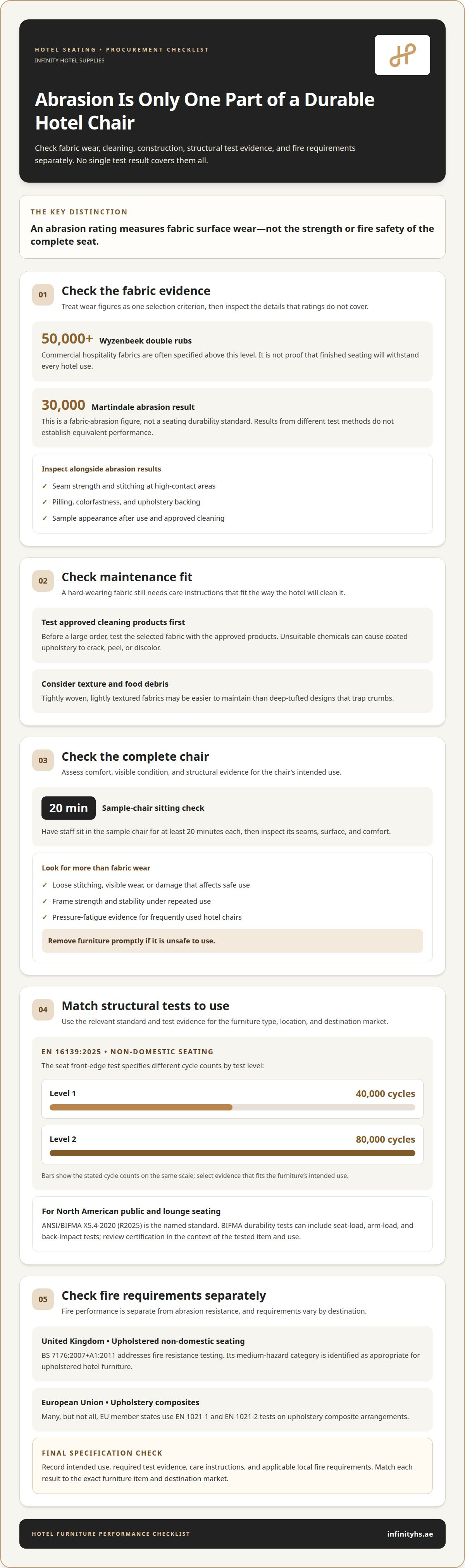
A high abrasion rating doesn’t prove that a hotel chair is structurally durable or fire-safe. Hotel furniture durability standards cover different performance questions, and the right criteria depend on the furniture’s use and destination market. For North American public and lounge seating, ANSI/BIFMA X5.4-2020 (R2025) is a relevant standard; fire-safety requirements vary internationally.
It’s understandable to focus on upholstery wear when furniture faces constant guest use. But a reliable specification also considers frame strength, construction, cleaning requirements, warranty terms, and fire performance. No single test result covers every factor.
This guide explains how to assess abrasion ratings alongside seating durability, construction, warranties, and applicable fire-safety requirements. It also clarifies where BIFMA standards fit, so you can compare evidence with the furniture’s intended use and local requirements before purchasing.
Key Takeaways
- Assess upholstery abrasion separately from the chair’s structural durability, and consider seams, pilling, colorfastness, and cleaning needs.
- Match fire-safety requirements and furniture testing to the destination market and the furniture’s intended use.
- Use written specifications to capture performance criteria, care instructions, relevant test records, and warranty terms.
- Evaluate commercial construction, joinery, finishes, and foam against the demands of frequent hospitality use.
- Use BIFMA standards as one input when assessing furniture performance, stability, and suitability for public or restaurant spaces.
2026 Hotel Furniture Procurement: How to Balance Fire Safety Standards and Durability?
Balance durability evidence with fire testing required in the furniture’s destination market. Standards differ internationally, so a result for one use or market may not address another.
Hotel mattresses and bed frames should be assessed against relevant product tests and local fire requirements. EN 1725:2023 covers beds; assess mattresses against applicable mattress-specific safety and testing standards. BS 7177:2008+A1:2011 can assess fire safety for hotel mattresses and upholstered bed bases in the UK.
For hotel furniture subject to ADA requirements, assess accessibility for guests with disabilities separately from durability testing. Accessibility design and furniture performance tests address different needs.
Commercial Furniture Testing and ANSI/BIFMA Standards
Commercial furniture testing evaluates performance under intended use, while ANSI/BIFMA standards provide benchmarks for furniture testing. For North American public and lounge seating, ANSI/BIFMA X5.4-2020 (R2025) is the named standard. Fire-safety requirements vary between destinations, including the European Union and the United States. Match test evidence to the furniture type, location, and applicable local requirements.
Structural Integrity and Durability Testing
Structural testing assesses whether furniture remains strong and stable under repeated use. For non-domestic seating, EN 16139:2025 recommends test level 1 to demonstrate strength, durability, and safety; its seat front-edge test specifies 40,000 cycles. Level 2 specifies 80,000 seat front-edge cycles. Pressure fatigue testing is especially relevant for frequently used hotel chairs, while table testing should match the table’s intended use.
BIFMA Certification and Frame Testing
BIFMA industry certifications can help evaluate furniture frames, but a certification should be read in context of the tested item and use. BIFMA durability tests simulate thousands of use cycles, including seat-load, arm-load, and back-impact tests. For a public lounge, review the frame evidence alongside the applicable seating standard, such as ANSI/BIFMA X5.4-2020 (R2025). This provides a clearer view than a generic commercial label alone.
Mattress and Bed Frame Durability
Bed and mattress standards assess product safety and functional performance, while fire testing addresses ignition resistance. EN 1957:2012 is a test method for bed and mattress functional characteristics; SATRA adapts it for contract items using more appropriate test parameters. EN 1725:2023 covers beds; assess mattresses against applicable mattress-specific safety and testing standards. In the UK, BS 7177:2008+A1:2011 can assess fire safety for mattresses and upholstered bed bases in hotels. Check destination requirements for each product category.
Distinguishing upholstery abrasion from seating durability
Abrasion ratings measure fabric wear, not the strength or safety of the complete seat. To help furniture last, inspect seams, pilling, colorfastness, and frame condition, then clean materials with approved products.
Upholstery Abrasion, Seams, and Colorfastness
Upholstery abrasion testing estimates how well a fabric surface resists rubbing; it doesn’t test the chair’s structure. Commercial hospitality fabrics are often specified above 50,000 double rubs on the Wyzenbeek scale. Treat that figure as one selection criterion, not proof that the finished seating will withstand every hotel use.
Assess seam strength, pilling, colorfastness, and backing alongside abrasion results. A fabric may resist surface wear but still develop loose stitching or change color after cleaning. Inspect seams and high-contact areas on a sample, then compare its appearance after use with the approved sample.
Abrasion Resistance and Stain Maintenance
Abrasion resistance describes surface wear; stain maintenance concerns how upholstery responds to spills and cleaning. A Martindale result of 30,000 is a fabric-abrasion figure, not a seating durability standard. Compare test methods carefully, since figures from different methods don’t establish equivalent performance.
Before placing a large order, test the selected fabric with approved cleaning products. Unsuitable chemicals can cause coated upholstery to crack, peel, or discolor. Tightly woven, lightly textured fabrics may also be easier to maintain than deep-tufted designs that trap crumbs. Include cleaning compatibility when selecting materials.
Use a sample chair to assess more than fabric appearance: have staff sit in it for at least 20 minutes each, then inspect its seams, surface, and comfort. During use, look for loose stitching, visible wear, or damage that affects safe use. Remove unsafe furniture promptly rather than leaving it in service.
Fire performance is a separate requirement from abrasion resistance. In the UK, BS 7176:2007+A1:2011 addresses fire resistance testing for upholstered non-domestic seating; its medium-hazard category is identified as appropriate for upholstered hotel furniture. Many, but not all, EU member states use EN 1021-1 and EN 1021-2 tests on upholstery composite arrangements. Apply the requirements relevant to the furniture’s destination.
Written product specifications and warranty terms
A written specification turns furniture expectations into measurable requirements. For each item, record dimensions, materials, finish references, hardware, upholstery, care instructions, intended use, and required test evidence. This gives suppliers and production teams a shared reference, from sample approval through delivery.
Requirements should reflect where each piece will be used. Guest-room chairs may face different demands from lobby seating or restaurant chairs used throughout the day. Public seating needs suitable strength and stability for its setting, while restaurant tables must remain stable during service. Specify each item’s location and use, then match relevant safety standards and test evidence to that product class.
Use applicable standards as precise specification points, not broad labels. For example, BS 2543:2004 classification GC identifies upholstery fabrics suitable for general contract use. Product-surface criteria can also be recorded where relevant: EN 12721:2009+A1:2013 assesses resistance to wet heat, while EN 12722:2009+A1:2013 addresses dry heat. Identify the required test and the applicable component, rather than relying on a general claim of commercial quality.
Warranty terms help clarify the manufacturer’s stated coverage, but they don’t replace test records or care instructions. Commercial-grade furniture warranties are described as lasting 5-10 or more years; residential-grade warranties typically last 1-2 years and may be voided by commercial use. Record the warranty period, covered components, exclusions, and maintenance conditions in the procurement documents. This makes the distinction between hotel use and domestic use explicit.
Production quality control connects specifications to the delivered furniture. A factory audit can review documented quality procedures and production checks. Compare the approved sample with production items for dimensions, materials, finish, hardware, upholstery, and workmanship. Document approval for any changes before production continues. These checks can help identify differences before a shipment reaches the property.
For products subject to California requirements, keep applicable compliance records, such as required labeling or flammability documentation, alongside test reports, care guidance, and warranty terms. The California Bureau of Household Goods and Services administers specific requirements for certain products, including upholstered furniture; it does not provide a general certification of furniture safety and quality. A complete file gives hotel teams a practical reference for maintenance and future replacements. Clear specifications also help suppliers reproduce approved details across repeat orders.
Commercial-grade construction, joinery, and finishes
Commercial construction combines suitable materials, reinforced joints, and finishes chosen for actual operating conditions. Specifications should connect each choice to frequent use, cleaning, and fire safety.
ANSI and ASTM Commercial Furniture Benchmarks
Industry benchmarks can help assess commercial furniture, including structural integrity. These references help define the performance evidence a specification should require, but they don’t make every item suitable for every hotel environment. Match the applicable benchmark to the furniture type and intended use, then keep its test documentation with the product records.
Construction details matter alongside test results. Mortise and tenon joints are recommended for wooden hotel furniture because the joint connects components through interlocking shapes. For seating, specify commercial high-resiliency foam with a density of at least 2.0 pounds per cubic foot. That concrete requirement is more useful than a broad description such as “high quality.”
Choose finishes to suit expected contact and cleaning. High-pressure laminate tops or catalyzed polyurethane finishes can help hospitality tables resist scratches. High-pressure laminate suits frequently used surfaces, but damaged seams and edges may allow moisture to reach the core. Solid wood can be refinished, though it may dent or react to moisture. The right choice depends on where the furniture will be used.
Commercial-Use Suitability and Test Documentation
Commercial-use suitability means the furniture’s construction and supporting evidence match its intended environment. A “commercial” label alone doesn’t explain what was tested or which uses the test covers. Keep reports, compliance certificates, and care instructions with the written specifications. This makes documented performance easier to assess when planning replacements.
Record hardware and finish requirements precisely. Tender documents can specify 304 stainless steel or higher-grade hardware; coastal or high-humidity properties can call for hardware that passed a 48-hour salt spray test. For wooden finishes, BS 3962-5:1980 assesses resistance to cold oils and fats, while BS 3962-6:1980 assesses mechanical damage resistance.
Compare the documented criteria with the actual furniture. Check the frame, joints, edges, hardware, and finish against the specification, noting differences that could affect strength or maintenance. For public seating, include relevant fire-safety evidence for the destination market. Clear records help teams distinguish normal wear from a specification mismatch and make consistent repair or replacement decisions.
BIFMA standards for hospitality furniture
BIFMA standards give hotel buyers a framework for assessing furniture performance, but the right reference depends on each item’s use. For purchasing, assess public seating, restaurant chairs, tables, and storage separately rather than treating hospitality furniture as one category. Applying hotel furniture durability standards by product type helps align test evidence with each item’s location and expected demands.
For hotels in the United States, requirements vary by location and furniture type. For North American public and lounge seating, ANSI/BIFMA X5.4-2020 (R2025) is a relevant standard. It gives buyers a defined reference for evaluating seating intended for public spaces. It doesn’t, by itself, resolve every question about fire safety, cleaning, or use in a particular building.
Restaurant use adds practical demands to purchasing decisions. A dining chair must remain stable during repeated use, while a table must stand securely in its intended setting. Assess chairs and tables separately, considering how guests move, sit, and interact with them. Stability, sharp edges, and dangerous protruding parts also matter when evaluating furniture safety.
BIFMA industry certifications can support frame evaluation, but interpret each certification within its stated scope. Identify the specific model and component it covers, then relate that evidence to the intended use. Frame certification doesn’t establish upholstery fire performance or cleaning compatibility. These are separate considerations in a hospitality specification.
For a practical review, compare product documentation with the planned location. A lobby lounge chair and a restaurant dining chair may both be public seating, yet their use patterns differ. Record the product category, applicable standard, certification scope, stability needs, and separate fire-safety evidence. This keeps the decision tied to the furniture being purchased, not just its label.
Use hotel furniture durability standards as one part of a broader evaluation, not as a substitute for other requirements. For example, restaurant tables and lounge chairs need performance evidence suited to their intended use, alongside destination-specific fire testing. The clearest specification names each product, its location, and the relevant evidence. This makes certification more useful and helps prevent a seating benchmark from being applied to unrelated furniture.
Infinity Hotel Supplies
Infinity Hotel Supplies supports hotels planning room refreshes and property updates with hospitality products and turnkey solutions. Keep each furniture decision tied to its intended use, and treat supporting documentation as part of the purchasing record. This helps teams make consistent project decisions without confusing one product category with another.
As you plan, keep furniture assessments separate from other guest-room requirements. Hotel linens and room electronics may be part of the same project, but they serve different purposes and need their own product criteria. Keeping categories distinct helps teams assign responsibilities, track specifications, and organize purchasing records without assuming one item’s documentation applies to another.
Infinity Hotel Supplies also offers premium guest amenities, sustainable toiletries, and fine leather accessories. These products can support a hotel’s additional supply needs alongside a room update. The right mix depends on the project’s scope. Clear category planning helps teams consider related requirements while keeping furniture decisions focused on furniture-specific criteria.
A useful project record brings together each item’s purpose, approved requirements, care information, and relevant documentation. Teams can use it to align internal decisions, coordinate purchasing, and keep future replacements consistent with the property’s needs. This is especially helpful when a refresh involves several product categories or teams, since a shared record makes responsibilities and decisions easier to follow.
In summary, assess furniture in context, keep product categories distinct, and organize the information teams need to make sound purchasing decisions. For related hotel supply needs, Infinity Hotel Supplies offers products that support project planning without changing furniture criteria. To plan a project, identify the relevant product categories and define what each requires, then request a tailored quote from our team.
Contact Infinity Hotel Supplies to discuss the products relevant to your hotel project.
Frequently Asked Questions
Hotel furniture: Is it safe and fit for purpose?
Furniture is fit for purpose when its construction, load limits, placement, and accessibility suit the guests and activities it serves. For example, a luggage bench should have a load limit appropriate to its use. Also consider clear routes for guests with disabilities and whether furniture creates a trip or impact hazard. Review each item in its actual room layout, not just as a standalone sample.
How can coastal or high-humidity hotels prevent hardware corrosion from ruining furniture?
Limit prolonged moisture exposure and address finish damage before corrosion spreads. During routine upkeep, inspect metal connections, fasteners, and frame joints for discoloration, peeling, or rough surfaces. Pay particular attention after cleaning or spills, since moisture can collect around fittings. A maintenance record noting the location and condition of affected pieces helps staff spot recurring problems and address them before a connection weakens.
What makes hospitality furniture durability contract-grade?
Contract-grade furniture is intended for commercial settings, where use patterns differ from those at home. Residential furniture generally isn’t designed or tested for a hotel guest-room chair used by hundreds of different people in a year. For purchasing, look for evidence tied to the intended setting, product, and use, rather than relying on a “commercial” label alone. This helps buyers judge whether an item suits the property’s operating demands.
What ANSI/BIFMA standards cover commercial hotel furniture?
ANSI/BIFMA standards provide benchmarks for evaluating furniture, but the applicable reference depends on the item and its setting. No single standard covers every hotel chair, table, bed, or storage unit. First identify the furniture category and intended location, then match the relevant test documentation to that scope. This prevents a seating result from being treated as evidence for another product type.
What testing methods measure hotel furniture strength and durability?
Testing can examine different movement points, so the report’s specific method matters. For example, EN 16139:2025 includes a side-to-side durability test for single-column seating: 10,000 cycles at level 1 and 20,000 cycles at level 2. Its foot-rest durability tests specify 30,000 cycles at level 1 and 60,000 cycles at level 2. These results add detail beyond a general statement that seating was tested.
What fire safety standards apply to upholstered hotel furniture in the United States?
U.S. fire-safety requirements depend on the property’s location, the furniture’s use, and the applicable risk framework. TB 133 is cited for high-occupancy public seating in California or strict corporate risk-management frameworks; it isn’t a universal hotel test. Distinguish public seating from mattresses and upholstered bed bases, since fire assessments can address different product categories and material arrangements.
What abrasion, stain, and colorfastness ratings should hotel upholstery meet?
There isn’t one abrasion figure that also establishes stain resistance and colorfastness. Specify each performance measure separately and state the test method so results can be interpreted consistently. For a practical review, compare upholstery samples under the lighting and in the location planned for the room, then assess whether the expected care routine suits the fabric. This helps prevent a surface-wear result from standing in for every textile requirement.
How do contract-grade and residential-grade hotel furniture compare in durability and cost?
Compare the full operating implications, not just the initial purchase amount. For each furniture type, consider cleaning labor, repairs, room downtime, appearance, and replacement needs based on condition. A chair that requires frequent repairs can disrupt room operations even if it cost less to purchase. Base the comparison on the property’s use patterns and maintenance capacity, rather than assuming every item follows the same replacement timetable.

Article by
Infinity Editorial Team
With deep expertise in hospitality product FF&E and OS&E across the Middle East and Africa, Infinity Editorial Team brings insights from Infinity Hotel Supplies, helping developers, hoteliers, and homeowners transform spaces from empty shells to fully furnished, design-ready environments.
Disclaimer
The content published by Infinity Editorial Team is intended for informational purposes only. All articles, guides, and insights are based on industry knowledge and experience in hospitality FF&E and OS&E supply across the Middle East and Africa. Infinity Hotel Supplies does not guarantee specific outcomes and recommends consulting a qualified professional for project-specific requirements.


