

A housekeeping cart that struggles across thick luxury carpet may need larger-diameter wheels, not simply softer ones. Larger wheels roll over deep pile and floor transitions more easily, while suitable tread material and load capacity help the cart move smoothly in daily use.
It’s understandable to focus first on wheel material, but carpet pile changes how a wheel performs. Choose an ergonomic housekeeping cart wheel replacement for thick luxury carpets in Abu Dhabi by considering wheel diameter, carpet depth, flooring transitions, tread material, and the cart’s total loaded weight.
This guide explains how these factors work together, including when hard or soft treads may suit different surfaces and why the cart’s load matters when selecting casters. You’ll also learn how to weigh manoeuvrability against straight-line movement, so your wheel choice better suits the carpet and daily housekeeping demands.
Key Takeaways
- Match the caster tread to carpet pile and the other floor surfaces the cart crosses.
- Assess wheel diameter against thick carpet and thresholds to support easier movement between areas.
- Compare wheel materials for noise, floor marking and suitability across mixed flooring.
- Choose casters based on the cart’s fully loaded weight, not the empty frame alone.
- Weigh soft rubber, polyurethane and pneumatic options against your carpet and operating conditions.
Caster suitability for low-pile, thick, and long-fiber carpet
Match tread material and wheel size to the carpet pile, fibers, and floor transitions. To measure and replace cart wheels safely, unload and secure the cart, record each wheel’s diameter and width and its mounting type, then fit replacements with matching dimensions and attachment points.
Caster Materials Across Carpet Types
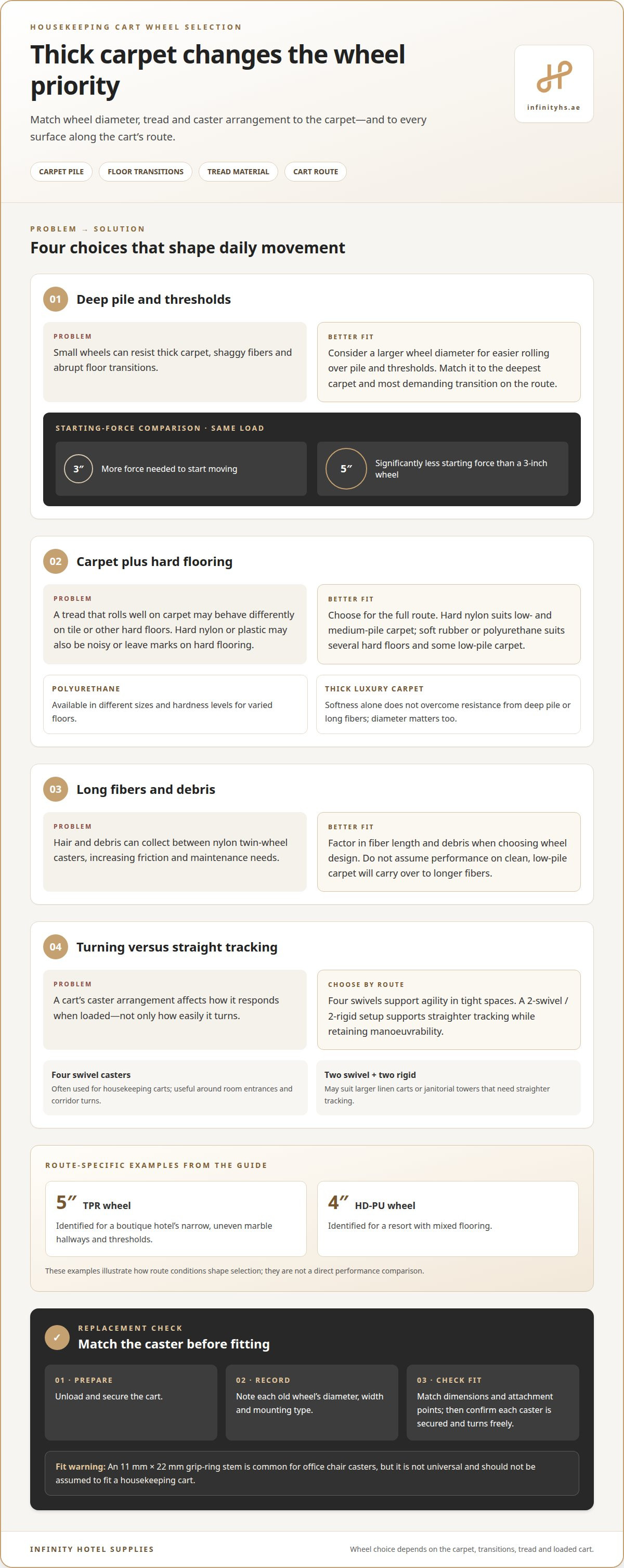
Hard nylon casters suit low- and medium-pile carpets, while polyurethane comes in different sizes and hardness levels for varied floors. Carpet fibers can resist a small wheel, and a tread suited to carpet may behave differently on tile or other hard surfaces. For thick pile, a larger diameter can help hard nylon wheels roll more readily.
Hard-tread casters generally need less force to move over rugs and carpets. However, hard nylon or plastic wheels may create noise or leave marks on hard flooring. A cart moving between carpeted rooms and tiled corridors needs wheels chosen for both surfaces, not carpet alone.
Long fibers also make wheel design important. Hair and debris can collect between the wheels of nylon twin-wheel casters, increasing friction and maintenance needs. A wheel that moves well on clean, low-pile carpet may perform differently where fibers are longer or debris gathers around the caster.
Housekeeping Cart Caster Configurations
Housekeeping cart caster configuration describes how swivel and rigid wheels are arranged beneath the frame. Most housekeeping carts use four swivel casters for agility in tight spaces, such as room entrances or corridor turns. Larger linen carts or janitorial towers may benefit from a 2-swivel / 2-rigid arrangement, which supports straighter tracking while retaining manoeuvrability.
Caster configuration affects how a loaded cart responds, not just how easily it turns. Four swivels allow the cart to pivot, while rigid casters guide it along a straighter path. On thick carpet, wheels must also roll over the pile without catching. Choose the arrangement and wheel type together to suit the route.
Soft Rubber, Polyurethane, and Pneumatic Options
These options differ in tread feel and the surfaces they suit, so compare them with the carpet and any hard-floor transitions. Soft rubber or polyurethane treads are generally suited to hardwood, laminate, vinyl, tile, and some low-pile carpets. Polyurethane is available in different hardness levels, offering flexibility across floor types.
For thick luxury carpet, wheel diameter matters alongside tread softness. A soft tread alone does not overcome resistance from deep pile or long fibers, so select a diameter suited to the carpet and transitions. Pneumatic casters are another category, but their suitability for luxury carpet is not established, so do not assume they offer a performance advantage.
Before replacement, compare the old caster’s diameter, width, and mounting method with the new wheel. An 11 mm × 22 mm grip-ring stem is common for office chair casters, but it is not universal and should not be assumed to fit a housekeeping cart. After fitting, check that each caster is secured and turns freely before returning the unloaded cart to service.
Large-diameter wheels for thick carpet and floor transitions
Larger-diameter wheels roll more easily over thick carpet, shaggy fibers, and floor transitions than smaller wheels. They are especially useful on routes between carpeted rooms and hard flooring.
Large-Diameter Wheels at Floor Transitions
A larger wheel can pass over carpet pile and thresholds more readily than a smaller caster. It rolls across a change in surface rather than meeting each edge as abruptly. This matters on routes from thick carpet to marble or tile, where a small wheel may catch and interrupt movement.
For example, a 5-inch TPR wheel is identified for a boutique hotel’s narrow, uneven marble hallways and thresholds. A 4-inch HD-PU wheel is identified for a resort with mixed flooring. These examples show why the route matters: carpet depth, threshold height, and adjoining surfaces all shape wheel selection.
Reducing Cart-Pushing Effort
Reducing pushing effort means choosing wheels that travel across the actual carpet and transitions without repeated force to get moving. Under the same load, a 5-inch wheel requires significantly less starting force than a 3-inch wheel. Larger wheels can also move through shaggy carpets more easily than smaller ones.
To support ergonomic movement, match wheel diameter to the deepest pile and most demanding threshold on the cart’s route. A larger wheel can reduce the force needed to start moving, but it must still suit the cart and flooring. Wheel selection alone does not establish compliance with ergonomic safety guidance.
Consider a housekeeping route across plush guest-room carpet, a doorway threshold, and a marble corridor. A smaller wheel may roll adequately on the corridor but resist the carpet or threshold. A larger diameter can help it cross both, while the tread material must still suit the hard flooring.
Flooring damage is separate from rolling effort. A wheel that catches or drags across thick pile can disturb fibers, while hard treads may be noisy or mark hard flooring. Balance wheel diameter with tread suitability instead of assuming the largest option is always right.
For a route with thick carpet and floor transitions, consider the pile, thresholds, adjoining surfaces, and cart load together. This helps identify whether wheel diameter or tread is the main constraint. Choose wheels that support smooth travel across the complete route without compromising surface suitability.
Quiet, non-marking wheel materials for carpet and hard floors
Wheel material affects noise and marking in carpeted rooms and hard-floor corridors. Larger or wider casters do not automatically damage, snag, or mark luxury carpet. Pile, tread, debris, and the way the cart moves all matter.
Quiet, Non-Marking Wheel Materials
Soft polyurethane or rubber-tread casters are generally suited to hardwood, laminate, vinyl, tile, and some low-pile carpets. Their range makes them relevant for carts that travel between carpeted guest rooms and hard-surface corridors. Choose for the full route, because a material suited to one surface may behave differently on another.
Non-marking TPR wheels have been used for 18 months of daily service in a luxury high-rise. That example illustrates a material choice for sustained use, not a guarantee for every floor. Carpet type, surface condition, load, and turning patterns remain part of the practical assessment.
Caster Effects on Luxury Carpet
Wheel diameter alone does not determine whether a caster will damage or snag carpet. Larger wheels can move through shaggy carpets more easily than smaller ones, but tread and fibers also affect movement. A caster that rolls smoothly over the pile is less likely to catch during normal use than one that stalls or drags.
Wheel width must also suit the cart and carpet, but wider does not automatically mean safer or more damaging. Consider whether the wheel tracks cleanly, turns without pulling fibers, and clears the cart frame. A cart turning repeatedly on a long-fiber rug places different demands on its casters than one travelling straight across low-pile carpet.
Marks are a particular concern at transitions. Hard nylon or plastic wheels can be noisy or leave marks on hard flooring, even when they roll across carpet. If a housekeeping route includes tile beside carpet, assess both surfaces rather than judging the caster only on the rug.
Debris also changes wheel behaviour. Hair or fibers caught between nylon twin wheels can increase friction and maintenance needs. A wheel that drags or turns unevenly may pull at carpet fibers, so inspect it periodically and clear build-up before it affects movement.
Assess the carpet’s pile and fiber length, then observe the cart on its actual route. Check for snagging, unusual noise, visible marks on adjoining flooring, and debris around the caster. This practical review helps distinguish a material mismatch from a maintenance issue, such as trapped fibers.
For luxury carpet beside hard flooring, weigh quiet movement, marking risk, and carpet clearance together. A soft rubber or polyurethane tread may suit mixed surfaces, while the 18-month TPR example offers a useful reference point rather than a universal service-life expectation.
Load capacity and safety margins
Choose casters by the housekeeping cart’s total working load, including its frame and supplies. A fully loaded cart typically weighs 85-130 kg, so selecting wheels based only on the empty cart can understate the demand.
Use the load formula: divide the cart’s total weight by three, then apply a 1.5 safety factor. For a 120 kg cart, that calculation is 120 ÷ 3 × 1.5, giving a minimum capacity of 60 kg per caster. This method accounts for uneven weight distribution, rather than assuming all four wheels carry equal loads at every moment.
Cart contents explain why the total load changes during a shift. A typical load may include:
- Linens weighing 15-25 kg.
- Towels weighing 20-30 kg.
- Amenities and cleaning supplies weighing 10-15 kg.
- The vacuum, mop bucket, and cart structure weighing 40-60 kg.
These ranges show how equipment and supplies combine. For example, linens and towels alone can contribute 35-55 kg before amenities, cleaning supplies, and the cart structure are counted. Use the actual operating load when sizing replacement casters, especially when teams carry a vacuum or filled mop bucket.
Capacity ratings apply to each caster, not to the full set. If the 120 kg example requires 60 kg per caster, four casters each rated at 60 kg provide the stated minimum under the formula. Do not divide the total load evenly by four and stop there; the calculation deliberately divides by three before applying the safety factor.
Thick carpet adds rolling resistance, so capacity is only one part of choosing suitable wheels. A caster must support the load while moving across carpet pile and transitions. A wheel that meets the load requirement but struggles to roll can still make a loaded cart harder to manoeuvre.
Recalculate when the cart’s use changes. Adding a vacuum, increasing linen quantities, or carrying a full mop bucket can raise the working load above the usual setup. Compare the normal room-service load with the heaviest routine load, then use the heavier total when selecting casters.
Finally, keep the unit consistent: compare the calculated requirement in kilograms with the caster’s stated capacity in kilograms. Apply the same calculation to every replacement decision, and retain the 1.5 safety factor after dividing by three. This gives housekeeping teams a clear, repeatable basis for assessing load capacity.
Are soft rubber, polyurethane, or pneumatic casters best for luxury carpets?
No single tread material is best for every luxury carpet and route. Soft rubber and polyurethane suit selected floors, while carpet pile, transitions, wheel diameter, and cart load also shape the choice.
Compare the Tread With the Route
Soft rubber-tread casters are generally suited to hardwood, laminate, vinyl, tile, and some low-pile carpets. That range can suit a cart moving between a carpeted room and a hard-floor corridor. It does not establish that soft rubber will roll easily through thick, long-fiber pile. Carpet depth and wheel diameter still affect how readily the caster moves.
Polyurethane comes in different sizes and hardness levels, making it suitable for a range of floor types. For a route across carpet and hard flooring, compare the wheel’s size and tread with both surfaces. A softer tread may help with floor contact, but softness alone cannot compensate for a wheel that struggles through deep pile.
Pneumatic casters use air-filled tires, which can flex over uneven surfaces. Their suitability for a housekeeping cart depends on the specific wheel, its load rating, and the carpet route. Do not treat an air-filled design as the default choice for luxury carpet without considering these factors.
Match the Material to Operating Conditions
Start with the floor that creates the greatest resistance, such as deep carpet or a raised threshold. Then consider the rest of the route. Soft rubber may suit hard floors and some low-pile carpet, while polyurethane offers choices in size and hardness for mixed surfaces.
Polyurethane also has a temperature limitation: exposure to temperatures around 230 degrees or higher may irreversibly degrade it. For typical room-to-corridor movement, the more immediate comparison is between carpet pile, thresholds, and hard flooring. The temperature point matters if wheels are exposed to unusually hot environments.
Before settling on a type, compare wheel diameter, tread, and load capacity with the cart’s working conditions. A pneumatic caster may seem appealing for uneven flooring, but its construction does not remove the need to match its capacity and dimensions to the cart. Rubber or polyurethane tread must likewise suit the surfaces on the route.
For thick luxury carpet, prioritize wheels that move across the pile without catching, then assess noise and marks on adjoining hard floors. This comparison is more useful than choosing by material name alone. Evaluate the complete setup under the cart’s normal load and on its actual route, including transitions and turns.
Contact Infinity Hotel Supplies to discuss your ergonomic housekeeping cart wheel replacement for thick luxury carpets Abu Dhabi requirements.
Infinity Hotel Supplies: Housekeeping Trolleys
Infinity Hotel Supplies offers Housekeeping Trolleys for hospitality operations where carpet type, floor transitions, and daily loads shape equipment choices. The guidance above can help teams identify relevant wheel characteristics; the trolley should also suit the property’s routes and housekeeping requirements.
When reviewing room-service operations or planning equipment for areas with thick luxury carpets, consider Housekeeping Trolleys. Carpet pile, adjoining flooring, and typical loads help define what the equipment needs to handle.
Contact Infinity Hotel Supplies to discuss your housekeeping trolley requirements.
Plan the Next Cart Decision
Replacing a wheel is also an opportunity to align housekeeping equipment with your property’s daily workflow. Start by considering the routes each cart serves and the tasks it supports. This context helps your team define practical requirements before selecting equipment.
Keep the review focused: note where carts travel, which areas create handling challenges, and whether current equipment suits the operation. Share these priorities with the team responsible for housekeeping supplies so the next decision reflects actual use.
Thoughtful planning can make equipment choices more consistent across the property. When your team is ready to discuss its housekeeping trolley requirements, contact Infinity Hotel Supplies.
Frequently Asked Questions About Carpet Casters
5 Best Caster Wheels for Carpet: What Are the Options?
Compare five options: hard nylon, polyurethane, soft rubber, TPR, and pneumatic casters. Treat them as candidates, not a universal ranking. Before choosing, note the cart’s existing wheel design, how often it turns, and whether staff need to clean around the casters. These practical details help narrow the options beyond material names and make the comparison more relevant to your property.
How Do I Choose Casters for a Housekeeping Cart?
Start by checking the cart model, caster mounting, and route. Then consider the carpet type, turning needs, and cleaning routine. Record how the current casters perform under the cart’s normal load, including whether they rotate freely and clear the frame. Use these details to compare suitable replacements and confirm that the mounting matches before ordering.
What’s the Difference Between Hard and Soft Casters?
Hard and soft casters differ in the firmness of the wheel’s running surface and how it interacts with the floor. To compare them, observe a cart during its usual task. Note whether the wheels rotate freely, track evenly, and suit the cleaning routine. Use these observations to describe the performance you need rather than relying on broad labels alone.
Why Does the Floor Determine the Right Caster?
Floor conditions affect a cart throughout its route. Map the areas the trolley crosses, including changes in surface, doorway clearances, and turning points. Use this route record to identify the caster characteristics each cart needs. Carts used in different areas of the same property may need different casters.
Which replacement caster wheels work best on thick luxury carpets for housekeeping carts?
Choose a replacement that matches the trolley’s mounting and clears its frame, then assess it under the cart’s normal working load. For thick luxury carpet, consider the route and how staff manoeuvre in guest-room spaces. Record the cart model and current caster arrangement before comparing replacements. This helps you avoid selecting a wheel that cannot be installed correctly.
What wheel diameter and tread width are recommended for pushing carts across plush carpet?
No single diameter and tread width suits every plush-carpet route. The cart frame, caster fork, mounting position, carpet depth, and turns all affect fit and movement. Check that the wheel rotates without rubbing against the frame, then test it on the cart’s usual route. Choose dimensions based on fit and movement in the areas where staff use the cart.
What caster stem and mounting plate sizes are used on common housekeeping carts?
Housekeeping carts do not share one universal mounting size. Check whether the existing caster uses a stem or a plate, then record its attachment dimensions and how it connects to the cart frame. For plate fittings, note the plate shape and bolt-hole layout; for stems, record the stem style and dimensions. Match these details to the replacement so it attaches securely.
Where can I buy housekeeping cart replacement casters in Abu Dhabi?
Infinity Hotel Supplies offers Housekeeping Trolleys for hospitality operations in Abu Dhabi and across the GCC, Middle East, and Africa. For a trolley requirement, share the intended use and operating context to discuss suitable housekeeping equipment. If you need a standalone replacement caster, provide the cart model and mounting details so your requirements are clear.

Article by
Infinity Editorial Team
With deep expertise in hospitality product FF&E and OS&E across the Middle East and Africa, Infinity Editorial Team brings insights from Infinity Hotel Supplies, helping developers, hoteliers, and homeowners transform spaces from empty shells to fully furnished, design-ready environments.
Disclaimer
The content published by Infinity Editorial Team is intended for informational purposes only. All articles, guides, and insights are based on industry knowledge and experience in hospitality FF&E and OS&E supply across the Middle East and Africa. Infinity Hotel Supplies does not guarantee specific outcomes and recommends consulting a qualified professional for project-specific requirements.


