

A remote resort’s opening package is only as dependable as the supplies behind daily operations. Planning turnkey hotel OS&E supplies for remote resorts means coordinating replenishable essentials, from room linen and towels to housekeeping and back-of-house equipment, around the property’s needs and delivery constraints.
OS&E procurement covers the operating items a hotel uses, replaces, and replenishes, unlike larger permanent assets such as beds and desks. For a remote resort, the challenge is not just choosing products: quantities, specifications, ordering schedules, and delivery logistics all shape the plan. A coordinated approach helps teams see how these decisions fit together before opening.
This guide explains what OS&E procurement includes, how to build a practical budget without relying on a one-size-fits-all figure, and what can affect costs and lead times. It also covers guestroom, housekeeping, and back-of-house essentials, along with common planning mistakes that can disrupt an opening. Understanding categories and timing helps resort teams make more confident procurement decisions.
Key Takeaways
- Separate operating supplies from permanent assets so budgets and purchasing schedules match each item’s role.
- Build contingency and replacement reserves into the plan to manage delays, replenishment, and unexpected costs.
- Coordinate sample approval, pre-shipment inspection, receiving checks, and installation to catch quality issues before opening.
- Plan guestroom, housekeeping, and back-of-house quantities around occupancy, laundry capacity, and daily operating needs.
- Assess how a coordinated product range can simplify supply planning for a remote resort, from linen and uniforms to room electronics and trolleys.
How professional OS&E procurement teams prevent budgeting and purchasing mistakes
There is no single OS&E cost per room that applies to every hotel or resort. Hospitality teams often express budgets as a cost per key, then build the allowance around room count, operating concept, product specifications, and delivery requirements. Project pricing depends on these factors and is provided through a quote request.
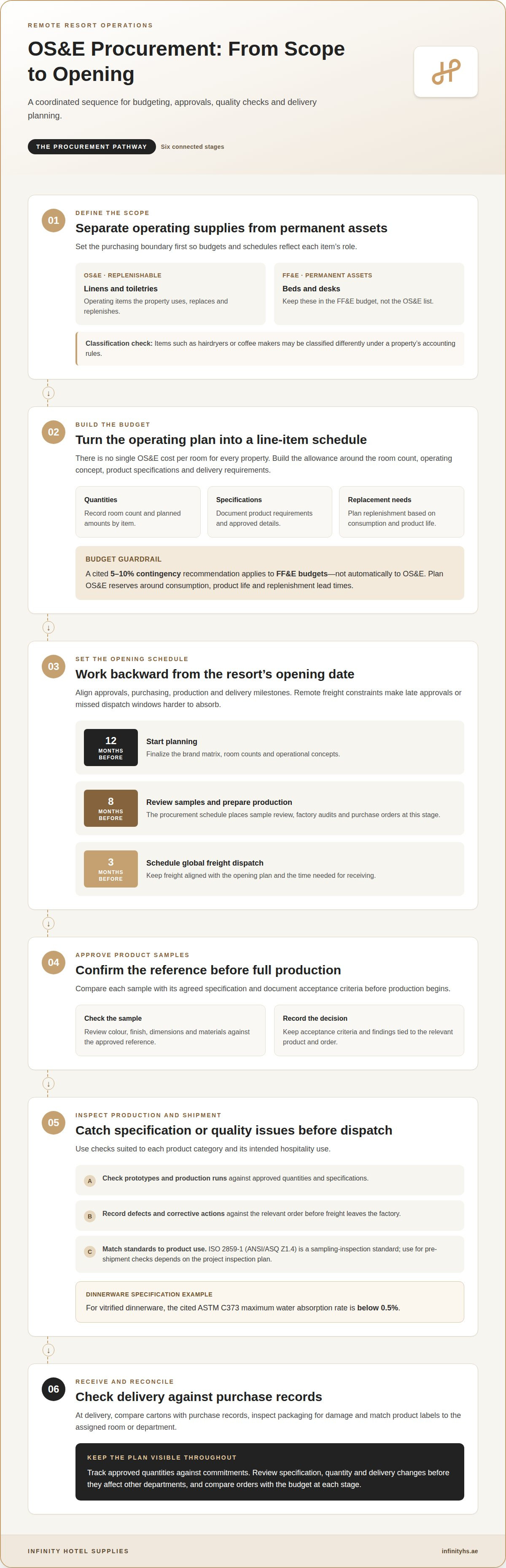
Procurement teams begin by separating replenishable operating supplies from permanent assets. The distinction between OS&E and FF&E matters: beds and desks belong in the FF&E budget, while linens and toiletries are OS&E. Some items, such as hairdryers or coffee makers, may be classified differently under a property’s accounting rules. A category matrix helps prevent duplicate purchases and keeps costs visible.
Next, teams develop a line-item budget from the room count, service model, and operating departments. They record quantities, specifications, expected replacement needs, and purchasing status in one schedule. A contingency can address unforeseen changes, while replacement reserves support ongoing replenishment. The cited 5-10% contingency recommendation applies to FF&E budgets, not automatically to OS&E. For OS&E, reserve planning should reflect consumption, product life, and replenishment lead times.
Schedules help teams identify delays before they become opening-day shortages. Planning can begin 12 months before opening by finalizing the brand matrix, room counts, and operational concepts. Teams then align specifications, approvals, purchasing, production, and delivery with the opening date. Global freight dispatch is scheduled at three months before opening in the procurement timeline. For a remote resort, late approvals or missed freight windows can compress receiving time and increase the risk of rushed substitutions.
During purchasing, teams track approved quantities against commitments and flag changes before they affect other departments. A linen order, for example, should reflect the property’s room count and operating plan, with a separate allowance for replacement. Comparing orders with the budget at each stage, and recording changes to specifications, quantities, or delivery plans, makes emerging overruns easier to trace and manage.
- Budget: Separate OS&E from FF&E and document assumptions.
- Schedule: Track approvals, orders, production, and freight against opening.
- Monitor: Review quantity and specification changes before purchase commitments.
Manufacturing lead times and quality inspections
Remote-resort OS&E should meet documented specifications for intended use, durability, and safe operation. For vitrified dinnerware, the maximum water absorption rate is below 0.5% under ASTM C373.
Manufacturing Lead Times
Manufacturing lead time is the period between placing an order and completing production. It matters because late production can squeeze freight, receiving, and installation windows, especially at remote properties. Hotel FF&E manufacturing typically takes 8-16 weeks, while FF&E procurement from specification through final installation typically takes 6-12 months. OS&E schedules should map each product’s production and delivery milestones against the resort’s opening plan.
The schedule places sample review, factory audits, and purchase orders eight months before opening. Procurement teams track production against approved quantities and specifications, then flag changes that could delay dispatch. This gives construction and operations teams time to coordinate site access, storage, and installation, rather than receiving supplies after rooms are ready.
Sample Approval and Quality Checks
Sample approval is the review of a product example against its agreed specification before full production. It matters because a mismatch in colour, finish, dimensions, or materials can affect an entire order. Teams document acceptance criteria for each sample, then compare production items with the approved reference. ISO 2859-1 (ANSI/ASQ Z1.4) is a sampling-inspection standard; its use for pre-shipment checks depends on the project’s inspection plan.
Quality control can include prototype checks, production-run checks, and factory inspections to identify defects before shipment. A sample review might assess whether a towel matches the selected fabric and dimensions, while a furniture check might focus on finish and construction. Recording findings and corrective actions against the relevant order helps teams resolve issues before freight leaves the factory.
Durability and Safety Standards
Durability and safety standards are documented criteria products must meet for their intended hospitality use. Repeated handling, cleaning, and housekeeping routines place different demands on different items. Teams should assess products by category rather than apply one test to everything. Dinnerware, textiles, room electronics, and cleaning equipment each need specifications suited to their function and operating environment.
For vitrified dinnerware, ASTM C373 provides the cited water-absorption criterion: a maximum rate below 0.5%. Other product checks should match the approved specification and intended use. Inspection records can capture visible defects, dimensions, finish, and functional issues, giving operations teams a consistent basis for acceptance before installation or use.
Receiving and installation: At delivery, teams compare cartons with purchase records, inspect packaging for damage, and match product labels to room or department allocations. They record shortages and visible defects before moving items into storage. During installation, teams place furniture and equipment according to approved layouts, remove protective packaging, and complete the required cleaning. A clear handover record helps housekeeping identify ready rooms and unresolved issues before opening.
Guestroom and housekeeping essentials
Remote-resort OS&E includes bed linen, towels, toiletries, dishware, and cleaning supplies. Guestroom essentials can also include mattress pads, room accessories, and replenishable consumables. Housekeeping needs cleaning cloths, chemicals, caddies, and room-servicing equipment. Fixed lighting fixtures are generally FF&E, while supplies used and replaced in daily operations belong in OS&E.
Linen and towels typically account for 35-45% of an opening OS&E package. A common planning level is three par of room linen; hotels with high occupancy or tight laundry capacity may hold four par. The right quantity shapes sourcing and logistics because remote properties need enough stock to cover use, washing, and replenishment between deliveries.
Laundry arrangements affect linen quantities. Hotels with in-house laundry are advised to plan a baseline of 3.5 par for guestroom linens. Hotels using outsourced commercial laundry are advised to plan 4.0 to 4.5 par. For a 60-room property, three par of linen is roughly 180 sets. These examples show why room count alone cannot determine an order.
Textile specifications also affect long-term replacement needs. Guestroom textile shrinkage should not exceed 3% to 5% after five commercial washes. Linen specifications should therefore account for the laundering process and the property’s operating requirements. For a luxury resort, consistency across sheets, pillowcases, bath towels, and pool towels also supports a cohesive guest experience.
Guest amenities and in-room consumables typically account for 10-15% of an opening OS&E package. Toiletries, tissues, and other replenishable items should match the service concept and guestroom setup. A property can group items by room type, then align quantities with room counts and planned occupancy. This helps teams prepare orders and keep replenishment visible within the supply chain.
Housekeeping supplies need the same room-by-room logic. Cleaning cloths, caddies, and chemicals typically account for 8-12% of an opening OS&E package. Teams can map each item to room-cleaning tasks and storage points, then coordinate delivery with housekeeping readiness. That step makes it easier to distribute supplies across buildings without overlooking remote guestroom blocks.
Budgeting also benefits from separating guestroom, suite, and bathroom needs, which may receive 35% to 42% of an OS&E budget. Build the list around actual examples: sheets, mattress pads, towels, toiletries, and bathroom accessories. Keep replacement items distinct from permanent assets, and coordinate their arrival with room setup. This gives procurement teams a practical basis for comparing quantities across properties.
Housekeeping and back-of-house equipment
Back-of-house OS&E supports daily service beyond guestrooms, from room cleaning to food and beverage operations. Procurement teams group equipment by department, then match specifications and quantities to each operating task. A housekeeping trolley, for example, organizes cleaning supplies and linen for room attendants. Its layout and quantity should reflect the property’s service pattern and storage locations.
Housekeeping equipment planning starts with tasks, not a generic catalogue. Teams map supplies for room servicing, public areas, and linen handling, then record where each item will be stored. Towels moving between guest areas and housekeeping stores need clear inventory allocations. This makes operating counts easier to track and helps separate working stock from replenishment stock.
Uniform counts also affect back-of-house readiness. A common practice is to provide three uniform sets per employee, allowing teams to plan quantities around staffing and department roles. Specifications should identify garment types and intended use, keeping purchasing records aligned with operational needs. Accounting teams can then assign costs consistently instead of mixing uniforms with unrelated room or food-service supplies.
For food and beverage areas, crockery and glassware counts need to reflect service volume. Hotels commonly hold glassware and crockery at three to four times cover count. Fine dining and bar operations use a dinner-plate quantity of 3.0 times the number of seats. These ratios provide a starting point for order planning, while menu format, service pace, and storage capacity shape the final mix.
Breakage and loss make replenishment planning essential. Annual attrition for bar and restaurant stemware is listed at 25% to 40%, so opening quantities alone may not support ongoing operations. Teams can set reorder points based on expected consumption during supplier lead time, plus safety stock to cover variability. Reviewing usage and delivery times helps keep these triggers appropriate as operating needs change.
Specifications turn these counts into a usable purchasing schedule. For each item, procurement records the department, approved product details, initial quantity, storage destination, and reorder trigger. For example, a resort can separate bar glassware from restaurant plates, then track each according to its own consumption. This makes it easier to adjust purchasing without obscuring which operation needs replenishment.
A coordinated equipment plan connects housekeeping, food service, and accounting before opening. It links trolley requirements to room servicing, uniform sets to staffing, and tableware counts to covers and seats. For remote properties, these details give logistics teams a clear basis for sorting and allocating supplies, while providing operating departments with traceable stock and practical reorder information.
Supplier network and product range
A supplier network can coordinate operating supplies and equipment across product categories. For a remote resort, coordinated sourcing can bring guestroom amenities, room electronics, linen, and housekeeping items into an opening package. Each category still needs suitable specifications, quantities, and delivery planning. Planning turnkey hotel OS&E supplies for remote resorts means aligning these requirements with the property’s operating plan.
Product range matters because resort operations extend beyond guestrooms. A property may need toiletries for rooms, electronics for guest use, and equipment for housekeeping. A well-defined package makes these needs visible together while preserving each product’s specifications. This helps procurement teams coordinate categories without treating different supplies as interchangeable or overlooking a department.
How can resorts compare OS&E supplier quotes and contract terms? Compare proposals using the same item list, quantities, specifications, and delivery scope. Review substitutions, payment milestones, delivery responsibilities, inspection terms, and how changes affect orders before assessing the full proposal.
For remote locations, logistics belongs in the comparison, not as an afterthought. A quote should clarify which products ship together, how deliveries are grouped, and how separate production schedules affect arrival. Toiletries and room electronics, for example, may move through different supply chains. This can change receiving plans even when both categories appear in one package.
- Product scope: Match each line to a room, department, or operating task.
- Specifications: Compare materials, dimensions, finishes, and intended use.
- Delivery: Review order grouping, schedules, and receiving arrangements.
- Contract terms: Compare substitutions, payment milestones, and change processes.
Supplier expertise is evident in how distinct categories are coordinated. Linen and amenities need replenishment planning, while electronics need clear specifications and quantities. A broad product range can help align orders, but the resort’s operating needs should guide the package. Teams can assign an owner to each category and track approvals against the same opening schedule.
After opening, replacement planning supports continuity. A resort can distinguish regularly replenished items, such as toiletries, from equipment expected to last longer. Clear item descriptions and order records help operations identify what needs replacing and keep future orders consistent with the opening package.
The practical takeaway is to compare like-for-like proposals, then assess category coverage, specifications, delivery coordination, and contract terms together. A coordinated plan for turnkey hotel OS&E supplies for remote resorts is most useful when it simplifies purchasing while keeping each department’s requirements clear.
Infinity Hotel Supplies
Working with specialized providers is a practical approach when a remote resort is planning operating supplies across several guest-facing categories. A comprehensive hotel product range typically includes premium hotel linen, advanced electronics, eco-friendly amenities, and leather accessories. These categories contribute to a coordinated OS&E plan, with each item aligned to the resort’s specific brand standards and operational requirements.
Linen planning, for example, involves more than choosing basic sheets and towels. Room counts, laundry arrangements, and replacement needs shape quantities and product specifications. Room electronics bring different considerations, including intended use and power requirements for each guestroom. Keeping these categories distinct helps resort teams build a practical product schedule without treating unlike items as interchangeable.
Diverse product offerings support different parts of the guest experience. Hotel linen relates directly to guestroom and bathroom preparation. Premium electronics and sustainable amenities provide modern options within the room setup, while leather accessories can suit selected guest-facing applications. The right mix depends on the property’s concept, room setup, and operating plan.
Clear project information helps align product decisions. Resort teams can organize requirements by room type or department, then define quantities, specifications, and intended use for each category. They can also identify which products belong in the opening package and which need ongoing replenishment. This gives discussions a practical basis and connects purchasing priorities to operations.
As plans develop, product categories can be considered alongside the wider OS&E schedule. A room list, operating concept, and item specifications help show how linen, electronics, and accessories fit the property. For a remote resort, this organized view aligns product choices with the opening timeline and guestroom readiness.
Sourcing from reliable partners is a practical choice when a resort needs to define or refine hotel product requirements across multiple categories. Comprehensive offerings provide a starting point for selecting products that support guestrooms and daily hospitality operations, while the resort determines quantities, specifications, and priorities.
Contact Infinity Hotel Supplies to discuss your resort’s hotel product requirements.
Frequently Asked Questions
What is OS&E Procurement?
OS&E procurement coordinates operational product requirements with purchasing decisions and project delivery. Its value lies in connecting the hotel’s departments, specifications, and opening needs within a managed scope. Housekeeping, guest services, and food operations, for example, may have different item owners and approval routes. Assigning responsibilities early helps prevent conflicting instructions and gives project teams a clear record of decisions.
What is OS&E?
OS&E means Operating Supplies and Equipment. It covers products used to support hotel operations, such as towels, toiletries, cleaning supplies, and dishware. Classification can depend on a company’s accounting rules: some properties may treat items such as hairdryers or coffee makers differently. A resort’s internal category definitions help keep purchasing records and departmental reporting consistent.
Which suppliers provide turnkey hotel OS&E procurement and installation?
Suppliers providing OS&E solutions can coordinate product sourcing and project requirements; installation should be expressly assigned in the project scope. Infinity Hotel Supplies provides OS&E Solutions for hospitality properties. For a resort project, define who owns site coordination, delivery acceptance, placement, and handover. A responsibility schedule distinguishes product supply from on-site tasks and clarifies each project participant’s role.
How are OS&E quantities and budgets calculated for a new resort?
Start with the resort’s operating model and define how each item will be counted. Some products are counted per room, others per employee, seat, or service point. A minibar item, for instance, may follow room configuration, while staff uniforms follow department roles. Record the unit of measure beside each quantity. This prevents mismatched counts when procurement, finance, and operating teams review the same schedule.
What are the best OS&E suppliers for remote resorts in the United States?
The best fit depends on the resort’s location, product requirements, and project scope, rather than a universal ranking. A remote property should consider whether the supplier can coordinate the relevant categories and communicate clearly about delivery responsibilities. For a United States resort, the operating team’s site access, receiving arrangements, and required product specifications are useful criteria for assessing whether a supplier’s proposed scope matches the project.
How do shipping, freight, and customs affect OS&E delivery to remote resorts?
International shipments may require destination-specific customs documentation and clearance, which can affect release and onward delivery. Requirements depend on the shipment and destination, so include customs coordination in the delivery plan. For a remote site, also account for the handoff from the main freight route to the property. Clear shipment descriptions and consistent order records help receiving teams identify which goods belong to each department.
What is the typical timeline for sourcing and delivering resort OS&E?
The overall schedule depends on product production, approval timing, freight routing, and the resort’s readiness to receive goods. A useful planning principle is to identify the item or route most likely to determine the opening schedule, then coordinate dependent activities around it. For example, delayed approval for an item with a long production schedule can affect packing and dispatch. Tracking milestone owners helps reveal schedule risks early.
How do turnkey OS&E providers handle design, purchasing, logistics, and installation?
Suppliers can coordinate product requirements with purchasing and logistics, while the project scope defines who handles installation. A responsibility matrix can assign decisions for specifications, approvals, order changes, delivery acceptance, and handover. This is especially useful when the resort’s design team, operations staff, and site contractors work separately. Clear assignments help each group understand what information it must provide and which decisions it controls.
Conclusion
A well-planned OS&E project connects product requirements, operational responsibilities, delivery coordination, and site readiness. Clear scopes and records help resort teams manage these moving parts. To discuss your hospitality supply requirements, contact Infinity Hotel Supplies.

Article by
Infinity Editorial Team
With deep expertise in hospitality product FF&E and OS&E across the Middle East and Africa, Infinity Editorial Team brings insights from Infinity Hotel Supplies, helping developers, hoteliers, and homeowners transform spaces from empty shells to fully furnished, design-ready environments.
Disclaimer
The content published by Infinity Editorial Team is intended for informational purposes only. All articles, guides, and insights are based on industry knowledge and experience in hospitality FF&E and OS&E supply across the Middle East and Africa. Infinity Hotel Supplies does not guarantee specific outcomes and recommends consulting a qualified professional for project-specific requirements.


