

Could a purchase that looks like a one-time project create years of operating demands? In hotel CAPEX vs OPEX procurement planning, the price tag alone doesn’t tell the whole story. Replacement needs, maintenance, property plans, and accounting treatment can all affect how a purchase fits the budget.
Finance and operations teams may start with different assumptions, especially when a major project must be sourced alongside everyday hotel requirements. A shared framework helps them compare upfront investment with recurring needs while keeping service quality and financial control in view. Accounting treatment depends on the property’s applicable standards and jurisdiction, so confirm it with a qualified finance professional.
This guide explains how to assess procurement by lifecycle and operational purpose, set planning priorities, and coordinate sourcing around opening dates or ongoing operations. Examples such as hotel linen, amenities, and room electronics show how purchasing decisions connect to a property’s operating plan. The aim is a clearer plan that aligns finance, operations, and procurement priorities across hotels in the GCC, Middle East, and Africa.
Key Takeaways
- Use hotel CAPEX vs OPEX procurement planning to align purchasing decisions with property priorities, operational purpose, and finance review.
- Assess each purchase by its use, expected lifecycle, and replacement pattern rather than assuming a product category has one fixed accounting treatment.
- Compare upfront investment with replenishment, maintenance, storage, and potential service disruption to build a fuller cost picture.
- Document category owners, specifications, sourcing timelines, assumptions, and approval checkpoints so teams can coordinate purchasing more effectively.
- Coordinate supplier conversations across relevant product categories, while asking a qualified finance professional to confirm accounting treatment.
Hotel CAPEX vs OPEX: What the Difference Means for Procurement Planning
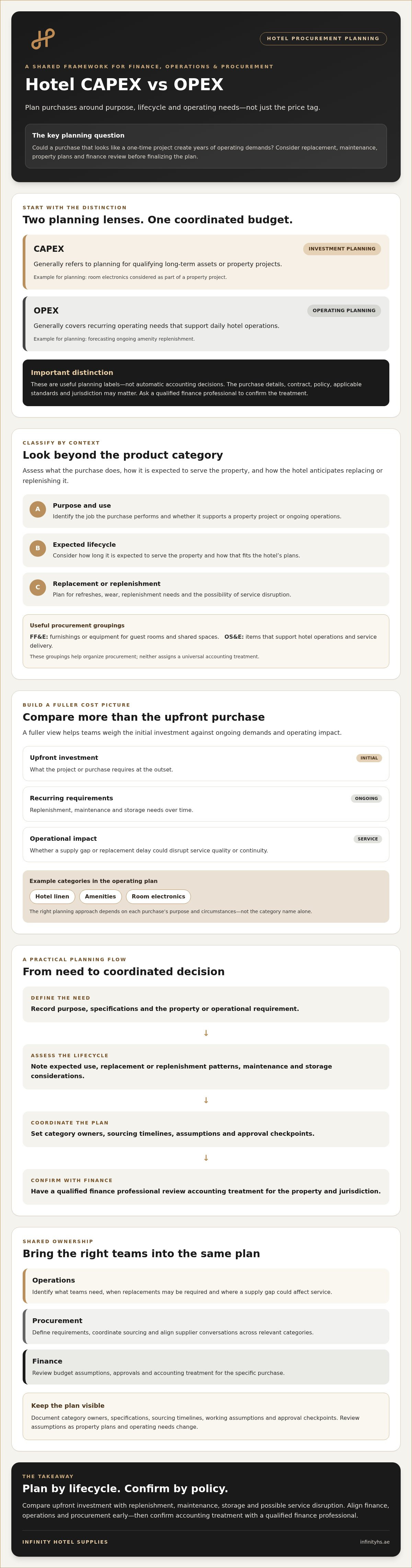
A hotel budget needs to show both what the property plans to invest in and what it needs to keep operating. CAPEX, or capital expenditure, generally refers to planning for qualifying long-term assets. OPEX, or operating expenditure, generally covers recurring operating needs. These are useful planning labels, not automatic accounting decisions.
CAPEX plans for qualifying long-term assets, while OPEX plans for recurring operating needs; the final accounting treatment depends on the purchase and the hotel’s applicable requirements. The Capital Expenditure (CAPEX) overview provides general background, but it can’t determine how a specific hotel purchase should be recorded.
For a brief visual overview of the terms, watch:
How CAPEX and OPEX differ in a hotel budget
In budget discussions, CAPEX can help teams plan for qualifying long-term assets or property projects. OPEX can help them plan for recurring requirements that support daily operations. For example, a team might include room electronics in a property project plan while forecasting ongoing amenity replenishment. These examples guide planning, but neither category has a universal accounting treatment.
Keep the distinction clear: a budget label is a working assumption, while accounting classification is a decision for the hotel’s finance team. Policy, applicable accounting standards, contract terms, and the details of the purchase may all matter. Before finalizing the budget or reporting, ask a qualified finance professional to confirm the treatment for the property’s jurisdiction.
Why procurement planning needs both finance and operations
Purchasing decisions affect guest experience, operating continuity, and financial controls. Operations can identify what teams need, when replacements may be required, and whether a supply gap could disrupt service. Procurement can define requirements and coordinate sourcing. Finance can review budget assumptions, approvals, and accounting treatment.
Without agreed ownership, teams may submit duplicate requests or miss replacement needs until they become urgent. In hotel CAPEX vs OPEX procurement planning, align decision owners before sourcing begins. Record the working budget category, who validates it, and when assumptions will be reviewed. For example, operations can confirm the rooms and specifications for a room electronics requirement, while finance checks how the proposed purchase should be treated. This creates a more coherent plan without confusing purchasing coordination with accounting advice.
Classify Hotel Procurement Needs by Use, Lifecycle, and Replacement Pattern
Start by recording the job a purchase performs, how long it is expected to serve the property, and how the hotel anticipates replacing or replenishing it. FF&E and OS&E are useful procurement groupings, but neither determines accounting treatment by itself. A purchase for a development, renovation, or room refresh may be planned differently from a recurring requirement for ongoing operations. Finance should review the specific details before the hotel finalizes its classification.
The same product category can receive different accounting treatment depending on its purpose, use, contract, and the property’s applicable policies. Use the matrix below to clarify planning responsibilities, not to assign a universal CAPEX or OPEX label.
| Category | Operational purpose | Replacement considerations | Budget owner | Finance review |
|---|---|---|---|---|
| FF&E | Furnishes or equips guest rooms and shared spaces | Assess project scope, expected use, and refresh plans | Development, project, or property team | Review purchase details and applicable policy |
| OS&E | Supports hotel operations and service delivery | Consider wear, usage, and replenishment needs | Department or operations lead | Confirm treatment for the specific purchase |
| Linen | Supports room readiness and guest service | Plan around usage, condition, and replacement needs | Housekeeping or procurement lead | Review budget assumptions and classification |
| Amenities | Provides guest-use items during the stay | Forecast consumption and replenishment | Rooms or procurement lead | Review the property’s accounting treatment |
| Room electronics | Supports in-room functions and guest experience | Consider expected use, maintenance, and refresh timing | IT, rooms, or project lead | Assess the purchase and relevant contract terms |
Review FF&E and OS&E in context
For each requirement, record whether it serves a development, renovation, room refresh, or ongoing operation. Then note who owns the need and what information finance needs to review. The article Operational Supplies and Equipment (OS&E): The Essential Guide for Hotel Operations in 2026 offers further context on OS&E in hotel operations. This approach makes hotel CAPEX vs OPEX procurement planning more specific without treating category names as accounting rules.
Plan recurring supplies around service continuity
Linen and amenities require attention to usage and replenishment; room electronics call for planning around expected use and replacement needs. These operational considerations help teams avoid gaps, but they don’t settle accounting classification. For linen sourcing considerations, consult The Comprehensive Guide to Sourcing Premium Hotel Linen in the UAE. Use the property’s own requirements to assess quantities, replacement assumptions, storage, and supply planning.
Coordinate category owners and finance review before sourcing discussions advance. A clear requirements brief helps suppliers understand the property’s needs, while a qualified finance professional confirms accounting treatment.
Compare Hotel CAPEX and OPEX Decisions Beyond the Initial Purchase
The purchase price is only one part of a hotel’s decision. Compare the item’s expected use, replenishment or replacement needs, maintenance, storage, and the operational impact of buying or replacing it. A lower initial outlay may not be a better overall fit, and neither CAPEX nor OPEX is automatically the cheaper route.
Which lifecycle factors should hotel teams compare?
Use property records and operating plans rather than generic benchmarks. For linen, review usage patterns, condition, storage capacity, and replenishment needs. For room electronics, consider expected use, maintenance responsibilities, and how replacement work could affect guest rooms. For a renovation or opening, align purchasing and delivery assumptions with the project schedule and continuity requirements.
Separate verified inputs from estimates. Record known quantities, specifications, current replacement patterns, and confirmed delivery assumptions as measurable inputs. Mark expected usage, future maintenance, or possible disruption as assumptions, then label resulting projections for finance review. This makes uncertainty visible instead of presenting estimates as settled facts.
| Comparison area | Operational value | Procurement timing | Risk to assess | Decision owner |
|---|---|---|---|---|
| Initial outlay and expected use | Shows how the purchase supports guest service or property operations | Align with budget approval and project milestones | Unverified quantities or assumptions about useful life | Budget owner with finance review |
| Replenishment and replacement | Helps maintain supply or room readiness | Plan around observed usage and replacement triggers | Stock gaps or premature replacement | Department lead |
| Maintenance and quality | Supports consistent performance and guest experience | Confirm responsibilities before selecting a proposal | Unclear service expectations or inconsistent quality criteria | Operations with procurement input |
| Storage and handling | Checks whether goods can be received and managed effectively | Coordinate delivery with available space and staffing | Insufficient storage or added handling demands | Property operations |
| Service disruption | Protects continuity during opening, refresh, or replacement | Schedule around occupancy and work windows | Room downtime or interruption to daily operations | Project or operations lead |
How to make supplier proposals easier to evaluate
Give each supplier the same specifications, quantities, delivery assumptions, and quality criteria. Ask proposals to clarify sourcing, quality-control, and logistics responsibilities so the team can compare like with like. Document exceptions and unresolved assumptions, then send relevant projections to finance for review. For broader context on coordinating hotel purchasing decisions, see Hospitality Procurement Solutions: A Strategic Guide for 2026. A disciplined comparison strengthens hotel CAPEX vs OPEX procurement planning without assuming that one budget route always costs less.
Build a Hotel CAPEX vs OPEX Procurement Plan Step by Step
A useful plan turns property priorities into reviewed, comparable purchasing decisions. For hotel CAPEX vs OPEX procurement planning, move from operational need to finance validation before committing to a sourcing route. Keep a record of what the team knows, what it assumes, and who must approve each decision.
Set priorities, define requirements, assign owners, validate budget and accounting assumptions, compare supplier proposals, then confirm approvals and timing. This sequence gives finance, operations, and procurement a shared reference without relying on unsupported deadlines or savings estimates.
Gather requirements before requesting supplier proposals
Start with the property scope: identify the rooms or facilities affected, required quantities, operating priorities, and intended timing. For an opening or renovation, connect purchasing needs to project milestones. For ongoing operations, document the need and any continuity considerations.
Separate essential specifications from preferences. This helps suppliers respond to a consistent brief and makes proposals easier to compare. Before evaluation, clarify who will coordinate delivery, review quality, and handle questions across departments. For example, a room electronics brief should state which rooms the products serve, the property’s specifications, and the planned purchasing window. Keep unresolved assumptions visible rather than leaving them implicit.
Set governance, approval, and review checkpoints
Assign a named owner for each category and define the review roles. Operations can confirm the practical need and specifications; procurement can coordinate sourcing; finance can validate budget availability and accounting classification. Document who approves the supplier decision and when each review must happen in relation to project or operating milestones.
- Property priorities: Record the project scope, operational need, and service-continuity requirements.
- Category brief: Capture quantities, essential specifications, timing, and delivery and quality-control responsibilities.
- Finance validation: Identify estimates and assumptions, then ask a qualified finance professional to review classification and budget treatment.
- Proposal review: Compare responses against the same requirements and note exceptions for approval.
- Local requirements: Verify relevant accounting, tax, import, and reporting considerations for the specific jurisdiction with qualified advisers.
For projects across the GCC, Middle East, or Africa, don’t assume requirements are identical between countries. Record which jurisdiction applies to the property and transaction, then complete the relevant checks before final approval. This keeps the plan specific to the hotel instead of relying on broad regional assumptions.
Before sourcing begins, make sure the plan identifies decision owners, timing, specifications, assumptions, and approval checkpoints. A coordinated supplier discussion can help clarify product requirements across categories, but it doesn’t replace finance or jurisdiction-specific professional review.
Coordinate Hotel Procurement with a Supplier That Understands Property Needs
A clear internal plan gives supplier conversations a stronger starting point. Category coordination can be useful when a hotel is sourcing several types of products for one property, opening, renovation, or refresh. It gives teams a practical way to communicate requirements across categories while keeping finance, operations, and sourcing responsibilities distinct.
Infinity Hotel Supplies is a Dubai-based hospitality supplier, founded in 2014, offering hotel products and FF&E and OS&E solutions. Its range includes hotel linen, amenities, uniforms, accessories, and room electronics. Coordinating discussions across relevant categories can help hotels organize sourcing requirements, but the hotel’s finance team remains responsible for confirming CAPEX or OPEX treatment.
What to clarify with a hotel supply partner
Prepare a concise brief before starting a sourcing conversation. Include the property type and project stage, product categories, required quantities, specifications, and timing. Separate confirmed requirements from open questions so the supplier can understand the hotel’s needs and which details still need internal agreement.
Clarify responsibilities, too. Ask how sourcing, quality-control steps, and logistics responsibilities will be communicated, and identify the hotel contact who will manage questions or decisions. For electronics, describe the intended use and relevant property requirements. Don’t assume that specifications for one property or project automatically apply to another.
Turn a planning framework into a sourcing conversation
Bring operations and procurement decision-makers into the discussion with finance’s review process already defined. A supplier can clarify product requirements and sourcing considerations, while the hotel team assesses proposals against its specifications, timing, and approval checkpoints. Keep accounting questions with a qualified finance professional.
- Property context: Share the hotel type, project stage, and operational priorities.
- Category needs: List products, quantities, specifications, and required timing.
- Responsibilities: Clarify sourcing, quality-control, and logistics roles.
- Internal review: Identify who approves requirements and validates accounting treatment.
This approach connects hotel CAPEX vs OPEX procurement planning to property needs without asking a supplier to make financial decisions. Discuss relevant hotel product and FF&E or OS&E requirements with Infinity Hotel Supplies, while keeping accounting review with the hotel’s finance team.
Make Your Next Hotel Procurement Plan More Cohesive
Strong hotel CAPEX vs OPEX procurement planning starts with the property’s operational priorities, then considers each purchase across its expected use, replacement needs, and lifecycle. A shared framework helps finance, operations, and procurement align assumptions, compare requirements beyond the initial outlay, and coordinate sourcing around project and service needs.
Keep budget planning distinct from accounting classification. Document specifications, owners, timing, and approval checkpoints, then ask a qualified finance professional to confirm the appropriate treatment for the property and jurisdiction.
Infinity Hotel Supplies has offices in the UAE, China, and the United Kingdom and offers hotel products and turnkey solutions across FF&E and OS&E. Coordinated supplier discussions can help clarify product requirements across relevant supply categories, while financial decisions remain with the hotel’s finance team.
Frequently Asked Questions
What is the difference between CAPEX and OPEX in a hotel?
In a hotel, CAPEX planning generally covers qualifying longer-term assets, while OPEX planning covers ongoing operating needs. These labels help teams organize budgets, but they don’t automatically determine how a purchase is recorded. The final accounting treatment depends on the hotel’s applicable policies, accounting standards, contract terms, and circumstances. Ask the finance team or a qualified adviser to confirm the classification for the specific purchase.
Are hotel furniture and equipment always classified as CAPEX?
No, a product category doesn’t automatically determine accounting treatment. The purchase’s purpose, the hotel’s applicable accounting policy, contract structure, and property circumstances may all affect how it’s classified. FF&E is a procurement grouping, not a guarantee that every item belongs in CAPEX. Before finalizing a budget or recording a purchase, share the relevant details with the hotel’s finance team or a qualified finance professional for review.
Can hotel linen be treated as OPEX?
Hotel linen is a recurring operational supply for many hotel teams, but that doesn’t establish a universal accounting rule. The property’s policy, materiality thresholds, intended use, and applicable requirements may affect its treatment. For planning, document expected usage and replacement assumptions, then ask finance to confirm the appropriate classification for the specific property and purchase. This helps teams budget for operational needs without treating a planning label as an accounting decision.
How should hotels compare CAPEX and OPEX procurement options?
Compare each option by operational purpose, expected use, replenishment, maintenance, storage, delivery, and service-continuity implications. In hotel CAPEX vs OPEX procurement planning, use consistent specifications and quantities across supplier proposals, and document which inputs are known versus estimated. The lowest initial purchase amount alone doesn’t establish the best lifecycle decision. Ask finance to review projections and confirm accounting treatment; don’t assume either budget route will always cost less.
What should a hotel procurement plan include?
A hotel procurement plan should capture property requirements, product specifications, quantities, timing, budget owners, finance review, approval checkpoints, and supplier responsibilities. It should also record assumptions and name who validates accounting treatment. For projects across the GCC, Middle East, or Africa, confirm applicable accounting, tax, import, and reporting requirements for the relevant country with qualified advisers. Don’t rely on generalized regional guidance for a property-specific decision.
How do hotels plan procurement for a new opening or renovation?
For an opening or renovation, align product requirements with project scope, operational priorities, delivery sequence, and the planned opening or work schedule. Bring finance, procurement, operations, and project stakeholders together early so requirements and approvals are coordinated. Document sourcing and logistics assumptions, including responsibilities and unresolved timing questions. This supports a more dependable plan without relying on invented lead times or assuming delivery can be guaranteed.
Does a hotel supplier decide whether a purchase is CAPEX or OPEX?
No, the hotel’s authorized finance team determines accounting treatment under the property’s applicable policies and requirements. A supplier can provide product specifications, quotations, and sourcing information for finance to consider, so share relevant product and contract details during review. Supplier coordination can support purchasing conversations, but it isn’t financial or accounting advice. For projects in the GCC, Middle East, or Africa, ask qualified advisers to verify jurisdiction-specific requirements.
Discuss your hotel linen and other hotel supply requirements with Infinity Hotel Supplies.

Article by
Infinity Editorial Team
With deep expertise in hospitality product FF&E and OS&E across the Middle East and Africa, Infinity Editorial Team brings insights from Infinity Hotel Supplies, helping developers, hoteliers, and homeowners transform spaces from empty shells to fully furnished, design-ready environments.
Disclaimer
The content published by Infinity Editorial Team is intended for informational purposes only. All articles, guides, and insights are based on industry knowledge and experience in hospitality FF&E and OS&E supply across the Middle East and Africa. Infinity Hotel Supplies does not guarantee specific outcomes and recommends consulting a qualified professional for project-specific requirements.


