

What if an OS&E item looks right but still fails brand review? A sample may match the intended style yet miss a required material, finish, size, or performance detail. Hotel OS&E brand standards compliance depends on turning requirements into clear, item-level specifications and documenting approvals before an order is placed.
That’s a familiar challenge for hotel project teams. Brand requirements may sit across several documents, while procurement, operations, suppliers, and brand reviewers interpret them differently. The result can be rejected samples, unapproved substitutions, or rework close to opening.
This practical checklist brings those requirements into a traceable process. It explains how to record each item’s specification, responsible owner, approval status, and delivery check; compare supplier proposals against consistent criteria; and flag unresolved decisions before they affect ordering or opening. It also clarifies how a supplier can support documented standards while final approval remains with the hotel brand’s authorized reviewer.
Key Takeaways
- Check the project’s current brand documents before defining OS&E requirements. Standards can vary by property and project.
- Build a requirements register that links each item to its source, specification, owner, approval status, and supporting evidence.
- Assess hotel OS&E brand standards compliance separately from supplier factors such as availability, lead time, logistics, and operational suitability.
- Use staged checks before ordering, before shipment, at receipt, and during handover to catch discrepancies and document exceptions.
- Coordinate supplier input across OS&E categories, while keeping final brand approval with the hotel’s authorized reviewer.
What hotel OS&E brand standards compliance means in practice
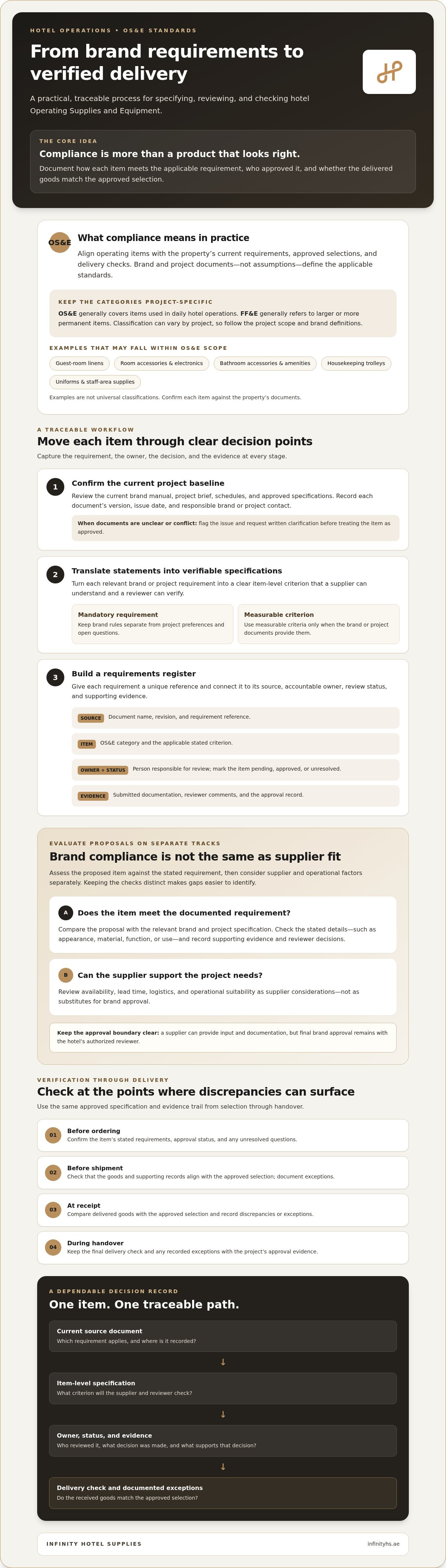
For hotel teams, hotel OS&E brand standards compliance means more than choosing items that look consistent with the property’s identity. It means documenting how each item meets the applicable requirement, who approved it, and whether the delivered goods match the approved selection.
OS&E, or Operating Supplies and Equipment, generally covers items used in daily hotel operations. FF&E, or Furniture, Fixtures and Equipment, generally refers to larger or more permanent items. The boundary can vary by project, so follow the definitions in the project documents rather than assuming every hotel classifies items the same way.
This short introduction from Marriott International Procurement offers context on OS&E terminology:
Featured snippet definition: OS&E brand standards compliance is the documented alignment of hotel operating items with current property requirements, approved selections, and delivery checks.
That traceability supports a consistent guest experience, a core aim of brand management. It also helps teams find gaps before ordering or opening. A product description alone may not show whether an item meets requirements for appearance, material, function, or use.
Which hotel items may fall within OS&E scope?
Start with how an item will be used, then confirm its category against the property’s documents. Examples may include guest-room linens, room accessories and electronics, bathroom accessories and amenities, housekeeping trolleys, and uniforms or other staff-area supplies. For instance, a hotel linen specification might document required characteristics, while fixed room furniture may sit under FF&E. These examples aren’t universal classifications. Follow the project’s scope and brand definitions.
Which documents should teams check first?
Review the current brand manual, project brief, schedules, and approved specifications. Record each document’s version, issue date, and responsible brand or project contact so reviewers are working from the same information. If requirements are missing, conflict, or leave a detail open to interpretation, flag the issue and request written clarification before treating an item as approved.
A brand manual may set broad expectations, while project documents explain how those expectations apply to a specific property. Build compliance from that project-specific record, not from assumptions or a single universal OS&E rulebook.
How to turn hotel brand requirements into OS&E specifications
Translate each relevant statement in the brand and project documents into a requirement a supplier can understand and a reviewer can verify. Keep mandatory brand rules separate from project preferences and open questions. A preference may guide selection, but it shouldn’t be presented as a binding standard unless the project documents say so.
Traceability rule: Every OS&E requirement needs a source and an approval record so the team can verify what was specified, who reviewed it, and what decision was made.
Build an OS&E requirements register
Give each requirement a unique reference, then link it to the document title, revision, and relevant section. Record the item, criterion, accountable owner, status, and evidence. Use measurable criteria only when the brand or project documents provide them. If a requirement is unclear or conflicts with another instruction, record the question and assign it for written clarification rather than filling the gap with an assumption.
A practical register can include:
- Source: Document name, revision, and requirement reference.
- Item and criterion: The OS&E category and applicable stated requirement.
- Owner and status: The person responsible for review and whether the item is pending, approved, or unresolved.
- Evidence and decision: Submitted documentation, reviewer comments, and approval record.
This structure distinguishes confirmed requirements from preferences and items still awaiting a decision. Research from Cornell University's Center for Hospitality Research can also inform how teams assess the value of particular brand standards, including those related to amenities, alongside project-specific requirements.
Create supplier-ready item specifications
For each item, state the approved category, intended use, required attributes drawn from the project documents, and evidence needed for acceptance. Depending on the requirement, that evidence might include a sample, technical document, or finish reference. Keep proposed alternatives separate from the approved specification. A similar-looking substitute is not automatically compliant. Submit it for review and record the decision before treating it as an accepted option.
Use this five-step workflow to move from documents to a controlled specification:
- Extract each relevant requirement and cite its source.
- Assign an accountable owner and authorized reviewer.
- Specify the item and required attributes without adding unsupported criteria.
- Verify supplier evidence against the documented requirement.
- Record approval, rejection, or a request for clarification in the register.
This record supports hotel OS&E brand standards compliance by giving procurement, operations, suppliers, and brand reviewers a shared reference. For a project involving several OS&E categories, review the project scope with Infinity Hotel Supplies.
How to compare OS&E proposals without losing brand compliance
Compare every proposed item against the same documented criteria, not just against competing supplier offers. Keep brand conformity separate from commercial and operational considerations. An item may meet the recorded requirements but differ in lead time, availability, logistics, or operational fit. Those factors matter, but they don’t turn an unapproved item into a compliant one.
Use a comparison record for each item with these fields:
- Requirement: Cite the relevant criterion and document revision.
- Proposed item: Identify the supplier’s exact item or submission.
- Evidence: Link the specification, sample, or product document reviewed.
- Deviation: State what differs from the requirement, or record “none identified.”
- Reviewer and decision: Name the reviewer and record the decision and date.
This format makes gaps visible across proposals and provides a clearer basis for documenting how proposed items comply with the hotel's 'brand standards' in project agreements and review records. A supplier’s assurance, catalogue image, or sample can support a review, but none replaces the required evidence and authorized decision.
What evidence supports an OS&E approval?
Match evidence to the specific requirement. A sample may help a reviewer assess a visual attribute, while a product specification may document other stated characteristics. Confirm the required evidence with the brand team rather than assuming one set will suit every item or project. Record feedback and approval status against the exact item and document revision, so a later proposal isn’t mistaken for the one reviewed.
How should teams assess substitutions and deviations?
Compare an alternative against every affected criterion, not only its general category. Record relevant visual, operational, compatibility, and delivery implications. Preserve the original requirement, identify the impact of the deviation, and name the person authorized to decide. Keep the alternative pending until written approval is documented. A supplier’s proposed substitute is not automatically accepted.
For example, if an alternative differs from an approved item, document the affected requirement, supporting evidence, likely project impact, decision owner, and written outcome. Then assess availability, lead time, logistics, and operational suitability as separate comparison factors. This keeps hotel OS&E brand standards compliance clear while allowing the team to evaluate practical trade-offs.
Hotel OS&E compliance checklist for ordering, delivery, and handover
Approval is only one control point. To maintain hotel OS&E brand standards compliance, carry the approved item record through ordering, shipment, receipt, placement, and operational handover. Assign an owner for each check and record exceptions rather than relying on verbal updates.
- Before placing and releasing orders: Confirm that the specification, quantity, finish reference, and document revision match the approved record. Resolve open deviations and record who authorized each accepted exception. Agree with the relevant project stakeholders who will coordinate delivery and inspect the goods, and clarify what evidence they’ll use.
- Before shipment: Check available shipment details against the approved item and order records. Confirm the items being sent, quantities, and any documented changes. If a substitution or discrepancy appears, pause the affected approval or release decision until the authorized reviewer records an outcome.
- At receipt: Compare delivered goods with the approved specification and order quantities. Check condition and note shortages, damage, or differences from the approved item. Capture evidence, such as a written description or photographs, in line with the project’s review process.
- At installation or placement: Where applicable, verify that the correct approved items have reached their intended locations. Record any mismatch, incomplete placement, or accepted exception against the relevant item reference.
- At operational handover: Give the operations team relevant product documents and care information, along with any open actions and their owners. Close the compliance record only after required reviews and corrective actions have been documented.
Keep a single issue log from order through handover. For each issue, record the item reference, description, supporting evidence, accountable owner, due date, resolution, and closure confirmation. This makes responsibility clear and helps prevent discrepancies from disappearing between project teams.
For example, if a received item differs from its approved finish reference, log the item and evidence, assign the review to the authorized contact, and document whether the team will accept it, request correction, or seek another approved resolution. Don’t close the issue until the decision and any required action are recorded.
This checklist works best when the hotel, supplier, and project stakeholders agree in advance on delivery coordination and inspection responsibilities. The brand or its authorized reviewer remains responsible for approval decisions. Delivery checks confirm what arrived against those decisions.
How a hotel supply partner can support OS&E standards compliance
A hotel supply partner may help coordinate sourcing across OS&E categories, organize item information, and clarify how proposed goods relate to documented requirements. This can help procurement, operations, project teams, and suppliers work from consistent specifications and records. The partner supports the process, but doesn’t define the hotel’s standards or grant brand approval. That responsibility stays with the brand or its authorized reviewer.
For hotel OS&E brand standards compliance, confirm the partner’s role before work begins. Ask how they’ll record specifications, sample submissions, proposed changes, reviewer feedback, and final decisions. Clarify which sourcing, quality-control, and logistics activities are included in the project scope, who performs them, and how discrepancies and corrective actions will be reported. Get these responsibilities in writing instead of assuming they’re part of a general supply arrangement.
What to ask a potential OS&E sourcing partner
Use these questions to establish a clear working process:
- How will each item be linked to its specification, source document, revision, and approval status?
- How will samples, supporting documents, substitutions, and changes be submitted and tracked?
- Which sourcing, quality-control, and logistics tasks are included, and which remain with the hotel or other project stakeholders?
- How will the team document a discrepancy, assign an owner, and track corrective action through closure?
Clear answers help the hotel assess whether the proposed support fits the project. They also establish that supplier review and coordination don’t replace the brand’s formal approval process.
Prepare a project brief before requesting support
Bring together the current brand documents, OS&E schedules, project location, and relevant opening milestones. Identify priority categories, known constraints, approval contacts, and unresolved decisions. For projects across the GCC, wider Middle East, or Africa, confirm location-specific delivery arrangements and stakeholder responsibilities with the project team. This gives a potential partner a defined basis for discussing scope, evidence needs, and coordination.
Infinity Hotel Supplies is a Dubai-based hospitality supplier founded in 2014, with OS&E solutions and categories that include hotel linen, room electronics, amenities, uniforms, and accessories. Its turnkey project support can include sourcing, quality control, and logistics management. Confirm which categories, activities, and deliverables apply to the specific project; verify scope before making commitments.
For an overview of the contact options, visit Infinity Hotel Supplies’ contact page.
Make every OS&E decision traceable
Strong hotel OS&E brand standards compliance starts with current, property-specific requirements and continues through approved specifications, supplier evidence, delivery checks, and operational handover. A shared register helps teams compare proposals consistently, assign decisions to the right reviewers, and document exceptions before they become costly surprises.
A supply partner can support sourcing and coordination across relevant OS&E categories, but final brand approval remains with the hotel’s authorized reviewer. Infinity Hotel Supplies is a Dubai-based hospitality supplier founded in 2014, with offices in the UAE, China, and the United Kingdom. Its project support can include sourcing, quality control, and logistics management. Confirm which activities and scope apply to your project.
With clear ownership, documented decisions, and checks at each stage, your team can move toward opening with greater clarity and confidence. To discuss OS&E requirements for a hotel project in the GCC, Middle East, or Africa, contact Infinity Hotel Supplies.
Frequently Asked Questions
What does hotel OS&E brand standards compliance mean?
Hotel OS&E brand standards compliance means checking that operational supplies and equipment meet the documented requirements for a specific hotel project. Teams should connect each item to its source requirement, record its proposed specification and supporting evidence, and retain the relevant approval. The applicable brand documents and project scope define what’s required. There isn’t one universal checklist that automatically applies to every property.
What is included in hotel OS&E?
OS&E generally covers operational supplies and equipment used to run a hotel, while FF&E commonly refers to furniture, fixtures, and equipment. The boundary between categories can differ across brands and projects. Check the project’s definitions and schedules to establish what falls within scope. If an item’s classification is unclear, ask the brand or project reviewer to confirm before procurement proceeds.
How do you create an OS&E compliance checklist?
Start with the current brand standards and project schedules, then create a register for each requirement. Record its source, revision, relevant item, accountable reviewer, required evidence, and approval status. Include fields for deviations, decisions, and closure. This turns a generic list into a project-specific tool, helping teams track hotel OS&E brand standards compliance and identify unresolved questions before ordering.
Who approves hotel OS&E brand standards?
Approval roles depend on the brand, project governance, and contract arrangements. Identify the authorized reviewer for each category and record their decision against the relevant item. Suppliers can provide specifications, samples, and other requested evidence, but they shouldn’t be treated as the authority on whether an item meets brand requirements. Confirm who can approve selections and deviations at the start of the project.
Can a hotel substitute an OS&E item after approval?
A proposed substitution should be treated as a deviation, not an automatic approval. Compare it with the original requirements, document relevant visual or operational differences, and submit it to the authorized reviewer. Keep the decision and supporting evidence with the item record. Don’t describe the substitute as compliant until the required project approval has been recorded.
What documents should a hotel request from an OS&E supplier?
Request the evidence required by the project, which may include item specifications, samples, finish references, or relevant product documents. Link each submission to the exact item and current requirement, and record reviewer feedback and status. Evidence needs vary by brand and project, so confirm the required documents with the authorized reviewer instead of assuming one standard package will suit every OS&E category.
How can hotels manage OS&E compliance across GCC and Middle East projects?
Use a consistent requirements register and approval workflow, but confirm the project-specific documents, delivery arrangements, and stakeholder responsibilities for each property. Don’t assume requirements for one location automatically apply to another. Keep item evidence, brand decisions, and approved deviations accessible to procurement, operations, and project teams. For hotels across the GCC, wider Middle East, and Africa, confirm location-specific details with the relevant project stakeholders.

Article by
Infinity Editorial Team
With deep expertise in hospitality product FF&E and OS&E across the Middle East and Africa, Infinity Editorial Team brings insights from Infinity Hotel Supplies, helping developers, hoteliers, and homeowners transform spaces from empty shells to fully furnished, design-ready environments.
Disclaimer
The content published by Infinity Editorial Team is intended for informational purposes only. All articles, guides, and insights are based on industry knowledge and experience in hospitality FF&E and OS&E supply across the Middle East and Africa. Infinity Hotel Supplies does not guarantee specific outcomes and recommends consulting a qualified professional for project-specific requirements.


