

That 800-thread-count sheet promised for your luxury suites might actually be the weakest link in your operational chain. While retail marketing suggests higher numbers mean better quality, the reality of industrial laundering in 2026 tells a different story. You've likely felt the frustration of seeing expensive hotel bed sheets pill or tear before they've even hit 50 cycles. It's a difficult balance to maintain guest comfort while facing the harsh realities of desert climate laundering and global supply chain volatility.
We understand that procurement isn't just about a single transaction; it's about securing the stability of your entire property. This guide will help you master the technical specifications of commercial linens, moving beyond marketing fluff to identify the exact yarn, weave, and density required for true operational longevity. We'll examine how the June 2026 OEKO-TEX Standard 100 updates impact your sourcing and why performance-driven metrics now outweigh simple thread counts. You'll learn to calculate PAR levels that prevent shortages during peak seasons and how to partner with global suppliers who prioritize consistent regional delivery. By the end, you'll have a procurement framework that protects both your guest experience and your bottom line.
Key Takeaways
- Understand why hospitality-grade hotel bed sheets are engineered for intensive industrial laundering, ensuring they significantly outlast standard retail products.
- Identify deceptive thread count marketing and learn why single-ply yarns between 250 and 400 TC provide superior tensile strength.
- Select the most appropriate weave for your property, balancing the crisp breathability of percale with the silky elegance of sateen.
- Implement a strategic sourcing framework that uses accurate PAR level calculations to protect your inventory during peak tourist seasons.
- Leverage a global supply chain partner with regional expertise to ensure quality control and consistent delivery across the GCC and beyond.
Decoding Commercial Hotel Bed Sheets: Hospitality Grade vs. Retail Linens
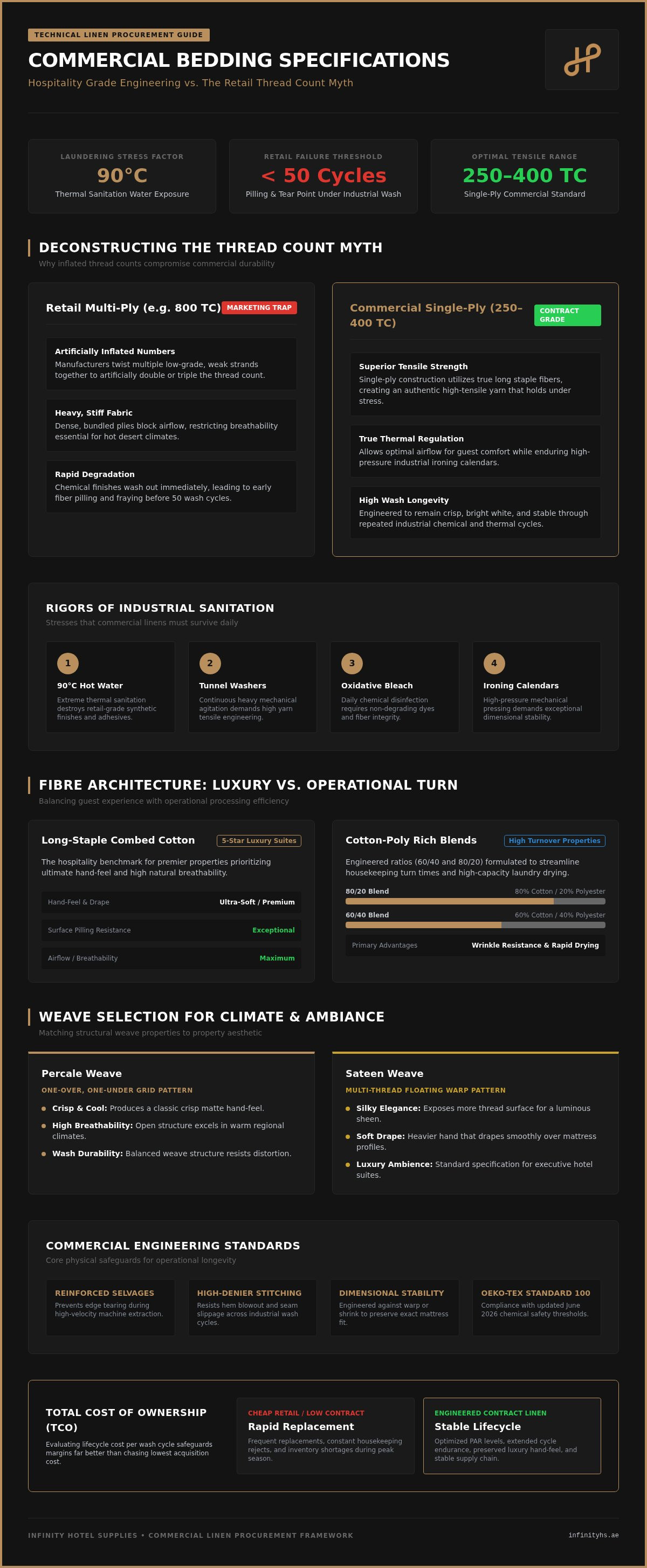
Procurement specialists often find that retail "luxury" is a liability in a commercial setting. Retail bedding prioritizes the initial hand-feel to secure a sale, but these chemical finishes often vanish after the first wash. In contrast, commercial hotel bed sheets are purpose-built to survive the rigors of industrial sanitation. They face 90-degree Celsius water, heavy pressing, and oxidative bleach daily. While consumers look at common bed sheet materials for domestic comfort, hospitality operators must prioritize tensile engineering to ensure the fabric doesn't disintegrate under pressure.
Understanding the technical gap between these categories is vital for maintaining property standards. For a deeper look at local requirements, explore our guide to sourcing premium hotel linen in the UAE to see how regional climate impacts fabric choice. To see how these professional-grade linens are handled in a real-world setting, watch this demonstration of hotel bedding efficiency:
Industrial Laundering Resistance and Tensile Engineering
Commercial textiles endure environments that would destroy standard linens within weeks. Professional Hotel Linen passes through massive tunnel washers and high-pressure ironing calendars that subject the fabric to intense mechanical stress. We ensure these products feature reinforced selvages and high-denier stitching to combat this. These technical additions resist fraying along the perimeter hems, which is where cheaper alternatives usually fail first. True commercial sheeting retains its dimensional stability, meaning it won't shrink or warp, ensuring a perfect fit after every laundry cycle.
Total Cost of Ownership vs. Initial Unit Acquisition Price
It's tempting to focus solely on the unit price, but that's a short-sighted strategy for any property manager. Low-cost linens frequently fail within 50 cycles, forcing properties into a constant, expensive cycle of replacement. Evaluating the lifecycle cost per wash cycle is the only way to safeguard your operating margins. High-performance contract linens protect the guest experience by remaining crisp and white for longer. They also reduce the labor costs spent by housekeeping staff who must constantly inspect and reject pilled or torn sheets. Investing in durability isn't just a quality choice; it's a pragmatic business decision that stabilizes your supply chain.
Technical Bedding Specifications: Fibres, Weaves, and the Thread Count Myth
Sophisticated hospitality procurement requires a departure from retail marketing myths. While domestic consumers are taught to chase high thread counts, professional buyers know these figures are often inflated through multi-ply yarn construction. Manufacturers twist multiple low-grade strands together to artificially double or triple the count. This results in heavy, stiff hotel bed sheets that lack the breathability required for a restful sleep experience. Genuine quality is found in the staple length of the fibre and the precision of the weave rather than a bloated number on a package.
Long-Staple Cotton vs. Cotton-Poly Rich Blends
The choice of fibre dictates both the guest experience and your property's operational efficiency. Long-staple combed cotton is the industry standard for five-star luxury suites because it delivers a superior hand-feel and exceptional breathability. Its long fibres create a smooth surface that resists pilling, even after hundreds of cycles. For high-turnover properties or mid-scale flags, cotton-poly rich blends (typically 60/40 or 80/20) offer a pragmatic alternative. These blends significantly enhance wrinkle resistance and improve drying efficiency, which directly impacts your utility overhead. By following established textile manufacturing standards, we ensure that every batch of Hotel Linen meets rigorous safety and quality benchmarks.
The 250 to 400 Thread Count Commercial Sweet Spot
Exceeding a 400 thread count is often counterproductive in a commercial environment. A weave that is too dense restricts airflow, leading to a "hot" sleep for the guest. More importantly, ultra-dense fabrics trap chemical residues and minerals during the laundering process. This eventually causes the fabric to become brittle and grey. The commercial sweet spot lies between 250 and 400 thread count using single-ply yarns. A 300 thread count construction provides optimal softness while maintaining the structural density needed for industrial pressing. This balance ensures the warp-and-weft tension remains stable, preventing premature thinning or "balding" of the fabric under mechanical stress. It's this level of meticulous detail that separates a standard supplier from a dedicated partner.
If you need assistance aligning these technical specs with your brand's tier requirements, you can reach out to our procurement experts for a detailed consultation.
Percale vs. Sateen: Selecting the Ideal Weave for Regional Climates
Selecting the right weave for hotel bed sheets is a strategic decision that influences guest comfort and laundry efficiency. While aesthetics matter, the regional climate of your property should dictate your choice. In high-ambient-heat zones like the GCC, the interaction between room cooling dynamics and fabric breathability is critical. Beyond the tactile experience, procurement teams must ensure that their selections comply with federal labeling requirements for textiles to guarantee transparency in fibre content and origin. Understanding the structural differences between percale and sateen allows you to align your inventory with both environmental realities and brand standards.
Crisp Cotton Percale: Thermal Regulation for Warm Destinations
Percale utilizes a traditional "one-over, one-under" plain weave structure. This simple grid promotes continuous microscopic airflow, making it the premier choice for properties in arid or tropical climates. It delivers a cool, matte sensation that international business travellers often favor for its crispness. From an operational standpoint, percale is highly resistant to surface pilling. Its tight, uniform structure maintains integrity even after extended commercial laundry processing, ensuring the fabric feels fresh for every new arrival. If you're managing seasonal occupancy shifts, you should review our hotel linen par level calculation guide to plan your rotation effectively.
Lustrous Cotton Sateen: Draped Elegance for Luxury Suites
Sateen is defined by a "three-over, one-under" satin weave that exposes more yarn surface to the light. This construction creates a lustrous, silky sheen and a heavier drape that aligns perfectly with five-star interior design. While sateen feels exceptionally soft against the skin, it's naturally warmer than percale due to its denser weave. It also requires precise iron calibrating in the laundry. If the temperature is too high, you risk scorching the exposed surface yarns and dulling the signature luster. For luxury suites where the "wow factor" is paramount, sateen remains the undisputed standard.
Dimensional Shrinkage Control and Commercial Ironing Performance
Precision in the laundry room starts with the fabric's finish. We ensure that our Hotel Linen undergoes pre-shrunk treatments so that fitted sheets maintain precise mattress tolerances throughout their lifespan. Weave density also impacts your utility costs; denser fabrics retain more water, which can slow down industrial moisture extraction. During the final stages, flat sheets must possess balanced tensile integrity to glide smoothly through commercial ironers without snagging or distorting. Choosing a weave that matches your finishing equipment's capabilities is just as important as the guest's sleep experience.
The Strategic Sourcing Framework: 5 Steps to Procure Hotel Bedding
Securing high-quality hotel bed sheets requires more than just reviewing a catalog. It demands a systematic framework that bridges the gap between initial design intent and daily operational reality. Successful procurement teams move beyond the transaction, focusing instead on a rigorous evaluation process that ensures every piece of fabric meets the property’s long-term demands. This methodology ensures that your investment in Hotel Linen remains protected against the high-turnover nature of modern hospitality.
Step 1 & 2: Define Brand Tier Specs and Conduct Sample Testing
Precision begins with a detailed technical sheet. You shouldn't simply ask for "white sheets"; you need to specify yarn count, tear strength, and optical whiteness levels. Once these specs are set, you must subject production samples to at least twenty continuous industrial laundry cycles. This aggressive trial reveals how the fabric truly behaves. Inspect the seams and hems for fraying, and check for color retention after exposure to commercial sanitizers. If the sample doesn't maintain its structural integrity during this phase, it won't survive a single season in a busy hotel.
Step 3 & 4: Calculate Operational PAR Levels and Inspect Production
Calculating inventory needs is a critical step to prevent operational disruptions. We recommend establishing a minimum 3.5 to 4 PAR standard across all guestrooms. This buffer accounts for standard laundry turnaround times, potential remote transport delays, and emergency reserves for peak occupancy. Once the order is placed, don't wait for delivery to check quality. Enforce pre-shipment inspections at the manufacturing facilities. Verifying the batch quality before it leaves the factory floor prevents costly logistical headaches and ensures the final product matches your approved samples.
Step 5: Establish Supply Chain Continuity Across GCC and Regional Hubs
Reliability is built through regional presence. You need a partner with warehousing hubs that can guarantee rapid replenishment during unexpected demand spikes. Consolidating your linen freight alongside other guestroom amenities can significantly optimize your landed costs. This holistic approach is a core part of modern operational supplies and equipment (OS&E) standards. By verifying a supplier’s trade compliance and logistics networks across Middle Eastern borders, you ensure that your supply chain remains resilient, regardless of market volatility.
Partnering with Infinity Hotel Supplies for Turnkey Hospitality Linens
Managing the complexities of hospitality procurement requires a partner that moves beyond simple transactions. Infinity Hotel Supplies provides contract-grade hotel bed sheets engineered specifically for world-class properties. Established in Dubai in 2014, our firm has developed a robust operational footprint that bridges global manufacturing hubs with regional hospitality demands. We offer properties across the GCC, Middle East, and Africa a stable foundation for their textile requirements.
Meticulous Factory Quality Assurance and Global Sourcing Reach
True quality control cannot be managed from a distance. With multinational operations across the UAE, China, and the UK, we maintain on-the-ground manufacturing supervision directly within key production regions. Our teams conduct rigorous raw material inspections to guarantee the consistency of long-staple cotton and yarn specifications. This factory-floor oversight eliminates dimensional discrepancies and structural weaknesses before bulk shipments ever depart, ensuring your order matches your brand standards exactly.
Comprehensive OS&E and Linen Consolidation Services
Streamlining your supply chain requires a holistic approach to property inventory. You can source premium Hotel Linen seamlessly alongside our comprehensive OS&E Solutions and FF&E Solutions. Consolidating your procurement into unified shipping containers reduces regional freight overheads and minimizes import friction at regional borders. This end-to-end quality control and logistics management allows asset managers to handle complex multi-property requirements through a single, accountable point of contact.
Regional Logistical Reliability for Pre-Openings and Restocking
Timing is everything when preparing for a property launch or managing seasonal demand spikes. Our Dubai headquarters offers rapid regional support tailored to high-profile GCC hotel projects and resorts. We help properties mitigate supply chain vulnerabilities through strategic inventory forecasting and localized staging. This proactive methodology ensures that whether you're executing a major pre-opening phase or restocking for a peak tourist season, your linen program remains fully operational without disruption.
Securing Operational Excellence Through Strategic Procurement
Mastering the technical intricacies of textile procurement ensures your property delivers both guest luxury and operational durability. By moving beyond the thread count myth and focusing on performance metrics like tensile strength and weave suitability, you protect your bottom line from the high costs of premature replacement. It's clear that the right hotel bed sheets are those engineered specifically for the rigors of industrial laundering and the unique thermal demands of your regional climate. This strategic approach transforms a simple supply need into a robust asset management plan.
Infinity Hotel Supplies has served as a dedicated turnkey partner since 2014, providing comprehensive OS&E and FF&E solutions from our offices in the UAE, China, and the UK. We offer the stringent international quality control and localized GCC supply chain support necessary to navigate 2026’s logistical challenges with absolute confidence. Our commitment to meticulous detail ensures that your linen program remains a seamless, high-quality component of the guest experience for years to come.
We look forward to facilitating your next successful property opening or renovation with a focus on stability and excellence.
Frequently Asked Questions
What thread count is best for luxury hotel bed sheets?
The optimal range for luxury hospitality is between 250 and 400 thread count using single-ply yarns. While retail marketing often pushes higher numbers, these are usually inflated through multi-ply construction that reduces breathability. For properties in the GCC, a 300 thread count sateen or percale provides the perfect balance of tactile softness and industrial durability. This allows for efficient laundering without sacrificing the high-end feel guests expect from premium properties.
Why do five-star hotels predominantly choose white bed sheets?
White linens serve as a visual guarantee of cleanliness, as they don't hide stains or debris. Psychologically, white creates a "halo effect" of luxury and freshness that aligns with five-star branding. Operationally, white hotel bed sheets are easier to manage because they can be laundered together at high temperatures with oxidative bleaches without fading. This color choice simplifies inventory rotation and ensures a timeless aesthetic that complements any modern guestroom design.
How many wash cycles should commercial hotel bed sheets withstand?
High-quality commercial sheets should withstand a minimum of 200 to 300 industrial wash cycles before showing signs of structural degradation. Percale weaves often survive 20% more cycles than sateen due to their tighter, simpler construction. We ensure every batch of Hotel Linen meets these longevity standards by supervising manufacturing directly in China and the UK. This durability is essential for maintaining operational margins in high-occupancy environments across the Middle East and Africa.
What is the recommended PAR level for hotel bed sheets?
Industry best practice is to maintain an inventory level of 3.5 to 4 PAR per guestroom. This means having one set on the bed, one in the laundry, one in storage, and a backup set for emergencies or rapid turnover. Maintaining these levels prevents operational disruptions during peak tourist seasons in the GCC. It also allows the fabric fibres to "rest" between uses, which can extend the overall lifespan of your inventory.
Is 100% cotton or a cotton-polyester blend better for hotels?
The choice depends on your property's specific service model and brand tier. Five-star resorts typically opt for 100% long-staple cotton for its superior breathability and prestigious hand-feel. Conversely, mid-scale properties often prefer cotton-poly blends, such as 60/40 or 80/20, because they offer significant wrinkle resistance and faster drying times. These blends reduce utility costs and labor hours in the laundry, making them a pragmatic choice for high-turnover hospitality environments.
Can hotel bed sheets be customized to fit bespoke mattress dimensions?
Yes, contract-grade linens can be customized to accommodate non-standard mattress dimensions often found in bespoke luxury suites. As a turnkey procurement provider, we facilitate custom manufacturing that ensures fitted sheets maintain precise tolerances even after industrial shrinkage. This level of customization extends to branding, allowing properties to incorporate embroidered logos or specific hem-stitch details. We manage these technical requirements through our global offices to ensure consistency across entire regional portfolios.
How do commercial laundry chemicals impact hotel linen longevity?
Aggressive commercial chemicals, particularly oxidative bleaches and high-alkaline detergents, can eventually make cotton fibres brittle if not managed correctly. Over-bleaching or insufficient rinsing leads to chemical carryover, which causes fabric to grey and tear prematurely. It's vital to use linens engineered with high tensile strength to resist this chemical stress. Proper laundry protocols, combined with high-denier stitching, help preserve the fabric's integrity across hundreds of cycles in harsh desert climate conditions.

Article by
Infinity Editorial Team
With deep expertise in hospitality product FF&E and OS&E across the Middle East and Africa, Infinity Editorial Team brings insights from Infinity Hotel Supplies, helping developers, hoteliers, and homeowners transform spaces from empty shells to fully furnished, design-ready environments.
Disclaimer
The content published by Infinity Editorial Team is intended for informational purposes only. All articles, guides, and insights are based on industry knowledge and experience in hospitality FF&E and OS&E supply across the Middle East and Africa. Infinity Hotel Supplies does not guarantee specific outcomes and recommends consulting a qualified professional for project-specific requirements.


