

Is your property's linen inventory a strategic asset or a hidden drain on your bottom line? Many hospitality leaders view sheet counts as a basic logistical necessity, but your PAR level is actually a vital recovery period for premium cotton fibers. You've probably faced the stress of unexpected shortages during peak seasons or seen your textile investments wear thin due to aggressive laundry cycles in high-heat environments.
This hotel linen par level calculation guide delivers the precise mathematical framework needed to stabilize your inventory and protect your brand’s reputation. We promise to help you master the balance between stock availability and fabric longevity to ensure a seamless guest experience every time. We will examine the essential formulas for 2026 operations and show you how meticulous inventory planning transforms housekeeping efficiency into long-term profitability.
Key Takeaways
- Understand why PAR levels are the foundation of operational stability and how a 1-PAR standard serves as the starting point for your inventory.
- Learn the science behind the 24-hour fiber recovery rule to prevent premature fabric wear caused by high-heat commercial laundering cycles.
- Use this hotel linen par level calculation guide to determine the exact multiplier needed based on your specific laundry turnaround times and occupancy peaks.
- Identify the critical variables that influence stock requirements, including the logistical differences between on-premise and outsourced laundry services.
- Discover how turnkey OS&E solutions help new property developments maintain pristine linen standards through professional inventory planning and global sourcing.
Understanding Hotel Linen PAR Levels: The Foundation of Operational Excellence
In the high-stakes environment of luxury hospitality, operational stability begins long before a guest checks in. It starts in the linen room. PAR stands for Periodic Automatic Replenishment. At its core, this metric represents the minimum quantity of inventory required to support daily operations without interruption. This hotel linen par level calculation guide serves as more than just a logistical tool; it's a blueprint for protecting your property’s most significant Hotel Linen investment.
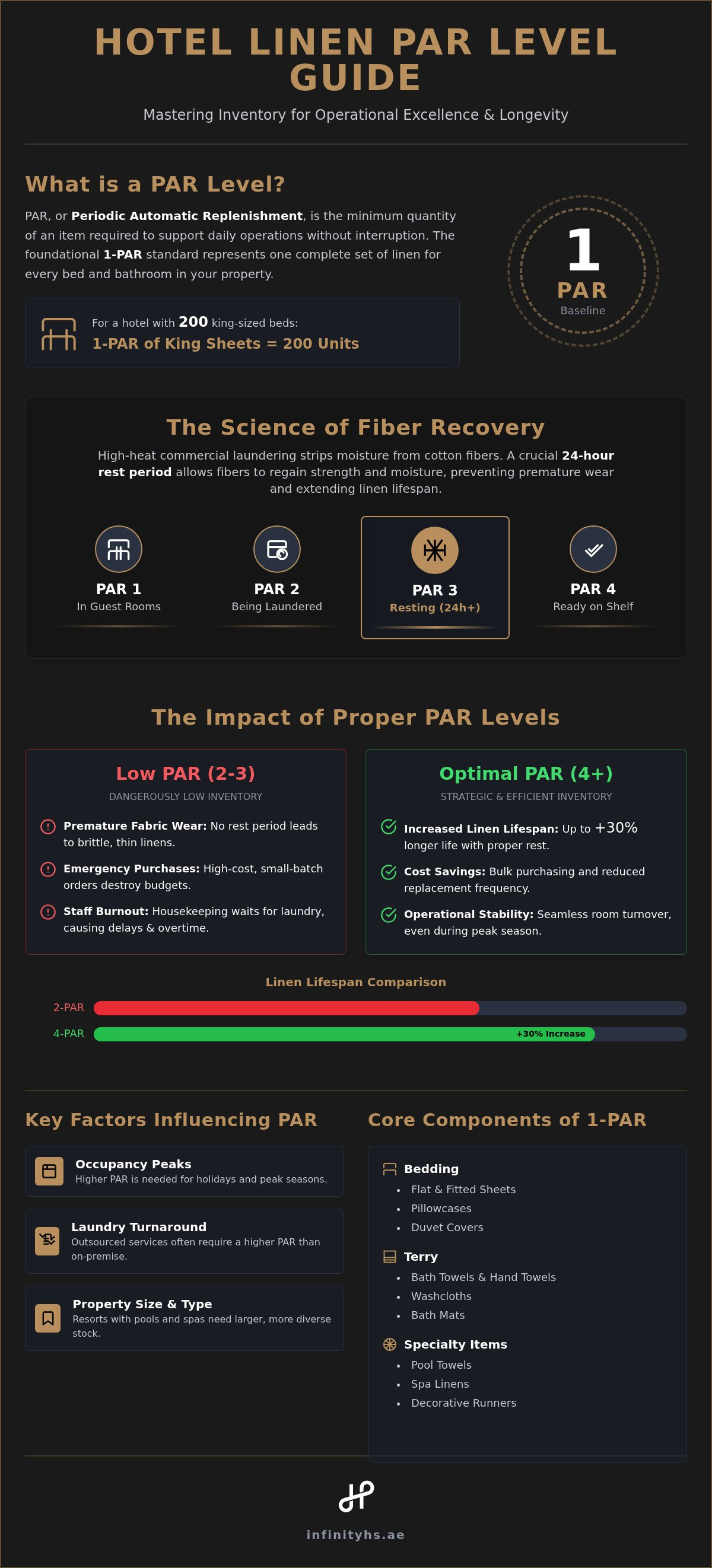
The 1-PAR baseline is the absolute starting point. It represents one complete set of linen for every bed and bathroom across the entire property. If your hotel has 200 king-sized beds, 1-PAR for king flat sheets is exactly 200 units, assuming one sheet per bed. However, a property never operates on a single PAR. Operating at such a low level would mean that as soon as a guest uses a towel, you have no replacement available while that item is in the wash.
Professional inventory management requires a clear distinction between total inventory and circulating stock. Total inventory includes every piece of linen owned by the hotel, including those sitting in long-term storage or safety stock. Circulating stock refers to the items currently moving through the "laundry loop"—on the beds, in the bins, or being processed in the machines. Maintaining the right balance ensures that your circulating stock never dips below the threshold required to flip rooms during peak check-out windows.
The Core Components of a Single PAR
To build an accurate inventory model, you must categorize every textile item. A standard 1-PAR setup typically includes:
- Bedding: Flat sheets, fitted sheets, pillowcases, and duvet covers.
- Terry: Bath towels, hand towels, washcloths, and bath mats.
- Specialty items: Pool towels, spa linens, and decorative runners.
Precision in these categories is vital. Missing a single component, such as a bath mat, can halt a housekeeper's progress just as effectively as a missing bed sheet.
Why 'Getting it Right' Impacts Your Bottom Line
Accuracy in your hotel linen par level calculation guide directly influences your financial health. Underestimating your needs leads to the "emergency purchase" trap. This forces procurement managers into high-cost, small-batch orders that bypass bulk-order savings. In competitive markets like Dubai or Riyadh, where brand standards are non-negotiable, these last-minute substitutions often fail to meet quality benchmarks.
Beyond the cost of goods, proper PAR levels protect your human capital. When stock is low, housekeeping teams spend valuable time waiting for laundry cycles to finish. This creates unnecessary downtime and leads to staff burnout. A well-stocked property allows your team to focus on the meticulous details that define a five-star guest experience rather than hunting for clean pillowcases.
The Science of the 'Rest' Period: Extending Bedding Lifecycle
Linen management involves more than just counting sheets; it requires a deep understanding of textile science. The "24-hour rule" is a non-negotiable standard for luxury properties. Cotton fibers are natural polymers that expand and contract under stress. When subjected to the rigors of commercial laundering, these fibers lose their structural integrity. Without a full day of rest to recover their shape and strength, the fabric becomes brittle. This hotel linen par level calculation guide emphasizes that resting your linens is just as vital as the washing process itself. To explore more about the scientific foundations that underpin material behavior and engineering, visit ALLEN Overseas.
Commercial washers and dryers use intense heat and aggressive mechanical agitation to sanitize bedding. This process strips natural moisture from long-staple cotton. Properties operating with dangerously low PAR levels often put "hot" linens straight from the dryer back onto the bed. This practice leads to premature thinning, pilling, and a significant loss of tensile strength. A 4-PAR level can increase linen lifespan by up to 30% compared to a 2-PAR level.
Fiber Recovery and Moisture Equilibrium
Freshly laundered items often retain microscopic levels of moisture even when they feel dry to the touch. If these items aren't allowed to reach moisture equilibrium in a climate-controlled environment, the fibers remain vulnerable to friction and tearing. In the Middle East, high humidity levels can complicate this stabilization process. Proper storage allows the cotton to "breathe" and return to its natural state. You can see our range of premium hotel linens designed for high-frequency rotation to understand how quality construction aids this recovery process.
Calculating Lifecycle ROI
Procurement managers often hesitate at the initial capital expenditure of a higher PAR. However, the long-term savings are undeniable. Investing in a 4-PAR system reduces the frequency of replacement orders by spreading the "wear and tear" across a much larger volume of stock. This approach stabilizes your annual OS&E budget and prevents the visible quality degradation that guests notice during their stay. If you need assistance determining the ideal stock levels for your specific property, consult with our inventory specialists to build a sustainable procurement strategy.
Understanding the science of fiber recovery provides the "why" behind the numbers. We must now look at the operational variables and environmental factors that dictate exactly how many sets you need in circulation to maintain these standards.
Key Factors Influencing Your PAR Requirements in 2026
While the mathematical foundation is constant, several operational variables dictate the final number in your hotel linen par level calculation guide. Occupancy fluctuations are the most immediate driver. In seasonal markets like Dubai or Riyadh, properties often swing from 60% to 100% capacity within weeks. A PAR level that suffices for mid-season will fail during a major international summit or holiday period. Strategic managers maintain a buffer to ensure that even at full occupancy, the fiber recovery period remains intact.
Laundry Turnaround Time (TAT) represents the second critical variable. If you operate an On-Premise Laundry (OPL), you might manage with a 3.5 or 4-PAR setup because you control the cycle speed. Conversely, outsourced services often require a 5-PAR minimum. This accounts for the time linens spend in transit and the processing window at the external facility. Any delay in the third-party delivery schedule can immediately compromise your room-turn efficiency if your stock is too lean.
Linen loss and damage also play a silent but significant role in inventory depletion. Staining from cosmetics, mechanical damage during high-speed extraction, and guest theft can deplete stock by significant margins annually. Many high-turnover hotels in the GCC market factor in a monthly replacement percentage to keep their circulating stock at the required levels. A 5-star resort, with its triple-sheeted beds and extensive towel menus, inherently requires a more robust PAR than a limited-service property where the linen count per room is lower.
Regional Logistics in the GCC and Africa
Managing inventory for remote resorts in the GCC or Africa presents unique challenges. Extended delivery lead times mean your safety stock must be larger to account for potential supply chain disruptions. Climate factors also influence fiber health; extreme heat and dust require meticulous storage solutions to prevent contamination of clean stock. Efficient movement of these textiles is equally important. Many operators utilize specialized housekeeping trolleys to transport bulk volumes safely from the laundry to the guest floor, reducing the risk of transit-related damage.
Specialized Linens for Spas and Pools
Pool and spa areas require a separate calculation entirely. Pool towels often stay with guests for longer periods or are left in public areas, frequently requiring a 4-5 PAR to avoid shortages. Spa linens face high-oil saturation, necessitating specialized laundering cycles that may take longer than standard bedding. Before finalizing your 2026 procurement strategy, review this checklist:
- Current average occupancy vs. peak seasonal forecasts.
- Historical linen loss and discard rates for your specific property type.
- Average laundry turnaround time (measured in hours, not days).
- Storage capacity for additional stock during peak periods.
Accounting for these variables ensures your math reflects the reality of your daily operations. Once these factors are identified, you can apply the step-by-step formula to determine your exact procurement needs.
Step-by-Step Guide: How to Calculate Your Hotel Linen PAR Level
Precision in inventory management requires a methodical approach that balances financial discipline with operational readiness. This hotel linen par level calculation guide follows a four-step process to ensure your property remains fully stocked even during peak demand. The goal is to move beyond guesswork and establish a data-driven baseline that protects your guest experience.
Step 1 begins with identifying your 1-PAR baseline. This is the total number of rooms multiplied by the specific items required per room. If your property features 250 king-sized beds and you utilize two sheets per bed, your 1-PAR for king sheets is exactly 500 units. Step 2 requires you to determine your Laundry Turnaround factor. This multiplier is dictated by whether your cycle is daily, 48-hour, or 72-hour. Longer cycles naturally require more stock to bridge the gap while items are off-site.
Step 3 involves adding the "Rest" factor. As we've analyzed, cotton fibers require a 24-hour recovery period to maintain their tensile strength and plush feel. This necessitates an additional 1-PAR dedicated solely to storage and rotation. Finally, Step 4 incorporates a 10-15% buffer. This safety margin accounts for inevitable linen loss, permanent staining, and emergency occupancy spikes that occur without warning.
The Standard 3-PAR Formula
For many properties with efficient on-premise laundry systems, the 3-PAR formula remains the traditional minimum. This setup allocates inventory into three distinct locations to maintain a continuous flow:
- Set 1: In the guest rooms, currently in use by staying guests.
- Set 2: In the laundry, consisting of soiled items being processed or transported.
- Set 3: In the linen closet, resting and ready for the next room change.
While this works for standard operations, it leaves very little room for error if a machine breaks down or a delivery is delayed.
Advanced Calculation for High-Turnover Properties
Luxury hotels in the UAE and across the GCC often adopt a 4-PAR or 5-PAR "Gold Standard." This is particularly critical when preparing for major international events such as COP or regional holidays that drive 100% occupancy. For example, consider a 200-room property with a 3-day laundry turnaround. You would require 1-PAR for the beds, 3-PAR to cover the three days the linen is in the laundry loop, and 1-PAR for storage and rest. This results in a 5-PAR requirement.
For a room requiring 2 sheets, this calculation looks like this: 200 rooms x 2 sheets x 5 PAR = 2,000 sheets. Adding a 15% buffer (300 units) brings your total procurement requirement to 2,300 sheets. This level of preparedness ensures that your housekeeping team never faces a shortage during high-pressure turnaround windows.
Mastering these calculations allows you to transition from reactive ordering to strategic procurement. The final step in this manual explores how a global partner can help you execute this strategy through high-quality sourcing and turnkey solutions.
Strategic Procurement: Partnering for Sustainable Linen Management
Mathematical accuracy in your hotel linen par level calculation guide ensures you have enough stock, but the quality of that stock determines how often you must revisit those calculations. Partnering with a global procurement expert allows properties to verify thread count standards and fabric durability at the source. This is particularly vital for luxury properties where guest expectations for tactile excellence are non-negotiable. Infinity Hotel Supplies facilitates this through a meticulous quality control process, leveraging our established presence in China and the UK to support properties across the GCC and Africa. We ensure that the textiles you procure today will withstand the rigorous laundering cycles of 2026 and beyond.
Turnkey OS&E solutions represent a significant shift for new property developments in Riyadh and Dubai. Rather than managing multiple vendors, operators now lean on a single strategic partner to handle inventory planning from the pre-opening phase. This holistic approach ensures that your initial PAR levels are calculated based on actual laundry capacity and projected occupancy rather than generic industry averages. For more insights into this high-level strategy, learn about Hospitality Procurement Solutions: A Strategic Guide for 2026.
Sustainability is no longer a peripheral concern; it's a core requirement for modern hospitality procurement. We're seeing a transition toward organic cotton and high-durability blends that offer a longer lifecycle in Middle Eastern climates. These materials require less frequent replacement, which lowers your total cost of ownership while supporting environmental goals. By choosing textiles engineered for longevity, you naturally protect the integrity of your PAR levels over time.
Beyond Linens: Holistic OS&E Management
A seamless guest experience requires coordination across all touchpoints. Meticulous procurement teams synchronize their linen orders with other essential items like bathroom accessories and guest amenities. This ensures a cohesive aesthetic and functional standard throughout the property. Quality control at the source is the only way to maintain this consistency. Our global sourcing footprint allows us to monitor production in real-time, ensuring that every batch of terry or bedding meets the specific requirements of the Middle Eastern market. You can read our Comprehensive Guide to Sourcing Premium Hotel Linen in the UAE for a deeper look at regional quality benchmarks.
Future-Proofing Your Inventory for 2026
Predicting supply chain shifts is essential for maintaining stable PAR levels. Lead times for the Middle East market can fluctuate based on global logistics, making local warehousing a critical asset for rapid replenishment. Properties that maintain a relationship with a partner offering localized stock management can recover from unexpected inventory dips much faster than those relying solely on international shipping. This proximity allows for a more agile response to market changes and occupancy spikes.
Executing a successful linen strategy requires a blend of mathematical precision and global sourcing expertise. If you're looking to optimize your property's inventory or preparing for a new opening, consult with our procurement experts for a custom inventory audit to ensure your property is equipped for excellence.
Securing Operational Excellence Through Precision Inventory
Mastering the mathematics of inventory is a fundamental requirement for any luxury property aiming for long-term profitability. As outlined in this hotel linen par level calculation guide, the balance between circulating stock and fiber recovery periods dictates the lifespan of your textile investments. By respecting the 24-hour rest rule and accounting for regional logistics, you protect both your bottom line and your brand’s reputation for excellence.
Since 2014, Infinity Hotel Supplies has served as a trusted turnkey OS&E provider. We help hospitality leaders navigate complex procurement challenges with ease. Our expertise in GCC brand standards and our global sourcing network in the UK and China ensure that your property remains equipped with high-quality linens that meet the demands of high-turnover environments. Meticulous planning today prevents the logistical bottlenecks of tomorrow.
Let's work together to build a more resilient and efficient future for your property's housekeeping operations. We're ready to help you implement a sustainable linen strategy that prioritizes both quality and operational stability.
Frequently Asked Questions
What is the industry standard PAR level for luxury hotels?
A 4 to 5 PAR level is the recognized benchmark for luxury properties. This robust inventory ensures you can maintain high brand standards such as triple sheeting while providing enough buffer for peak occupancy and the essential 24-hour fiber recovery period.
How does laundry turnaround time affect my PAR level requirements?
Your PAR level must directly mirror the length of your laundry cycle. If your turnaround time is 48 hours, you require two full sets of linen just to cover the time items spend in the wash and transit. Any delay in this cycle without sufficient stock leads to immediate room-turn failures.
Why do cotton sheets need to 'rest' for 24 hours?
Cotton is a natural fiber that undergoes significant mechanical and thermal stress during commercial laundering. A 24-hour rest period allows the fibers to reabsorb ambient moisture and return to their natural state. This stabilization prevents the fabric from becoming brittle and significantly reduces the risk of tearing or pilling.
How much should I budget for annual linen replacement?
Most professional hospitality operators budget for a 15% to 20% annual replacement rate. This allowance covers "rag out" items that are permanently stained or damaged, as well as inventory loss through guest theft. Maintaining this budget ensures your circulating stock never dips below your calculated PAR requirements.
Is a 2-PAR level ever sufficient for a commercial hotel?
No, a 2-PAR level is insufficient for sustainable commercial operations. This level provides zero room for fiber recovery and leaves no safety stock for laundry delays or occupancy spikes. Operating at 2-PAR forces you to use linens immediately after drying, which accelerates fabric degradation and leads to higher long-term costs.
How do I calculate PAR levels for pool and spa towels?
Pool and spa towels require a higher 4 to 5 PAR calculation because guest usage is more frequent and less predictable than room linens. These items are often left in public areas or taken off-site, requiring a larger volume of circulating stock to ensure availability at the towel station at all times.
What is the difference between OPL and outsourced laundry PAR needs?
Properties with On-Premise Laundry (OPL) can often operate on a 3.5 to 4 PAR because they control the washing schedule and eliminate transit time. Outsourced services generally require a minimum of 5 PAR to account for the logistics of off-site transportation and the processing windows of the external facility.
Can high-quality linens reduce my overall PAR requirement?
High-quality linens don't reduce the number of sets needed to cover your laundry loop, but they do improve your operational ROI. Following this hotel linen par level calculation guide with premium textiles means your stock will last for more wash cycles before needing replacement. This reduces the frequency of bulk reordering while maintaining a superior guest experience.

Article by
Infinity Editorial Team
With deep expertise in hospitality product FF&E and OS&E across the Middle East and Africa, Infinity Editorial Team brings insights from Infinity Hotel Supplies, helping developers, hoteliers, and homeowners transform spaces from empty shells to fully furnished, design-ready environments.
Disclaimer
The content published by Infinity Editorial Team is intended for informational purposes only. All articles, guides, and insights are based on industry knowledge and experience in hospitality FF&E and OS&E supply across the Middle East and Africa. Infinity Hotel Supplies does not guarantee specific outcomes and recommends consulting a qualified professional for project-specific requirements.


