

The difference between FF&E and OS&E comes down to their purpose: FF&E covers furniture, fixtures and equipment that complete an interior, while OS&E covers the supplies and equipment used in daily operations. For hotel procurement for serviced apartments in Dubai, this distinction separates items that shape the space from those that keep it running. Both categories matter, but they serve different needs.
It’s easy to put everything needed for an apartment opening into one broad procurement budget. A clearer breakdown helps define the scope, set priorities and compare proposals. This guide explains what each category can include, how project requirements affect costs, and how to assess value beyond the initial purchase price.
You’ll also learn what to include in a procurement brief, from the project location and priority zones to style, budget, timeline and available plans or visual references. Organizing these decisions gives you a clearer view of what the project needs and why.
Key Takeaways
- Organize guest amenities and operational supplies by use and priority so the scope is easier to manage.
- Plan replacement and bulk requests around quantities, specifications and delivery sequencing.
- Assess value by weighing quality, maintenance needs, project fit and logistics, not purchase price alone.
- Build a practical procurement brief with project details, priority zones, style, budget, timeline and visual references.
- Use a defined brief to align product choices, supply requirements and handover priorities.
Sourcing guest amenities and operational supplies
Separate furnishings from daily-use supplies before requesting proposals. This clarifies quantities, priorities and handover requirements for each serviced apartment.
Local Sourcing Versus Imports
Operators can source furniture and equipment locally or import them for Dubai properties. Compare options by specification, material suitability, supplier information, lead time and delivery sequence. For example, a locally sourced bedside table and an imported model should meet the same approved dimensions and finish requirements. Record differences in one comparison so decision-makers can weigh project fit alongside cost and timing.
Furnishing and equipment approvals depend on the property classification, project scope and approved plans. Align product specifications and proposed changes with the project’s approval process before ordering. This helps prevent a selected fixture, layout or installation detail from conflicting with the approved design.
Build guest-room furniture packages around each room’s layout and intended use. A package might include a bed, bedside tables, a desk, seating, a wardrobe and a mirror. List quantities by room type, then specify finishes, dimensions and approved alternatives. This makes complete room sets easier to compare and helps catch omissions, such as desk chairs or bedside lighting.
Guest-use public areas need their own schedule, rather than being treated as extensions of guest rooms. Map the lobby, lounge, reception and shared dining areas, then list furniture and equipment for each zone. A lounge schedule, for example, can distinguish sofas, occasional tables and decorative lighting. Note whether an item is for indoor or outdoor use, since materials should suit the environment and maintenance needs.
Furniture and Supply Vendors
Furniture makers and distributors can supply loose furniture, case goods, mirrors and specified lighting. Equipment suppliers cover selected room and operational equipment, while hospitality suppliers handle operating supplies. Match each supplier category to a defined package, then compare specifications, samples, lead times and logistics information. This structure shows who supplies each item and how it fits the approved scope.
FF&E means furniture, fixtures and equipment used to complete an interior; OS&E covers supplies and equipment used in daily operations. For example, a wardrobe belongs in the room’s FF&E schedule, while guest-use consumables belong in its operational supply list. Link both lists to room types and public-area zones so order quantities reflect the property’s actual setup.
For amenities, define the guest-facing items, presentation, quantity basis and replenishment requirements. Separate welcome amenities from operational supplies used by housekeeping or front-of-house teams. A clear schedule can identify items by apartment type and shared area, helping coordinate purchasing, delivery and placement without mixing daily-use stock with permanent furnishings.
Hotel and hospitality procurement
For a Dubai serviced-apartment project, procurement connects approved specifications with purchasing, delivery and opening readiness. Treat each item as part of a coordinated scope, not an isolated order.
Import duties, VAT and customs requirements depend on product classification, origin, shipment route and importer arrangements. Include customs documentation and tax treatment in landed-cost planning before committing to imported items. Don’t assume the same rate or process applies to every product.
Sustainability, fire safety and accessibility criteria should shape specifications from the outset. Apply the project’s approved design and relevant authority requirements to each product, then document evidence and dimensions during submittal review. For example, compare proposed materials and access clearances with the project’s documented requirements before approving a substitute.
Procurement risks include incomplete approvals, mismatched submittals, unreviewed alternatives and delivery dates that don’t align with site readiness. Quality issues can arise when a sample, drawing and delivered item don’t match. Warranty coverage depends on the product and purchase terms, so record applicable terms and responsibilities in the procurement schedule rather than assuming all items have the same coverage.
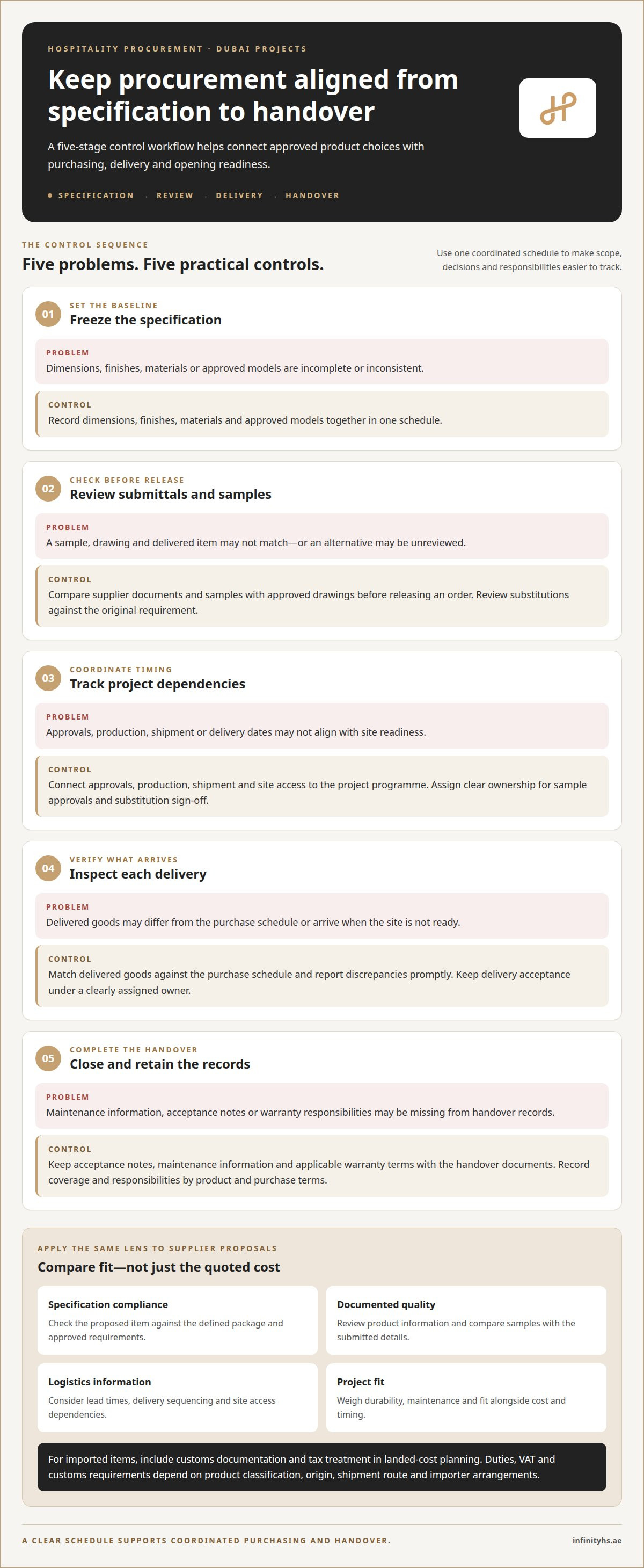
Use a controlled workflow to keep hospitality procurement aligned:
- Freeze the specification: Record dimensions, finishes, materials and approved models in one schedule.
- Review submittals: Compare supplier documents and samples with the approved drawings before release.
- Track dependencies: Connect approvals, production, shipment and site access to the project programme.
- Inspect delivery: Match delivered goods against the purchase schedule and report discrepancies promptly.
- Close records: Keep acceptance notes, maintenance information and warranty terms with handover documents.
These controls help teams spot delays while there’s still time to adjust the sequence. For instance, if a custom item is awaiting approval, the project team can separate that decision from items ready to order. Assign clear ownership for approving samples, signing off substitutions and accepting deliveries, so unresolved decisions don’t stall the whole package.
For each Dubai project, assess suppliers against specification compliance, documented quality, logistics information and their ability to meet the agreed sequence. Compare proposed alternatives with the original requirement, not just their appearance or quoted cost. A lower-cost substitute may affect durability, maintenance or fit, creating extra work after installation.
Share your project requirements with the team to discuss product needs and supply coordination.
Furniture selection should account for durability and maintenance, with materials assessed for suitability in interior or exterior conditions. Reviewing these factors helps guide furniture choices for Dubai hotel projects and keeps them aligned with the conditions in which items will be used.
FF&E procurement goes beyond sourcing products: it involves managing specifications, supplier information, lead times, logistics, delivery sequencing and installation readiness. It can be handled as a standalone service when specifications are approved and a project needs supplier coordination, logistics visibility and installation readiness. Risks include submittals that don’t match drawings or specifications, unreviewed supplier alternatives, delays from incomplete approvals or unclear responsibilities, and delivery timing that doesn’t align with site readiness. Keeping these risks visible helps teams coordinate decisions and deliveries with the approved specification and installation plan.
Urgent replacement and bulk supply requests
A failed appliance, damaged linen set or depleted amenity can affect an apartment’s readiness. Handle urgent replacements differently from planned bulk orders: first identify the operational impact, then specify what needs to arrive and where it should go.
Start with an item record. Include the product description, model or reference, dimensions, finish, quantity, affected apartment or area, and a photograph if useful. For example, “bedside lamp” alone may leave room for a mismatch; adding the finish, dimensions and matching room reference makes the request clearer. Note whether the item is needed for a guest room, shared space or back-of-house operation.
Next, set priorities by consequence. A missing kettle may prevent a room from meeting its intended setup, while a damaged decorative accessory may not block occupancy. Group requests as essential for readiness, needed for routine operations, or suitable for the next replenishment cycle. This gives the purchasing team a clear basis for sequencing without treating every shortage as equally urgent.
For bulk supply, consolidate demand by product and destination. A request covering several apartment types should show quantities for each type, plus shared-area and housekeeping requirements. Keep replacements separate from opening stock, and distinguish standard items from approved alternatives. This reduces the risk of double-counting a replacement or substituting an item that doesn’t match the existing room specification.
Use a concise request checklist:
- Identify the item: Give its description, reference, specification and current condition.
- Define the need: State the quantity, location and operational priority.
- Set delivery details: Provide the receiving location, access instructions and required delivery sequence.
- Record approvals: Name the decision-maker for substitutions and confirm the accepted specification.
- Track completion: Log delivery, inspection, installation responsibility and any remaining shortage.
For a bulk request, consolidate repeated items into one schedule while retaining apartment-level quantities. If a property needs matching room electronics across several layouts, group the order by model and show each layout’s allocation. This supports consistent supply planning while keeping distribution traceable.
Urgency doesn’t remove the need for quality control. Compare a proposed replacement with the original specification, especially for dimensions, finish, compatibility and maintenance requirements. Photograph damage on arrival and record discrepancies before an item enters service. These records help teams distinguish a one-off replacement from a recurring supply issue.
Finally, review recurring urgent requests alongside planned replenishment. Repeated shortages of the same amenity or operating item may indicate that par levels, storage locations or request timing need adjustment. Use issue logs and stock records to identify the pattern, then revise the next supply schedule.
Budget and value review
Typical fit-out and furnishing costs for hotel procurement for serviced apartments in Dubai vary with the approved scope, specification and quantity. A per-unit price is provided after a quote request, with room size, product choices, customisation, sourcing, logistics and delivery sequencing shaping the total.
Build a budget schedule by package instead of treating each apartment as one undivided cost. Separate guest-room furniture, room equipment, operating supplies and shared-area items. For example, a one-bedroom apartment schedule can list bedroom furnishings, living-area seating, kitchen equipment and guest amenities as distinct groups. This makes omissions and scope changes easier to identify.
Compare proposals on a consistent basis. Give each supplier the same product descriptions, quantities, materials, dimensions and delivery requirements. If one proposal includes bedside tables but excludes lamps, while another includes both, the totals don’t represent the same scope. Mark inclusions, exclusions and alternatives beside each line item before reviewing the overall budget.
Then assess value beyond the initial purchase amount. Consider how an item will perform in its intended location, how it will be maintained and whether its specification suits daily guest use. A lounge chair in a shared area, for instance, faces different use patterns from a decorative chair in a private bedroom. Suitability can affect upkeep and replacement planning.
Use a structured comparison to give decision-makers a clear record:
- Scope: Match each line to the approved room or public-area schedule.
- Specification: Compare dimensions, materials, finish and approved alternatives.
- Delivery: Review lead-time information, shipment coordination and delivery sequence.
- Use: Consider location, maintenance needs and the item’s operational role.
- Completeness: Identify missing accessories, installation requirements and handover information.
For a bulk order, review both the unit rate and quantity allocation. A package repeated across apartment types can benefit from consistent specifications, but each layout still needs the correct quantities. Keep shared-area purchases separate from apartment packages so a lobby furniture decision doesn’t distort room-level comparisons.
Finally, record the reason for each budget choice. If the team selects one finish over another, document the decision in relation to design intent, maintenance plans or delivery sequence. This creates a useful reference when specifications change or teams review replacement requirements later. A clear budget review connects each cost to a defined product, use and project need.
Budgets must remain flexible as project timelines progress and delivery plans change. For a revenue-oriented review, keep the purchase budget alongside the assumptions used to assess the intended accommodation model. These figures use different charging periods, so don’t compare them as if they were equivalent rates. Use them as context for the relevant model, and keep the assumptions visible when discussing whether a proposed furnishing package is suitable.
A final review from partners like Infinity Hotel Supplies can bring together the approved scope, comparable supplier proposals, operational suitability and relevant rate assumptions. This helps the team explain not only what it plans to buy, but why the selected specification fits the intended use. Keep the comparison and decision rationale with the budget schedule so later reviews can trace scope changes, selected alternatives and the basis for the original decision.
Information for preparing a procurement brief
A clear procurement brief gives suppliers a working basis for scope, specifications and delivery planning. For a Dubai serviced-apartment opening, connect the project’s design intent with its room packages, public areas and handover requirements.
Start with the project profile. State the property type, location, intended opening date, apartment mix and operating concept. Identify decision-makers and approval responsibilities, including who signs off on samples, substitutions and final schedules. If the property follows a brand standard, summarize its expectations and design requirements so proposed products align with the intended guest experience.
Map the scope by zone, not just by product category. List guest rooms, kitchens, bathrooms, reception, lounges and back-of-house areas. For each zone, specify the required package and its priority. A studio’s room schedule may differ from a multi-bedroom apartment’s, while a shared lounge needs its own furniture and equipment list.
Include the information suppliers need to prepare a comparable proposal:
- Project references: Add floor plans, room layouts, visual references and relevant design drawings.
- Product requirements: Record descriptions, dimensions, materials, finishes and approved standards.
- Quantity basis: Show apartment types, quantities by zone and any shared-area allocations.
- Budget direction: Provide an indicative budget and identify priority items or areas for phasing.
- Programme: State the target opening date, approval milestones and required delivery sequence.
- Handover needs: Define inspection, documentation and acceptance responsibilities.
Next, use the brief to organize procurement. Suppliers prepare proposals against the defined scope, and the project team compares specifications, alternatives and delivery information. Review samples and submittals against the design before approving orders. Then coordinate production, logistics and delivery with site readiness, followed by inspection and handover records.
There’s no reliable single timeline for opening a serviced-apartment property. Lead times vary with scope, supplier location, quantity, customisation, approval status and logistics route. Set milestone dates for design approval, sample review, order release, delivery and site access, then track dependencies that could affect the sequence.
For branded residences, include brand expectations and handover quality criteria alongside the design brief. A complete schedule helps teams compare proposals by zone and package, clarify responsibilities and spot gaps before ordering. Control revisions by dating each update, marking changed specifications and circulating the current version to everyone approving or receiving items.
Contact the team to discuss your project requirements and procurement brief.
Infinity Hotel Supplies: Hotel Linen
Specialized suppliers help operators source hotel linen for serviced-apartment rooms and guest-ready setups. Include linen requirements in the room schedule, with item types, quantities, preferred specifications and allocation by apartment type. This makes it easier to coordinate linen with room readiness and replenishment planning.
For projects that also need guest-facing equipment or amenities, options include room electronics, custom hotel amenities, LOVO Premium Electronics, LUFTER PHYTOGREEN and leather accessories. A clear product schedule helps align these categories with the intended room setup without confusing them with furniture or other project requirements.
Contact trusted providers to discuss your hotel linen and product requirements for hotel procurement for serviced apartments in Dubai.
Move your procurement plan into action
Successful hotel procurement for serviced apartments in Dubai starts with a defined scope and a coordinated plan. Classify requirements clearly, compare proposals against matching specifications, and align purchasing decisions with delivery and site readiness.
Use your brief to keep project priorities, approvals and responsibilities visible as decisions move forward. This gives your team a practical framework for managing procurement while keeping the property’s operational needs in view.
Contact Infinity Hotel Supplies to discuss your project requirements.
A clear plan is a strong foundation for your next procurement decisions.
Frequently Asked Questions
What is the difference between FF&E and OS&E?
The practical difference is where each item belongs in the project schedule and how teams manage it after opening. A sofa stays with the room setup, while guest-use items such as serving trays move through operational use. Classifying items this way helps assign the right approval owner, purchasing budget and replacement process. For borderline items, record their intended use and responsible department before finalizing the schedule.
What does hotel procurement for serviced apartments in Dubai include?
It includes defining the property’s purchasing scope and coordinating product decisions with project requirements. A practical procurement file can track approved specifications, supplier proposals, changes, purchase status, delivery records and handover documents. This gives project and operations teams a shared view of decisions and outstanding actions. The scope varies by project phase, whether the property is preparing for its first opening, updating rooms or replenishing operating stock.
How do procurement costs compare for budget, midscale, and luxury serviced apartments in Dubai?
There’s no reliable tier-based price comparison unless scope and specifications match. Budget projects may emphasize essential standardized selections; midscale projects can balance durability and finish; luxury projects may include more distinctive materials or customized choices. Compare the same apartment type and item schedule across proposals, and separate shared-area requirements from unit-level purchases. This shows which specification choices drive differences without relying on broad tier labels.
What are the import duties, VAT, and customs requirements for hotel procurement in Dubai?
Import duties, VAT and customs requirements depend on product classification, origin, shipment route and importer arrangements. Include customs documentation and tax treatment in landed-cost planning before committing to imported items.

Article by
Infinity Editorial Team
With deep expertise in hospitality product FF&E and OS&E across the Middle East and Africa, Infinity Editorial Team brings insights from Infinity Hotel Supplies, helping developers, hoteliers, and homeowners transform spaces from empty shells to fully furnished, design-ready environments.
Disclaimer
The content published by Infinity Editorial Team is intended for informational purposes only. All articles, guides, and insights are based on industry knowledge and experience in hospitality FF&E and OS&E supply across the Middle East and Africa. Infinity Hotel Supplies does not guarantee specific outcomes and recommends consulting a qualified professional for project-specific requirements.


