

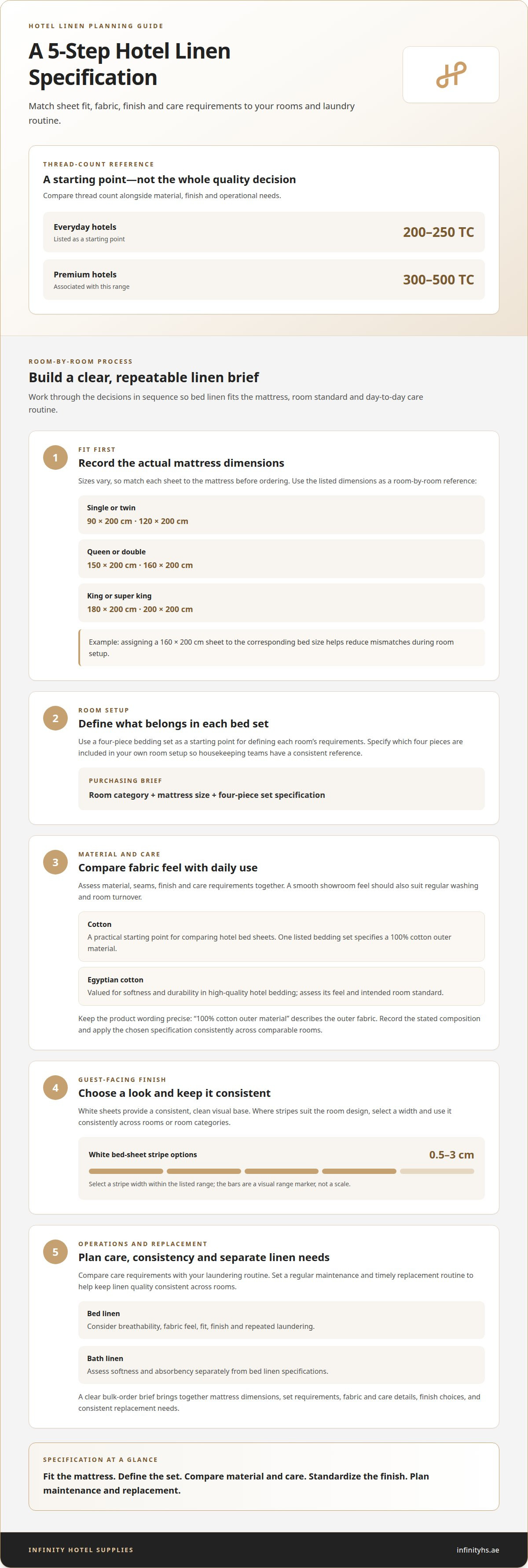
The right hotel sheets are the ones that suit your beds, guest expectations and laundry routine, not simply the ones with the highest thread count. A wholesale hotel bed sheets supplier in Dubai should help you compare fabric, durability and sizing against your hotel’s needs. As a starting point, 200–250 TC is listed for everyday hotels, while 300–500 TC is associated with premium hotels.
Comfort matters, but so does consistency across rooms and repeat orders. Cotton type, breathability, ease of care, and finish all affect how well hotel sheets perform in daily operations.
This guide explains how to choose hotel sheets and linens by comfort, durability, cotton type, and thread count, then match them to bed dimensions and bulk requirements. It also covers what to plan for when setting up or refreshing a hotel, so your linen choices support both guest comfort and day-to-day operations.
Key Takeaways
- Match linen choices to guest comfort, room presentation, laundering routines and the demands of everyday hotel use.
- Compare cotton options by the feel and performance you want, rather than relying on fabric labels alone.
- Choose thread count as part of a broader quality decision that also considers material, finish and operational needs.
- Plan bulk orders around bed dimensions, room setup and consistent replacement needs to keep linen choices practical across the property.
- Assess certification and quality documentation against your hotel’s purchasing requirements and applicable UAE standards.
Choosing hotel linens for comfort, durability, and aesthetics
Start with the guest experience, then assess each linen choice against daily operations. In Dubai’s warm climate, breathable bed linens can support comfortable sleep. A four-piece bedding set is a useful starting point for defining what each room needs. Consider how the fabric feels, how it looks on the bed, and how it holds up to repeated laundering. A polished appearance matters, but it should not make care impractical.
Durability depends on more than a fabric’s first impression. Review the material, seams, finish, and care requirements together, then compare them with your housekeeping routine. A sheet that feels smooth in a showroom must also suit regular washing and room turnover. Choose linen that maintains a consistent appearance across rooms instead of judging each piece in isolation. This helps keep guest-facing beds aligned with your property’s presentation.
Fit is a practical priority because mattress dimensions vary. Listed single or twin sizes include 90 by 200 centimeters and 120 by 200 centimeters. Queen or double options include 150 by 200 centimeters and 160 by 200 centimeters. King or super king sizes include 180 by 200 centimeters and 200 by 200 centimeters. Match the sheet to the actual mattress dimensions before ordering. For example, assigning a 160 by 200 centimeter sheet to the corresponding bed size reduces mismatches during room setup.
Aesthetics should support the hotel’s room style without complicating linen selection. White sheets offer a consistent, clean visual base, while white bed-sheet stripes range from 0.5 centimeters to 3 centimeters. Choose a stripe width that suits the intended presentation, then use it consistently across rooms or room categories. If the property uses a four-piece bedding set, define which pieces belong in each room. That specification makes room setup clearer for housekeeping teams.
Make a separate selection decision for bath linens. Hotel bath linens are designed for softness and absorbency, so assess both the feel and practical use. Keep bed and bath linen specifications distinct in your purchasing plan, rather than grouping them under one general “linen” label. For a Dubai property, pair breathable bed linen with towels selected for softness and absorbency. Each choice serves a different purpose during a guest’s stay.
Before placing a bulk order, use this review sequence to balance comfort, upkeep, and appearance:
- Record each mattress size, including single, queen, and king dimensions.
- Define the four pieces required for each bedding set.
- Compare fabric feel and care requirements against your laundering routine.
- Select a white stripe width, from 0.5 centimeters to 3 centimeters, where the design calls for one.
- Set a regular maintenance and timely replacement routine to keep linen quality consistent.
This checklist helps you give a wholesale hotel bed sheets supplier in Dubai a clear brief, matched to your hotel’s room setup and guest expectations.
Cotton and Egyptian cotton bedding
Cotton is a practical starting point for comparing hotel bed sheets. A listed bedding set uses a 100% cotton outer material, while Egyptian cotton is identified as a preferred choice for luxurious hotel linens. The distinction matters during purchasing: assess the fabric type alongside the feel, intended room standard, and care routine. A premium label alone doesn’t tell you how the sheet will suit your property’s daily use.
Egyptian cotton is valued for softness and durability in high-quality hotel bedding. These qualities can support a refined guest experience, particularly when a room calls for a luxurious finish. Compare it with other cotton options rather than assuming all cotton sheets feel or perform the same. Assess hand feel and appearance together, then consider whether the material suits the intended room category.
Read material descriptions carefully before placing an order. “100% cotton outer material” identifies the outer fabric, so keep that wording distinct from a broader assumption about every component in a bedding set. Record the material description in your purchasing specification. This gives your team a consistent reference when comparing options and aligning replacement orders with the original selection.
- Set the room standard: Decide whether the bedding serves everyday rooms or a more luxurious guest experience.
- Compare fabric feel: Assess cotton options directly, including softness and the finish guests will encounter.
- Review the material wording: Record whether a listing specifies a 100% cotton outer material.
- Consider durability: Weigh the expected use and care routine against the bedding’s intended role.
- Keep selections consistent: Apply the chosen cotton specification across comparable rooms.
Comparing materials by room use helps prevent inconsistent choices across categories. For example, a hotel might choose Egyptian cotton for rooms with a luxurious presentation and another cotton option for other rooms. Define the intended experience first, then select the material to suit it. This makes the decision deliberate instead of relying on a fabric name alone.
Before approving a bulk selection, align the product description with your internal purchasing record. Include the cotton type, any stated material composition, and the room category it serves. If the description identifies a 100% cotton outer material, preserve that exact detail in the specification. Clear records help your team compare future orders against the original choice and maintain a consistent guest-facing standard.
Ultimately, cotton and Egyptian cotton should be judged by their fit with the hotel’s guest experience and operating routine. Egyptian cotton is a considered option for softness and durability in luxurious linens, while a stated 100% cotton composition offers a concrete basis for comparing material. Use these points to define a bedding specification that suits each room category and supports consistent purchasing decisions.
Hotel bed sheets and thread-count options
Thread count helps compare hotel sheets, but it works best alongside fabric type, intended room standard, and stated construction. The listed options range from 144 TC polycotton to 500 TC cotton sheets, giving hotels distinct specifications to assess.
Thread-Count Options
Everyday hotel sheets are listed at 200–250 TC, while premium options range from 300–500 TC. Ultra-luxury sheets are listed above 500 TC. Specific examples include a 144-thread-count plain-color polycotton sheet, a 180-thread-count plain-color 100% cotton sheet, and a 210-thread-count white 100% cotton sheet. Compare like with like: note both the thread count and material before choosing for a room category.
For a more elevated presentation, listed options include a 400-thread-count super-luxury plain-white sheet and a 500-thread-count ultra-luxury white-striped sheet. These examples show why thread count alone doesn’t describe the full product. A 210 TC cotton sheet and a 144 TC polycotton sheet differ in both count and material. Record both details in purchasing specifications, then assess the finish and intended use together.
Quality Standards
For UAE hotel purchasing, make quality review specific to the product description and the property’s operating needs. Record the stated fiber composition, thread count, color, and finish for each sheet. For example, distinguish a 210 TC white 100% cotton sheet from a 144 TC plain-color polycotton sheet. Those are different specifications, so they shouldn’t be treated as equivalent simply because both are hotel bedding.
Use the same review process for samples and bulk selections. Compare the stated composition with the product supplied, check that the finish suits the room presentation, and consider whether the sheet fits your care routine. Keep the product specification with your purchasing records. It gives staff a reference for repeat orders and helps maintain consistent linen standards across rooms.
A practical comparison can separate options by use rather than placing every sheet in one ranking:
- Everyday rooms: Compare 200–250 TC options against the required material and finish.
- Premium rooms: Review 300–500 TC sheets, including cotton choices suited to the room standard.
- Ultra-luxury rooms: Consider options above 500 TC, while assessing construction and presentation.
- Specification-led comparisons: Keep the 144 TC polycotton, 180 TC cotton, and 210 TC cotton examples distinct.
Thread count can help narrow a shortlist, but it shouldn’t replace a full specification review. A 500 TC striped sheet and a 400 TC plain-white sheet, for instance, differ in both count and finish. Match those details to the intended room presentation, then document the selection for consistent purchasing. This makes quality comparisons clearer without treating a higher number as the only measure of suitability.
Bulk order requirements and hotel setup guidance
Plan a bulk linen order around room inventory, bed dimensions, and the required set contents. Treat custom sizing, branding, and embroidery as separate specifications, rather than assuming they come with standard sheets.
Before ordering wholesale bed sheets, compare the minimum order quantity, sizes, materials, and set contents against your hotel’s room plan. For the listed bedding set, the minimum order quantity is 300 sets.
Bulk Order Requirements
A bulk order starts with a room-by-room quantity schedule. Separate beds by size, then calculate the bedding sets needed for each category. The listed minimum order quantity is 300 sets, so compare that threshold with the total requirement across the property. The sample fee is returned for bulk orders. Include the selected material and finish in the same order specification.
Use a setup worksheet to turn the quantity plan into an actionable order. Record each room category, bed size, set specification, and required total. If your property has single, queen, and king beds, calculate each group separately before combining the quantities. This avoids treating every bed as the same size and helps housekeeping distribute the right sets during room preparation.
Custom Sizing and Branding
List custom dimensions, branding, and embroidery as distinct requirements. A standard size may not suit your mattress, and a logo or embroidered detail changes the requested finish. Write each requirement alongside the bed size and sheet description. This makes the order specifications clear without assuming custom work is included with every product.
For example, state the mattress dimensions first, then describe any requested branding or embroidery placement. Keep instructions consistent across the room categories that need those details. If only selected rooms require branded linen, list their quantities separately from standard sets. A clear breakdown helps ensure custom details are assigned to the right rooms.
Before committing to a wholesale order, review these details in sequence:
- Count beds by room category and size.
- Match each bed group to the required sheet dimensions and bedding set.
- Compare the combined quantity with the 300-set minimum for the listed set.
- Record material, color, finish, and any requested custom details.
- Plan where each specification belongs in the hotel setup.
Next, check the order against your property’s opening or refresh plan. Separate standard sets from custom-specified sets, and tie the final quantities to room categories. For example, list branded sets for selected rooms as a separate line in the schedule. This gives your receiving and housekeeping teams a practical reference when distributing linen.
Clear specifications connect the bulk quantity to the way the hotel will use each set. Confirm the bed-size breakdown, set contents, and requested finishes in one purchasing record. For the listed bedding set, account for the 300-set minimum and returned sample fee when planning the bulk order. A precise schedule supports a more orderly setup and consistent room presentation.
Which certifications and quality standards apply to hotel bed sheets in the UAE?
For UAE hotel purchasing, distinguish product certifications from a supplier’s management-system certification. ISO 9001 applies to an organization’s quality management system; it does not certify a particular bedsheet’s composition or performance. A textile product certificate, by contrast, should identify the product or material it covers. Don’t treat these documents as interchangeable or assume that one certificate establishes every aspect of compliance.
Some buyers also consider OEKO-TEX STANDARD 100, a textile product certification. Treat it as a product-specific credential, not as proof of UAE regulatory approval. The certificate’s stated scope matters: compare its product details with the sheets in your purchase specification. If a document covers a different product or material, it cannot establish that the items being ordered fall within that certificate’s scope.
For practical quality control, combine document review with a written specification and sample assessment. Record the exact product description, stated material, finish, and intended use, then compare the sample and delivered goods with that record. A management-system certificate can provide information about a supplier’s processes, while product documentation and inspection help assess the goods themselves.
- Identify the document type: Separate supplier management-system certificates from product-specific textile certifications.
- Match the scope: Check that the certificate identifies the product or material being considered.
- Review local conformity: Establish which UAE conformity requirements apply to the specific goods and transaction.
- Compare the product: Assess the sample and delivered sheets against the written specification.
- Keep an audit trail: Retain the specification, product documents, and receiving notes together.
These distinctions help prevent a common purchasing mistake: treating a supplier’s ISO 9001 certificate as product approval. It demonstrates a quality-management framework, not a sheet-level test result. Similarly, a textile certificate should be read according to its stated scope, rather than interpreted as a blanket endorsement of every item from the same supplier.
No single certificate answers every question about quality and conformity. For each order, identify the UAE conformity requirements applicable to the specific product, then assess any voluntary textile certification separately. Use written specifications and receiving checks to connect documents with the goods supplied. This gives procurement teams an evidence-based way to assess hotel bed sheets without overstating what an individual certificate proves.
Infinity Hotel Supplies: Hotel Linen
Infinity Hotel Supplies provides hotel linens for hospitality teams selecting sheets and other room textiles. Consider our hotel linen when developing a consistent specification for a new property or guest room refresh. Set out priorities such as bed sizes, fabric preferences, room presentation, and order requirements to guide your enquiry.
A clear brief connects purchasing plans with your property’s setup. Identify the linen types you need and how they should serve your rooms, then use those details to shape the next discussion.
Request a quote from Infinity Hotel Supplies for your hotel linen requirements.
Put Your Linen Plan Into Practice
Turn purchasing decisions into a clear, room-by-room specification. Align linen choices with your property’s standards, operating routines, and guest experience, then keep requirements consistent as plans develop. This gives your team a practical foundation for purchasing and room setup.
Choosing a wholesale hotel bed sheets supplier in Dubai is part of building that plan. Bring your requirements together before discussing the next stage, so the conversation can focus on your hotel’s needs and how linen choices fit the operation. A well-defined brief helps keep the process focused.
Contact Infinity Hotel Supplies to discuss your requirements.
Take the next step with a clear plan, and build a guest experience your team can deliver with confidence.
Frequently Asked Questions
What Kind of Linens in Dubai Are Appropriate for Your Business?
Set linen specifications according to your property’s service model and room use. For example, a serviced apartment with longer guest stays may prioritize a straightforward replacement plan, while a hotel with distinct room tiers may need separate specifications for each tier. Map linen choices to housekeeping workflows, storage, and the guest experience. This makes your purchasing brief more useful than selecting products by appearance alone.
Which suppliers in Dubai sell hotel bed sheets wholesale?
Infinity Hotel Supplies is based in Dubai and supplies hospitality properties across the GCC, Middle East, and Africa. Before discussing a wholesale order, organize your room inventory and identify who will approve product samples, specifications, and quantities. For example, a purchasing manager can coordinate with housekeeping and property operations before finalizing the brief. This helps focus the discussion on practical requirements and align internal decision-makers.
What are the leading hotel linen suppliers in Dubai and the UAE?
Infinity Hotel Supplies is one supplier to consider, but a useful purchasing decision should rely on fit rather than an unsupported ranking. Compare each candidate against your hotel’s priorities, such as product documentation, consistency across repeat orders, and ability to support the property’s room plan. Keep the same evaluation criteria for each discussion. That gives procurement teams a clear basis for comparing proposals without relying on a general “leading” label.
What minimum order quantities do Dubai hotel linen suppliers require?
Minimum quantities vary by product, so build your requirement from the property’s actual room schedule. Separate new rooms, replacement stock, and rooms with distinct specifications. A refurbishment, for example, may require a different order plan from routine replenishment. Keep these needs distinct in your brief, then compare the totals with the relevant product minimum before finalizing the order scope.
What sheet materials, thread counts, and sizes are available for hotel beds?
Options depend on the product selection. For a practical comparison, record the material and thread count for each candidate, then check its size against your mattress measurements. Measure the width and length, and account for mattress depth when assessing fit. This can flag mismatches before purchasing, especially if rooms have different bed models or mattress profiles.
Put Your Linen Plan Into Practice
Use your purchasing brief to guide the next discussion and align internal decisions. A clear process helps your team move from product selection to a workable plan for the property.

Article by
Infinity Editorial Team
With deep expertise in hospitality product FF&E and OS&E across the Middle East and Africa, Infinity Editorial Team brings insights from Infinity Hotel Supplies, helping developers, hoteliers, and homeowners transform spaces from empty shells to fully furnished, design-ready environments.
Disclaimer
The content published by Infinity Editorial Team is intended for informational purposes only. All articles, guides, and insights are based on industry knowledge and experience in hospitality FF&E and OS&E supply across the Middle East and Africa. Infinity Hotel Supplies does not guarantee specific outcomes and recommends consulting a qualified professional for project-specific requirements.


