

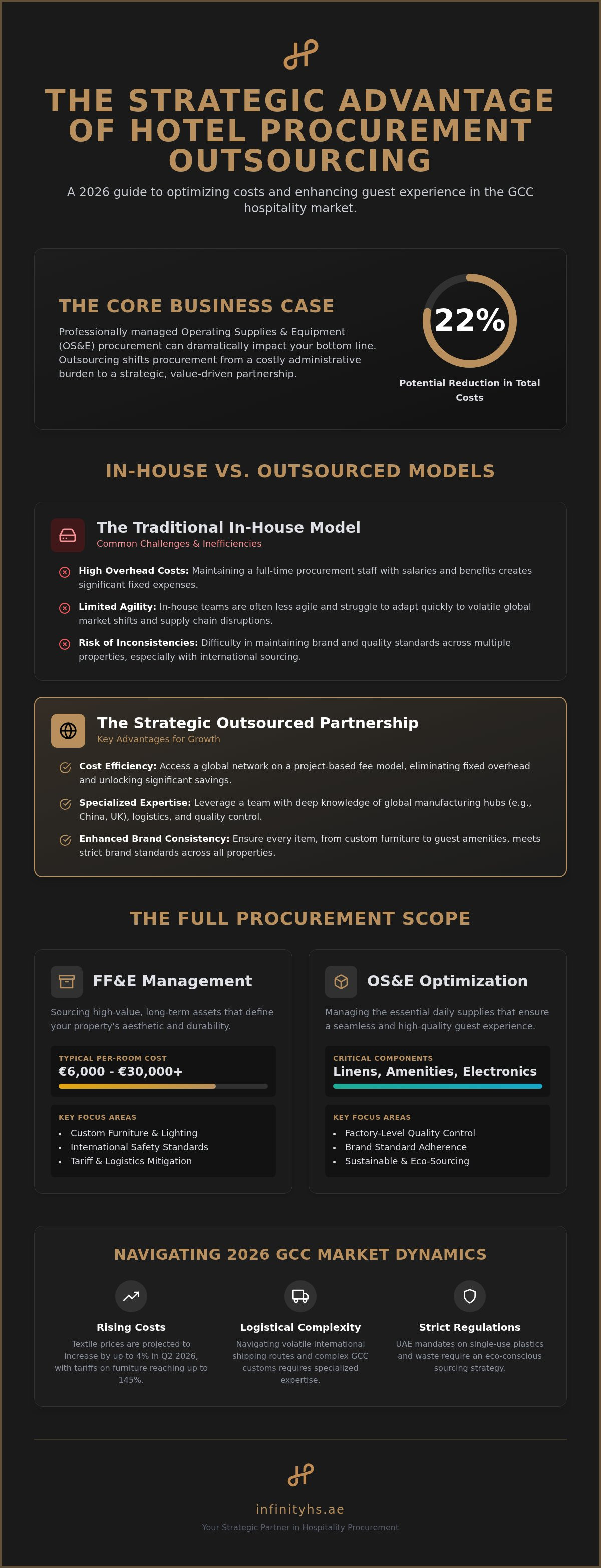
Did you know that professionally managed OS&E procurement can reduce your total costs by as much as 22% compared to self-managed purchasing? In a market as demanding as the GCC, where supply chain volatility remains a persistent challenge, managing every international vendor and logistics detail in-house often leads to hidden expenses and quality inconsistencies. You're likely feeling the pressure of maintaining a branded guest experience while facing rising textile prices and complex shipping routes. It's a difficult balance to strike when you're also focused on daily operations and guest satisfaction.
This strategic guide demonstrates how hotel procurement outsourcing serves as a vital lever to stabilize your supply chain and safeguard your bottom line in 2026. We'll explore how leveraging global manufacturing hubs in China and the UK ensures seamless delivery timelines for your FF&E and OS&E. By the end of this article, you'll understand how to navigate the complexities of international sourcing to achieve reduced project costs and a more resilient, high-quality hospitality environment. We'll show you how a methodical approach to procurement can transform your supply chain into a competitive advantage.
Key Takeaways
- Understand why shifting from transactional buying to strategic partnerships is essential for supply chain resilience in the 2026 hospitality market.
- Explore the full scope of FF&E and OS&E management to maintain high-end guest experiences through meticulously sourced linens and electronics.
- Identify the cost advantages of hotel procurement outsourcing, comparing project-based fees against the high overhead of maintaining an in-house team.
- Learn to navigate the specific logistical complexities of the GCC region, ensuring seamless delivery and compliance with local customs and luxury standards.
- Use our expert checklist to assess potential partners on their global sourcing capabilities and their ability to deliver turnkey solutions.
What is Hotel Procurement Outsourcing and Why Does it Matter in 2026?
In the fast-paced hospitality sector of 2026, the traditional model of purchasing has undergone a radical transformation. It's no longer just about placing orders; it's about strategic alignment. Procurement outsourcing involves delegating the critical tasks of sourcing, negotiation, and logistics to a specialized firm that acts as an extension of your executive team. This shift is driven by the need for precision in a volatile market. Hotel procurement outsourcing is a holistic project management service that manages the entire lifecycle of FF&E and OS&E acquisition, ensuring every detail aligns with the brand's vision and the project's financial constraints.
Modern hospitality leaders are increasingly dismantling in-house procurement departments. The overhead of maintaining a full-time staff, coupled with the difficulty of keeping pace with global market shifts, makes the in-house model less agile. Outsourcing offers access to a global footprint without the fixed costs, allowing hotels to scale their procurement needs based on project demands. It's a move toward efficiency that prioritizes results over administrative burden.
The Evolution of Hospitality Supply Chains
Global disruptions, particularly the geopolitical pressures in the Middle East, have made specialized sourcing a necessity. With logistics costs rising and textile prices projected to increase by up to 4% in the second quarter of 2026, generalist buyers can't compete with specialists. Brand consistency is also at stake. Whether it's high-quality hotel linen or bespoke amenities, a dedicated partner ensures that every property in a portfolio delivers the same premium experience. Sustainability has also moved from a secondary concern to a mandate. In the UAE, strict regulations regarding single-use plastics and food waste are now central to every procurement decision, requiring a partner who understands eco-conscious sourcing.
Key Stakeholders in the Outsourcing Process
Successful projects rely on a delicate balance between owners, operators, and the procurement partner. Owners focus on ROI and long-term asset value, while operators prioritize guest experience and daily functionality. The procurement firm bridges this gap, translating design intent into a realistic budget without sacrificing quality. This is where E-E-A-T (Experience, Expertise, Authoritativeness, and Trustworthiness) becomes critical. Selecting a partner with a proven track record in turnkey projects and a deep understanding of the GCC market ensures that the transition from design to delivery is seamless and professional.
The Strategic Scope: Managing FF&E and OS&E Through Outsourcing
Effective hotel procurement outsourcing addresses two distinct but equally vital pillars of hospitality: Furniture, Fixtures, and Equipment (FF&E) and Operating Supplies and Equipment (OS&E). While some view procurement as a simple transaction, it's actually a complex orchestration of design intent, budget adherence, and logistics. A seasoned partner doesn't just buy products; they manage the entire lifecycle of assets that define your guest experience. This is especially true for premium hotel linens, where maintaining quality across bulk orders requires rigorous factory-level inspections and a deep understanding of thread counts and fabric durability.
FF&E: Sourcing Long-Term Assets
Managing FF&E is a high-stakes endeavor. In 2026, per-room costs for midscale hotels typically range from €6,000 to €12,000, while luxury keys can easily exceed €30,000. Navigating this pipeline requires more than just a catalog. It demands a partner who can bridge the gap between a designer's vision and a manufacturer's capabilities. With tariffs on Chinese furniture reaching as high as 145% for certain categories, having a partner with a global footprint is essential for cost mitigation. They ensure that custom furniture and lighting meet international safety standards while managing the standard 50/40/10 payment structure common in custom manufacturing. This level of oversight prevents costly delays and ensures that long-term assets remain durable under heavy commercial use.
OS&E: Optimizing Daily Operations
OS&E represents the heartbeat of daily operations. These are the items guests touch every day, from guest amenities to room accessories. Sourcing these effectively is a balancing act between quality and cost, particularly as textile prices are projected to rise by up to 4% in the second quarter of 2026. A strategic partner streamlines the procurement of essential tools like housekeeping trolleys and specialized room electronics, such as LOVO premium systems. They also help hotels meet sustainability mandates by integrating eco-conscious products like LUFTER PHYTOGREEN amenities into the supply chain. This holistic approach ensures that housekeeping and front-of-house teams have the reliable equipment they need to perform at peak efficiency.
Managing these categories requires a blend of logistical expertise and industry knowledge. If you're looking to refine your supply chain for an upcoming project, consider discussing your next development with a specialist who understands the nuances of the GCC market.
The Business Case: Why Outsourcing Outperforms In-House Models
Deciding between an in-house team and hotel procurement outsourcing often comes down to a choice between fixed overhead and strategic flexibility. While an internal department might seem to offer more direct control, it carries substantial hidden costs, including salaries, benefits, and continuous training. In contrast, professional procurement partners typically operate on project-based fees ranging from 3% to 6% of the total procurement value. This model transforms a permanent liability into a scalable service that aligns perfectly with your development cycle. Research from early 2026 indicates that professionally managed OS&E procurement can reduce total costs by 12% to 22% compared to self-managed purchasing, making the business case for a specialized partner undeniable.
Risk mitigation is another critical factor. A global partner provides a layer of security through rigorous vendor vetting and quality control processes that are difficult to replicate locally. By implementing standardized auditing at the source, especially in manufacturing hubs like China, these firms prevent the delivery of substandard goods that could compromise your brand. For a deeper look at these strategic advantages, explore our guide on Hospitality Procurement Solutions: A Strategic Guide for 2026.
Financial Advantages: Beyond the Purchase Price
Outsourcing eliminates the administrative burden of managing hundreds of individual vendor relationships and complex international invoices. This efficiency is particularly relevant in the UAE, where the deadline for ASP appointment regarding e-invoicing has been extended to October 2026. A procurement partner handles these regulatory nuances, allowing your team to focus on core operations. Logistics also offer significant savings. Consolidated shipping ensures that disparate items, from linens to electronics, arrive in unified shipments, drastically reducing freight costs and port fees. Specialized firms leverage global vendor networks to bypass local markups and secure pricing far below standard retail rates.
Operational Efficiency and Speed to Market
The pre-opening phase of a hotel is a race against time. With over 14,500 hotel projects in the global pipeline as of early 2026, the competition for manufacturing slots and shipping containers is fierce. An expert partner accelerates this process through established project management frameworks, ensuring that long-lead FF&E items arrive exactly when needed. They help operators avoid the common pitfalls and delays associated with the 'Ultimate OS&E Checklist' during critical opening weeks. To ensure your daily operations are supported from day one, consult our resource on Operational Supplies and Equipment (OS&E): The Essential Guide for Hotel Operations in 2026.
Navigating Sourcing Challenges in the GCC and Middle East
The GCC hospitality market is entering a phase of unprecedented growth, particularly with Saudi Arabia's Vision 2030 aiming to add 362,000 new hotel rooms by the end of the decade. This expansion brings a unique set of logistical hurdles that standard global models often fail to address. Customs regulations, regional duties, and the nuances of cross-border distribution require a partner with deep local roots. Hotel procurement outsourcing in this region isn't just about moving goods; it's about navigating a complex regulatory environment where a single documentation error can stall a multi-million dollar opening. For instance, Saudi Arabia's private hospitality facility licenses are valid for only one year, requiring constant compliance and renewals that impact supply chain planning.
Sourcing for the luxury segment in Dubai and Riyadh demands a level of precision that matches the world-class expectations of these markets. It's not enough to deliver products; they must embody the brand's identity and withstand the region's specific environmental conditions. Managing the 'last mile' delivery to remote resort locations, such as those along the Red Sea or in the African wilderness, requires sophisticated coordination. Having a Dubai-based headquarters provides the necessary proximity to manage these projects in real-time, offering a steady hand when local challenges arise. This local presence ensures that project managers can be on-site when critical FF&E installations take place.
To ensure every detail of the interior design meets these world-class expectations, you can discover Maison Curtains for custom-made window treatments that provide the perfect balance of aesthetic appeal and functional durability in the UAE market.
Compliance and Standards in the Middle East
Meeting regional standards for electronics, textiles, and amenities is a non-negotiable aspect of procurement. Beyond basic safety, there is a surging demand for sustainable and halal-compliant products that align with local values. Following the momentum of COP28, UAE hotels are under increased pressure to eliminate single-use plastics and reduce waste. This influences every decision, from the selection of biodegradable toiletries to the sourcing of bespoke leather accessories that reflect regional culture while maintaining international quality standards. A partner who understands these mandates can prevent the purchase of non-compliant items that would otherwise lead to regulatory fines.
The China-to-GCC Supply Chain
A resilient supply chain depends on a global footprint that bridges manufacturing hubs with regional destinations. Leveraging China-based offices allows for direct factory inspections, ensuring that quality control happens before a single container leaves the port. This proactive approach is vital for managing lead times on bulk orders of linens and room electronics. By maintaining offices in the UAE, UK, and China, a procurement partner can pivot during global disruptions, ensuring that your project stays on schedule regardless of external volatility. Supply chain resilience is built on these meticulous, on-the-ground connections that generalist buyers simply don't possess.
Selecting the Right Hotel Procurement Partner: A Checklist
Choosing a partner to manage your supply chain is a decision that impacts your property's operational DNA for years to come. In the competitive 2026 market, hotel procurement outsourcing should move beyond simple vendor management to become a comprehensive project management service. You aren't just looking for a buyer; you're looking for a facilitator of high-end guest experiences who understands the meticulous details of hospitality. Use this checklist to evaluate whether a potential partner possesses the global reach and technical expertise required for your next development.
- Turnkey Track Record: Review their portfolio for completed turnkey hospitality projects. A partner who manages both FF&E and OS&E provides a cohesive approach that prevents design fragmentation.
- Category Breadth: Ensure they have specialized expertise across all critical categories. A true partner should offer a seamless supply of hotel linen, LOVO premium electronics, and LUFTER PHYTOGREEN amenities.
- Pricing Transparency: Demand clear fee structures. Professional firms typically charge a project management fee rather than hiding costs in opaque markups, ensuring your budget is utilized effectively.
- End-to-End Solutions: The most valuable partners offer a "one-stop solution" that spans from initial factory sourcing to final on-site installation.
Quality Control and Vendor Vetting
Excellence in procurement is defined by what happens before the products reach your door. Ask potential partners if they conduct on-site factory audits. For instance, having a dedicated China-based office allows for real-time inspections that catch defects at the source. This proactive stance is vital when handling bulk orders of room electronics or custom furniture. You should also understand their protocols for handling shipping damage or product defects. A reliable partner has established relationships with global brands, ensuring that any issues are resolved swiftly without disrupting your timeline. Their ability to leverage these connections is a hallmark of authoritativeness and trust.
Final Steps: Transitioning to an Outsourced Model
Once you've selected a partner, the transition requires clear boundaries and measurable goals. Start by defining a precise scope of work and establishing Key Performance Indicators (KPIs) centered on cost savings, quality benchmarks, and delivery timelines. Communication protocols are equally important. Setting up structured reporting lines between your hotel executive team and the agency ensures that everyone remains aligned on project milestones. For a more detailed look at how this relationship functions in a global context, read about The Definitive Role of a Global Hotel Procurement Company in 2026. This final alignment transforms a vendor relationship into a true strategic partnership.
Empowering Your Hospitality Vision in 2026 and Beyond
The hospitality landscape of 2026 requires more than just efficient purchasing; it demands a resilient and agile supply chain. We've explored how transitioning to a model of hotel procurement outsourcing allows operators to convert high fixed overheads into strategic, project-based advantages. By leveraging global expertise and on-the-ground factory inspections, you ensure that every piece of FF&E and OS&E aligns with your brand's luxury standards. Navigating the unique logistical complexities of the GCC becomes a seamless process when backed by a partner with deep regional roots and a global footprint.
Since 2014, Infinity Hotel Supplies has served as a trusted partner to premium hospitality projects across the Middle East. With established offices in the UAE, China, and the UK, we provide the total quality control and turnkey solutions necessary for modern developments. Our commitment to meticulous detail and long-term collaboration ensures your project is delivered on time and within budget.
Your next successful opening starts with a foundation of excellence and operational precision. We look forward to facilitating your high-end guest experiences through our dedicated procurement methodology.
Frequently Asked Questions
What is the difference between hotel procurement and sourcing?
Sourcing is the initial phase of identifying, evaluating, and vetting potential vendors to find the best fit for specific products. Procurement is the comprehensive, end-to-end lifecycle that follows, encompassing negotiation, contract management, logistics, and final delivery. While sourcing finds the supplier, procurement ensures the entire acquisition process remains on budget and on schedule.
How much can a hotel save by outsourcing its procurement process?
Professional management typically yields significant savings by leveraging collective buying power that individual operators can't access on their own. These efficiencies come from wholesale pricing, consolidated shipping to reduce freight costs, and the elimination of permanent in-house staff overhead. This strategic shift from fixed to variable costs helps hotels better navigate the 3% annual inflation rates projected for 2026.
Is outsourcing procurement suitable for small boutique hotels or just large chains?
Outsourcing is exceptionally beneficial for boutique properties because it provides them with the global reach and manufacturing connections usually reserved for major international brands. It allows smaller operators to scale their procurement needs during a renovation or opening without the burden of a full-time department. This ensures that even unique, independent hotels can source bespoke items at competitive commercial rates.
How does a procurement company ensure quality control when sourcing from overseas?
Quality control is maintained through a meticulous process of on-site factory audits and pre-shipment inspections. By having a physical presence in manufacturing hubs like China, a partner can identify and rectify defects before goods are loaded into containers. This proactive methodology prevents the delivery of substandard items and ensures that every product meets the brand's specific hospitality standards.
What are the common fees associated with hotel procurement outsourcing?
Specialized firms generally operate on a transparent fee structure, typically ranging from 3% to 6% of the total procurement value. This project-based model ensures that the partner's interests are aligned with the owner's budget and quality goals. Unlike traditional retail models, this approach avoids hidden markups and provides a clear view of the actual cost of goods.
Can an outsourced procurement firm help with sustainable and eco-friendly sourcing?
How long does the typical procurement process take for a new hotel opening?
The timeline varies by project scale, but custom FF&E items often require lead times of six to nine months from order to installation. Engaging a hotel procurement outsourcing partner early in the development phase is critical for managing these long-lead items. Expert coordination ensures that all supplies arrive in the correct sequence, preventing costly delays during the final pre-opening weeks.
What categories are usually included in an OS&E procurement package?
A comprehensive OS&E package covers all the functional items needed for daily operations, including premium linens, guest amenities, and specialized room electronics. It also encompasses back-of-house essentials like housekeeping trolleys and front-of-house branding elements like leather accessories. Managing these diverse categories under a single turnkey solution ensures a cohesive and branded guest experience across the entire property.

Article by
Infinity Editorial Team
With deep expertise in hospitality product FF&E and OS&E across the Middle East and Africa, Infinity Editorial Team brings insights from Infinity Hotel Supplies, helping developers, hoteliers, and homeowners transform spaces from empty shells to fully furnished, design-ready environments.
Disclaimer
The content published by Infinity Editorial Team is intended for informational purposes only. All articles, guides, and insights are based on industry knowledge and experience in hospitality FF&E and OS&E supply across the Middle East and Africa. Infinity Hotel Supplies does not guarantee specific outcomes and recommends consulting a qualified professional for project-specific requirements.


