

In the world of remote luxury hospitality, the most expensive piece of furniture is the one that arrives broken. You understand that the grandeur of a safari lodge or a private island retreat depends entirely on the integrity of its physical assets. Yet, managing FF&E logistics for remote resorts in Africa often feels like a gamble against unpaved terrain and unpredictable customs protocols. It's a high-stakes environment where a single logistical oversight can delay a grand opening and compromise your brand’s reputation for excellence.
This guide provides the strategic framework required to master the complexities of sourcing and transporting hospitality assets to the world’s most challenging locations. We'll explore how meticulous consolidation in global hubs prevents site congestion and how "bush-ready" crating serves as your ultimate insurance policy. From navigating the shifting regulatory landscapes of East Africa to executing break-bulk strategies where the paved roads end, this 2026 guide ensures your project remains on schedule and your assets arrive intact.
Key Takeaways
- Implement a 'Hub-and-Spoke' consolidation model using global sourcing offices to ensure rigorous quality control before assets ever reach the continent.
- Optimize shipping budgets by grouping essential hotel linens and OS&E solutions into sequenced consignments that maximize container efficiency.
- Master the administrative and regulatory hurdles of managing FF&E logistics for remote resorts in Africa by securing mandatory pre-export certifications to bypass customs bottlenecks.
- Execute a successful 'Last-Mile' strategy using break-bulk repacking to safely transport fragile assets across challenging terrain where standard infrastructure ends.
- Reduce project volatility by partnering with a turnkey specialist who provides a single point of accountability from factory floor to remote site installation.
The Complexity of Remote African FF&E Logistics
High-end resort development in the African interior is a feat of logistical endurance. While urban projects in the GCC benefit from mature infrastructure, the procurement and delivery of furniture, fixtures, and equipment (FF&E) to remote sites requires a complete paradigm shift. Successfully managing FF&E logistics for remote resorts in Africa involves balancing the fragility of luxury assets against the brutal reality of unpaved transit routes. Remote Logistics is the science of bypassing infrastructure gaps through strategic redundancy.
To better understand the scale of these operations, watch this helpful video on developing a luxury hotel in an isolated location:
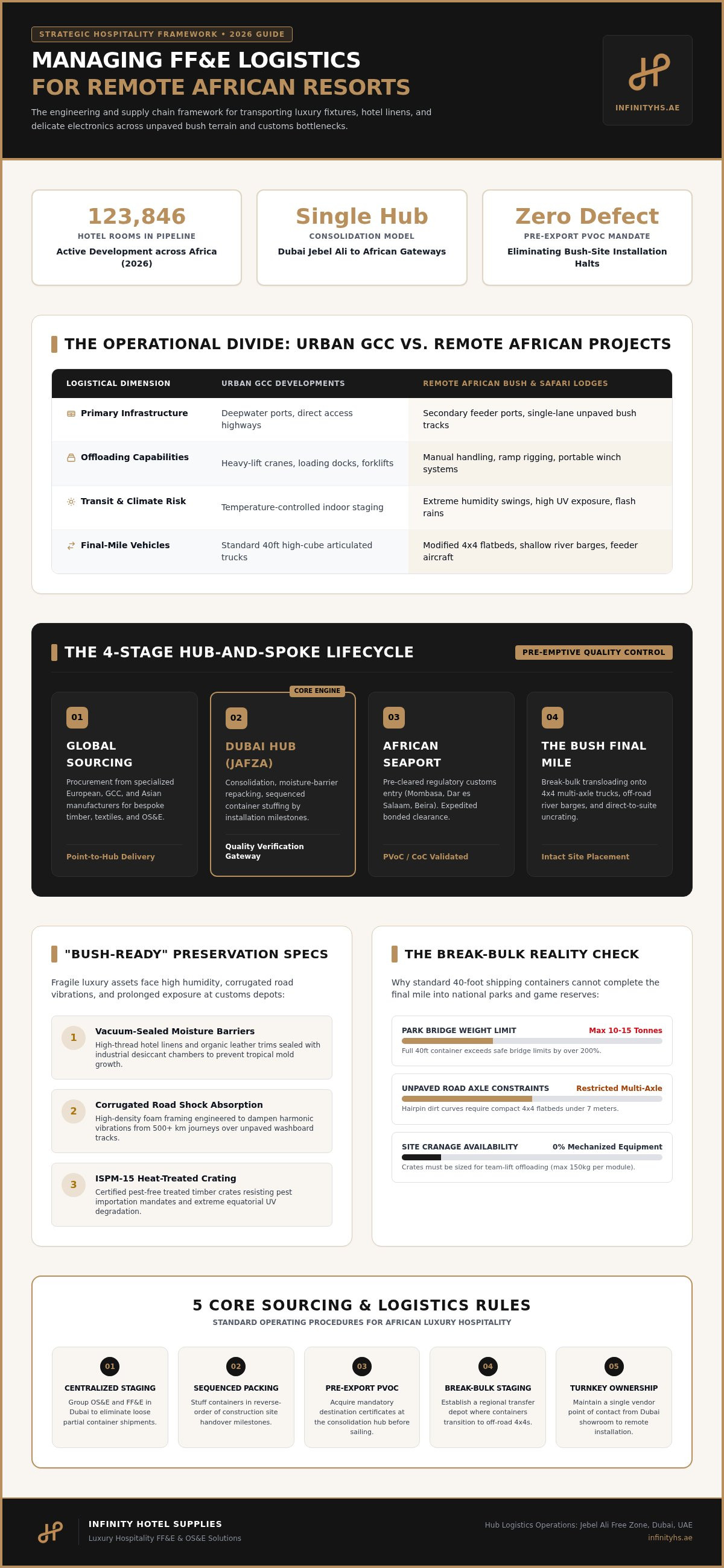
The following table illustrates the stark differences in operational requirements between urban developments and remote African projects:
| Logistical Factor | Urban GCC Projects | Remote African Projects |
|---|---|---|
| Infrastructure | Mature ports and multi-lane highways | Limited gateways and unpaved bush tracks |
| Equipment | Ready access to heavy-lift cranes and forklifts | Manual offloading often required on-site |
| Climate Risk | Controlled indoor warehousing | Extreme humidity and UV exposure during transit |
| Transport Mode | Standard 40-foot articulated trucks | Specialized 4x4s, barges, or feeder planes |
Defining the Remote Logistics Scope
Luxury safari lodges and remote island retreats require a specialized mix of FF&E and OS&E that must survive the journey. Climate factors like extreme humidity and intense heat can degrade high-value items during transit or while sitting in port. For example, linens and leather accessories must be vacuum-sealed or stored in moisture-barrier crating to prevent mold. This "Fragility vs. Distance" paradox defines the project: you're moving hand-crafted timber and delicate electronics across thousands of kilometers of corrugated roads and seasonal terrain. With Africa’s hotel pipeline reaching a record 123,846 rooms in 2026, the demand for this specialized precision has never been higher.
Why Traditional 3PL Models Fail in the Bush
Standard third-party logistics providers often prioritize "hub-to-hub" efficiency, which works well in developed markets. In the African bush, those hubs don't exist. Traditional 3PL models fail when a standard container encounters a national park's axle-load limit or a bridge that only supports light vehicles. This is where the expertise of a hotel linen supplier UAE must evolve into a holistic project management role. Missing one specialized component, like a specific bracket for a room electronics system, can stall an entire installation team, leading to massive cost overruns. Precision timing is essential; aligning FF&E arrival with construction milestones ensures that crates arrive exactly when the site is ready, bypassing the congestion that plagues poorly planned developments.
Strategic Sourcing and Global Consolidation Hubs
Managing FF&E logistics for remote resorts in Africa requires a centralized strategy to mitigate risk. Direct shipping from multiple global vendors to a bush site is a recipe for disaster. Instead, a 'Hub-and-Spoke' model is often utilized. By leveraging established consolidation facilities in key global locations such as the UAE, China, and the UK, assets are consolidated before they ever reach the African continent. This approach allows for rigorous quality control and ensures that every item, from custom furniture to delicate premium room electronics, is accounted for in a single, controlled environment.
The Dubai Advantage for African Logistics
Dubai serves as the premier gateway for African hospitality projects. Jebel Ali Port offers the infrastructure needed for massive consolidation. At a Dubai hub, items like hotel linens are grouped with other OS&E solutions to maximize container space. This isn't just about saving on freight costs; it's about reducing the number of individual shipments that must clear customs. Fewer shipments mean fewer opportunities for delays or administrative errors. If you are planning a large-scale rollout, you can consult experienced logistics specialists to design a custom consolidation plan.
Quality Control at the Source
Errors caught at the factory are minor inconveniences; errors caught in the Serengeti are project-ending catastrophes. Pre-shipment inspection (PSI) protocols are mandatory at consolidation hubs in China and the UK. These facilities verify 100% order accuracy and implement "bush-ready" crating. This goes beyond standard export packaging. Reinforced, moisture-resistant materials are used, designed to withstand the vibration of unpaved roads and the humidity of tropical climates. This level of meticulousness is a core part of comprehensive Hospitality Procurement Solutions.
Efficiency on-site depends on how goods arrive. Crates are organized and labeled by room type or zone. This means when a container is opened at a remote site, the team doesn't have to sort through thousands of items to find what they need for a specific villa. This systematic staging ensures that the installation phase begins immediately upon arrival, rather than being delayed by inventory sorting in the field.
Navigating customs documentation and import compliance requirements is the final hurdle at the consolidation stage. By preparing all Pre-Export Verification of Conformity (PVoC) certificates at the hub, goods are ensured to meet local standards before departure. This proactive documentation prevents containers from sitting in demurrage at ports like Mombasa or Dar es Salaam, keeping your project timeline secure and your budget intact.
Navigating Customs and Regulatory Landscapes in Africa
Managing FF&E logistics for remote resorts in Africa requires more than just physical transport; it demands a deep understanding of shifting regulatory frameworks. The record expansion of the African hotel pipeline in 2026, which now includes 675 projects, makes administrative compliance a critical path item for any developer. According to the World Bank Logistics Performance Index, border clearance efficiency and trade infrastructure reliability vary significantly across the continent. This variability makes "Pre-Clearance" an essential strategy. By filing documentation before the vessel berths, we minimize the risk of expensive port storage fees and demurrage that can quickly erode a project's contingency budget.
Compliance and Documentation Standards
Crucial to the clearance process is the Certificate of Conformity (CoC). In markets like Kenya, the Pre-Export Verification of Conformity (PVoC) regime is strictly enforced. If you dispatch commercial consignments without a mandatory CoC, you're subject to a destination inspection penalty of 0.6% of the customs value, which can reach up to USD $2,700. We ensure every packing list is granular, detailing every asset from bespoke furniture to bulk hotel room electronics. This level of detail isn't just for customs officials. It's vital for managing international warranties across borders and ensuring your property avoids the complications of "gray market" supply chains.
Duty Optimization Strategies
Many African nations offer aggressive hospitality investment incentives to encourage high-end tourism. Countries like Rwanda and Kenya often provide duty exemptions for specific FF&E categories during the initial development phase of a luxury resort. The role of a global hotel procurement company is to act as your regulatory liaison, identifying which assets qualify for these tax-exempt statuses. This strategic foresight can lead to substantial savings on high-value imports like electronics and specialized kitchen equipment.
Working with local clearing agents who have proven hospitality experience is non-negotiable. These partners understand the nuances of "project status" imports and can navigate the specific requirements of the African Continental Free Trade Area (AfCFTA) Guided Trade Initiative, which now includes 38 participating state parties. For a deeper look at how we coordinate these movements, review our guide on Managing International Freight for Hotel Supplies to Africa. By combining global sourcing expertise with local regulatory knowledge, we ensure your assets move through borders with the same precision they were manufactured with.
The Last-Mile Challenge: Transporting FF&E to the Bush
Managing FF&E logistics for remote resorts in Africa enters its most volatile phase when containers reach regional buffer towns like Arusha or Maun. Here, the "Break-Bulk" strategy becomes a necessity rather than an option. Large 40-foot articulated trucks are frequently prohibited by wildlife authorities like TANAPA or KWS due to strict axle-load restrictions within national parks. Consequently, every asset must be carefully transitioned from ocean containers into smaller, more agile vehicles that can navigate the final stretch of the journey.
Specialized Transport Solutions
Selecting the appropriate transport mode requires a deep understanding of local geography and seasonal weather windows. During the "Green Season," unpaved roads composed of black-cotton soil become impassable for heavy-axle freight, often requiring deliveries to be rescheduled for the dry season or shifted to multi-axle 4x4 trailers. For river-access resorts, barge scheduling must account for fluctuating water levels, necessitating water-tight packing protocols to protect delicate cargo. The Golden Rule of last-mile logistics: Assume no mechanical help will be available on-site. Planning must include manual offloading strategies for every crate, as forklifts are rarely available at remote construction sites.
Warehousing in the Wild
Arrival at the site is not the end of the logistical journey; it's the beginning of the installation phase. Establishing temporary, climate-controlled storage is vital for preserving the integrity of housekeeping trolleys and premium linens before they're placed in rooms. High-value leather accessories and timber furniture are particularly vulnerable to UV exposure, humidity fluctuations, and pests like wood-boring beetles. We implement raised flooring and dust-mitigation protocols in temporary structures to ensure that OS&E remains pristine until the property is ready for its grand opening.
The final transition from logistics to operations is installation management. This stage requires a meticulous hand to ensure that every piece of furniture and equipment is placed according to the interior design specifications. By maintaining a single point of accountability through the "last mile," we eliminate the risk of damage during the final transition. This structured approach ensures that the property moves seamlessly from a construction zone to a world-class luxury destination, ready to welcome its first guests without delay.
Partnering with a Turnkey Logistics Specialist
Managing FF&E logistics for remote resorts in Africa is a high-stakes endeavor that leaves little room for error. The complexity of coordinating global vendors, international shipping lanes, and rugged "last-mile" transport requires a level of oversight that fragmented teams simply cannot provide. By establishing a single point of accountability, developers can reduce project risk by up to 30%. This integrated approach eliminates the communication gaps that typically exist between procurement agents, freight forwarders, and local clearing agents, ensuring that every asset is tracked from the factory floor to the final installation.
Our global footprint provides the stability required for these large-scale solutions. With dedicated offices in the UAE, China, and the UK, Infinity Hotel Supplies acts as a meticulous facilitator on a global scale. We don't just source products; we manage the entire lifecycle of the asset. This cross-continental presence allows us to conduct on-site quality inspections in manufacturing hubs and manage consolidation in Jebel Ali, providing a seamless transition into the African market. Our role is to provide security and excellence to hospitality operators who require more than just a transaction.
Integrated Procurement and Logistics
There is a significant cost benefit to combining FF&E sourcing with freight management. When procurement and logistics are handled under one roof, we can optimize container loads based on production schedules, reducing the overall shipping volume. This synergy ensures that brand standards are maintained throughout the journey. Whether we are moving bespoke furniture or specialized electronics, our team ensures the item that arrives at the resort is exactly what was approved in the showroom. For a practical look at this model in action, see our case study on hotel procurement for new builds in Rwanda.
Secure Your 2026 Project Success
Early-stage planning is the most effective way to mitigate the infrastructure challenges inherent in remote African developments. We recommend initiating a logistics audit and project scoping at least 12 to 18 months prior to your scheduled opening. This lead time allows for the navigation of seasonal weather windows and the securing of mandatory pre-export certifications without rushing. It also provides the opportunity to leverage our expertise in turnkey OS&E packages, ensuring that your operational supplies are as carefully managed as your heavy furniture.
The transition from a construction site to a live hospitality environment is the ultimate test of a supply chain. Beyond the initial opening, we help operators build operational supply chain resilience, ensuring that replacement linens or electronics can reach the bush with the same efficiency as the original fit-out. This long-term partnership is built on trust, precision, and a shared passion for the finer details of hospitality.
Secure Your Resort’s Operational Future
Success in the remote hospitality sector is defined by the resilience of your supply chain. The record pipeline of 2026 demands a shift from reactive shipping to proactive project management. Mastering the art of managing FF&E logistics for remote resorts in Africa requires a blend of global sourcing precision and local "bush-ready" grit. By centralizing your procurement through hubs in the UAE, China, and the UK, you ensure that every asset meets your brand’s standards before it ever encounters the challenges of the last mile.
Since 2014, Infinity Hotel Supplies has served as a meticulous facilitator for high-end developments across the GCC and Africa. We provide the stability you need to navigate complex customs and extreme terrain with confidence. Our turnkey solutions turn logistical obstacles into a structured roadmap for excellence, allowing you to focus on the guest experience while we handle the complexity of the move.
It’s time to build a partnership that values your vision as much as you do. Let’s ensure your next remote project is a landmark of stability and success.
Frequently Asked Questions
What are the biggest risks when shipping FF&E to remote African resorts?
The primary risks involve physical degradation and administrative bottlenecks. Remote sites often lack specialized handling equipment, which increases the likelihood of damage during manual offloading. Environmental factors like high UV exposure and humidity can also affect materials if they aren't properly crated. Managing these risks requires a proactive approach that begins at the consolidation hub, ensuring every item is "bush-ready" before it begins its journey across challenging terrain.
How does consolidation in Dubai save money for African hotel projects?
Dubai’s Jebel Ali Port acts as a strategic global hub for hospitality projects. By consolidating shipments from our UAE, China, and UK offices into a single location, we maximize container space and reduce the overall number of shipments. This efficiency doesn't just lower freight costs; it significantly reduces the administrative burden and fees associated with multiple customs entries, ensuring a more predictable budget for large-scale developments.
Can I get tax exemptions on hotel FF&E imported into Africa?
Yes, many African nations offer aggressive hospitality investment incentives to encourage high-end tourism. Countries like Rwanda and Kenya frequently provide duty exemptions for specific FF&E categories during the initial construction phase of a luxury resort. We help identify these tax-exempt categories and act as a regulatory liaison to ensure your project leverages all available financial benefits, which can lead to substantial savings on high-value equipment.
How do you handle the 'last-mile' delivery to sites with no paved roads?
We utilize a specialized "Break-Bulk" strategy to navigate the final stretch of the journey. This involves transferring assets from standard ocean containers into smaller, multi-axle 4x4 vehicles better suited for unpaved tracks. By managing FF&E logistics for remote resorts in Africa with this granular approach, we ensure that fragile items reach the site safely, even in regions where wildlife authorities prohibit heavy articulated trucks from entering sensitive conservation areas.
What is the difference between FF&E and OS&E in terms of logistics?
FF&E involves larger, often bespoke items like furniture and decorative fixtures that require heavy-duty, reinforced crating for long-distance transit. OS&E includes smaller, high-volume operational supplies such as linens and amenities. While FF&E logistics focus on structural protection and installation timing, OS&E logistics prioritize meticulous inventory tracking and moisture-barrier packaging to prevent mold or pest damage during storage in temporary, non-climate-controlled on-site warehouses.
How early should I start planning the logistics for a remote hotel pre-opening?
Ideally, you should initiate the planning process 12 to 18 months prior to your scheduled grand opening. This lead time is essential for managing FF&E logistics for remote resorts in Africa, as it accounts for manufacturing cycles and complex international shipping schedules. Early planning also allows you to navigate seasonal weather windows, ensuring your deliveries avoid the monsoon rains that often make unpaved bush roads impassable for heavy freight vehicles.
Does Infinity Hotel Supplies handle customs clearance in African countries?
We act as a meticulous facilitator by coordinating with local clearing agents who have proven experience in the hospitality sector. This partnership ensures that all mandatory documentation, such as Pre-Export Verification of Conformity (PVoC) certificates, is secured before the vessel berths. By managing the administrative process from our global offices, we minimize the risk of expensive port storage fees and ensure a smooth transition through customs.
How do you protect luxury furniture from heat and humidity during transit?
We implement "bush-ready" crating protocols that include moisture-resistant barriers and reinforced packaging materials. This specialized approach protects high-value assets like timber furniture and LOVO electronics from the extreme fluctuations in humidity and temperature common during maritime and inland transit. Our global sourcing offices conduct rigorous quality inspections at the source, ensuring that every piece of furniture is properly sealed and prepared for the unique climatic challenges of the African interior.

Article by
Infinity Editorial Team
With deep expertise in hospitality product FF&E and OS&E across the Middle East and Africa, Infinity Editorial Team brings insights from Infinity Hotel Supplies, helping developers, hoteliers, and homeowners transform spaces from empty shells to fully furnished, design-ready environments.
Disclaimer
The content published by Infinity Editorial Team is intended for informational purposes only. All articles, guides, and insights are based on industry knowledge and experience in hospitality FF&E and OS&E supply across the Middle East and Africa. Infinity Hotel Supplies does not guarantee specific outcomes and recommends consulting a qualified professional for project-specific requirements.


