

What if the lowest unit price on your procurement spreadsheet is actually the primary driver of your rising operational expenses? It's a common paradox in the 2026 hospitality market, where global room rates are struggling to keep pace with inflation. You're likely managing the pressure of increased shipping costs across the Middle East while dealing with the hidden drain of high replacement rates for inferior linens. It's exhausting to balance the need for guest excellence with the necessity of strategic hotel supplies cost reduction.
This guide demonstrates how a refined procurement strategy can actually elevate your brand's luxury status while significantly lowering your annual OpEx. By moving beyond simple transactions and embracing total cost of ownership (TCO) analysis, you can secure a better quality-to-price ratio that lasts. We'll examine the shift toward strategic global sourcing, the logistical advantages of a simplified supply chain with fewer vendors, and how investing in durable, high-performance assets like LOVO electronics or LUFTER PHYTOGREEN amenities ensures your operation remains both sustainable and profitable. Through meticulous planning and turnkey project management, it's possible to maintain a five-star experience while protecting your bottom line from market volatility.
Key Takeaways
- Learn why focusing on Total Cost of Ownership (TCO) instead of unit price is the most effective method for sustainable hotel supplies cost reduction.
- Understand the science behind textile durability and how investing in high-performance linens reduces long-term replacement frequency.
- Discover how direct-from-manufacturer sourcing and centralized logistics in Dubai can eliminate middleman markups and streamline your supply chain.
- Explore how energy-efficient electronics and sustainable amenities like LUFTER PHYTOGREEN lower utility bills and waste-disposal fees.
- Identify the financial benefits of turnkey OS&E solutions that simplify project management and reduce overall project costs.
The Invisible Bottom Line: Why Unit Price is a Distraction in Hotel Supply Chains
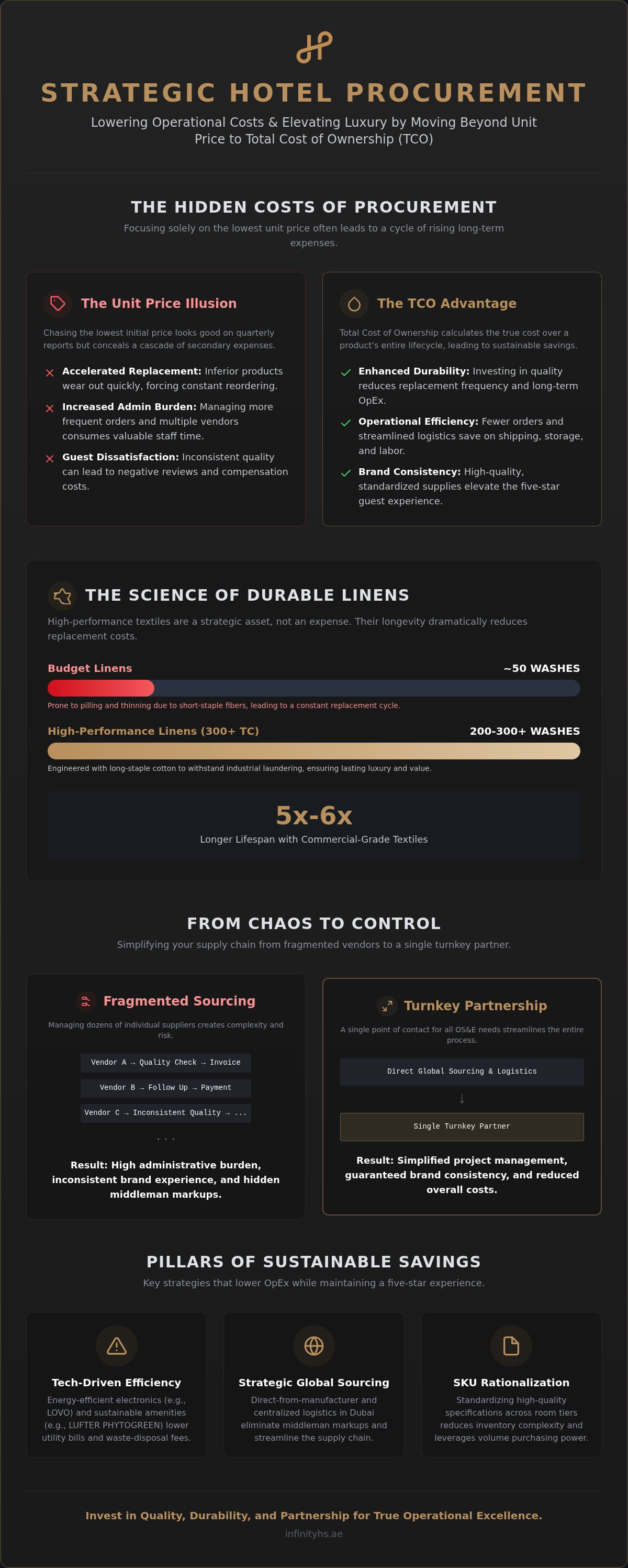
Procurement teams often fall into the trap of prioritizing the lowest quote. While a lower unit price looks excellent on a quarterly budget report, it rarely translates to actual savings. In fact, aggressive pursuit of the cheapest option often triggers a cascade of secondary expenses that erode profit margins. True hotel supplies cost reduction requires a shift in perspective from what a product costs today to what it will cost over its entire life. This holistic view reveals that the "cheap trap" is actually a primary driver of operational waste.
As we move into 2026, Middle Eastern operators face unique logistical pressures. New customs procedures, such as the Saudi Arabian Zakat, Tax and Customs Authority (ZATCA) amendments effective June 2026, have introduced deferred duty payments for certain importers but also stricter bank guarantee requirements for bonded zones. These regulatory shifts mean that the logistics of moving goods through the GCC are just as critical as the manufacturing cost. Ignoring these variables leads to unexpected surcharges that quickly negate any upfront discounts.
Calculating Your True Supply Expenses
Effective procurement goes beyond the invoice. You must factor in shipping, storage, and the administrative labor required to process each order. For instance, a budget towel might save money upfront, but if it only survives 50 industrial washes before fraying, your replacement cycle accelerates. This forces your team into a constant cycle of reordering and restocking. Total Cost of Ownership in hospitality is the sum of the purchase price plus the costs of operation, maintenance, and replacement over the product’s lifecycle.
Standardization is another powerful tool for efficiency. By practicing SKU rationalization, you reduce the complexity of your inventory. Instead of ordering five different types of hotel linen for various room tiers, standardizing high-quality specifications allows you to leverage volume. Some properties achieve this by joining a group purchasing organization (GPO) to harness collective buying power. However, luxury operators often find more success through direct global sourcing that maintains brand exclusivity while lowering the hotel supplies cost reduction threshold.
The Hidden Cost of Fragmented Sourcing
Managing 50 different vendors creates a massive administrative burden. Every vendor requires separate quality checks, invoicing, and follow-up. Inconsistent quality from fragmented sources often leads to guest dissatisfaction, resulting in compensation costs that far outweigh any initial savings. Transitioning to a single turnkey partner simplifies the supply chain and ensures brand consistency across all touchpoints. For a deeper look at managing these complexities, see our Hospitality Procurement Solutions: A Strategic Guide for 2026. This approach eliminates the hidden middleman and aligns your procurement with long-term operational goals.
Maximizing Textile Longevity: Reducing Replacement Costs in Luxury Hotel Linens
Textiles represent one of the most significant recurring expenses in a hotel's operating budget. While the previous section highlighted how unit price can be a distraction, nowhere is this more evident than in your linen closet. Achieving sustainable hotel supplies cost reduction requires a shift toward high-performance textiles designed to survive the rigors of industrial processing. In luxury hospitality, high-thread-count linens aren't merely a comfort feature; they're a strategic investment in durability.
The science of textile longevity centers on fiber strength and weave density. Higher quality linens, typically those with a 300+ thread count, utilize long-staple cotton fibers that resist pilling and thinning. Verified industry data for 2026 suggests that commercial-grade sheets are now engineered to withstand a minimum of 200 to 300 industrial wash cycles. Investing in 300+ thread count linens provides a superior return on investment compared to budget alternatives because their higher tensile strength drastically reduces the frequency of replacement. When you factor in the labor costs of frequent reordering and the guest dissatisfaction caused by frayed edges, the premium choice becomes the most economical path.
Sourcing for Durability in the GCC Climate
Middle Eastern hospitality operators face unique environmental challenges that accelerate textile degradation. High ambient temperatures and high mineral content in regional water supplies can make fibers brittle during the laundering process. To combat this, procurement teams should prioritize cotton-polyester blends or specialized long-staple cotton that maintains structural integrity under frequent high-heat cycles. These materials also offer better water retention properties, which shortens drying times and lowers utility consumption in the laundry facility. If you're looking to optimize your inventory for these specific conditions, you can consult with our procurement experts to identify the right specifications for your property.
Standardizing Bedding to Reduce Housekeeping Complexity
Operational efficiency is a silent partner in cost control. Many luxury properties are moving toward "all-white" programs to simplify the laundering and bleaching process. This standardization eliminates the risk of color bleeding and allows for bulk processing without the need for complex sorting. For more detailed insights, read The Comprehensive Guide to Sourcing Premium Hotel Linen in the UAE. Implementing integrated tags and size-coding further accelerates the sorting process, reducing the labor hours required to return linens to the guest rooms. By refining these small details, you simplify your supply chain and ensure a consistent guest experience while keeping your overhead manageable.
Strategic Volume Purchasing: Navigating Global Sourcing for Middle Eastern Hospitality
Direct-from-manufacturer sourcing is the most effective way to eliminate the middleman markups that quietly inflate your annual budget. Many Middle Eastern hotels rely on local wholesalers for convenience, but this often results in a significant premium that offers no additional value. By establishing a direct pipeline to global manufacturers, you gain total transparency into production costs and material quality. This transparency is a cornerstone of effective hotel supplies cost reduction. Leveraging Dubai as a central logistics hub further enhances this strategy, allowing for seamless GCC-wide distribution and significantly reduced transit times.
Implementing a 'Just-in-Time' (JIT) delivery model has become essential for modern hospitality operations. This approach minimizes the need for massive on-site warehouses, freeing up valuable real estate for guest-facing services. With Saudi Arabia's 2026 customs updates placing a five-year cap on goods stored in bonded zones, the pressure to maintain lean, efficient inventory is higher than ever. To make JIT work, you need absolute confidence in your manufacturing partners. Having a dedicated quality control office in production hubs like China ensures that every shipment meets your specifications before it's loaded for transport.
Direct Sourcing Strategies for 2026
Infinity Hotel Supplies' presence in China serves as a critical safeguard for our global partners. Our team conducts on-site inspections to verify that every batch of OS&E or FF&E aligns with the meticulous standards expected in the luxury sector. We focus on negotiating logistics-based contracts that prioritize reliable delivery windows rather than just the lowest price-per-unit. Managing these lead times with precision prevents the need for emergency air-freight orders. In the current economic climate, avoiding even one unplanned air shipment can save thousands in logistics surcharges.
Optimizing Your Storage and Inventory
Dead stock is a silent profit killer. Storing excess inventory in expensive hotel back-of-house areas is an inefficient use of capital. Instead of buying based on arbitrary calendar dates, use your occupancy forecasts to drive procurement cycles. This data-driven approach ensures you have exactly what you need without overextending your budget. Even your choice of operational equipment impacts long-term costs. Selecting durable housekeeping trolleys prevents equipment downtime and the need for frequent repairs. High-quality equipment ensures your staff remains productive, which is vital as labor costs continue to rise across the region.
Tech-Driven Efficiency: Lowering Operational Costs with Smart Room Electronics and Eco-Amenities
The integration of intelligent technology into guest rooms has evolved from a luxury perk into a fundamental tool for hotel supplies cost reduction. With commercial electricity rates in markets like Egypt rising by an average of 20% in April 2026, the energy consumption of in-room hardware is now a critical line item. Modern Advanced Hotel Room Electronics, such as the LOVO Premium Electronics range, are engineered to minimize this drain without sacrificing the guest experience. By selecting hardware with high energy-efficiency ratings, operators can contribute to the 15% to 25% reduction in utility costs typically achieved through smart building controls. Achieving meaningful hotel supplies cost reduction requires looking past the purchase price to the energy and labor savings these products generate over their lifecycle.
Smart Electronics as an OpEx Reducer
Choosing high-end electronics like LOVO kettles, hair dryers, and minibars is a proactive strategy to lower long-term operating expenses. These units are built for the heavy-duty cycles of hospitality, significantly reducing the frequency of guest complaints and the subsequent need for financial compensation. Reliability is reinforced by 3 to 5 year warranties, which provide a predictable replacement schedule and protect the budget from sudden hardware failures. This durability ensures that the initial procurement cost is amortized over a much longer period compared to consumer-grade alternatives.
Sustainable Amenities: Phytogreen and the Circular Economy
Waste management is another area where strategic procurement yields immediate dividends. Transitioning from single-use plastics to bulk dispensers for Sustainable Guest Amenities drastically lowers the cost-per-stay. The LUFTER PHYTOGREEN line exemplifies this shift, offering high-quality formulations that appeal to eco-conscious travelers while reducing plastic waste and associated disposal fees. This transition also streamlines housekeeping workflows. Replenishing bulk dispensers takes significantly less time than restocking individual bottles, allowing staff to focus on higher-value tasks.
Beyond electronics and liquids, the choice of leather room accessories contributes to a maintenance-free environment. Unlike plastic or wood alternatives that may chip or stain, high-quality leather is exceptionally durable and easy to sanitize. This longevity supports a holistic approach to efficiency, ensuring that every element of the room contributes to a stable and profitable operational model.
The Procurement Partnership: Scaling Efficiency through Turnkey OS&E Solutions
Turnkey solutions represent the pinnacle of hotel supplies cost reduction. By moving away from fragmented, multi-vendor sourcing and adopting a comprehensive procurement model, hotel operators can achieve significant financial and operational advantages. A turnkey approach manages the entire lifecycle of supply—from initial specification and global sourcing to final delivery and installation. This consolidated methodology typically saves 15% to 20% on total project costs. These savings aren't just found in lower unit prices; they're the result of reduced administrative labor, unified logistics, and the elimination of the hidden middleman markups that often plague regional supply chains.
Consolidating FF&E (Furniture, Fixtures, and Equipment) and OS&E under a single strategic partner is particularly vital for new openings and large-scale refurbishments. It ensures that the aesthetic vision of the property is maintained across all touchpoints while optimizing the budget. Managing these complex categories through a single point of contact simplifies the supply chain, allowing executive teams to focus on guest experience and pre-opening marketing rather than chasing dozens of individual shipping manifests.
The Strategic Advantage of One-Stop Sourcing
Coordinated logistics are essential to prevent the high costs associated with delayed property openings. When sourcing is fragmented, a delay in one category can stall the entire project. A turnkey partner provides a synchronized delivery schedule, ensuring that everything from the kitchen equipment to the guest room linens arrives exactly when needed. This level of meticulous project management is a hallmark of a seasoned global partner. It ensures brand consistency across multiple properties in the GCC, a critical factor for groups looking to scale their operations while maintaining a uniform standard of luxury.
Preparing for Your Next Refurbishment
Planning for a refurbishment requires a delicate balance between elevating the property and minimizing guest disruption. Strategic upgrades to OS&E can provide a high-impact "refresh" without the need for a full, invasive renovation. For example, integrating Premium Leather Room Accessories can instantly elevate a room's aesthetic and perceived value. By aligning these upgrades with your broader Operational Supplies and Equipment (OS&E) strategy, you ensure that every investment contributes to long-term durability and lower replacement rates.
Summary: Strategic Procurement for 2026
Navigating the hospitality landscape in 2026 requires more than just careful budgeting; it demands a sophisticated approach to the entire supply chain. True cost reduction is found by:
- Prioritizing Total Cost of Ownership (TCO) over simple unit prices.
- Investing in high-performance textiles and energy-efficient LOVO electronics.
- Leveraging global sourcing and turnkey partnerships to eliminate middlemen.
- Using data-driven inventory management to reduce waste and storage costs.
Infinity Hotel Supplies stands as the authoritative partner for hotels across the UAE, China, and the UK. Since 2014, we've provided the steady hand and global expertise required to navigate complex logistical challenges. We're dedicated to helping you maintain five-star standards through meticulous procurement and a commitment to long-term partnership.
Ready to optimize your procurement strategy for 2026? Contact our turnkey solutions team today to schedule a comprehensive audit of your OS&E and FF&E requirements.
Mastering the 2026 Hospitality Supply Chain
The path to sustainable hotel supplies cost reduction in 2026 lies in the transition from tactical purchasing to strategic procurement. By prioritizing Total Cost of Ownership (TCO) and investing in durable, high-performance assets like LOVO electronics and LUFTER PHYTOGREEN amenities, you protect your margins from rising utility and logistics costs. These choices don't just lower operational expenses; they reinforce the luxury standards that define your brand and ensure long-term stability.
Infinity Hotel Supplies brings over a decade of expertise in GCC logistics and Middle East hospitality standards to every partnership. Our global sourcing offices in China and the UK provide the oversight needed to eliminate middleman markups while ensuring brand consistency across your entire portfolio. Whether you're managing a new opening or a complex refurbishment, our comprehensive FF&E and OS&E turnkey solutions offer the steady hand and precision required to thrive in a shifting global market.
We're ready to help you navigate the logistical challenges of the coming years with care and foresight. Let's build a more efficient, resilient, and luxurious future for your property together.
Frequently Asked Questions
How can a hotel reduce supply costs without affecting guest satisfaction?
Focusing on the Total Cost of Ownership (TCO) is the most effective way to achieve sustainable hotel supplies cost reduction. By investing in high-quality, durable items that survive more industrial wash cycles or heavy-duty use, you reduce the frequency of reordering. Guests continue to enjoy a premium experience with items that don't show premature wear, while your annual operating expenses drop due to lower replacement volumes.
What is the biggest hidden cost in hotel procurement?
The administrative labor required to manage a fragmented vendor list is often the largest unseen expense. Processing dozens of individual invoices, following up on separate shipments, and conducting multiple quality checks creates a significant drain on internal resources. Consolidating your supply chain under a single turnkey partner eliminates these inefficiencies and removes the hidden middleman markups that quietly inflate your procurement budget.
Can sustainable amenities actually save my hotel money?
Sustainable amenities provide immediate financial benefits when you transition from single-use plastics to bulk dispenser systems. Products like LUFTER PHYTOGREEN reduce the cost-per-stay by eliminating the premium price of individual packaging. This shift also lowers waste-disposal fees and reduces the time housekeeping staff spends restocking rooms, allowing for more efficient labor allocation across your property.
Is it better to buy hotel supplies from a local wholesaler or a global partner?
A global partner with a local footprint offers a superior balance of price and reliability. While local wholesalers provide convenience, they often include significant markups to cover their own overhead. A partner with direct manufacturing relationships in hubs like China can secure factory-direct pricing. This ensures a more effective hotel supplies cost reduction strategy while maintaining the logistical expertise needed for GCC-wide distribution.
How often should a hotel replace its bed linens to maintain a 5-star rating?
Replacement cycles should be based on the number of industrial wash cycles rather than arbitrary calendar dates. Commercial-grade luxury linens are typically engineered to withstand 200 to 300 washes before showing signs of degradation. Implementing a rigorous inspection process ensures you maintain five-star standards by replacing items only when their structural integrity or aesthetic appeal begins to fade.
What are the benefits of turnkey OS&E solutions for hotel refurbishments?
Turnkey solutions offer unified project management that typically saves 15% to 20% on total project costs. By synchronizing the procurement of all OS&E categories, you prevent the expensive delays that occur when different vendors ship on conflicting schedules. This consolidated approach ensures brand consistency and allows your executive team to focus on the relaunch rather than managing complex logistics.
How does smart room technology impact a hotel's bottom line?
Smart technology directly reduces utility expenses and guest compensation costs. Energy-efficient hardware, such as LOVO Premium Electronics, minimizes electricity consumption in guest rooms. Furthermore, high-end electronics are less prone to failure, which reduces the frequency of maintenance calls and prevents the need to offer guest discounts or vouchers due to faulty in-room equipment.
What is the ideal GSM for luxury hotel towels to balance comfort and drying costs?
A weight between 600 and 650 GSM is the ideal specification for luxury hospitality. This range provides the plush, absorbent feel that guests associate with high-end properties while remaining efficient in the laundry. Towels exceeding 700 GSM significantly increase drying times and water consumption, which can lead to higher utility bills and a faster degradation of the cotton fibers.

Article by
Infinity Editorial Team
With deep expertise in hospitality product FF&E and OS&E across the Middle East and Africa, Infinity Editorial Team brings insights from Infinity Hotel Supplies, helping developers, hoteliers, and homeowners transform spaces from empty shells to fully furnished, design-ready environments.
Disclaimer
The content published by Infinity Editorial Team is intended for informational purposes only. All articles, guides, and insights are based on industry knowledge and experience in hospitality FF&E and OS&E supply across the Middle East and Africa. Infinity Hotel Supplies does not guarantee specific outcomes and recommends consulting a qualified professional for project-specific requirements.


