

What if the lowest hotel-supply quote becomes the most expensive purchase by the time it reaches your property? Knowing how to avoid hidden costs in hotel procurement starts with looking beyond the unit price. Freight, handling, currency changes, and unclear delivery responsibilities can all affect the final cost. A product that needs early replacement may also add expense later.
It’s understandable to focus on the quoted price when comparing suppliers, but a reliable decision needs a fuller view. This guide offers a practical method to compare the full landed cost and likely lifecycle costs before you commit. You’ll learn how to align specifications, identify assumptions and exclusions, clarify who is responsible for each cost, and account for quality and operational suitability. Input from finance and hotel teams, supported by coordinated sourcing and quality control, can help reduce mismatches, protect project budgets, and keep purchasing decisions grounded in your property’s needs.
Key Takeaways
- Map costs from approved specifications through delivery and receiving, separating quoted amounts from assumptions and exclusions.
- Compare equivalent products by specification, quantity, delivered scope, quality evidence, and cost assumptions, not unit price alone.
- Record the quotation version, delivery destination, cost owner, acceptance process, and change handling before approving a purchase.
- To understand how to avoid hidden costs in hotel procurement, align finance and hotel teams on requirements and responsibilities before committing.
- Coordinated sourcing, quality control, and logistics can improve cost visibility across multi-category hotel projects.
Why Hidden Costs in Hotel Procurement Start Before the Purchase Order
Hidden procurement costs are foreseeable expenses or risks that don’t appear in an initial unit-price comparison. They aren’t necessarily concealed by a supplier. They can go unnoticed when a quote leaves assumptions, exclusions, or operating requirements unclear. That’s why learning how to avoid hidden costs in hotel procurement begins before approval, with a shared understanding of what the purchase includes and what it takes to receive and use the goods.
This is different from negotiating a corporate hotel travel agreement, where buyers assess room rates and extras such as breakfast or parking. Hotel supply procurement concerns physical products and project requirements, such as hotel linen, amenities, and room electronics. Each category has its own specifications, quantities, delivery needs, and acceptance criteria. A sound comparison keeps those requirements visible rather than treating every quote as a price for an interchangeable item.
Which hotel procurement costs are easy to overlook?
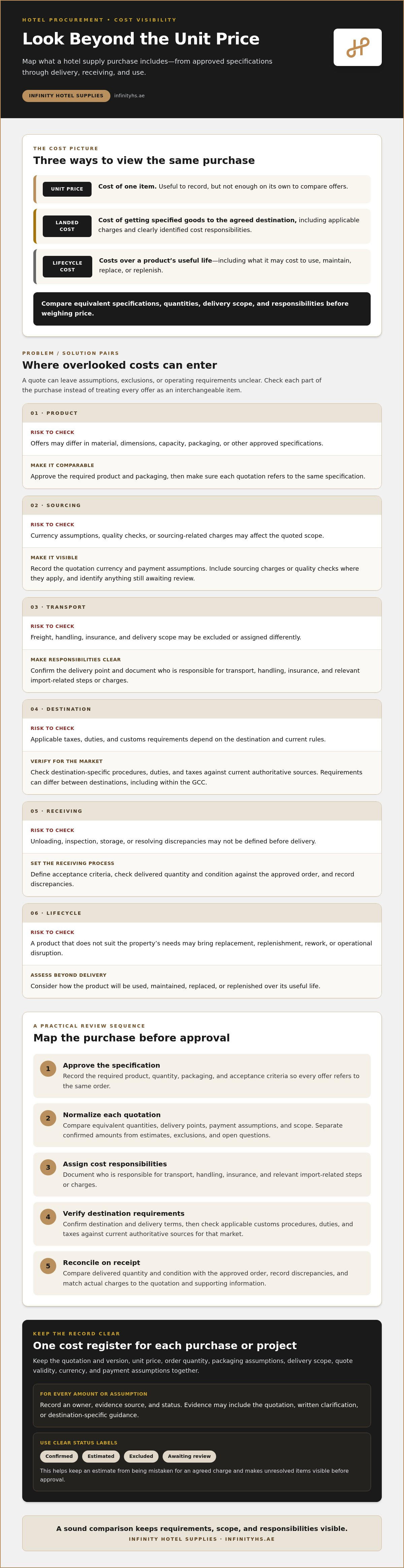
Map potential costs across the full purchase, not just the product line:
- Product: The required material, dimensions, capacity, packaging, or other approved specifications.
- Sourcing: Currency assumptions, quality checks, or sourcing-related charges stated in the quotation.
- Transport: Freight, handling, and delivery scope, including what the quoted amount leaves out.
- Destination: Applicable taxes, duties, and customs requirements, which depend on the destination and current rules.
- Receiving: Unloading, inspection, storage, and the process for recording or resolving discrepancies.
- Lifecycle: Replacement, replenishment, or operational impacts if a product doesn’t suit the property’s needs.
Separate confirmed quotation amounts from estimates, assumptions, and exclusions. Verify destination-dependent requirements against current, authoritative sources for the specific market rather than assuming they are the same across GCC destinations.
Why the lowest quoted price may not be the lowest-cost option
A comparison can mislead if one offer covers a different pack size, quantity, product specification, or delivery scope. For instance, two amenity quotes aren’t directly comparable if they describe different packaging or quantities. Likewise, room electronics with different requirements shouldn’t be treated as equivalent just because their unit prices look similar.
An unsuitable product can also create replacement needs, rework, or operational disruption. The broader Total Cost of Ownership (TCO) concept helps buyers look beyond the initial purchase and consider costs over a product’s useful life.
Unit price is the cost of one item; landed cost is the cost of getting the specified goods to the agreed destination; lifecycle cost considers what they may cost to use, maintain, replace, or replenish. Compare equivalent specifications, quantities, delivery scope, and responsibilities before weighing price. That is the foundation for a dependable purchasing decision.
How to Map the Full Landed Cost of Hotel Supplies
A landed-cost map follows a hotel supply order from its approved specification to delivery and receiving. It helps teams distinguish amounts stated in a quotation from assumptions, exclusions, and charges that depend on the destination. The exact cost categories vary by purchase and market, so use a consistent review process rather than assuming one formula applies everywhere.
Landed cost is the documented cost of bringing a specified order to its agreed delivery point, including applicable charges and clearly identified cost responsibilities.
Build a hotel procurement cost register
Create one register for each purchase or project. Record the supplier quotation and version, unit price, order quantity, packaging assumptions, delivery scope, quote validity, currency, and payment assumptions. Add freight, handling, insurance, or other charges only where they apply to the quotation. Mark every line as confirmed, estimated, excluded, or awaiting review.
For each amount or assumption, identify an owner, evidence source, and status. The owner may be a hotel team, supplier, or another party involved in delivery. Evidence could include the quotation, a written clarification, or destination-specific guidance. This keeps an estimate from being mistaken for an agreed charge and makes unresolved items visible before approval.
Map the cost from specification to reconciliation
- 1. Approve the specification. Record the required product, quantity, packaging, and acceptance criteria so every offer refers to the same order.
- 2. Normalize each quotation. Compare equivalent quantities, delivery points, payment assumptions, and scope. Separate confirmed amounts from estimates, exclusions, and open questions.
- 3. Assign cost responsibilities. Document who is responsible for transport, handling, insurance, and any import-related steps or charges relevant to the shipment.
- 4. Verify destination requirements. Confirm the destination and delivery terms, then verify applicable customs procedures, duties, and taxes against current authoritative sources for that market. Requirements can differ between destinations, including within the GCC.
- 5. Reconcile on receipt. Compare the delivered quantity and condition with the approved order, record discrepancies, and match actual charges to the quotation and supporting documents.
Keep currency and payment terms visible in the register, including the currency used for the quote and any stated payment timing or conversion assumption. Don’t predict exchange movements. Instead, flag what the offer specifies and who owns any unresolved exposure. A consolidated register can also make fragmented supply arrangements easier to review, a concern discussed in UKHospitality’s article on simplifying the supply chain through consolidation.
This documented process is a practical foundation for how to avoid hidden costs in hotel procurement. For hotel projects involving several product categories, a coordinated view of sourcing, quality control, and logistics can help keep requirements and responsibilities clear.
How to Compare Hotel Procurement Quotes Beyond Unit Price
Once the cost components are mapped, compare supplier offers against the same purchasing brief. A side-by-side comparison table makes differences visible and gives finance, procurement, and hotel teams a shared basis for review. Use columns for each supplier and rows for the criteria below, keeping confirmed information separate from estimates or unanswered points.
Compare like-for-like specifications and delivery scope
Before comparing totals, align the written specification, approved samples, order quantity, packaging, and delivery destination. A linen quote for one material or size is not equivalent to a quote for another, even if both are listed as hotel linen. The same principle applies when sourcing heavy-duty hospitality assets—such as commercial kitchen and cooling systems from suppliers like Üzletguru—or room electronics, where differences in capacity, energy ratings, or configuration can substantially alter both the product and the scope of supply.
Include distinct rows for product specification, quantity, packaging, delivery point, and acceptance criteria. Then give inclusions and exclusions their own columns. For example, note whether delivery to the agreed receiving point is included, and record any stated handling or other charges separately. This makes it easier to see whether a lower price reflects a true cost advantage or a narrower scope. For linen purchases, keep the required material, dimensions, and other approved details explicit in the comparison.
Include quality, replenishment, and operational fit
A strong comparison also considers how well each option fits the property’s use. Record the quality evidence provided, such as an approved sample or documented specification, and assess it against the hotel’s stated requirements. Avoid assuming a product will last for a particular period unless reliable evidence supports that expectation.
Replenishment and consistency matter, too. If a property needs to reorder amenities or match room electronics across rooms, note the required product identity and any documented continuity assumptions. A quote that meets the initial order but leaves future replenishment unclear may carry operational risk. LODGING Magazine has discussed how hidden costs in hotel procurement can arise when purchasing lacks transparency, reinforcing the value of recording evidence rather than relying on broad claims.
- Specification: Does the offer match the approved requirements and sample?
- Quantity and packaging: Are order units and pack assumptions aligned?
- Delivery scope: Are destination, inclusions, and exclusions clear?
- Quality evidence: What documentation or sample supports the offer?
- Operational fit: Does the item suit intended use and replenishment needs?
- Cost assumptions: Which amounts are confirmed, estimated, or excluded?
Use documented criteria to assess each offer, not unsupported supplier rankings or generic savings claims. This is a practical step in how to avoid hidden costs in hotel procurement: keep product equivalence visible, then weigh the full scope and operational fit alongside price.
How to Prevent Procurement Cost Surprises Before Approval
A purchase should not move to approval while important scope or cost questions remain buried in emails or informal conversations. A concise approval record gives finance, procurement, and hotel teams the same version of the decision and provides a reference when the goods arrive and invoices are reviewed.
Create a pre-approval checklist for hotel purchases
Before issuing a purchase order, record the decision in a checklist or approval file. Keep the quotation version and supporting documents together so the approved scope is clear.
- Specification and quantity: Confirm the approved product requirements, order quantity, packaging, and any sample or quality criteria used for evaluation.
- Delivery and receiving: State the delivery destination, included delivery scope, receiving responsibilities, and process for checking goods on arrival.
- Quotation scope: Record what the offer includes, excludes, assumes, and leaves dependent on destination-specific requirements.
- Cost ownership: Name the person or team responsible for each unresolved amount or assumption, along with its evidence source and review status.
- Decision record: Note the selected offer, approval owner, rationale, and any conditions that must be resolved before the order proceeds.
If a cost remains unverified or variable, don’t treat it as a confirmed amount. Mark it as provisional, assign an owner to verify it, and document how the project will handle it. Depending on the uncertainty and its potential impact, the approval process might pause until evidence is available or record a clearly defined contingency for budget review. Avoid applying an arbitrary percentage that has no basis in the purchase details.
Manage changes, quality control, and receiving
Set a written change process before the order is placed. Record any change to specification, quantity, packaging, delivery point, or scope with its reason, cost impact, and approval before it becomes part of the order. This prevents teams from working from different versions of the same purchase.
Plan quality checks against the approved requirements, then document the receiving outcome before products move into hotel operations. For example, record whether quantities match the order and whether items meet the agreed acceptance criteria. Route discrepancies to the assigned owner and retain the relevant delivery and approval records for invoice reconciliation.
These controls make how to avoid hidden costs in hotel procurement a repeatable approval practice, not just a quote-review exercise. Apply the same documented approach to operational supplies and equipment—whether procuring commercial catering displays from specialists like TFSE Products Ltd or ordering guest-room essentials—so purchases remain aligned with hotel requirements.
How Coordinated Hotel Sourcing Supports Cost Visibility
For hotel projects with several product categories, teams need more than separate quotations. They need a consistent view of product requirements, sourcing, quality review, and delivery. Bringing these details together helps decision-makers see how each purchase fits the wider project and where responsibilities or assumptions may differ.
When coordinated sourcing can help hotel teams
Coordination is useful when a project involves multiple stakeholders, specifications, or delivery requirements. Finance may focus on budget assumptions, while hotel teams understand how products need to perform in daily operations. A shared project record brings these perspectives together, helping purchasing decisions reflect both financial requirements and practical use.
Consistent documentation also supports communication from quotation review through receiving. Teams can work from the same records for specifications, quantities, quality criteria, delivery details, and cost assumptions instead of relying on disconnected files. This makes gaps easier to identify and can help reduce avoidable mismatches or rework, without promising a particular saving or outcome.
Founded in 2014, Infinity Hotel Supplies has offices in the UAE, China, and the United Kingdom. Its hospitality project work can bring sourcing, quality control, and logistics management into a coordinated view across product categories. This supports tailored multi-category sourcing and project coordination, with requirements and responsibilities documented as the project develops. For hotel projects in the GCC, Middle East, and Africa, destination-specific delivery and import requirements should remain visible in the project record.
Prepare a clear brief for your next procurement decision
A concise brief gives project teams a shared starting point. Gather the information that shapes the comparison and identifies open questions:
- Product requirements: Specifications, approved samples, quantities, packaging, and quality criteria for each category.
- Project details: Delivery destination, project schedule, receiving process, and approval requirements.
- Cost questions: Quotation assumptions, exclusions, currency and payment terms, and destination-specific matters requiring verification.
- Responsibilities: The owner for each decision, unresolved cost item, quality review, and receiving check.
Keep uncertain items visible rather than treating them as settled. Assign an owner and next step, such as obtaining written clarification or verifying destination requirements against current authoritative sources. This gives the team a clearer basis for approval and follow-up.
Align specifications, compare equivalent scope, document assumptions, and track quality and delivery through receipt. This approach gives hotel teams a consistent record for decisions and follow-up across product categories.
Make Your Next Hotel Purchase More Predictable
Understanding how to avoid hidden costs in hotel procurement means looking beyond the quoted unit price. Compare equivalent specifications and quantities, map the full delivered scope, and document assumptions, exclusions, and cost responsibilities before approval. Then carry those requirements through quality checks, receiving, and invoice review.
This disciplined approach helps hotel teams protect budgets while maintaining product quality and operational fit. It also gives finance, procurement, and property teams a shared record for decisions and follow-up.
Infinity Hotel Supplies provides hotel linens, room electronics, amenities, and other hospitality supplies. Its turnkey project work can include sourcing, quality control, and logistics management. With offices in the UAE, China, and the United Kingdom, the company supports hospitality projects across the GCC, Middle East, and Africa.
Discuss your hotel procurement requirements with Infinity Hotel Supplies to explore coordinated sourcing and project support.
Frequently Asked Questions
What are hidden costs in hotel procurement?
Hidden costs in hotel procurement are foreseeable expenses or risks that an initial unit-price comparison may miss. A quotation may clearly state product price and quantity while leaving freight, handling, delivery responsibilities, or other assumptions unclear. Replacement needs or rework can also affect total spend later. The term describes gaps in cost visibility, not necessarily charges deliberately concealed by a supplier.
How do you calculate the total cost of hotel supplies?
Compare costs by purchase component rather than relying on a single total. Start with the approved specification and quantity, then record quoted product amounts, applicable freight and handling, delivery scope, destination-dependent charges, and receiving or lifecycle considerations. Separate confirmed figures from estimates, exclusions, and assumptions, and assign an owner to unresolved items. A practical way to learn how to avoid hidden costs in hotel procurement is to compare identical terms and reconcile actual charges at receipt.
What costs should hotels include when comparing international supplier quotations?
Review each quotation for applicable freight, handling, insurance, and delivery charges, then identify who is responsible for each item. Record the quote currency and payment assumptions so offers can be compared on a consistent basis. Customs procedures, duties, and taxes depend on the destination and current requirements, so treat them as destination-specific items to verify, not automatic additions or uniform costs across the GCC.
How can hotels compare supplier quotations fairly?
Use the same written specification, quantity, packaging assumptions, delivery destination, and acceptance requirements for each offer. Compare inclusions and exclusions in separate fields, and distinguish confirmed amounts from estimates or unresolved assumptions. Product equivalence matters: offers for different materials, dimensions, capacities, or pack sizes aren’t directly comparable. Once the scope aligns, assess quality evidence and operational suitability alongside the quoted price.
Can a lower unit price lead to higher hotel procurement costs?
Yes, it can, although a low unit price doesn’t automatically mean a poor choice. If a product differs from the approved specification or doesn’t suit hotel operations, it may create replacement needs, rework, or disruption. A price comparison should therefore consider delivered scope, quality evidence, and practical fit, as well as the initial amount. These checks help teams identify risks before approving a purchase.
How can hotels manage import-related costs in the GCC?
Start by documenting the shipment’s destination, delivery terms, and responsibility for transport and import-related costs. Verify applicable customs procedures, duties, and taxes against current authoritative information for that specific destination. Requirements shouldn’t be assumed to be uniform across GCC countries or other markets. Record the source and status of each cost assumption, along with the person responsible for resolving any open questions before approval.
What should a hotel procurement approval checklist include?
Record the approved specification, quantity, packaging, quotation version, delivery destination, and receiving responsibilities. List what the quotation includes, excludes, or assumes, and flag any destination-dependent costs that still need verification. Identify the owner of each unresolved item, the approval owner, and the reason for the purchasing decision. Keep these records together so the team can review delivery, quality, and invoices against the agreed scope.

Article by
Infinity Editorial Team
With deep expertise in hospitality product FF&E and OS&E across the Middle East and Africa, Infinity Editorial Team brings insights from Infinity Hotel Supplies, helping developers, hoteliers, and homeowners transform spaces from empty shells to fully furnished, design-ready environments.
Disclaimer
The content published by Infinity Editorial Team is intended for informational purposes only. All articles, guides, and insights are based on industry knowledge and experience in hospitality FF&E and OS&E supply across the Middle East and Africa. Infinity Hotel Supplies does not guarantee specific outcomes and recommends consulting a qualified professional for project-specific requirements.


