

Did you know that 71% of hotel owners currently identify the rising cost of goods and supplies as their most significant financial pressure? In a year defined by shifting trade tariffs and erratic shipping lead times through Middle Eastern ports, the margin for error in your procurement strategy has effectively vanished. You've likely felt the strain of rising cotton prices for your linens or the difficulty of maintaining premium brand standards while costs climb. It's a complex puzzle that requires more than just reactive spending adjustments.
Managing hotel procurement budgets in a volatile market demands a shift from simple transactions to strategic, long-term partnerships. We understand that your goal isn't just to save money. You need to ensure every guest interaction remains exceptional despite global supply chain fluctuations. This article provides the master framework you need to achieve budget predictability for 2026. You'll discover how value engineering and holistic supply chain visibility can reduce logistical headaches and protect your Operating Supplies and Equipment (OS&E) investments. We'll explore the specific tactics that transform procurement from a cost center into a reliable pillar of operational stability.
Key Takeaways
- Identify the specific 2026 economic drivers, such as raw material cost hikes and Middle East shipping trends, that directly impact your bottom line.
- Master value engineering techniques to preserve high-end brand standards for OS&E while navigating significant budgetary constraints.
- Discover why a consolidated partnership model is the most robust strategy for managing hotel procurement budgets in a volatile market.
- Learn to leverage long-term demand forecasting to secure bulk pricing for critical inventory like hotel linens and guest room electronics.
- Evaluate the logistical benefits of an end-to-end supply chain partner to minimize lead-time uncertainty and reduce vendor fragmentation.
Navigating the 2026 Hospitality Procurement Landscape
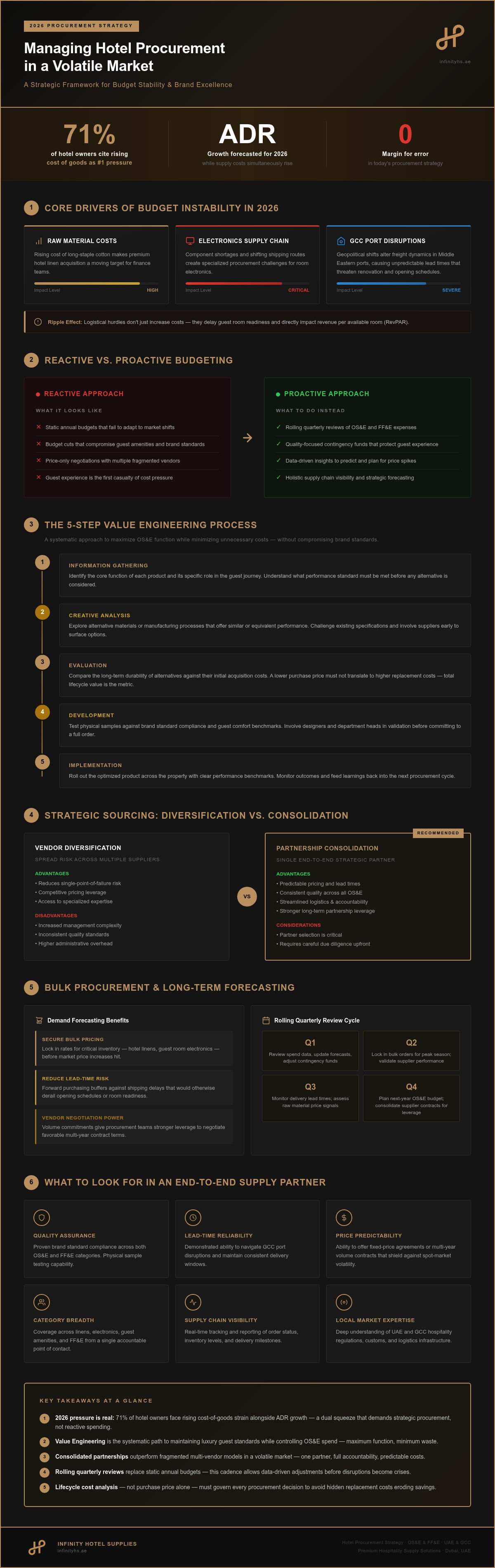
The 2026 hospitality market is defined by a shift from predictable seasonal cycles to a state of constant flux. Managing hotel procurement budgets in a volatile market no longer involves simple price negotiations; it requires a sophisticated understanding of how global macroeconomics impact local operations. Volatility currently manifests as a forecasted growth in Average Daily Rates (ADR) alongside a 71% reported pressure on the cost of goods. This environment makes the traditional procurement process more complex, as supply chain disruptions in Middle Eastern ports collide with rising raw material costs and energy-driven price hikes. When market instability hits, the pressure to cut costs often threatens the very brand standards that drive guest loyalty.
Identifying Core Drivers of Budget Instability
Raw material fluctuations remain a primary concern for luxury operators. Specifically, the rising cost of long-staple cotton has made the acquisition of premium hotel linen a moving target for finance teams. Similarly, the electronics sector faces unique pressures. Procuring high-quality room electronics now requires navigating specialized supply chains that are sensitive to both component shortages and shifting shipping routes. In the GCC, geopolitical shifts have altered freight dynamics, often leading to unpredictable lead times that threaten to derail renovation schedules or new property openings. These logistical hurdles don't just increase costs; they create a ripple effect that can delay guest room readiness and impact overall revenue per available room.
Moving from Reactive to Proactive Budgeting
Static annual budgets are increasingly obsolete. Modern procurement leaders are adopting rolling quarterly reviews to manage OS&E and FF&E expenses more effectively. This proactive stance allows for the establishment of quality-focused contingency funds that protect the guest experience. Instead of reactive budget cuts that compromise guest amenities, hotels can use data-driven insights to predict price spikes. This foresight is essential for managing hotel procurement budgets in a volatile market, ensuring that brand standards remain intact even when the global economy fluctuates. When budget cuts are handled poorly, the guest experience is often the first casualty. Maintaining high-quality standards in linens and electronics is a non-negotiable requirement for properties that wish to sustain their ADR growth. By focusing on holistic visibility and strategic forecasting, properties can maintain their luxury appeal without falling victim to sudden logistical cost surges.
Implementing Value Engineering for Budget Stability
Value Engineering (VE) serves as a critical methodology for properties looking to balance luxury with fiscal responsibility. It's a systematic approach to ensure that every dollar spent on OS&E or FF&E delivers maximum utility without sacrificing the guest experience. For those looking to Combat Market Volatility Through Procurement, VE provides the technical framework to swap high-cost components for smarter alternatives. Effectively managing hotel procurement budgets in a volatile market requires this shift from simple purchasing to rigorous functional analysis. It's about maximizing function while minimizing unnecessary costs.
The 5-Step Value Engineering Process
Successful value engineering follows a methodical path to ensure brand standards remain intact. This structured flow allows procurement managers to identify savings that aren't immediately obvious on a spec sheet. The process includes:
- Information Gathering: Identifying the core function of the product and its role in the guest journey.
- Creative Analysis: Exploring alternative materials or manufacturing processes that offer similar performance.
- Evaluation: Comparing the long-term durability of alternatives against their initial acquisition costs.
- Development: Testing physical samples for brand standard compliance and guest comfort.
- Implementation: Rolling out the optimized product across the property with clear performance benchmarks.
Collaborating with designers and suppliers early in the project lifecycle is vital. This partnership allows you to identify cost-saving alternatives before specifications are finalized and orders are placed. Analyzing the entire lifecycle of hotel products, from linens to electronics, ensures that a lower purchase price doesn't lead to higher replacement costs later.
Applying VE to Hotel Linens and Textiles
Textiles offer significant opportunities for lifecycle optimization through value engineering. While high thread counts are often equated with luxury, they can sometimes lead to shorter lifespans under the stress of industrial laundering. By Sourcing Durable Hotel Linens that utilize specific blend ratios, properties can reduce laundry costs and increase product longevity. Evaluating these blend ratios is a practical way to maintain the soft feel guests expect while ensuring the fabric withstands frequent high-temperature washes. Managing hotel procurement budgets in a volatile market becomes more predictable when you prioritize durability over vanity metrics. If you're looking to refine your current specifications for better ROI, you can speak with our team about tailored OS&E solutions.
Strategic Sourcing: Diversification vs. Consolidation
Choosing between a broad vendor base and a single strategic partner is a pivotal decision for any procurement director. In 2026, the answer isn't binary; it requires a nuanced understanding of risk and efficiency. Managing hotel procurement budgets in a volatile market often feels like a balancing act between the safety of multiple sources and the cost-effectiveness of a consolidated partnership. For GCC-based hotels, where logistics can be complex, a 'one-stop solution' for turnkey OS&E and FF&E projects offers a way to simplify the foundational step in understanding supply chain management while maintaining high quality control standards.
The Case for Vendor Consolidation
Consolidating your vendor list significantly reduces administrative overhead. Instead of managing dozens of individual invoices and delivery schedules, you deal with a single point of accountability. This approach is particularly effective for Streamlined OS&E Solutions, where bulk logistics can lower per-unit shipping costs. A partner with a global footprint, featuring offices in the UAE, China, and the UK, can manage the meticulous details of quality control at the source. This ensures that brand standards are met before items even reach the port, reducing the risk of expensive returns or project delays. By centralizing your spend, you gain stronger negotiating leverage, which is essential for managing hotel procurement budgets in a volatile market.
Diversifying Sourcing for Critical Items
While consolidation drives efficiency, certain high-risk categories benefit from a more diversified mindset. Items like bespoke guest amenities or complex electronics require a resilient supply chain that can pivot during freight disruptions. Managing hotel procurement budgets in a volatile market means identifying which categories are most susceptible to regional instability or raw material shortages. By leveraging a partner with regional expertise across multiple continents, you gain the ability to shift sourcing locations without losing the benefits of a consolidated relationship. This hybrid model ensures supply continuity even when traditional shipping lanes face pressure. A resilient supply chain isn't just about having more vendors; it's about having a partner with the global reach to navigate obstacles with ease and precision.
Locking in Costs: Bulk Procurement and Forecasting
Managing hotel procurement budgets in a volatile market requires looking well beyond the next fiscal quarter. While some competitors suggest frequent bidding to catch market lows, this approach often leaves properties vulnerable to sudden price spikes and inconsistent supply. True stability comes from using historical data to forecast OS&E needs for a period of 12 to 18 months. This long-term view allows you to identify windows of relative market calm to lock in pricing for essential inventory before the next wave of volatility hits.
Effective Inventory Forecasting for 2026
Calculating precise PAR levels is the first step toward a predictable budget. This metric ensures a consistent supply of essentials without the burden of overstocking or the risk of stockouts during peak occupancy. For a technical deep dive into this process, refer to our Hotel Linen PAR Level Calculation Guide. In the Middle East hospitality sector, seasonal demand spikes are often predictable. Securing your stock before these peaks prevents the logistical bottlenecks and premium pricing that occur when every property in the region attempts to restock simultaneously.
Bulk ordering for high-turnover items like hotel linens provides a significant financial buffer. By committing to larger volumes, you can negotiate contracts that include price protection clauses. These clauses act as a hedge against raw material surges, protecting your bottom line from fluctuations in cotton or synthetic fiber costs. A strategic warehousing approach further strengthens this position. Storing essential supplies in regional hubs allows you to bypass future logistics delays, ensuring that your property maintains its guest standards even when global shipping routes face sudden disruptions.
Leveraging Turnkey OS&E Packages
Managing hotel procurement budgets in a volatile market becomes significantly easier when you move away from the uncertainty of spot-buying. Pre-negotiated turnkey packages are a powerful tool for stabilizing costs during new hotel builds or large-scale renovations. These packages consolidate your needs into a single, predictable expenditure. By integrating Comprehensive Hotel Amenities into a turnkey agreement, you eliminate the risk of pre-opening budget overruns caused by fragmented vendor pricing.
Early procurement through these packages ensures that your project remains on schedule. It also guarantees that your brand standards are not compromised by last-minute substitutions when preferred items are out of stock. This methodical approach allows you to maintain the meticulous quality your guests expect while keeping total project costs within your established financial boundaries. By locking in your supply chain early, you transform procurement from a reactive task into a proactive business advantage.
Securing Stability with an End-to-End Partner
A simple vendor fulfills an order; a dedicated procurement partner secures your property’s future. Managing hotel procurement budgets in a volatile market requires more than just a signature on a purchase order. It demands an ally that understands the intricacies of the GCC landscape while maintaining a global operational footprint. This synergy between international reach and local insight is what transforms a standard supply chain into a resilient strategic asset. By moving away from fragmented vendor lists, you eliminate the communication gaps that often lead to costly delays and brand standard deviations.
Global Reach, Local Expertise
Direct-from-factory sourcing is a cornerstone of this stability. By utilizing regional offices in China and the UK, a partner can bypass traditional middleman markups and go straight to the source of production. This is particularly vital for Premium Room Electronics. Managing GCC-specific requirements for technology requires a partner who knows local voltage standards, regional content licensing, and the specific aesthetic demands of Middle Eastern luxury. Meticulous project management at this level ensures that every piece of hardware arrives configured and ready for installation. This global-to-local methodology provides a steady hand in navigating the logistical challenges mentioned in previous sections.
The Partnership Approach to Budgeting
The shift from a transactional relationship to a collaborative partnership is the final piece of the 2026 budget puzzle. It moves the conversation beyond unit prices and into the sphere of long-term operational efficiency. Transparent quality control at every stage of the manufacturing process builds a level of trust that no RFP software can replicate. When you work with an end-to-end provider, you gain access to ongoing value engineering that evolves with market conditions. This ensures your property remains competitive without sacrificing the high-end experiences your guests expect.
As you prepare for the challenges of the coming year, the first step is a thorough review of your current vendor landscape. Auditing your existing strategy for 2026 resilience will reveal hidden inefficiencies and fragmentation that may be draining your budget. Transitioning to a consolidated, turnkey model can reduce logistical headaches and provide the predictability your finance team requires. It's time to move beyond the stress of market fluctuations and toward a future of operational excellence. Managing hotel procurement budgets in a volatile market doesn't have to be a reactive struggle when you have the right support in place.
Achieving Long-Term Fiscal Resilience in Hospitality
Stability in 2026 isn't found in reactive bidding but in the meticulous application of value engineering and data-driven forecasting. By locking in costs for essential OS&E through bulk procurement, you shield your property from the unpredictable price surges that currently define the global economy. Managing hotel procurement budgets in a volatile market requires a fundamental shift toward end-to-end partnerships that offer both direct factory access and deep GCC expertise. This strategy ensures that your financial targets are met without sacrificing the luxury standards your guests expect.
Since our founding in 2014, we've helped major hospitality brands navigate these complexities through turnkey solutions and rigorous quality control from the factory floor to the hotel lobby. This comprehensive approach ensures your guest experience remains uncompromised even as shipping routes and material costs fluctuate. You now have the framework to transform these logistical challenges into a distinct competitive advantage. With a steady hand and a strategic partner, your property is well-positioned for operational excellence and fiscal security throughout the coming year. It is time to move forward with confidence and precision.
Frequently Asked Questions
What is the biggest challenge for hotel procurement in 2026?
The most significant challenge is the confluence of rising operating costs and unpredictable supply chain logistics. Specifically, 71% of hotel owners report that the cost of goods and supplies is their primary financial pressure. In the GCC, shifting shipping routes and trade tariffs further complicate lead times. Effectively managing hotel procurement budgets in a volatile market requires moving beyond reactive bidding to find stability through strategic, long-term forecasting and diversified sourcing.
How does value engineering differ from simple cost-cutting in hotels?
Value engineering is a strategic methodology that maximizes a product's function while minimizing its cost, whereas cost-cutting often sacrifices quality for a lower price. In a hotel environment, this means analyzing the lifecycle of items like linens or electronics to find smarter material blends or manufacturing processes. This approach ensures that you maintain premium guest standards and brand reputation even when you face strict budgetary constraints or rising raw material prices.
Can bulk procurement actually save money if warehousing costs are high?
Bulk procurement often yields significant net savings by locking in prices before market surges, which frequently outweighs the cost of regional warehousing. For high-turnover items like hotel linens, purchasing in volume allows you to negotiate price-protection clauses against raw material inflation. By utilizing a partner with regional hubs, you can bypass future logistics delays and ensure supply continuity. This strategy provides a vital buffer against the price spikes common in a volatile economy.
What are the benefits of using a GCC-based hotel supplier?
A GCC-based supplier provides essential local expertise regarding regional standards, voltage requirements for room electronics, and specialized logistics for the Middle East and Africa. Infinity Hotel Supplies combines this local knowledge with a global footprint, including offices in China and the UK. This allows for direct-from-factory sourcing while ensuring that products meet the specific aesthetic and technical demands of luxury hospitality brands operating within the Gulf region and surrounding areas.
How do I maintain brand standards when market prices are rising?
Maintaining brand standards requires shifting from spot-buying to integrated turnkey OS&E and FF&E solutions. By collaborating with a partner early in the project lifecycle, you can identify cost-saving material alternatives through value engineering before specifications are finalized. This ensures that guest-facing items like premium linens and amenities remain high-quality. Managing hotel procurement budgets in a volatile market effectively means protecting the guest experience through meticulous quality control and strategic vendor consolidation.
Is it better to source linens locally or internationally in the Middle East?
The most effective strategy for the Middle East is a hybrid model that utilizes international sourcing for better pricing and local offices for quality control. Sourcing linens directly from global manufacturing hubs allows for bulk savings on raw materials like long-staple cotton. However, having a partner with a local presence in the UAE ensures that these products meet regional durability standards and can be delivered without the logistical headaches often associated with unmanaged international shipping.
What role does technology play in managing procurement budgets?
Technology transforms procurement from a manual analysis task into a data-driven predictive model. AI-driven tools are now used for predictive demand forecasting and analyzing spending patterns to optimize inventory levels. One case study showed that implementing AI improved demand forecasting accuracy from 72% to 91%, leading to a 34% reduction in waste. These insights help properties move toward continuous optimization and smaller, more frequent negotiations that adapt to real-time market conditions and demand fluctuations.
How often should I review my hotel's OS&E budget?
Traditional annual reviews are no longer sufficient in the current economic climate. You should transition to rolling quarterly budget reviews to account for rapid changes in raw material costs and freight rates. This proactive approach allows you to establish contingency funds and adjust procurement strategies before price spikes impact your bottom line. Regular reviews ensure that your OS&E and FF&E investments remain aligned with both your financial targets and your property’s operational requirements.

Article by
Infinity Editorial Team
With deep expertise in hospitality product FF&E and OS&E across the Middle East and Africa, Infinity Editorial Team brings insights from Infinity Hotel Supplies, helping developers, hoteliers, and homeowners transform spaces from empty shells to fully furnished, design-ready environments.
Disclaimer
The content published by Infinity Editorial Team is intended for informational purposes only. All articles, guides, and insights are based on industry knowledge and experience in hospitality FF&E and OS&E supply across the Middle East and Africa. Infinity Hotel Supplies does not guarantee specific outcomes and recommends consulting a qualified professional for project-specific requirements.


