

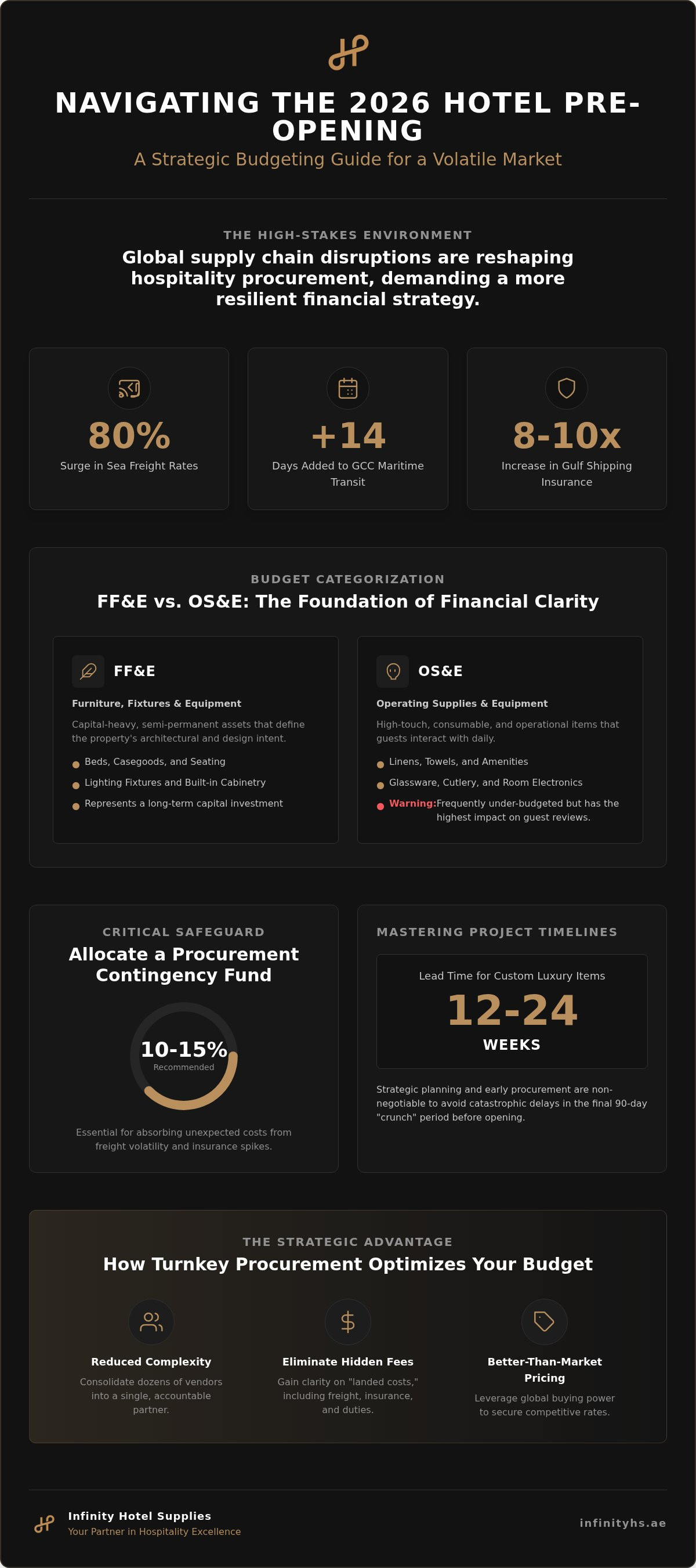
With sea freight rates surging by up to 80% and maritime transit times to the GCC extending by 14 days this year, the margin for error in hospitality procurement has never been thinner. You likely feel the weight of the final 90 days before opening, where the fear of hidden costs and fragmented supplier coordination often threatens to derail a luxury launch. It's a high-stakes environment where a standard spreadsheet isn't enough to safeguard your investment. That's why we've developed a professional hotel pre-opening budget template tailored for the specific logistical demands of 2026.
We understand that maintaining alignment between a sophisticated design vision and budget reality is your top priority. This article provides a robust framework to master your procurement lifecycle, from estimating lead times for custom linens to integrating LOVO premium electronics. You'll gain access to an editable structure and a meticulous checklist designed to reduce the risk of delayed openings. By the end of this guide, you'll have the strategic tools needed to manage global suppliers with the confidence of a seasoned partner, ensuring your property opens on time and within its financial parameters.
Key Takeaways
- Understand why the 2026 logistical landscape requires a flexible financial bridge to account for surging freight costs and extended maritime lead times.
- Learn to differentiate accurately between FF&E and OS&E categories to ensure every guest touchpoint is accounted for in your financial planning.
- Discover how to utilize a professional hotel pre-opening budget template to align your design vision with the practicalities of procurement and quantity take-offs.
- Master the management of 12-24 week lead times for custom luxury items by leveraging strategic hubs like Dubai for regional supply chain stability.
- Identify the operational advantages of turnkey procurement solutions in reducing vendor complexity and securing better-than-market pricing through global buying power.
The Strategic Importance of a Hotel Pre-Opening Budget in 2026
The final 90 days before launch, often called the "crunch," is where procurement errors become most catastrophic. Mistakes during this phase are the most expensive because options for correction are limited by time. When a critical shipment of guest room amenities or equipment is delayed due to rerouted shipping lanes, the cost of air-freighting replacements can consume a contingency fund in a single week. A well-structured hotel pre-opening budget template ensures that owners, operators, and procurement partners remain in lockstep, preventing the costly miscommunications that lead to delayed grand openings.
To better understand the risks associated with poor financial planning in hospitality, watch this helpful video:
The Financial Architecture of a New Hotel Launch
Launching a property within the hospitality industry requires a clear distinction between Capital Expenditure (CAPEX) and Pre-Opening Expenses. While CAPEX covers the physical building and permanent assets, the pre-opening budget focuses on the supplies and operational readiness required to welcome guests. This includes working capital requirements for the first six months of operation, ensuring that payroll and utility costs are covered while occupancy stabilizes. We recommend allocating a contingency fund of 10-15% specifically for procurement surprises, as 2026 shipping insurance premiums in the Gulf have increased eight to ten times, significantly impacting the total cost of ownership for imported goods.
The Role of Procurement in Budget Accuracy
Precision in budgeting relies on understanding "landed" costs rather than mere "estimated" unit prices. A landed cost includes the original price, insurance, freight, and customs duties, providing a realistic view of what an item actually costs once it reaches your warehouse. Turnkey procurement solutions minimize budget variance by consolidating the supply chain, which eliminates the hidden fees often associated with managing dozens of fragmented vendors. In 2026, inflation is particularly volatile, with hotel linen costs expected to rise by up to 3% in Q1 and room electronics facing similar upward pressure. Relying on a professional hotel pre-opening budget template allows you to track these fluctuations in real-time, ensuring your project remains financially viable despite global market shifts.
Categorizing Your Hotel Pre-Opening Budget Template: FF&E vs. OS&E
Precision in a hotel pre-opening budget template requires a surgical understanding of the boundary between Furniture, Fixtures, and Equipment (FF&E) and Operating Supplies and Equipment (OS&E). While they are often discussed in the same breath, their impact on the balance sheet and the guest experience differs significantly. FF&E represents the capital-heavy, semi-permanent assets that define the architectural intent. In contrast, OS&E encompasses the high-touch items that guests interact with daily. Mistaking one for the other doesn't just create accounting headaches; it can lead to critical supply gaps during the final countdown to opening.
OS&E is frequently under-budgeted because it's often the last category finalized before the soft launch. When construction overruns occur, the OS&E budget is typically the first to be raided. This is a strategic mistake given that these items have the highest correlation with guest reviews. There's also a "crossover zone" where items like specialized leather accessories or decorative desk lamps might shift between categories depending on specific accounting practices. Identifying these potential overlaps early in your hotel pre-opening budget template prevents double-counting or, worse, missing items entirely during the final procurement push.
FF&E: Setting the Stage
FF&E forms the backbone of your property's aesthetic identity. This category includes guestroom furniture, custom lighting, and the decorative fixtures that anchor your public spaces. For luxury properties, the Hotel Cost Estimating Guide from HVS suggests that FF&E costs for luxury hotels can start at $22,000 per room and climb significantly higher. Ensuring these FF&E solutions align with the original design intent is crucial for maintaining brand consistency. This isn't just about appearances; it's about durability and long-term asset management in high-traffic environments like lobbies, dining halls, and spas.
OS&E: The Guest Experience Essentials
If FF&E is the stage, OS&E is the performance. These are the items that directly influence guest satisfaction scores and repeat bookings. Prioritizing premium hotel linens is non-negotiable for properties aiming for elite sleep quality standards. In 2026, guests increasingly demand sustainable luxury, making eco-conscious guest amenities like the LUFTER PHYTOGREEN range a strategic necessity. Modern room electronics also fall under this umbrella. Integrating LOVO premium electronics, from smart docking stations to intuitive controls, ensures the technology matches the tactile luxury of the room's finishes. If you're unsure how to categorize your specific requirements, consulting with a procurement specialist can provide the clarity needed to protect your margins.
The Essential Hotel Pre-Opening Procurement Checklist & Budget Structure
Transitioning from a financial framework to operational reality requires a disciplined, step-by-step methodology. While finance departments often view budgeting as a purely fiscal exercise, successful procurement managers use a hotel pre-opening budget template as a living checklist. This ensures that every item, from the grandest lobby chandelier to the smallest vanity tray, is accounted for before the soft opening date arrives. Precision at this stage prevents the last-minute scramble that often results in compromised quality or inflated air-freight costs.
- Step 1: Quantity Take-offs: Calculations must be based on actual room counts and specific par levels. For high-turnover items like linens, a 3-par or 4-par system is standard to ensure one set is in the room, one is in the laundry, and one is in storage.
- Step 2: Specification Development: Create detailed technical sheets for every item. This prevents "quality drift" where inferior substitutes are purchased because the original requirements weren't clearly defined.
- Step 3: Vendor Shortlisting: Leverage global sourcing networks to identify suppliers that meet luxury standards. This phase involves managing Requests for Quote (RFQs) across multiple time zones and currencies.
- Step 4: Comparison and Selection: Decisions should be based on the "Total Cost of Ownership." This includes the purchase price plus freight, insurance, and the projected operational lifespan of the product.
- Step 5: PO Issuance and Tracking: Once orders are placed, real-time tracking is essential. In the 2026 climate of maritime delays, knowing exactly where your cargo sits is the only way to manage project risk.
Room and Bathroom Accessories Checklist
Guest touchpoints require a meticulous eye for detail. Budgeting for leather accessories such as desk blotters, remote holders, and tissue boxes adds a layer of tactile luxury that guests notice immediately. Similarly, essential bathroom accessories, including soap dispensers and amenity trays, must be durable enough to withstand daily cleaning with industrial chemicals. Establishing par levels for towels and bathrobes early ensures that your housekeeping team has the inventory needed to maintain a seamless operational flow from day one.
Housekeeping and Back-of-House Needs
Efficiency in the back-of-house is the engine of a successful hotel. Selecting heavy-duty, ergonomic housekeeping trolleys reduces physical strain on staff and speeds up room turnover. This section of your budget must also account for uniforms across all departments. Managing the design, sizing, and inventory of uniforms for a full staff is a complex logistical task that requires early planning. Finally, don't overlook the specialized operating equipment needed for your laundry and maintenance departments to protect your long-term FF&E investments.
Managing Logistics, Lead Times, and Quality Control in the GCC
Logistical volatility in the GCC has rendered traditional procurement schedules obsolete. In 2026, a hotel pre-opening budget template must account for lead times of 12 to 24 weeks for bespoke hospitality products. This extended window is driven by the 10-14 day maritime transit delays and the Strait of Hormuz crisis, which has pushed war risk insurance premiums up by eight to ten times. Dubai remains the indispensable center for hospitality procurement in the UAE, offering the specialized infrastructure and bonded warehousing necessary to manage these shifting timelines with precision and reliability.
Quality control protocols must begin at the point of origin, long before cargo reaches the Gulf. Conducting meticulous inspections at factories in China or the UK is non-negotiable to prevent the arrival of non-compliant goods that could stall an opening. Consolidated shipping provides a significant strategic advantage in this environment. By grouping FF&E and OS&E orders into single, managed shipments, operators can mitigate the 40-80% increase in sea freight rates seen this year. This approach protects the bottom line while ensuring that guest room electronics and linens arrive in a synchronized sequence, ready for immediate installation upon delivery.
Navigating Middle East Sourcing Challenges
Navigating the Middle East requires a deep familiarity with customs duties and VAT implications, which can vary significantly across the GCC. Materials must be selected with the local climate in mind, prioritizing high-performance finishes that withstand extreme heat and high humidity without losing their aesthetic appeal. Professional hospitality procurement solutions mitigate regional logistics risks by providing a steady, business-like composure to supply chain management and ensuring that all regulatory paperwork is handled with foresight. This level of preparation is what separates a seamless launch from a project plagued by customs delays.
The Importance of Physical Sampling
Physical sampling is the final safeguard against design discrepancies and manufacturing errors. We require "Golden Samples" for every custom linen and uniform order before mass production is authorized. This stage is critical for managing the approval process between interior designers, who prioritize aesthetics, and hotel operators, who require operational durability. Infinity Hotel Supplies manages this global quality control through regional offices in China and the UK, providing a seasoned hand to navigate complex manufacturing challenges. This presence ensures that the final guest experience remains uncompromised and perfectly aligned with the original brand vision. To secure your 2026 supply chain against these regional disruptions, connect with our global logistics experts today.
Partnering for Success: How Turnkey Procurement Solutions Optimize Your Budget
Strategic procurement is the final line of defense against the market volatility described in previous chapters. While a hotel pre-opening budget template provides the necessary structure, the execution of that plan determines the property's ultimate financial health. Choosing hotel procurement outsourcing allows operators to shift from a reactive stance to a proactive one. This model replaces the administrative burden of managing 100 or more individual vendor contracts with a single, accountable partnership. By consolidating your requirements, you leverage global buying power to secure pricing that is often unattainable through direct, one-off negotiations.
Turnkey solutions also ensure absolute compliance with brand standards across all OS&E and FF&E categories. In a luxury environment, even a minor deviation in the thread count of your linens or the interface of your room electronics can dilute the guest experience. A dedicated procurement partner maintains the "Golden Samples" and technical specifications established in your checklist, ensuring that mass-produced items mirror the approved prototypes perfectly. This level of oversight eliminates the quality failures that generic software solutions simply cannot detect or resolve. It's a commitment to excellence that moves beyond simple transactions.
Why Infinity Hotel Supplies is the Preferred GCC Partner
Founded in 2014, Infinity Hotel Supplies has spent over a decade navigating the specific complexities of the Middle East and African hospitality markets. We provide a comprehensive range of high-end solutions, from our signature hotel linen to the sophisticated integration of LOVO premium electronics. Our global footprint, with sourcing offices in China and the UK, allows for direct quality control at the source. This proven track record in turnkey procurement for luxury launches makes us a steady, experienced ally for developers who prioritize operational excellence and long-term reliability in every detail.
Next Steps: Finalizing Your 2026 Pre-Opening Budget
As you move toward your launch date, the priority shifts to validation and scheduling. Conduct a final review of your hotel pre-opening budget template against the latest 2026 market rates for textiles and equipment, as F&B and linen costs have seen increases of up to 5% this year. Once the figures are stabilized, establish a rigid delivery and installation schedule that accounts for the current 14-day maritime delays in the GCC. To refine your OS&E specifications or to request a professional audit of your procurement checklist, contact our specialist team today. Let's ensure your property opens with the precision and sophistication your guests expect.
Securing Your Property’s Future with Strategic Procurement
Managing the final months before opening shouldn't be a period of uncertainty. Since 2014, we've acted as a meticulous facilitator for luxury properties, leveraging our global sourcing offices in the UAE, China, and the UK to deliver stability. Whether you require the technical precision of LOVO electronics or the sustainable luxury of our LUFTER PHYTOGREEN amenities, our turnkey expertise reduces the complexity of your supply chain. It's time to move beyond transactional procurement and embrace a partnership built on excellence and reliability.
Request a Professional OS&E Budget Consultation to secure your property's operational success. Your vision deserves a foundation of uncompromising quality.
Frequently Asked Questions
What are the typical pre-opening costs for a 4-star hotel?
Typical pre-opening costs vary based on the scale and location of the property. For upscale properties in 2026, setup budgets often range from $14,000 to $22,000 per room, while luxury properties can exceed $50,000. These figures encompass everything from initial FF&E to the first full inventory of OS&E. It's essential to include a 10-15% contingency fund to manage current volatility in global shipping and insurance premiums.
How much of the hotel budget should be allocated to OS&E?
OS&E allocation generally accounts for 15% to 20% of the total furniture, fixtures, and equipment budget. While it represents a smaller capital outlay than FF&E, these high-touch items have the most significant impact on guest satisfaction scores. Investing in premium linens and electronics early ensures that your operational standards align with your brand promise. A well-structured hotel pre-opening budget template helps track these essential guest-facing investments without overextending your working capital.
What is the difference between FF&E and OS&E in hotel budgeting?
FF&E refers to Furniture, Fixtures, and Equipment, which are the semi-permanent assets like beds, lighting, and desks. OS&E stands for Operating Supplies and Equipment, encompassing high-turnover items such as towels, soap dispensers, and housekeeping trolleys. The primary difference lies in their accounting treatment and lifespan. FF&E is usually capitalized and depreciated over several years, whereas OS&E is often treated as an operational expense due to its higher replacement frequency.
When should I start the procurement process for a new hotel opening?
You should ideally begin the procurement process 18 to 24 months before the scheduled soft opening. This timeline is necessary to accommodate the 12-24 week lead times now required for custom luxury products in 2026. Early engagement allows for thorough physical sampling and "Golden Sample" approvals. It also provides a buffer against the 14-day maritime transit delays currently affecting the GCC region due to rerouted shipping lanes.
How do I calculate par levels for hotel linens and guest amenities?
Linen par levels are calculated using a 3-par or 4-par system to ensure uninterrupted service. This means one set is in the guest room, one is in the laundry, and one is clean in the linen room, with a fourth par often held as safety stock. For guest amenities, calculations are based on your projected occupancy rates and average daily consumption per occupied room. High-occupancy luxury properties often maintain a 60-day inventory of amenities to mitigate supply chain risks.
What are the most common hidden costs in hotel pre-opening budgets?
Hidden costs frequently arise from logistics, specifically the 40-80% increase in sea freight rates and the 8-10x surge in war risk insurance premiums seen this year. Customs duties, VAT, and local storage fees can also inflate the landed cost of imported goods. If a project falls behind, the cost of air-freighting critical items like uniforms or electronics can decimate a budget. A meticulous hotel pre-opening budget template accounts for these variables to prevent financial surprises.
Can I use a generic Excel template for a luxury hotel budget?
Generic Excel templates often fail to capture the logistical complexities and quality standards required for a luxury property. They typically lack specialized line items for high-end electronics or bespoke leather accessories, which can lead to significant under-budgeting. A professional framework is designed to handle the nuances of 2026 supply chains, including landed cost calculations and extended lead times. Relying on a basic spreadsheet puts your project at risk of quality drift and unexpected cost overruns.
How does a turnkey procurement partner save money on a pre-opening budget?
A turnkey procurement partner saves money by leveraging global buying power to achieve better-than-market pricing on bulk orders. We consolidate FF&E and OS&E shipments to reduce freight costs and minimize the administrative overhead of managing multiple vendor contracts. By conducting quality control at our sourcing offices in China and the UK, we prevent the arrival of defective goods. This end-to-end methodology reduces budget variance and ensures your property opens on schedule without costly delays.

Article by
Infinity Editorial Team
With deep expertise in hospitality product FF&E and OS&E across the Middle East and Africa, Infinity Editorial Team brings insights from Infinity Hotel Supplies, helping developers, hoteliers, and homeowners transform spaces from empty shells to fully furnished, design-ready environments.
Disclaimer
The content published by Infinity Editorial Team is intended for informational purposes only. All articles, guides, and insights are based on industry knowledge and experience in hospitality FF&E and OS&E supply across the Middle East and Africa. Infinity Hotel Supplies does not guarantee specific outcomes and recommends consulting a qualified professional for project-specific requirements.


