

The quietest minibar is not necessarily the lowest-energy option. In a LOVO hospitality minibar vs. Dometic absorption refrigerator comparison for the Middle East, absorption technology is known for silent operation and having no moving parts. To compare energy use, review each model’s specifications under the conditions it will face. Neither technology is automatically more efficient in every hotel.
Both factors matter: guests value a quiet room, while hotel teams need appliances that support efficient daily operations. A useful comparison goes beyond cooling technology to cover actual energy consumption, noise, room use and the demands of a GCC property.
This article explains the differences between absorption and compressor cooling, what to look for in energy and noise information, and how room layout and operating priorities shape the decision. Use it as a practical framework for assessing minibar options for your hotel’s guest rooms.
Key Takeaways
- Compare each minibar’s stated energy use with how it will operate in your rooms, rather than choosing by cooling technology alone.
- Weigh quiet operation against energy priorities, especially where guest-room noise can affect comfort.
- Understand the practical differences between absorption, thermoelectric and compressor cooling before narrowing your options.
- Match minibar capacity, placement and expected use to the room type and hotel operating model.
- Use a consistent comparison of specifications and room requirements to assess options for a GCC property.
Energy efficiency and quiet operation
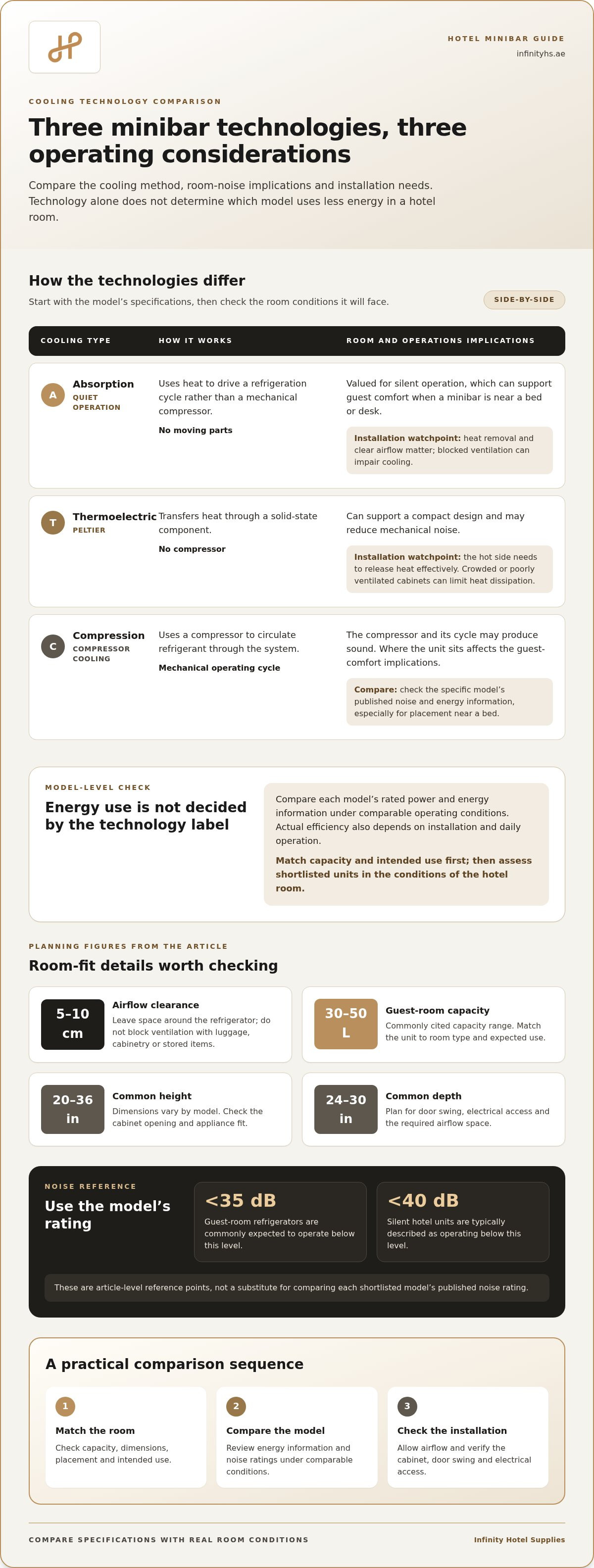
For a GCC hotel, compare energy use and operating noise at the model level. Absorption units are valued for silent operation and having no moving parts, while compressor units use a different cooling technology. The technology label alone does not show which refrigerator will use less energy in a particular room.
Guest-room refrigerators are commonly expected to operate below 35 decibels, and silent hotel units are typically described as operating below 40 decibels. Use the manufacturer’s noise rating to compare shortlisted models. A quiet unit can support guest comfort, especially when the refrigerator sits close to a bed or desk.
Energy efficiency is best assessed by comparing models under comparable operating conditions. Compare each unit’s rated power and energy information under comparable conditions, rather than relying on the technology name. For a property outfitting 100 to 500+ rooms, small differences in appliance use can add up across the room inventory.
Energy efficiency also depends on installation and daily operation. Leave 5-10 cm around the refrigerator for airflow, and avoid blocking ventilation with luggage, cabinetry or stored items. In a warm room or enclosed cabinet, restricted airflow can make cooling harder and affect how efficiently the unit operates.
What are the dimensions, capacities, and installation requirements of LOVO and Dometic models? Dimensions vary by model; hotel refrigerators commonly measure 20-36 inches tall and 24-30 inches deep, with guest-room capacities generally around 30-50 liters. Plan the cabinet opening, door swing, electrical access and ventilation clearance around the chosen unit, including the 5-10 cm airflow space.
Do Middle Eastern hotel regulations or energy-efficiency standards affect minibar selection? Local requirements and project specifications can determine which electrical appliances are permitted and what documentation is needed. Before finalizing a room schedule, compare each model’s energy information and electrical requirements with the destination’s regulations and the project criteria.
What should hotels compare when assessing warranty terms, service coverage and spare-parts availability for LOVO and Dometic in the Middle East? These factors vary by model and market arrangements, not simply by cooling technology. Include warranty duration, service access and parts support in the purchase assessment, alongside energy use and noise.
Efficient minibar restocking supports consistent operation. Group items by shelf and use a room-by-room stock plan so staff can replenish promptly without leaving doors open during extended checks. Keep stock levels aligned with the hotel’s minibar policy. Excess inventory takes up cooling space and makes routine replenishment less straightforward.
For sustainability reviews, assess energy use alongside guest comfort, installation conditions and servicing needs. Record each selected model’s energy rating and noise level in the room-equipment schedule. This gives engineering and housekeeping teams a shared reference for replacements and everyday operating practices.
Absorption, thermoelectric/Peltier, and compression technologies
Hotel minibars use three main cooling approaches: absorption, thermoelectric or Peltier, and compression. Each moves heat differently, affecting noise, cooling behavior, maintenance needs and suitability for a compact guest room. For a fair comparison, match capacity and intended use first, then assess each unit under the hotel’s actual operating conditions.
A LOVO hospitality minibar is an in-room refrigerator within LOVO Premium Electronics, and its cooling technology depends on the model. Dometic absorption refrigerators use absorption cooling, but each model determines its own dimensions, capacity and operating details. The brand name alone does not establish which unit best fits a room or property.
Absorption cooling uses heat to drive a refrigeration cycle rather than a mechanical compressor. This design can operate quietly, an advantage for guests sleeping near the minibar. Performance depends on heat removal and installation conditions, so airflow around the appliance matters. A blocked ventilation path can impair cooling, even when the refrigerator is correctly sized.
Thermoelectric, or Peltier, cooling transfers heat through a solid-state component. It has no compressor, supporting a compact design and potentially reducing mechanical noise. However, the hot side must release heat effectively. A crowded cabinet or poorly ventilated enclosure can limit heat dissipation, so assess the planned installation against the room’s cooling needs.
Compression cooling uses a compressor to circulate refrigerant through the system. This familiar approach provides active cooling, but the compressor and its operating cycle may produce sound. For a practical comparison, review the model’s noise and energy information, then consider its location. A unit beside a bed has different implications for guest comfort from one placed farther away.
What maintenance issues and risks should hotels consider with LOVO minibars and Dometic absorption refrigerators? For both, keep ventilation paths clear and follow the manufacturer’s care instructions. Absorption models require correct installation and airflow; compressor models have moving mechanical components, while thermoelectric models depend on effective heat dissipation. These technology-level considerations do not replace model-specific service guidance.
During room checks, housekeeping teams can note cooling complaints, unusual sounds and visible airflow obstructions. Engineering can then distinguish a placement issue from a unit that needs attention. For example, a minibar struggling inside a tightly enclosed cabinet may need more clearance, while a compressor unit’s operating sound should be compared with its published rating.
Choose according to room function, not technology label alone. A quiet absorption unit may suit a sleep-sensitive room; a compact thermoelectric model may suit a specific light-duty application; compression may fit rooms that need its cooling characteristics. Compare exact model specifications and installation requirements before standardizing equipment across guest rooms.
Absorption and thermoelectric cooling
Absorption and thermoelectric systems both avoid a conventional compressor, but their cooling cycles differ. An absorption refrigerator uses heat to circulate refrigerant through its system. A thermoelectric unit uses a semiconductor module to move heat from one side to another. For hotel teams, these differences affect installation, operating conditions and the guest experience.
Absorption technology has a strong presence in hospitality: it accounted for 56.8% of the mini-bar refrigerator market in 2024. Its quiet operation can suit a boutique room where guests sleep close to the minibar. The design has no moving parts in its cooling cycle, but it still requires suitable ventilation to release heat. Placement inside a tight cabinet can limit that airflow.
Thermoelectric cooling is often used in compact appliances. A Peltier module transfers heat, while a heat sink and fan help disperse it. The fan can make noise, so “thermoelectric” does not necessarily mean silent. Review the complete unit’s noise rating and installation instructions, especially if the minibar is beside a bed or work area.
Cooling performance depends on the operating environment. Both technologies must move heat away from the cabinet, and restricted ventilation can interfere with that process. In a warm guest room, compare each model’s stated operating conditions and cooling performance. Two units with similar external dimensions may not maintain the same interior temperature under identical room conditions.
Use a practical comparison process before choosing:
- Match the load: Identify the drinks and items guests will store, including whether upright bottles matter.
- Check capacity: Guest-room refrigerators typically hold 30-50 liters, but the usable shelf layout matters as much as total volume.
- Review cooling range: Hotel guest-room refrigerators typically cool to around 0-10°C; compare the target model’s stated range with the hotel’s intended use.
- Plan the location: Check airflow, cabinet openings, door swing and nearby sleeping areas before fixing the room layout.
- Compare consumption: Use each model’s energy information and expected operating conditions, not technology type alone.
For sustainability planning, record each selected model’s cooling technology, rated energy information and room location. This gives engineering teams a consistent basis for reviewing electricity use across room types. A boutique property may prioritize quiet operation in every room, while a larger hotel may also weigh standardization and ease of routine maintenance.
Neither absorption nor thermoelectric cooling is automatically right for every room. Compare actual model specifications with guest needs, room conditions and operating standards. This connects cooling performance with energy consumption and helps protect guest satisfaction without relying on technology labels alone.
Absorption minibars
Absorption minibars may suit hotels that prioritize a quiet guest-room experience. Select them according to room function, not a property-wide assumption. A minibar intended for bottled drinks has different interior needs from one expected to hold varied packaged items. Start by defining what each room category will offer guests.
Build the specification around the items to be stocked. Note bottle sizes, package shapes and the planned shelf arrangement, then compare those needs with the usable interior. A practical layout and adjustable shelves can make the space easier for guests to use and staff to restock.
Before approval, assess a sample unit in a representative room. Check that the door opens comfortably beside the furniture and that guests can reach the controls without moving stored items. This practical review can reveal usability concerns that a product sheet alone may not show.
Use a room-use checklist to guide the selection:
- Define the stock: List the drinks and packaged items planned for each room category.
- Review the layout: Check shelf positions, door storage and access to the interior.
- Test guest use: Confirm that controls are easy to reach and simple to understand.
- Plan replenishment: Arrange items so staff can identify missing stock during routine room service.
- Document the standard: Record the approved setup for housekeeping and engineering teams.
Restocking procedures also shape the minibar experience. A fixed shelf plan helps staff spot missing items and return products to consistent positions. For example, placing frequently selected drinks together can make the arrangement easier to understand, while a room checklist can record stock levels without relying on memory.
Keep the setup consistent within each room category. If the hotel changes its minibar assortment, update the shelf plan and staff instructions at the same time. This reduces confusion between rooms and helps teams maintain a predictable presentation for guests.
Absorption models are one option for hotels seeking a quiet minibar, but selection should also account for usability and daily service. Reviewing a representative room, defining a stock plan and documenting the interior layout provide practical criteria beyond cooling technology. These details help align the appliance with the room’s purpose and the hotel’s operating routines.
Capacity is another useful check alongside the interior layout. Hospitality mini bar refrigerators commonly range from 1.7 cubic feet and 3.2 cubic feet. For compact hotel rooms or boutique properties, a mini bar refrigerator with a capacity of 1.7 to 2.4 cubic feet is often a practical choice. Mini bar refrigerators with capacities between 2.5 and 3.2 cubic feet are commonly used in larger guest rooms, suites, and extended-stay properties. Hotel mini-fridges are generally described as ranging from 1.7-4.5 cubic feet, so compare the intended room use with the specific unit’s usable space rather than relying on a broad category alone.
Allow for installation conditions as well as capacity. Allow ventilation space around the unit and check placement guidance before installation. Check the manufacturer’s placement guidance and the room plan before choosing a location, particularly where the appliance will sit within cabinetry or close to furnishings. Adequate clearance can support the intended operation, while a suitable location keeps access convenient for guests and staff. Include the space around the unit in the sample-room review, and confirm that the planned position does not interfere with the door swing or the room’s circulation. A capacity that suits the stock plan still needs to fit the space safely and practically.
Compressor versus absorption refrigerator energy use
A compressor or absorption label cannot tell you which minibar uses less electricity. Consumption depends on the exact model, cooling capacity, room conditions and installation. Compare model-level energy figures on the same basis, then weigh noise, temperature performance and guest convenience together. Hotels comparing LOVO hospitality minibars with Dometic absorption refrigerators in the Middle East should assess specific models, not brand names alone.
There is no single energy-consumption figure that applies to every LOVO or Dometic minibar refrigerator. Compare the rated energy information for the exact models under consideration. Check that the figures use comparable conditions, since different test methods or assumptions can make a direct comparison misleading.
Compressor refrigerators use a mechanical cycle to move refrigerant and remove heat. Absorption models use heat to drive their cooling cycle. Because their operating patterns differ, a simple wattage comparison may not reflect energy use over a full day. Review each manufacturer’s stated consumption alongside the operating conditions and temperature performance.
Performance in hot climates depends on each model’s rated ambient conditions and ability to release heat. Absorption, compressor and thermoelectric units all need suitable ventilation. For a minibar installed in a warm room or cabinet, compare the stated temperature range and cooling performance, then plan the installation around required airflow. A model suited to an open room may perform differently in a restricted enclosure.
Use this sequence to evaluate shortlisted models:
- Compare like with like: Match capacity and intended room use before comparing energy consumption.
- Review energy data: Record each model’s rated power and stated consumption in the equipment schedule.
- Check temperature needs: Compare the operating range with the drinks and items the hotel plans to store.
- Assess sound: Consider whether compressor operation matters in rooms where guests sleep near the minibar.
- Inspect placement: Allow the clearance specified for the selected model and keep vents unobstructed.
A quiet absorption unit may suit a room where noise is a priority, while a compressor model may better match another room’s cooling needs. Neither choice guarantees lower energy use. When comparing LOVO hospitality minibars and Dometic absorption refrigerators for Middle East hotels, weigh model-specific consumption against the required temperature, room conditions and operating pattern.
At property scale, multiply each unit’s expected consumption by the number of rooms and planned operating hours. This creates a consistent estimate for comparing alternatives without assuming every room is used identically. Track minibar type, room location and energy data together so engineering teams can review performance after installation and refine future equipment specifications.
The final selection should always reflect a careful balance of guest priorities, not just a headline energy figure. In a survey of US travellers, 82% chose silent operation over the lowest energy consumption when asked to trade off between them. In a survey of German travellers, 89% made the same choice. Energy-efficient mini-refrigerator models consuming less than 1 amp to 2 amps are described as becoming more prevalent, but the stated consumption and sound characteristics should still be checked for each shortlisted model.
Infinity Hotel Supplies: Hotel Linen
Infinity Hotel Supplies helps hotels align room essentials with the guest experience, from Hotel Linen to LOVO Premium Electronics. For minibar decisions, consider LOVO Premium Electronics alongside the operational factors covered above, including cooling technology, noise and energy use.
Hotel Linen supports the wider room environment, while carefully selected room electronics contribute to a functional guest stay. Hotels reviewing minibar options can plan these needs together when setting room standards, replacing equipment or fitting out a new property.
Contact Infinity Hotel Supplies to discuss Hotel Linen or LOVO Premium Electronics for your hotel.
FAQs
Should every room category use the same minibar model?
Not necessarily. A standard room, suite and extended-stay room may serve different guest needs. Set requirements by room category, then standardize where one model meets those needs without compromising the room layout.
What should hotel teams assess before a wider rollout?
Evaluate the shortlisted unit in a representative room. Include feedback from housekeeping and engineering about everyday usability, and note any issues that could affect the room setup or routine operations.
Which interior features help guests use a minibar?
Look for easy-to-understand controls, accessible shelves and an interior suited to the items your hotel stocks. These details make the minibar more functional for guests and simpler for staff to replenish.
What are the energy consumption figures for LOVO and Dometic minibar refrigerators?
Compare each model’s rated power and energy information under comparable conditions; hotel refrigerators rated at 70 W or less are a useful efficiency benchmark.

Article by
Infinity Editorial Team
With deep expertise in hospitality product FF&E and OS&E across the Middle East and Africa, Infinity Editorial Team brings insights from Infinity Hotel Supplies, helping developers, hoteliers, and homeowners transform spaces from empty shells to fully furnished, design-ready environments.
Disclaimer
The content published by Infinity Editorial Team is intended for informational purposes only. All articles, guides, and insights are based on industry knowledge and experience in hospitality FF&E and OS&E supply across the Middle East and Africa. Infinity Hotel Supplies does not guarantee specific outcomes and recommends consulting a qualified professional for project-specific requirements.


