

Transparent hotel procurement relies on documented decisions, clear supplier terms and records that can be reviewed. For hotel procurement ethics and transparency in the Middle East, teams should make the basis for sourcing and supplier selection clear while protecting confidential information. In public procurement, transparency also includes access to tender opportunities, selection criteria, award reasoning, contract terms and implementation information.
Clear records matter because inconsistent information makes it harder to control costs, compare supplier performance and explain decisions. Transparency does not mean publishing everything: hotels need effective oversight while handling sensitive supplier and business data responsibly.
This article explains how supplier transparency can help hotels manage reliance on individual suppliers, strengthen negotiating positions and address different procurement rules across the region. It also examines why public access to procurement information matters, and how consistent documentation, clear expectations and digital records can support accountable decisions. The practical goal is to show how transparency can strengthen supplier relationships and inform purchasing choices.
Key Takeaways
- Use clear supplier terms and consistent records to make quotations, invoices and procurement decisions easier to review.
- Understand how auditors, public agencies and civil society can contribute to oversight at different stages of public procurement.
- Account for differences in procurement rules by documenting requirements and assessing suppliers against relevant standards.
- Consider how access to tender, award and contract information can strengthen accountability while protecting sensitive data.
- Compare each country’s applicable requirements before applying a procurement approach across the region.
How can you ensure transparency and gain control?
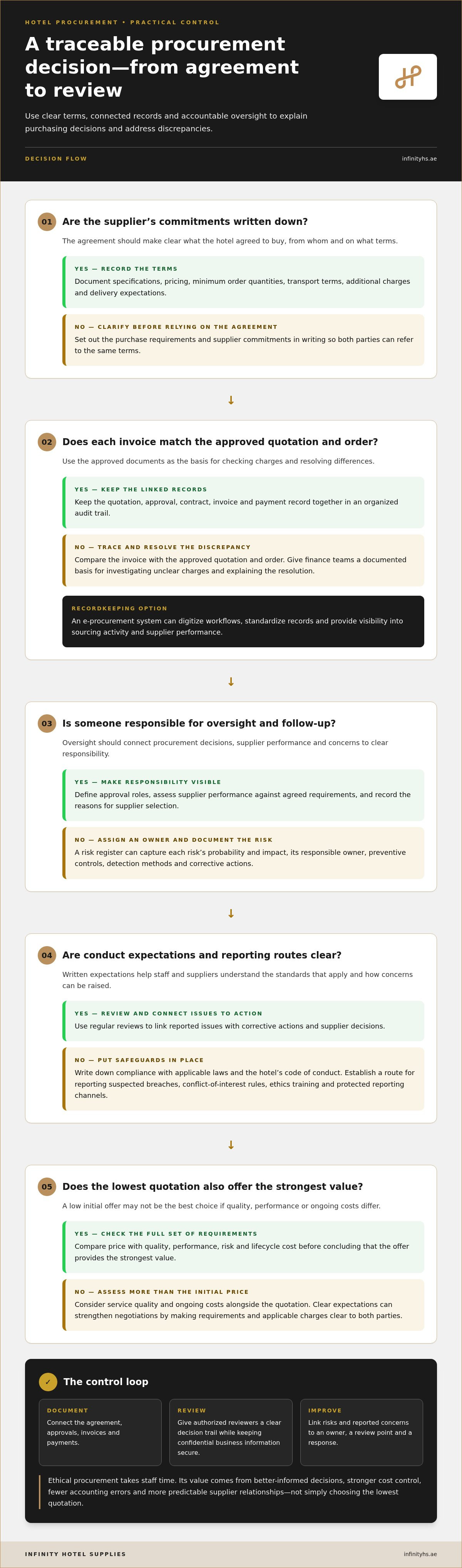
Hotels gain control when procurement decisions, supplier commitments and payments are clearly recorded. Written terms, consistent accounting and practical oversight help teams identify discrepancies and explain their decisions.
Contracts and Audit Records
Contracts and audit records should document what a hotel agreed to buy, from whom and on what terms. Include specifications, pricing, minimum order quantities, transport terms, additional charges and delivery expectations in supplier agreements. Compare each invoice with the approved quotation and order. This gives finance teams a traceable basis for resolving discrepancies and helps prevent unclear charges from accumulating.
Keep quotations, approvals, contracts, invoices and payment records together in an organized audit trail. An e-procurement system can digitize workflows, standardize records and provide visibility into sourcing activity and supplier performance. For example, a reviewer can trace an invoice variance to its quotation and approval instead of relying on scattered emails or verbal explanations.
Oversight and Supplier Accountability
Effective oversight assigns responsibility for reviewing procurement decisions and responding to concerns. Hotels can define approval roles, assess supplier performance against agreed requirements and record the reasons for selection. A risk register can capture each risk, its probability and impact, the responsible owner, preventive controls, detection methods and corrective actions.
Supplier accountability also depends on clear conduct expectations. Put compliance with applicable laws and the hotel’s code of conduct in writing, and establish a route for reporting suspected breaches. Conflict-of-interest rules, ethics training and protected reporting channels help staff raise concerns. Regular reviews can connect reported issues with corrective actions and supplier decisions.
Ethical Procurement Trade-Offs
What are the costs and benefits of ethical hotel procurement? Assessing suppliers, documenting decisions and maintaining oversight take staff time, but these practices can improve cost control, reduce accounting errors and make supplier relationships more predictable. The value comes from better-informed decisions, not simply choosing the lowest quotation.
Compare price with quality, performance, risk and lifecycle cost. A low initial offer may not provide the strongest value if service quality or ongoing costs differ. Clear expectations can also strengthen negotiations by ensuring both parties understand the requirements and applicable charges. This supports trust while preserving the need to review supplier performance.
For practical control, assign an owner to each procurement risk and link it to a record, review point and response. Keep confidential business information secure while ensuring authorized reviewers can follow the decision trail. These connected practices make ethical procurement easier to explain, audit and improve.
Why Is Supplier Transparency Critical in the Future of Hotel Procurement?
Transparent procurement gives reviewers a clearer view of how decisions were made and where concerns need examination. Oversight can involve public agencies, auditors and external observers, with confidentiality safeguards for sensitive records.
Procurement Monitoring and Audits
Procurement monitoring examines activity throughout the sourcing process, from tender preparation to contract implementation. Government agencies oversee public procurement, while auditors examine decisions and supporting records. Citizens and civil society groups can contribute by monitoring public information and identifying concerns that might otherwise go unnoticed.
An independent procurement audit can reveal areas where an organization may be overpaying without its in-house team realizing it. Its value lies in an impartial review of procurement activity and supporting evidence, not simply another internal approval. For example, an auditor may check whether implementation records match the awarded contract and whether changes have a documented rationale.
Effective public oversight also requires follow-through. Mechanisms for uncovering and investigating corruption need consistent enforcement and proportionate, dissuasive sanctions. Responses can include exclusion from procurement, confiscation of illegal gains, liability for damage, contract cancellation and debarment. The response should reflect the misconduct and applicable process, with findings and actions recorded for later review.
External monitoring can complement official oversight, but it needs meaningful access to relevant information. Published tender and award details give observers a basis for understanding decisions. Monitoring that continues into contract implementation can show whether delivery follows the published agreement, rather than ending when a supplier receives an award.
Documentation, Audit Trails, and Data Security
Compliance documentation and audit trails show how procurement decisions were made and changed. Digital platforms can standardize supplier onboarding, maintain records and support ongoing performance monitoring across complex supply chains. Traceable records help reviewers follow the sequence of decisions without relying on informal accounts.
Transparency must be balanced with data security and confidentiality. Centralized procurement data can support consistent oversight, while access controls limit sensitive information to appropriate users. For example, a public-facing award notice may explain the decision while commercially sensitive supplier records remain restricted to authorized reviewers.
Data analytics can help organizations identify anomalies and patterns that may signal corruption. A flagged pattern requires examination alongside relevant records, context and approvals; it is not proof of misconduct on its own. Clear audit trails allow investigators to understand what happened, identify decision points and document any corrective response.
For hotel procurement, these practices structure reviews while preserving appropriate confidentiality. They provide a stronger basis for accountability within an organization and across public procurement processes.
Complex and inconsistent procurement regulations
Across the Middle East, national procurement rules and expectations can differ, complicating supplier assessments across markets. Complex or inconsistent regulations can also create opportunities for manipulated outcomes, particularly when evaluation criteria are unclear or applied inconsistently.
For hotel teams, useful reference points include national requirements, supplier ESG criteria and the United Nations Convention against Corruption (UNCAC). UNCAC provides internationally agreed standards that can serve as a benchmark for public procurement. These references can help structure policies, but teams still need to assess requirements in each operating country.
For example, the UAE’s In-Country Value program promotes partnerships with suppliers demonstrating local commitment, compliance and performance. Local criteria are therefore one consideration in supplier assessment, alongside delivery capability and relevant risk exposure. A consistent evaluation record helps explain how each criterion affected the sourcing decision.
Prequalification requires particular care. Criteria that favour selected entities can restrict competition and may enable collusion between bidders and officials. Clear requirements, documented scoring and recorded reasons for exclusion make the process easier to review. Awarding work to an unqualified supplier can also result in substandard services or infrastructure.
Supplier onboarding can reduce confusion by collecting consistent information before a supplier enters the approved process. Standardized forms can capture ownership details, operating practices, compliance statements and relevant ESG information. Procurement teams can then monitor changes, refresh records and flag gaps for review instead of relying on inconsistent emails or informal updates.
ESG checks should connect to the hotel’s actual supplier risks. Assess environmental, safety and human-rights practices alongside performance and risk exposure. Millennium Hotels & Resorts reported asking many major suppliers to complete self-assessment questionnaires containing more than 60 questions, including slavery and human-trafficking risks. The example shows how structured questions can surface issues for further assessment.
Questionnaires are useful only when teams review the responses. Establish a process for identifying missing evidence, recording follow-up and escalating concerns to the appropriate decision-maker. Centralized document management can help buyers and suppliers work from consistent information, while ongoing monitoring tracks changes in compliance status and performance.
Employee training supports consistent application of procurement standards. Procurement officials need ongoing instruction on ethical standards, applicable national requirements and the hotel’s internal processes. Scenario-based sessions can cover conflicts of interest, supplier disclosures and documentation expectations. A shared understanding helps staff apply evaluation criteria consistently, including across markets.
For hotel procurement ethics and transparency in the Middle East, the practical aim is a defensible process: define relevant criteria, assess suppliers against them, record decisions and monitor performance. This helps teams manage regulatory differences without treating one country’s requirements as a region-wide rule.
Procurement transparency and public access to information
Public access can make procurement information useful before, during and after a purchasing decision. For public projects, transparency involves more than releasing a final award. It also helps potential bidders understand upcoming needs and gives communities a clearer view of how public resources support projects.
Governments can use open-data platforms to provide timely updates on tenders, bids and awards. A supplier reviewing an upcoming opportunity can use the information to decide whether to participate. Clear, consistent notices can also reduce barriers for businesses unfamiliar with a particular purchasing process.
Plan disclosure across the project lifecycle. Long-term project and resource planning can clarify what a public body intends to purchase and when. Public consultation on major projects can raise community concerns before procurement decisions become difficult to change. Separating key functions, such as preparing requirements and evaluating bids, can also limit concentrated decision-making.
Useful public procurement information can cover:
- Planned tenders and the purpose of each project.
- How bids are assessed and how awards are decided.
- Contract changes and progress during implementation.
- Reporting that explains how allocated resources are used.
Comprehensive bookkeeping and sound reporting systems connect disclosures with actual project activity. For example, a public report can compare planned work with implementation updates, while accounting records support internal review. This helps identify gaps between an announced project and its progress without relying only on a final summary.
Transparency also needs safeguards. Public information should help people understand decisions without exposing confidential details that could compromise legitimate business interests or data security. Public bodies can separate information intended for broad release from records restricted to authorized reviewers. Clear procedures for preparing and updating disclosures help maintain that boundary.
For hotels involved in public projects, these practices can clarify how procurement plans affect timelines, supplier participation and community expectations. A hotel team can distinguish its private purchasing records from information required in a public tender or project report. This helps staff share relevant information responsibly without treating every supplier document as public.
The practical goal is to make public decisions understandable throughout a project, not just visible at the award stage. Planning, consultation, separated responsibilities, reliable bookkeeping and timely reporting all contribute. Together, they help public procurement remain open to scrutiny while preserving the confidentiality needed for responsible supplier engagement.
Which Middle Eastern countries have hotel procurement laws or transparency requirements?
There is no single procurement rule for hotels across the Middle East. Requirements depend on national frameworks and the procurement context, so a regional policy should not replace country-level review. Hotels operating across borders need to identify which rules apply to each entity and purchasing arrangement.
Start by distinguishing legal requirements from internal standards and tender conditions. A hotel group may adopt one common ethics policy for its operations, while a public tender may set additional conditions for that opportunity. Keeping these categories distinct helps teams avoid describing company policy as national law or applying a tender condition to unrelated purchases.
For each operating market, identify the legal entity making the purchase and the organization issuing any tender. Then establish whether the purchase is part of a public procurement process or a private commercial transaction. The distinction matters because public procurement transparency and hotel purchasing policies do not necessarily have the same scope.
Before applying a regional procurement policy, record:
- The country and purchasing entity involved.
- Whether the purchase follows a public tender or private process.
- Any conditions set by the tendering organization.
- Which internal policies apply alongside those conditions.
This record gives procurement and legal teams a shared view of the decision’s context. For example, a hotel group can record a tender-specific disclosure condition separately from its standing supplier questionnaire. This clarifies which obligation comes from the procurement process and which reflects the group’s own approach.
Review the relevant documents at the start of procurement, not only when preparing an award. Tender documents, contract terms and written policies can each shape what a hotel must disclose or document. Assigning responsibility for interpreting these documents also helps prevent departments from applying inconsistent standards to the same purchase.
For a regional hotel group, the practical answer is a country-by-country assessment, not a single list assumed to apply everywhere. Maintain a separate record for each market, note the purchasing entity and process, and distinguish legal duties from internal practices. This helps decision-makers adapt responsibly when procurement crosses borders or involves a public tender.
Infinity Hotel Supplies: Hotel Linen
Quality hotel linen plays a vital role for properties reviewing their sourcing requirements in the Middle East. Clear product specifications, detailed order records, and transparent supplier terms help hotel procurement teams compare options objectively and document purchasing decisions. High-standard linen becomes particularly relevant when a property is refreshing guest-room essentials or aligning procurement practices across its regional operations.
Apply core transparency principles to these textile categories: precisely define technical requirements, keep quotations and departmental approvals together, and record the exact basis for supplier selection. These internal practices support clearer compliance reviews and uphold high standards of hotel procurement ethics and transparency in the Middle East.
For hotels assessing textile needs alongside responsible supply chain practices, focusing on verified product quality and clear documentation remains essential. Establishing structured communication channels helps hospitality operators maintain accountability and traceability throughout the linen procurement lifecycle.
Make transparent sourcing part of your next decision
The next step is to turn procurement principles into a practical decision routine. Before a new sourcing cycle, agree how teams will assess suppliers, preserve decision records and respond to concerns. A consistent approach can help hotel leaders apply hotel procurement ethics and transparency in the Middle East across changing projects and markets.
Product choices also form part of the process. Infinity Hotel Supplies offers Hotel Linen, LOVO Premium Electronics and LUFTER PHYTOGREEN. Hotels can consider these offerings when planning relevant supply needs and assessing how each purchase fits operational requirements.
Keep the next review focused: define the need, document the selection rationale and clarify responsibilities. These habits provide a constructive foundation for supplier relationships and future procurement decisions.
Contact Infinity Hotel Supplies to discuss your hotel supply requirements.
Make your next procurement decision with care, clarity and confidence.
Frequently Asked Questions
Transparency in procurement negotiations: how can hotels avoid hidden costs?
Hotels can reduce hidden-cost surprises by requesting an itemized quotation before placing an order. Ask suppliers to separate product charges from transport, packaging, handling and other fees, and clarify minimum order quantities and delivery terms. Compare the quotation with the final invoice and flag charges without an agreed description. Keep written approval for changes so procurement and finance teams share the same cost basis.
Why is transparency important?
Transparency helps hotels explain purchasing decisions, identify inconsistencies and build accountable supplier relationships. If a department selects a higher-priced offer, for example, a clear record can show how quality, delivery capability or lifecycle considerations influenced the choice. This makes internal review more useful and supports fair treatment of suppliers. In public procurement, accessible information can also help outside observers scrutinize decisions and maintain confidence in public institutions.
What ethical procurement standards apply to hotels in the Middle East?
Hotels should distinguish internal ethical standards from legal requirements that apply to a particular buyer or transaction. Useful practices include conflict-of-interest controls, fair supplier evaluation, accurate records, responsible information handling and clear reporting routes for misconduct. The United Nations Convention against Corruption offers internationally agreed standards as a benchmark for public procurement. It does not replace country-specific requirements or automatically define the rules for every private hotel purchase.
How do hotel procurement practices differ across Middle Eastern countries?
Practices differ because national requirements, public-sector processes and local programs are not uniform across the region. The UAE’s In-Country Value program, for example, promotes supplier partnerships based on local commitment, compliance and performance. A hotel group operating across borders can maintain a shared internal review process while mapping each market’s applicable requirements separately. The buyer’s status and transaction type also affect which procurement conditions apply.
What are common corruption and conflict-of-interest risks in hotel procurement?
Common risks include bribery, kickbacks, undisclosed personal relationships, biased specifications and bid evaluations that favour a selected supplier. A conflict may arise if an evaluator has a personal or financial connection to a bidder but participates without disclosing it. Hotels can reduce exposure by requiring declarations, separating evaluation and approval roles, recording award reasons and providing a confidential route for raising concerns. These controls help identify warning signs for review.
How can hotels ensure transparent supplier selection and competitive bidding?
Hotels can make supplier selection more transparent by defining requirements before inviting offers and applying the same evaluation criteria to each bidder. Assess price alongside product quality, delivery capability, performance, risk and lifecycle considerations. Keep records of bids received, scoring, clarifications and approval rationale. If a hotel makes a single-source purchase, document the business reason and approval path so reviewers understand why competition was not used.
What labor, human rights, and modern slavery standards should hotel suppliers meet?
Hotels should set clear expectations for lawful conduct, human rights and the prevention of forced labor throughout supplier relationships. Due diligence can include supplier declarations, risk questionnaires, reviews of relevant policies and a channel for workers or partners to report concerns. Follow-up matters: procurement teams should record how they assess disclosures and address identified risks. Applied standards should reflect the hotel’s policy and requirements relevant to its location and contracts.
How do sustainability and local-sourcing requirements affect hotel procurement in the Middle East?
Sustainability and local-sourcing criteria can shape supplier evaluation, but their relevance depends on the country, buyer and procurement context. The UAE’s In-Country Value program is one example of a program promoting local commitment, compliance and performance. Hotels can also assess environmental risks and product lifecycle considerations alongside quality and cost. Make each criterion explicit before evaluation, then document how it affected the decision rather than treating preferences as universal legal rules.

Article by
Infinity Editorial Team
With deep expertise in hospitality product FF&E and OS&E across the Middle East and Africa, Infinity Editorial Team brings insights from Infinity Hotel Supplies, helping developers, hoteliers, and homeowners transform spaces from empty shells to fully furnished, design-ready environments.
Disclaimer
The content published by Infinity Editorial Team is intended for informational purposes only. All articles, guides, and insights are based on industry knowledge and experience in hospitality FF&E and OS&E supply across the Middle East and Africa. Infinity Hotel Supplies does not guarantee specific outcomes and recommends consulting a qualified professional for project-specific requirements.


