

A hotel OS&E supplier in Africa must do more than provide guestroom and bathroom essentials. The sourcing plan needs to match project specifications and account for the costs of bringing goods into each destination. Import duties can affect landed costs, so the destination country and the goods being shipped both matter. Regional coverage across Africa and the Middle East can also influence how a project is supplied.
For hotel owners, operators and project teams, balancing quality, consistency and logistics across multiple product categories is a practical procurement challenge. This guide explains what OS&E sourcing covers, how duties affect landed costs, and what to consider when planning guestroom and bathroom supplies.
You’ll also learn how regional supplier coverage can support hospitality projects and when a coordinated supply partner can help bring product requirements and delivery planning together.
Key Takeaways
- Separate OS&E requirements from FF&E so budgets, specifications and purchasing decisions reflect each category’s role.
- Plan guestroom and bathroom supplies around expected use, storage needs and replacement requirements.
- Assess landed cost by considering how import duties and shipment logistics affect the total delivered cost.
- Compare suppliers on product suitability, specification approval, quality and their ability to support project logistics.
- Map supplier coverage across Africa and the Middle East against each project’s destination and delivery needs.
Need FF&E or OS&E Sourcing for Your Hospitality Project?
Start by separating the project’s FF&E requirements from its OS&E requirements. Then define the quantities, specifications and delivery destination for each product before procurement begins.
Supplier Networks and Product Sourcing
A supplier network connects a hotel project’s product requirements with suitable manufacturers and distributors. It may cover guestroom supplies, bathroom items, amenities and operational equipment. Compare product specifications, quality and quantities with the approved requirements. A supplier catalogue can inform selections, but it should not replace the project specification.
To request a hotel OS&E quote, provide the property location, room count, opening schedule, item list, quantities and specifications. Include preferred materials, finishes, branding requirements and delivery destination where relevant. These details help suppliers assess the request and plan sourcing and logistics around the project.
Local and International Sourcing
Hotels in South Africa can assess local sourcing alongside international options. The right mix depends on product specifications, supply capacity, required quantities and delivery destination. For example, a project might source some guestroom products locally while considering international suppliers for items with specific requirements or coordinated procurement needs.
International sourcing adds logistics decisions to product selection. Match each item’s shipment plan to the project schedule, receiving arrangements and destination. Keep product descriptions and quantities consistent across quote and order documents. This gives the hotel team a clearer basis for coordinating deliveries across suppliers and product categories.
Supplier Quality and Reliability
Hotels can assess supplier quality by reviewing product specifications, samples and quality-control processes before placing an order. Compare samples with approved requirements for dimensions, materials, finish and intended use. For pre-shipment inspection, use ISO 2859-1 (ANSI/ASQ Z1.4) sampling standards, according to the International Organization for Standardization.
Reliable procurement also depends on clear communication and accurate order records. Confirm that the quote, approved sample and final order describe the same products and quantities. Agree on a documented process for handling discrepancies, and track milestones from order confirmation through shipment. These steps can reveal gaps before goods reach the property.
Local and Sustainable OS&E Options
Consider local African manufacturers when their products meet the hotel’s specifications, quality expectations and quantity requirements. Compare them with international alternatives using the same criteria, including materials, finish, consistency and delivery logistics. This provides a practical basis for deciding whether local sourcing suits each category.
Assess sustainable OS&E choices by considering product materials, expected use and replacement needs. Include these requirements in the item specification and compare supplier responses against them. For example, a project seeking reusable guestroom items can assess durability and suitability for its operating standards before approving a product.
Guestroom and bathroom supplies
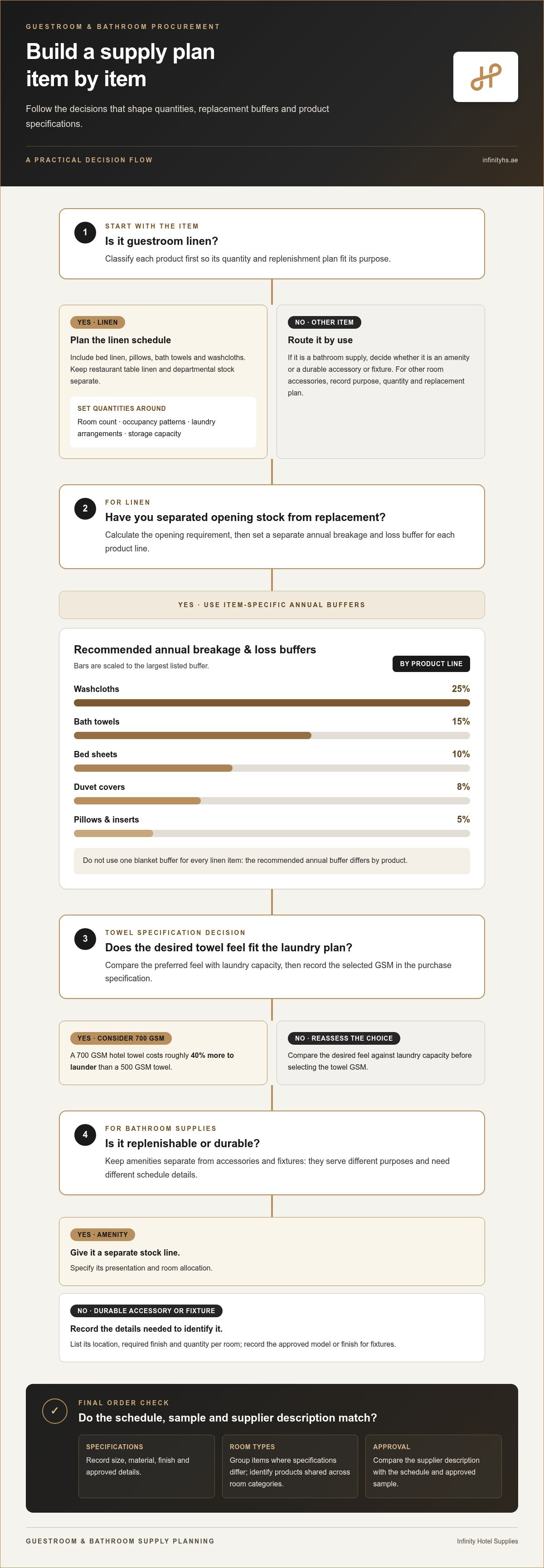
A guestroom supply schedule should connect each item to its purpose, quantity and replacement plan. Start with bed linen, pillows, bath towels, washcloths, bathroom amenities and room accessories. Separate guestroom items from restaurant table linen and departmental stock. This makes quantities easier to review and helps teams prepare clear purchase orders for each area.
Build the linen schedule around room count, occupancy patterns, laundry arrangements and storage capacity. For each item, record its size, material, finish and approved specification. Then calculate the opening requirement and a separate replacement buffer. The recommended annual breakage and loss buffers are 10% for bed sheets, 8% for duvet covers, 15% for bath towels, 25% for washcloths, and 5% for pillows and inserts.
Set a separate allowance for each product line rather than applying one blanket buffer. For example, the recommended annual buffer for washcloths is higher than for duvet covers. This helps procurement teams plan quantities by item and track replenishment needs across guest rooms.
Towel specifications affect both guest comfort and operating routines. A 700 GSM hotel towel costs roughly 40% more to launder than a 500 GSM towel. Compare the desired feel with laundry capacity, then record the selected GSM in the purchase specification. That keeps product samples and orders aligned with the hotel’s operating requirements.
For bathroom supplies, list amenities separately from durable accessories and fixtures. Record each item’s location, required finish and quantity per room. A replenishable amenity and a durable vanity accessory serve different purposes, so give them separate stock lines. For amenities, specify the presentation and room allocation. For fixtures, record the approved model or finish.
Clear product records also support manufacturing and delivery planning. Group items by room type when specifications differ, and identify products shared across room categories. Before approving an order, compare the supplier’s description with the schedule and sample. A detailed list helps teams coordinate guestroom linen, bathroom items and amenities with the property’s requirements.
Import duties and landed-cost considerations
For an African hotel project, import charges and delivery logistics can affect the total purchase cost. Build the estimate by destination and product category rather than applying one assumption to every shipment.
Import Duty Considerations
Duty treatment can vary by destination and by the goods being imported. A kitchen item, glassware shipment and housekeeping trolley may each have different import treatment. Group the order by product type, record each item’s description and origin, then assess import charges for the destination country. This gives a clearer estimate than treating a mixed OS&E shipment as one uniform category.
For international sourcing, map each product line to its destination before approving the purchase. Keep the supplier’s descriptions, quantities and shipment documents consistent. If an order combines laundry supplies, guestroom products and restaurant glassware, separate those lines in the cost schedule. This makes it easier to see how destination-specific charges affect each part of the order.
Landed-Cost Considerations
Landed cost includes the purchase price and expenses required to move goods to the hotel. Account for product charges, freight, insurance, import duties, clearance and onward delivery where applicable. The final amount depends on the shipment, destination and goods. A quote showing only the item price is therefore an incomplete basis for comparing suppliers.
Build a landed-cost worksheet with one row per product category. For example, list bathroom amenities separately from kitchen glassware, then record the quoted goods, shipping assumptions and applicable destination charges. Keep currency, quantities and delivery terms consistent across supplier quotes. This helps the project team compare like with like and identify which assumptions explain cost differences.
What is the typical cost of hotel OS&E for a new hotel in Africa? There is no single project figure: the total depends on hotel segment, room count, operating departments, specifications, quantities and destination charges. Build the estimate room by room and department by department, including areas such as housekeeping, laundry and food service.
Use the room schedule to calculate guestroom quantities, then add department-specific requirements. A restaurant needs a separate list for service items and glassware; housekeeping needs its own equipment and operating supplies. Tie each quantity to the planned operation and storage capacity. This keeps bulk purchasing aligned with actual use rather than broad assumptions.
Before approving a purchase, compare each supplier quote against the same item schedule and delivery destination. Check that product descriptions, quantities, shipping assumptions and duty treatment match. If a quote excludes delivery or import charges, show those separately instead of comparing its subtotal with another supplier’s delivered estimate. Clear cost lines support a considered sourcing decision.
Hotel OS&E suppliers serving Africa
How do hotel OS&E suppliers in Africa compare on product range and service? Compare the categories each can supply, how closely products meet your specifications, and how clearly the supplier coordinates transport and delivery. A broad catalogue matters only when its products suit the property’s operational needs and timeline.
Start with a department-by-department scope. A hotel may need guestroom items, bathroom supplies, housekeeping equipment, kitchen goods and restaurant serviceware. Compare supplier responses against the same item schedule, including quantities and specifications. This shows whether a quote covers the complete requirement or only selected categories, and helps teams identify gaps before preparing purchase orders.
Next, assess how suppliers handle product selection and custom requirements. A property with a distinct brand standard may need specific finishes, materials or branded amenities. Ask for those requirements to be itemized separately from standard goods. Review samples against the written specification, then record approved details for the final order. This reduces ambiguity between product discussions and purchasing documents.
Compare service as well as product range. Review how each supplier communicates order status, coordinates logistics and manages schedule changes. For example, a hotel receiving furniture and operating supplies at different stages needs clear delivery coordination. Compare the shipment plan with site access, storage capacity and the project timeline, and note dependencies between product groups.
Use a simple comparison matrix to assess each supplier on the same criteria:
- Range: Which departments and item categories does the proposal cover?
- Specification: Do descriptions, samples and quantities match the approved schedule?
- Custom work: Are branding, finishes or tailored amenities clearly documented?
- Logistics: Does the transport plan align with the destination and receiving arrangements?
- Communication: Are responsibilities and order updates clearly explained?
Compare evidence rather than broad claims. One supplier may have a wider catalogue, while another proposal may better match the project’s specifications. Review sample approvals, item-level quotations and delivery plans together. For a hotel OS&E supplier in Africa, regional suitability also means understanding the destination and coordinating shipments with the property’s receiving process.
Finally, rank proposals by operational fit. Identify which supplier can cover the required departments, where separate sourcing remains necessary, and how each proposal supports the opening timeline. Keep the comparison tied to documented requirements. This gives owners, operators and procurement teams a clear basis for choosing a supply approach without judging options on catalogue size alone.
Regional supplier coverage across Africa and the Middle East
Regional coverage is more than a list of destinations. For a hotel project, it means aligning product sourcing, shipment planning and delivery coordination with the property’s location, opening schedule and receiving capacity. A supplier serving the GCC and Middle East can provide a regional sourcing point, while each African destination still needs its own delivery plan.
Start by mapping each property to its country, site address and required delivery window. Then group products by department and record where each group needs to arrive. A city hotel with limited storage, for example, may need carefully scheduled deliveries, while a resort project may have different receiving arrangements. The destination shapes transport planning and coordination.
For projects spanning Africa and the Middle East, use one master schedule with a separate delivery line for each property. Record the site contact, receiving hours, access requirements and order status. Keep product specifications consistent across locations where brand standards require matching interiors. Flag local differences clearly so teams don’t mistake a destination-specific adjustment for a change to the approved design.
Regional coordination also depends on shipment readiness. Align supplier dispatch plans with construction progress, room completion and installation sequencing. If guestroom products and amenities arrive before rooms can receive them, storage and handling become project concerns. A phased delivery plan can connect each shipment to a defined project milestone without assuming every country follows the same route or schedule.
Compare regional suppliers using the same location-based criteria:
- Destination: Which property and receiving site does the shipment serve?
- Product scope: Which room or operating departments does each order cover?
- Delivery plan: How does dispatch align with site readiness and opening?
- Coordination: Who manages updates when quantities or schedules change?
- Documentation: Do order records identify the correct property and delivery point?
Regional suitability depends on the project’s actual destination, not a broad claim of reach. Compare the proposed route and delivery responsibilities with the site plan. For a multi-property group, maintain a separate cost and delivery record for each location. This makes it easier to track differences, coordinate interior requirements and identify which goods support each opening.
The practical takeaway is to assess regional coverage property by property. A supplier based in the Middle East may help coordinate regional sourcing, but the hotel’s African destination, delivery schedule and receiving conditions determine the plan. Document those details before approving orders, then align each shipment with the relevant department and opening milestone.
Discuss your regional hotel supply requirements.
Infinity Hotel Supplies: Hotel Linen
Infinity Hotel Supplies supports hotel projects with hotel linen suited to guestroom specifications and operating requirements. For a new opening or linen refresh, define the required items, materials, sizes and quantities before preparing the order schedule. This gives the hotel team a practical basis for matching selections to room standards and housekeeping needs.
Review hotel linen requirements alongside the property’s room schedule and preferred specifications. A clear list helps keep selections consistent across guest rooms and supports coordinated purchasing. Infinity Hotel Supplies also offers LOVO Premium Electronics, LUFTER PHYTOGREEN and Leather Accessories for projects where those categories fit.
Contact Infinity Hotel Supplies to discuss hotel linen requirements for your project.
Plan Your Next Sourcing Step
Use your project schedule to turn sourcing decisions into a clear brief. Set out the property’s priorities, destination, required products and approval process, then align internal teams around those requirements. This gives supplier discussions a practical starting point and keeps decisions connected to the guest experience and opening plans.
When assessing a hotel OS&E supplier in Africa, focus on how its relevant product categories fit your project requirements. Infinity Hotel Supplies offers Hotel Linen, LOVO Premium Electronics and LUFTER PHYTOGREEN for hospitality projects. These categories may suit teams developing guestroom requirements alongside broader sourcing plans.
Discuss your project priorities and product requirements with Infinity Hotel Supplies.
With a well-defined brief, your team can move forward with greater clarity and confidence.
Frequently Asked Questions
What Does OS&E Mean in Hotels?
In hotels, OS&E means operating supplies and equipment used to serve guests and run daily operations. It covers items that teams use, replenish or replace, rather than the building’s permanent structure. For example, a hotel may track guestroom amenities, towels and housekeeping equipment as OS&E. Keeping these items in separate inventory categories helps department heads plan purchasing, storage and replenishment around actual operations.
What is OS&E?
OS&E stands for operating supplies and equipment. The term describes operational goods used across hotel departments, including guest rooms, housekeeping and food service. It differs from FF&E, which generally refers to furniture, fixtures and equipment. For example, a hotel might classify guestroom consumables as OS&E and a fixed room furnishing as FF&E. Clear classification helps teams assign purchases to the right budget and department.
Who are the leading hotel OS&E suppliers in Africa?
No single supplier leads every African market or hotel category. Compare suppliers by product range, destination coverage, specification fit and ability to support purchasing requirements. Infinity Hotel Supplies serves hospitality projects across Africa and the Middle East, offering OS&E and hotel products. For a hotel OS&E supplier in Africa, the key measure is how well its products and regional scope fit the property’s needs.
Which African countries and regions do hotel OS&E suppliers serve?
Coverage varies by supplier and project, so assess it against each property’s destination rather than assuming continent-wide service. Regional hospitality supply can connect African projects with suppliers based in the GCC or wider Middle East. For a group opening properties in different markets, create a separate destination and delivery record for each hotel. This helps distinguish shared product standards from location-specific purchasing and delivery arrangements.
What products are included in hotel OS&E procurement?
Hotel OS&E procurement can include operational goods for guest rooms, bathrooms, housekeeping, food service and staff areas. Examples include linens, guest amenities, room electronics, housekeeping trolleys and uniforms. The exact schedule depends on the hotel’s operating model and brand requirements. Organize the list by department and item purpose, then note whether each product is for opening stock, routine replenishment or replacement.
Do African hotel OS&E suppliers offer sourcing, shipping, and installation?
Supplier scope can differ: product sourcing, shipment coordination and installation are separate responsibilities that the project should define clearly. A hotel’s responsibility matrix can assign purchasing approval, delivery receipt and installation to the appropriate project teams. For example, a supplier may provide a product while the hotel’s appointed project team manages its placement. Documenting these roles prevents gaps between delivery and readiness for guest use.
What are the lead times and shipping costs for hotel OS&E delivery to Africa?
Lead times and shipping costs depend on product availability, order quantities, shipment origin, destination and delivery arrangements. Custom items may require additional production coordination, while mixed-category orders can involve different dispatch schedules. To plan effectively, align the required on-site date with the project opening schedule, then organize product lines by destination and shipment. This makes timing and transport assumptions visible during purchasing decisions.
What are the risks of sourcing hotel OS&E internationally for African properties?
International sourcing can expose projects to specification mismatches, shipment delays, transit damage and unexpected destination charges. Product descriptions can also become inconsistent across quotes, approved samples and final orders. Reduce these risks by maintaining one controlled item schedule, recording approved samples and linking each shipment to its receiving location. For a multi-property project, keep separate order records so goods reach the correct hotel and department.

Article by
Infinity Editorial Team
With deep expertise in hospitality product FF&E and OS&E across the Middle East and Africa, Infinity Editorial Team brings insights from Infinity Hotel Supplies, helping developers, hoteliers, and homeowners transform spaces from empty shells to fully furnished, design-ready environments.
Disclaimer
The content published by Infinity Editorial Team is intended for informational purposes only. All articles, guides, and insights are based on industry knowledge and experience in hospitality FF&E and OS&E supply across the Middle East and Africa. Infinity Hotel Supplies does not guarantee specific outcomes and recommends consulting a qualified professional for project-specific requirements.


