

A wholesale banquet-linen order starts with the full event setup, not a single tablecloth. For hotel banquet linen wholesale in Dubai, plan around the linens and accessories required, the order quantity, sample approval and production lead time. Minimum quantities and timelines depend on the order’s specifications and product mix.
When sourcing hotel banquet linen wholesale in Dubai, it’s easy to focus on how the tables will look and overlook details that affect a bulk order. Fabric, finish, sizing, and consistency all matter when linen must suit different banquet layouts and events.
This guide covers banquet linen and accessories to consider, how minimum quantities shape an order, and how to plan for samples and production. You’ll also learn what to include in an order brief so products and quantities match your venue’s needs.
Key Takeaways
- Plan table linens, skirting, stack covers, and carts around your venue’s layouts and service needs.
- Understand how product mix and order specifications can shape bulk quantities and minimum order requirements.
- Use samples to assess the look and feel of linens before moving into production planning.
- Build quality and environmental considerations into your selection criteria, not just the initial appearance.
- Align hotel and restaurant linen requirements in a clear order brief to support a more coordinated wholesale purchase.
Table linens, skirting, stack covers, and carts
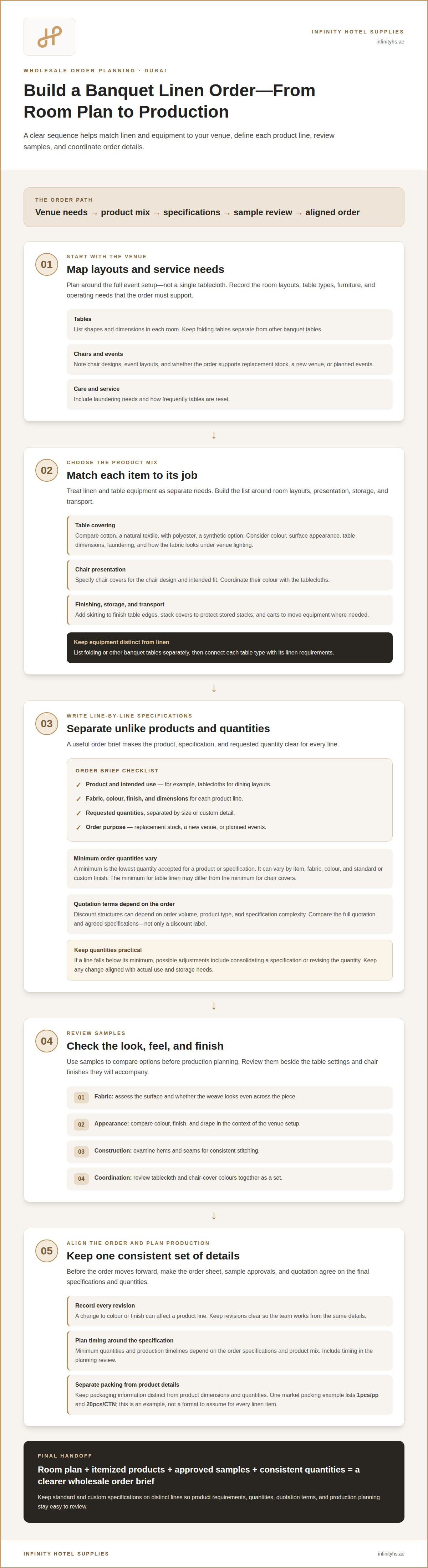
Banquet setups combine linen with practical table equipment. Match each item to the venue layout and service routine.
Tablecloth Material Options
Cotton and polyester are two tablecloth materials to compare. Cotton is a natural textile, while polyester is synthetic. Consider how each looks under the venue’s lighting and suits its event schedule. Include colour, surface appearance, table dimensions, and laundering needs in the selection brief.
For example, a hotel hosting formal dinners may prioritise a refined appearance and consistent drape. A venue that resets tables frequently may focus more on ease of care. Review fabric samples beside the table settings and chair finishes they will accompany. This gives the team a direct basis for comparing options.
Custom Tablecloths and Chair Covers
Custom tablecloths and chair covers can be specified for a particular layout or visual scheme. Start by recording table shapes and dimensions, then define the required drop and coverage. For chair covers, note the chair design and intended fit. These details help align the linen specification with the furniture used at events.
For a coordinated setup, specify tablecloth and chair-cover colours together. Include the preferred finish and placement details in the order brief. Reviewing a sample lets the team assess how the materials and colours work as a set before production planning proceeds.
Banquet Linen and Table Equipment
A banquet order can include table linen, skirting, stack covers, and carts, alongside folding or other banquet tables. Skirting finishes table edges, while stack covers protect stored stacks. Carts help move equipment. Treat each as a separate line item, with quantities based on room layouts and operating needs.
For example, list folding tables separately from other banquet tables. Record the sizes and shapes used in each room, then connect each table type with its linen requirements. Include skirting and stack covers where the setup or storage plan calls for them. This itemised approach makes the order easier to review.
Packaging can also affect how a bulk order is handled after arrival. One market packing example lists 1pcs/pp and 20pcs/CTN. Treat this as a planning detail for that example, rather than assuming every linen item follows the same format. Keep packing information distinct from product dimensions and quantities.
Before finalising the specification, group items by function: table covering, chair presentation, table finishing, storage protection, and transport. This helps the purchasing team identify gaps between the room plan and requested products. It also keeps custom linen details distinct from equipment requirements.
Bulk orders and minimum order quantity
Bulk purchasing works best when an order reflects actual operating needs. Separate item quantities, specifications, and timing before reviewing supplier terms.
Bulk Order Discounts
Discount structures can depend on order volume, product type, and specification complexity. A large order of one standard tablecloth may have different terms from a mixed order with separate sizes, colours, or finishes. Compare the full quotation, including quantities and agreed specifications. This gives a clearer picture than focusing on a discount label alone.
For example, list tablecloths and chair covers as separate product lines. This shows which items contribute to the total and whether combining them changes the quoted terms. Keep revised quantities in the same order brief so the quotation reflects the current request.
Minimum Order Quantities
A minimum order quantity is the lowest quantity accepted for a product or specification. It can vary by item, fabric, colour, and whether the order uses a standard or custom finish. Treat each line separately: the minimum for table linen may differ from that for chair covers.
Set requested quantities according to venue use, replacement needs, and planned events. If a custom colour applies to only one room, separate that line from standard colours. State the item, specification, and requested quantity for each product. This makes the requirements easier to assess.
Before submitting a bulk request, group products by specification. This makes differences clear and helps prevent unlike items from being treated as interchangeable. A useful order sheet includes:
- Product name and intended use, such as tablecloths for dining layouts.
- Fabric, colour, finish, and dimensions for each product line.
- Requested quantities, separated by size or custom detail.
- Whether the order supports replacement stock, a new venue, or planned events.
Suppliers can assess the request against product-specific minimums and production requirements. If a line falls below its minimum, possible adjustments include consolidating a specification or revising the quantity. Any change should still reflect operational needs. Increasing quantities without a storage or usage plan can leave excess stock.
For example, keep standard white tablecloths separate from custom-colour covers. This makes it easier to see whether different specifications affect order terms. It also gives the purchasing team a consistent basis for reviewing volume-related discounts.
Keep final quantities consistent across the order sheet, sample approvals, and quotation. A change to colour or finish can affect a product line, so record every revision clearly. The team can then use the same details when planning receiving, storage, and future replacement orders.
Quality and environmental standards
Quality decisions affect the appearance and service life of banquet linen. Set clear acceptance criteria before approving a sample or placing a bulk order.
Assess construction and consistency
Begin with the fabric sample and inspect its surface, colour, and finish. For a tablecloth, check whether the weave looks even across the piece. Examine hems and seams for consistent stitching. These details help assess construction before ordering the same specification in bulk.
Next, compare the approved sample with the written product specification. Record the fabric, colour, dimensions, and finish in one document. For example, if the sample is warm white, describe the shade clearly rather than relying on a general colour name. This gives production a precise reference for comparison.
Care requirements matter too. Review the supplier’s care guidance against the venue’s laundry process. Ask how the stated fabric should be washed, dried, and finished, then assess whether those steps suit normal operations. A fabric that looks suitable before use may not fit the venue’s routine if its care requirements are impractical.
Evaluate environmental claims
Environmental language needs to be specific. A claim such as “eco-friendly” does not explain the material, production practice, or supporting evidence. Ask for the basis of the claim and identify which product or process it covers. Keep supporting documents with the product specification rather than treating a broad label as proof.
For example, distinguish a claim about recycled content from one about manufacturing practices. They describe different things and require different supporting details. If a product carries an environmental certification, record its exact name and scope. Do not assume a claim applies to every fabric or colour in the order.
Use a documented review process for each linen line:
- Compare the sample with the stated material, colour, and finish.
- Record construction details, including hems and visible seams.
- Review care guidance against the venue’s laundering routine.
- Match each environmental claim to evidence for that product.
Keep the approved sample and final specification together. If a later batch differs in shade or finish, those references help identify the variation. For mixed orders, maintain separate records for each fabric or custom colour. One approval should not automatically cover distinct materials.
These checks turn quality and environmental criteria into practical purchasing decisions. They give the team a clear basis for reviewing samples, product descriptions, and supporting documents before accepting banquet linen.
Samples and production lead times
Samples help assess colour, fabric, finish, and workmanship before production. Delivery timing depends on the order specifications and fulfilment requirements.
For hotel banquet linen wholesale orders in Dubai, delivery timing depends on stock status, customisation, order size, and destination. Shipping costs depend on shipment size and delivery arrangements. Request a quote for the order cost.
Production Lead Times
Production lead time covers the period required to make an order, not its delivery journey. A standard item and a custom-colour tablecloth can follow different schedules. The production plan depends on the selected fabric, dimensions, finish, quantity, and approval stage.
Keep the process moving by submitting complete specifications together. Include the product type, colour, dimensions, finish, and order quantities. If the sample needs a change, record the revision before production begins. For example, changing a tablecloth’s dimensions after approval may require the production details to be updated.
Ask for a production schedule that identifies its starting point and stages. A useful schedule separates sample review, final approval, production, and dispatch. This helps a hotel plan around a banquet opening or linen replacement without treating production time as the full delivery period.
Delivery Times and Shipping Costs
Delivery time begins after the order is ready for dispatch, so it is separate from production. Destination, shipment size, and delivery arrangements affect the overall timeline. For example, a made-to-specification order requires production before dispatch, while a stocked item follows a different sequence.
Shipping costs depend on the shipment and delivery requirements. Order size, packaging, destination, and the chosen delivery arrangement can affect the total. Include the delivery location and complete product quantities in a quote request so shipping can be calculated with the order.
Use a simple planning sequence to coordinate purchasing and venue operations:
- Submit product specifications, quantities, and the required delivery destination.
- Review the sample and record any changes before approval.
- Align the confirmed production schedule with the event or opening plan.
- Allow for the separate dispatch and delivery stage in the operating schedule.
For example, a hotel preparing for a banquet launch can plan backward from its first service date. The purchasing team can allow time for sample review, production, and delivery as separate stages. This makes late specification changes visible before they compress the remaining schedule.
Keep approvals and schedule updates in one order record. If the colour, dimensions, or quantities change, document the revision and its effect on production and dispatch. Clear records help the venue coordinate receiving, inspection, and storage when the linen arrives.
Wholesale hotel and restaurant linen
Wholesale linen orders can support banquet events, restaurant service, and hotel operations. Separate each use case so product details and quantities match the work each team performs.
VAT, import duties, and other rules depend on the transaction and the goods’ origin. Review applicable charges and tax treatment in the quotation and invoice before approving the purchase.
Dubai hospitality suppliers offer hotel and banquet linen for wholesale purchasing. Compare product specifications, sample processes, order terms, and delivery arrangements rather than relying on the word “wholesale” alone.
Payment terms and return policies vary by supplier and contract. Read the written terms for payment stages, order changes, defects, and return conditions before confirming an order.
Hotels and restaurants may share linen needs, but their operating patterns differ. A hotel banquet team might need coordinated tablecloths for changing room layouts. A restaurant may prioritise consistent sizes and colours for daily service. Group products by use, then describe material, dimensions, finish, and quantity for each line.
For mixed hospitality orders, separate banquet linen from guest-room linen. Tablecloths, chair covers, and skirting serve event settings, while bed linen supports room operations. For example, a hotel sourcing both categories should list them independently, even if they share a colour palette. This keeps the intended use clear in each product specification.
Replacement planning also differs by venue. A restaurant may reorder a familiar tablecloth specification to maintain a consistent dining room. A hotel may need several table sizes for different banquet layouts. Record each requirement as its own product line, even when the fabric or colour matches.
A purchasing brief for a mixed hotel or restaurant order can include:
- Intended setting, such as banquet service, restaurant dining, or guest rooms.
- Product type, material, colour, dimensions, and finish.
- Required quantities for each item and specification.
- Sample approval, production schedule, delivery destination, and commercial terms.
This structure helps purchasing teams compare quotations against equivalent requirements. A lower total may reflect a different fabric, finish, quantity, or delivery arrangement. Review each quotation against the requested specification, then document any differences before deciding.
For a Dubai hotel sourcing banquet linen, focus the purchasing brief on venue operations, from event layouts to repeat restaurant settings. A clear product list keeps these distinct needs organised under one wholesale order without blurring their specifications.
Before confirming, keep the final product list, sample approvals, delivery details, and agreed terms together. This gives the hotel or restaurant a shared reference for approval, receiving, and future repeat orders. Contact the supplier to discuss your wholesale linen requirements.
Infinity Hotel Supplies: Hotel Linen
Infinity Hotel Supplies offers Hotel Linens for hospitality operators sourcing banquet textiles. Once you’ve identified the products and specifications your venue needs, discuss how they fit your hotel’s linen requirements.
For example, outline whether your order supports banquet events, restaurant service, or broader hotel operations. Include the relevant linen types and specifications, such as material, colour, and dimensions. This gives the discussion a clear operational focus.
Contact Infinity Hotel Supplies to discuss your hotel linen requirements.
Make Your Next Linen Order Work Harder
Use your hotel banquet linen wholesale order in Dubai to establish a clear standard for future purchasing. A concise product brief can help your team keep later orders aligned with venue requirements as layouts and operating needs change.
Infinity Hotel Supplies offers Hotel Linens for hospitality operations. Contact the team to discuss your venue’s linen requirements.
Contact Infinity Hotel Supplies
Take the next step with a clear brief and a focused conversation about your order.
Frequently Asked Questions
What types of hotel banquet linen are available wholesale in Dubai?
Wholesale banquet linen commonly includes tablecloths, chair covers, and skirting. Some orders also include stack covers for stored items. Organising a hotel banquet linen wholesale order in Dubai by room or event setup helps teams distinguish each space’s needs. For example, a ballroom with several table shapes may require separate linen specifications for each layout.
What are the minimum order quantities and bulk discounts offered by Dubai linen wholesalers?
Minimum quantities and discount terms vary by product and order specification. A request for one standard item may have different terms from a mixed order with several colours or custom details. For a fair comparison, use the same item descriptions and quantities in each quote request. Consider storage capacity and expected replacement needs alongside any volume discount, so the order remains practical for operations.
Which fabrics, sizes, and colors are best for hotel banquet linen?
The right choices depend on the venue’s furniture, service routine, and design scheme. Match linen dimensions to table measurements and the desired coverage, then coordinate colours with the room’s finishes. Cotton and polyester are options to assess for appearance and care requirements. For example, a hotel with multiple event rooms may choose a consistent base colour while using different sizes for each table layout.
Do Dubai wholesalers offer custom sizing, embroidery, or branding?
Custom sizing, embroidery, and branding are supplier-specific options, not features to assume across every wholesale offer. If these details matter, include them in the product specification. State dimensions, artwork, placement, and colour clearly. For example, a logo request should identify its intended position on the linen so the proposed sample and order details can be assessed against the venue’s brief.
How can buyers compare the quality and durability of banquet linen suppliers in Dubai?
Compare physical samples with written product descriptions, and assess fabric, colour consistency, hems, and finishing. Consider whether the care requirements fit your venue’s laundering routine. Keep the approved sample and specification as references for later purchases. For example, a purchasing team can compare a replacement batch with the retained sample to assess whether its appearance and finish match the original selection.

Article by
Infinity Editorial Team
With deep expertise in hospitality product FF&E and OS&E across the Middle East and Africa, Infinity Editorial Team brings insights from Infinity Hotel Supplies, helping developers, hoteliers, and homeowners transform spaces from empty shells to fully furnished, design-ready environments.
Disclaimer
The content published by Infinity Editorial Team is intended for informational purposes only. All articles, guides, and insights are based on industry knowledge and experience in hospitality FF&E and OS&E supply across the Middle East and Africa. Infinity Hotel Supplies does not guarantee specific outcomes and recommends consulting a qualified professional for project-specific requirements.


