
What if sourcing eco-friendly products at scale didn't have to mean compromising on quality or wrestling with unreliable supply chains? For procurement specialists and hospitality operators across the GCC and Middle East, that tension is all too familiar. Finding verified, high-performance sustainable hotel supplies wholesale is one of the most pressing challenges facing hotels serious about reducing their environmental footprint without sacrificing the guest experience.
You already know sustainability isn't optional anymore. Guests expect it, operators demand it, and the operational benefits of a well-managed eco-conscious supply chain are real. The difficulty lies in execution: identifying suppliers who can deliver on both quality and verified sustainability credentials, at the volumes a modern hotel operation requires.
This guide cuts through that complexity. You'll discover how to evaluate and source wholesale eco-friendly hotel supplies with confidence, from linens and room amenities to FF&E and OS&E solutions, with a clear framework for streamlining your procurement process and building a supply chain that genuinely supports your sustainability goals.
Key Takeaways
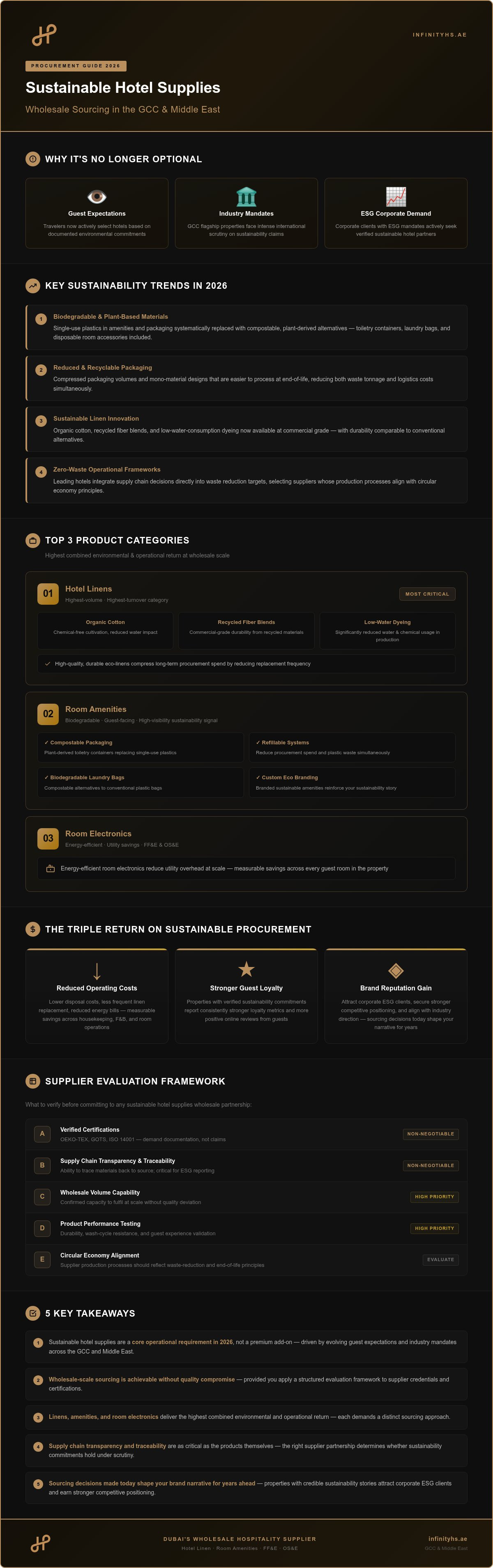
- Sustainable hotel supplies are no longer a premium add-on — they are a core operational requirement in 2026, driven by evolving guest expectations and industry-wide sustainability mandates across the GCC and Middle East.
- Sourcing sustainable hotel supplies wholesale at scale is achievable without compromising quality, provided you apply a structured evaluation framework to assess supplier credentials, certifications, and product performance.
- From eco-conscious linens and biodegradable room amenities to energy-efficient electronics and FF&E solutions, each product category offers measurable environmental and operational benefits worth understanding before you procure.
- Building a transparent, traceable supply chain is as critical as the products themselves — the right supplier partnership determines whether your sustainability commitments hold up under scrutiny.
- Infinity Hotel Supplies offers a comprehensive, sustainability-focused product range — including hotel linen, custom amenities, and room electronics — designed to support hospitality operators in meeting their eco-friendly goals at wholesale volumes.
The Importance of Sustainable Hotel Supplies in 2026
Sustainable hotel supplies are products and materials procured to minimize environmental impact across a hotel's operational lifecycle. This encompasses everything from biodegradable room amenities and responsibly sourced linens to energy-efficient electronics and recyclable packaging. Far from being a niche consideration, these supplies now sit at the core of how hospitality operators design, run, and differentiate their properties.
The shift isn't subtle. Guest expectations have fundamentally changed. Travelers are increasingly selecting accommodation based on documented environmental commitments, and hotel brands that cannot substantiate their sustainability claims face reputational risk at a scale that simply didn't exist a decade ago. Across the GCC and Middle East, where flagship hospitality projects are subject to intense international scrutiny, this pressure is particularly acute.
Key Sustainability Trends in Hotel Supplies
Several converging trends are reshaping how operators approach procurement in 2026. Understanding them is essential before evaluating any sourcing strategy for sustainable hotel supplies wholesale.
- Biodegradable and plant-based materials: Single-use plastics in amenities and packaging are being systematically replaced with compostable, plant-derived alternatives. This extends to toiletry containers, laundry bags, and disposable room accessories.
- Reduced and recyclable packaging: Suppliers are compressing packaging volumes and shifting to mono-material designs that are easier to process at end-of-life, reducing both waste and logistics costs.
- Sustainable linen innovation: Organic cotton, recycled fiber blends, and low-water-consumption dyeing processes are now available at commercial grade, offering durability comparable to conventional alternatives.
- Zero-waste operational frameworks: Leading hotels are integrating supply chain decisions directly into broader waste reduction targets, selecting suppliers whose production processes align with circular economy principles.
Benefits of Sustainable Hotel Supplies
The case for sustainable procurement isn't built on ethics alone. The operational and commercial returns are concrete.
Reduced waste across housekeeping, F&B, and room operations translates directly into lower disposal costs. Products designed for durability, such as high-quality hotel linen or refillable custom hotel amenities, require less frequent replacement, compressing long-term procurement spend. Energy-efficient room electronics reduce utility overhead at scale.
Guest satisfaction follows. Properties that communicate genuine, verifiable sustainability commitments consistently report stronger loyalty metrics and more positive reviews. It's not simply about perception; guests staying in rooms equipped with thoughtfully sourced, high-quality eco-friendly supplies experience the difference directly.
Brand reputation is the compounding return. Hotels that build a credible sustainability narrative attract corporate clients with ESG mandates, secure stronger positioning in competitive markets, and align with the direction the entire industry is moving. Sourcing decisions made today shape that narrative for years ahead.
Essential Sustainable Hotel Supplies You Should Consider
Knowing sustainability matters is one thing. Knowing precisely which product categories to prioritize, and what to look for within each, is where procurement decisions are actually won or lost. Across the full spectrum of sustainable hotel supplies wholesale, three categories consistently deliver the highest combined environmental and operational return: linens, room amenities, and electronics. Each demands a distinct sourcing approach and a clear understanding of what genuine sustainability looks like at commercial scale.
Sustainable Hotel Linens
Linen is one of the highest-volume, highest-turnover categories in any hotel operation, which makes it one of the most consequential procurement decisions from a sustainability standpoint. The materials used, the dyeing processes applied, and the durability engineered into the product all determine the true environmental cost over the lifecycle of the item.
Organic cotton remains the benchmark for eco-conscious linen procurement. Grown without synthetic pesticides or fertilizers, it reduces chemical runoff and soil degradation at the source. Recycled fiber blends offer a complementary option, diverting post-industrial textile waste from landfill while maintaining the thread counts and tensile strength that hospitality operations require. Low-water dyeing technologies have advanced considerably, and operators should now expect suppliers to provide documentation on water consumption per kilogram of processed fabric.
Durability is not a secondary consideration here. It's central to the sustainability calculation. A linen product that withstands significantly more commercial wash cycles before degrading reduces replacement frequency, procurement spend, and cumulative waste. When evaluating suppliers, request wash-test data alongside any environmental certifications such as GOTS (Global Organic Textile Standard) or OEKO-TEX Standard 100, both of which verify material integrity and production ethics independently. Explore hotel linens designed to meet these standards at wholesale volumes.
Eco-Friendly Hotel Room Amenities
Room amenities occupy a unique position in the guest experience. They're tactile, personal, and often the most visible signal of a hotel's environmental values. Guests notice the difference between a miniature plastic bottle and a refillable dispenser, between synthetic fragrance and a plant-derived formulation.
Plant-based and biodegradable amenity products have reached a level of formulation quality where they're genuinely competitive with conventional alternatives on performance. Shampoos, conditioners, and body washes derived from botanical ingredients, packaged in compostable or recyclable containers, are now available at the volumes a mid-to-large hotel operation requires. Refillable dispenser systems reduce single-use packaging consumption substantially and lower per-room amenity costs over time.
Custom formulation also plays a role. Properties that develop branded amenity lines using sustainable ingredients create a differentiated guest experience that reinforces their sustainability narrative at the room level. Hotel amenities sourced with verified biodegradability credentials and responsible packaging contribute directly to measurable waste reduction targets.
If you're mapping out a procurement strategy across these categories, speak with the team at Infinity Hotel Supplies to discuss product specifications and wholesale sourcing options suited to your property's sustainability commitments.
Guide to Procuring Sustainable Hotel Supplies
Commitment to sustainability only translates into operational reality through disciplined procurement. Knowing which products to source is the starting point; building the processes and partnerships that deliver those products consistently, at scale, is where the real work begins. For hospitality operators procuring sustainable hotel supplies wholesale, a structured approach to supplier evaluation and policy integration is what separates genuine environmental progress from surface-level compliance.
Evaluating Sustainable Suppliers
Supplier evaluation is the most consequential step in any sustainable procurement process. A polished sustainability claim on a supplier's website tells you very little. What matters is the evidence behind it.
Start with certifications. Independent eco-labels and standards provide third-party verification that a supplier's materials and production processes meet defined environmental thresholds. Relevant certifications vary by product category, but procurement specialists should be familiar with standards such as GOTS for textiles, OEKO-TEX Standard 100 for chemical safety in linens, and ISO 14001 for environmental management systems. Request current certificates, not just references to them, and verify their validity directly with the issuing body.
Beyond certifications, the following questions sharpen your evaluation considerably:
- Can you provide full supply chain traceability documentation for this product line? Transparency from raw material to finished product is a baseline requirement, not a premium offering.
- What is your packaging reduction strategy, and what percentage of your packaging is currently recyclable or compostable?
- What minimum order volumes apply to your eco-certified product ranges? Some suppliers restrict sustainable lines to smaller runs, which creates complications at wholesale scale.
- How do you handle product consistency across large or repeat orders? Quality variance is a common failure point when sustainable sourcing moves from pilot to full deployment.
Supplier partnerships matter as much as supplier credentials. A supplier with strong sustainability credentials who can't reliably fulfill large orders on schedule creates operational risk that undermines the entire procurement strategy. Evaluate logistical capability alongside environmental performance, not instead of it.
Integrating Sustainability in Procurement Policies
Sustainable procurement doesn't happen through individual purchasing decisions. It requires policy-level integration that embeds environmental criteria into every stage of the sourcing cycle.
The practical steps are sequential. Begin by auditing your current supplier base against defined sustainability criteria, identifying gaps where conventional suppliers can be transitioned to verified alternatives. Establish minimum environmental standards as non-negotiable procurement thresholds, not aspirational targets. Define which certifications or documented practices a supplier must demonstrate before qualifying for approved vendor status.
Stakeholder alignment is critical here. Procurement teams, operations managers, and finance leads need to share a common understanding of why sustainable criteria are weighted as they are, particularly when a certified sustainable product carries a higher unit cost that's offset by durability or waste reduction over time. Building that internal case with concrete lifecycle cost data, rather than environmental rationale alone, tends to accelerate buy-in at the decision-making level.
Supplier partnerships amplify what policy alone cannot achieve. Working with suppliers who actively support your sustainability objectives, sharing data, co-developing specifications, and aligning on long-term targets, creates the kind of supply chain resilience that makes wholesale eco-friendly procurement genuinely scalable. Infinity Hotel Supplies operates with that partnership model in mind, offering a sustainability-focused product range across hotel linens, custom amenities, and room accessories designed to support operators building credible, auditable eco-procurement frameworks.
Managing a Sustainable Supply Chain in Hospitality
Procurement policy and product selection lay the groundwork. What determines whether a sustainability strategy actually holds together at operational scale is supply chain management: how products move from source to property, who is accountable at each stage, and how much visibility you genuinely have into that journey. For hospitality operators sourcing sustainable hotel supplies wholesale, this is where commitments are either validated or quietly undermined.
Building a Transparent Supply Chain
Traceability is the foundation of a credible sustainable supply chain. Without it, even the most carefully selected eco-certified product carries an accountability gap that guests, auditors, and corporate clients will eventually surface. Knowing that a linen product carries a GOTS certification matters less if you can't document where the raw cotton was grown, which mill processed it, or how it was transported to your warehouse.
Practical traceability starts with supplier documentation requirements embedded in your procurement contracts. Vendors should be required to provide chain-of-custody records, material origin declarations, and production-stage audit reports as standard deliverables, not optional disclosures. Digital tools are increasingly available to support this: supply chain visibility platforms that consolidate supplier data, flag compliance gaps, and generate audit-ready reporting. These systems don't eliminate the need for supplier relationships built on transparency; they reinforce them.
The strategic dimension of this is worth understanding clearly. Global hotel procurement strategies in 2026 are placing traceability at the center of vendor qualification processes, not as a compliance exercise but as a risk management discipline. Properties that can document their supply chain end-to-end are better positioned to respond to regulatory scrutiny, satisfy ESG reporting requirements, and protect their brand when supply chain issues arise.
Logistics and Sustainability
Transportation is a meaningful contributor to a supply chain's total environmental footprint, and it's an area where deliberate decisions compound over time. Consolidating shipments reduces per-unit carbon intensity significantly compared to fragmented, high-frequency ordering. Working with freight partners who provide emissions data per delivery allows operators to track and report on logistics-related carbon output alongside product-level environmental metrics.
Local and regional sourcing deserves serious consideration within any sustainable procurement framework. Shorter supply routes reduce transportation emissions, compress lead times, and lower the logistical complexity that comes with cross-continental sourcing. For GCC operators, regional suppliers with verified sustainability credentials offer a pragmatic path to reducing both environmental impact and supply chain vulnerability simultaneously.
- Shipment consolidation: Batch ordering across product categories reduces freight frequency and associated emissions.
- Regional supplier prioritization: Shorter routes mean lower transport emissions and faster replenishment cycles.
- Carrier emissions reporting: Require logistics partners to provide carbon data per shipment for inclusion in sustainability reporting.
- Packaging optimization: Work with suppliers to right-size packaging for wholesale volumes, reducing material waste and improving load efficiency; Duboxx Packaging LLC offers specialized guidance on selecting high-quality, eco-friendly shipping materials for this purpose.
Infinity Hotel Supplies combines global sourcing capabilities with a sustainability-focused product range spanning hotel linen, custom amenities, and room accessories, supporting operators who need both environmental credibility and supply chain reliability at wholesale scale.
Why Choose Infinity Hotel Supplies for Sustainable Products
Selecting a wholesale supplier is one of the most consequential decisions a hospitality operator makes. Product quality, supply chain reliability, and genuine sustainability credentials all have to align simultaneously. Infinity Hotel Supplies was built around precisely that requirement, serving hotels across the GCC and Middle East with a product range and sourcing methodology designed for operators who won't accept a compromise between environmental performance and operational excellence.
Infinity's Sustainable Product Offerings
The product range spans the categories that matter most in a sustainable hotel supplies wholesale strategy. Eco-conscious hotel linens crafted from responsibly sourced materials sit alongside custom hotel amenities formulated with biodegradable and plant-derived ingredients. Room electronics are selected with energy efficiency as a core specification, not an afterthought. Each category is supported by sourcing decisions that prioritize verified environmental credentials alongside the durability and performance standards that hospitality operations demand.
What distinguishes this approach is the integration across categories. Rather than sourcing linens from one vendor, amenities from another, and electronics from a third, operators working with Infinity consolidate their sustainable procurement under a single, accountable partner. That consolidation reduces administrative complexity, strengthens supply chain visibility, and ensures that sustainability criteria are applied consistently across every product line, not selectively.
Partnering with Infinity for Sustainability
Global sourcing capability matters when you're procuring at wholesale volumes. Infinity's international supplier network means operators aren't constrained by regional availability when sourcing eco-certified products. At the same time, the team's regional expertise across the GCC and Middle East ensures that product specifications, delivery logistics, and compliance requirements are understood at a local operational level.
The partnership model is built around long-term collaboration rather than transactional fulfillment. Operators working with Infinity benefit from:
- Comprehensive product range: Linens, amenities, room electronics, leather accessories, housekeeping trolleys, and FF&E and OS&E solutions available through a single sourcing relationship.
- Sustainability-aligned sourcing: Products selected to support verifiable environmental commitments, not simply marketed as eco-friendly.
- Wholesale-scale reliability: Consistent product quality and supply continuity across large and repeat orders.
- Regional operational knowledge: An understanding of the specific procurement environment facing hospitality operators across the GCC and Middle East.
Building a credible, auditable sustainable supply chain requires a supplier who takes that responsibility seriously. Infinity Hotel Supplies brings the product depth, sourcing reach, and partnership ethos that operators need to make sustainable procurement genuinely scalable rather than aspirational.
Your guests notice the difference. Your sustainability reports will reflect it. And your supply chain will be built to last.
Frequently Asked Questions
What are sustainable hotel supplies?
Sustainable hotel supplies are products procured to minimise environmental impact across a hotel's operational lifecycle. This includes biodegradable room amenities, responsibly sourced linens made from organic cotton or recycled fibers, energy-efficient room electronics, and packaging designed for recyclability or compostability. The defining characteristic isn't simply the material; it's the verifiable environmental performance across the full production and use cycle.
How can sustainable supplies benefit my hotel?
The benefits are operational as much as environmental. Durable eco-certified linens reduce replacement frequency, lowering long-term procurement spend. Refillable amenity systems cut single-use packaging costs. Energy-efficient electronics reduce utility overhead at scale. Beyond direct cost management, properties with credible sustainability credentials consistently attract corporate clients with ESG mandates and report stronger guest loyalty metrics, particularly in competitive international markets.
What should I consider when sourcing sustainable hotel products?
Sourcing sustainable hotel supplies wholesale successfully requires evaluating three things simultaneously: verified certifications, product performance at commercial grade, and supplier reliability at scale. A product can carry credible eco-credentials but fail operationally if quality varies across large repeat orders. Prioritise suppliers who can provide independent certification documentation, supply chain traceability records, and demonstrated capacity to fulfill wholesale volumes consistently.
How do I ensure my supply chain is sustainable?
Traceability has to be embedded in your procurement contracts from the outset. Require vendors to provide chain-of-custody records, material origin declarations, and production-stage audit reports as standard deliverables. Consolidating orders reduces transport emissions and simplifies oversight. Wherever feasible, prioritising regional suppliers shortens supply routes, compresses lead times, and reduces the logistical complexity that makes sustainability verification harder to maintain at scale.
Why choose Infinity for sustainable hotel supplies?
Infinity Hotel Supplies combines a comprehensive sustainability-focused product range with global sourcing capabilities and deep regional expertise across the GCC and Middle East. Operators can consolidate procurement across hotel linen, custom amenities, room electronics, leather accessories, housekeeping trolleys, and FF&E and OS&E solutions through a single accountable partner. That consolidation strengthens supply chain visibility and ensures sustainability criteria are applied consistently across every category, not selectively.
What certifications should sustainable products have?
Relevant certifications vary by product category. For textiles and linens, GOTS (Global Organic Textile Standard) verifies organic material integrity and ethical production practices, while OEKO-TEX Standard 100 confirms that finished products meet defined chemical safety thresholds. ISO 14001 certification indicates a supplier operates a structured environmental management system. Always request current certificates and verify their validity directly with the issuing body rather than relying solely on a supplier's self-declaration.

Article by
Infinity Editorial Team
With deep expertise in hospitality product FF&E and OS&E across the Middle East and Africa, Infinity Editorial Team brings insights from Infinity Hotel Supplies, helping developers, hoteliers, and homeowners transform spaces from empty shells to fully furnished, design-ready environments.
Disclaimer
The content published by Infinity Editorial Team is intended for informational purposes only. All articles, guides, and insights are based on industry knowledge and experience in hospitality FF&E and OS&E supply across the Middle East and Africa. Infinity Hotel Supplies does not guarantee specific outcomes and recommends consulting a qualified professional for project-specific requirements.


