

The lowest upfront price isn’t always the lowest-cost choice over time. Weighing long-term value vs short-term cost in hotel supplies means looking beyond the purchase price to product quality, lifespan, storage needs, replacement frequency, and effects on daily operations. The right balance depends on how each supply performs in your property.
It’s sensible to manage purchasing costs closely, especially when ordering supplies regularly or in large quantities. But a low unit cost can lose its appeal if products wear out quickly, take up valuable storage space, or leave you with excess stock.
This guide covers five practical ways to assess hotel supply costs, from comparing quality and lifespan to managing inventory, buying in bulk, and negotiating with suppliers. You’ll learn to weigh savings against operational needs so purchasing decisions support both current budgets and lasting value.
Key Takeaways
- Compare a supply’s total ownership cost, including replacement frequency, storage needs, and operational impact, rather than focusing only on its purchase price.
- Use inventory patterns to identify which items are suitable for bulk orders and which could tie up space or cash if overstocked.
- Assess cost-saving decisions against their effect on service quality, staff workload, maintenance, and future operating needs.
- Calculate per-unit savings across realistic order quantities, then weigh them against storage capacity and expected use.
- Strengthen purchasing decisions by consolidating orders where practical, coordinating with other properties, and negotiating terms around your actual demand.
1. Presenting value instead of relying on discounts
A discount reduces the purchase price, but it doesn’t automatically lower total expenses. For each offer, compare the saving with product lifespan, replacement frequency, storage needs, and the risk of ordering more than operations can use. A low-cost supply that needs frequent replacement may cost more over time than a durable option. Compare the cost of meeting the same operating need, not just the amount taken off one invoice.
Supply quality can shape guests’ daily experience and the feedback they leave. Worn linen, unreliable room electronics, or poorly stocked amenities can disrupt a stay; consistent, well-maintained supplies help support guest comfort. Review guest comments alongside replacement records. If complaints repeatedly mention the same item, assess its quality and performance before choosing the lowest-priced replacement.
For recurring-order discounts and bulk offers, start with actual consumption. Compare the discount with the full order cost, including storage and the possibility of unused or outdated stock. Match the proposed quantity to purchasing records and occupancy patterns. For example, if a bulk offer requires more than the property can store or use efficiently, savings per unit may be outweighed by tied-up cash and handling. A repeat-order incentive is more useful when its terms fit the hotel’s replenishment cycle.
Review loyalty discounts and subscriptions term by term. Note the commitment period, eligible items, order frequency, and conditions for changing quantities. Then weigh the expected benefit against the flexibility the hotel gives up. A subscription may suit predictable demand for standard supplies, while variable occupancy can make fixed quantities less practical. Assess the total purchase commitment, not just the advertised discount, and record a review date before renewal.
Longer-stay pricing offers a clear example of value framing, although room rates differ from supply purchasing. Monthly pricing is often the lowest overall cost for extended-stay hotel bookings of 30 days or more. The same decision principle applies to supply offers: compare the total commitment with the actual need, rather than treating a lower unit or headline price as proof of better value.
Before approving a discount, document three points: what the hotel will buy, how quickly it expects to use it, and what trade-offs the offer creates. This check keeps competitive pricing aligned with guest expectations and operating needs. If the offer changes the product, quantity, or commitment, compare those terms directly with a regular purchase before deciding.
2. Bulk purchasing and inventory management
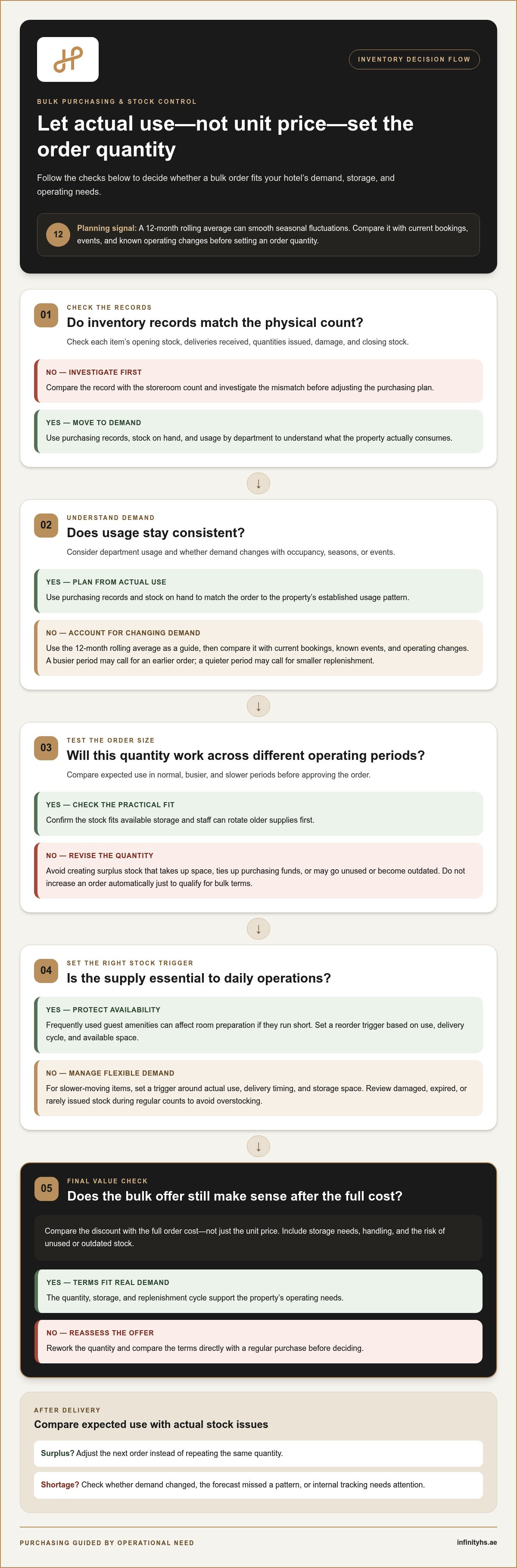
Bulk purchasing works best when order quantities reflect actual use, not just attractive unit terms. Start with purchasing records, stock on hand, and usage by department. Compare housekeeping consumption with guest-room demand, since amenities used in occupied rooms may move differently from back-of-house supplies. Then group items by how quickly they are used, how easily they can be stored, and whether demand changes with occupancy. This helps identify where larger orders support continuity and where they risk creating excess stock.
Keep a simple inventory record for each item: opening stock, deliveries received, quantities issued, damage, and closing stock. For example, housekeeping can record amenities issued to rooms and returned unused. Compare those entries with the storeroom count before placing the next order. If recorded stock differs from the physical count, investigate the mismatch before adjusting your purchasing plans. Accurate records help limit emergency purchases and reduce the risk of holding supplies the property cannot use efficiently.
Demand can shift with seasons, events, and occupancy. A 12-month rolling average can smooth seasonal fluctuations and help reveal underlying use patterns. Compare that trend with current bookings and known operating changes before setting a reorder level. For example, a hotel preparing for a busy period may need to bring forward an order, while a quieter period may call for smaller replenishment. The average informs planning; current operational details help determine the quantity.
Separate essential supplies from items with flexible demand. A shortage of frequently used guest amenities can disrupt room preparation, while overstocking slower-moving items takes up storage space and ties up purchasing funds. Assign each category a reorder trigger based on its use, delivery cycle, and available space. Review damaged, expired, or rarely issued stock during regular counts. This turns inventory checks into a practical way to protect revenue, support guest satisfaction, and keep replenishment aligned with daily operations.
Before approving a bulk order, compare three scenarios: normal use, a busier operating period, and a slower period. Check that the order fits storage capacity and that staff can rotate older stock first. Record expected use, then review actual issues against the plan after delivery. If an order leaves a surplus, adjust the next quantity rather than repeating the same pattern. If stock runs short, identify whether demand changed, the forecast missed a pattern, or internal tracking needs attention. These steps ground purchasing decisions in operational evidence, not assumptions.
Avoid increasing the order automatically, and instead ensure every purchasing decision remains strictly tied to operational need rather than bulk terms alone.
3. Long-term cost control and growth
Plan supply spending around the property’s operating goals, not just this month’s purchase total. A five-year vision can help managers distinguish temporary savings from decisions that support future growth. Before reducing a supply budget, identify the expense affected, the expected operational change, and how the result will be assessed. This connects purchasing decisions to capital planning and profitability without assuming every cost reduction creates lasting value.
The supplies with the lowest total cost of ownership meet the property’s needs with less combined spending on purchase, use, maintenance, and replacement. Compare equivalent items across those cost categories, then consider service life and operational disruption. A durable item may be more economical if it stays usable longer and needs fewer repairs. The right choice depends on actual hotel performance, not price alone.
To compare supply cost per use and replacement cycles, divide the purchase cost by the number of uses, then include maintenance and replacement costs. Compare the result across alternatives with similar functions. For example, track how often a frequently used item needs repair or replacement, then compare its full cost with a longer-lasting option. Consistent records make the comparison useful for budgeting and future orders.
Evaluate hotel cleaning supplies for effectiveness as well as cost, rather than choosing solely on a low purchase price. Compare the product’s use instructions with the property’s cleaning procedures, staff handling needs, and the results on the surfaces being cleaned. Reducing product use without following manufacturer instructions can undermine cleaning performance. The U.S. Environmental Protection Agency also notes that investing in green cleaning can save hotels money.
For energy-efficient appliances, compare the upfront purchase with expected operating costs using product information and the property’s utility records. Consider how often the equipment will run and whether its energy use suits the hotel’s actual needs. A low initial cost doesn’t show the full financial impact; operating expenses over the appliance’s useful life matter too. This helps managers assess whether an upgrade or another property priority is the better use of capital.
Warranty, maintenance, and repair costs also affect ownership value. Review what the warranty covers, its duration, and any exclusions alongside the expected maintenance schedule. Record repair history and operational interruptions for existing equipment. These details help managers compare replacement with continued repair while accounting for effects on staff and guest service.
According to the U.S. Environmental Protection Agency, a San Antonio hotel saves $35,000 annually on water and sewer bills after upgrading restroom fixtures, and also has fewer maintenance calls. The example shows how an upgrade can affect both operating expenses and upkeep. For a growth plan, document the expected benefit, assign responsibility for tracking results, and review whether the change supports the property’s service and profitability goals.
4. Bulk purchasing and per-unit savings
Bulk purchasing lowers the quoted unit rate only if the order delivers the expected usable quality. Compare the effective cost per accepted unit, not just the listed unit price. This matters when a shipment includes items that fail inspection, differ from the approved sample, or need extra preparation before use. A clear acceptance standard helps teams judge whether the apparent bulk saving holds up after delivery.
Define product requirements before requesting quotes. Specify material, finish, dimensions, construction, and any relevant performance criteria. Then compare offers against the same specification and quantity. If a quote uses a different grade or omits an agreed feature, its lower rate may not represent equivalent value. Document approved samples and inspection criteria so delivered goods can be assessed consistently.
Use this calculation: total purchase cost divided by the number of units accepted for use. Include any directly associated charges shown in the offer, then compare the unit figure across equivalent options. For example, if two orders have similar invoice totals but one has fewer accepted units, its effective unit cost will be higher. This makes quality differences visible in the purchasing review.
Also consider whether a bulk order creates consistency across guest rooms. Matching linen or accessories can support a uniform presentation, while mixed batches may show visible differences in colour, finish, or feel. Before committing, compare the sample with existing room standards and confirm replacements can maintain the same specification. This is a quality-control question, not simply a matter of how many units fit in one purchase.
For supplies with several components, compare the complete usable set rather than individual pieces. A bundle may look economical but offer limited value if the property must source missing components separately. List what the operation needs, identify what each offer includes, and calculate the cost of obtaining a complete, service-ready set. This prevents a low per-piece rate from hiding extra purchasing steps.
Long-term value vs short-term cost in hotel supplies also depends on the consistency of later orders. Record the approved specification and keep quality review notes with purchasing records. When a new batch arrives, compare it with the standard before distribution. This helps identify variations early and supports a reliable guest experience without assumptions about future deliveries.
Use long-term value vs short-term cost in hotel supplies as a practical comparison, not a slogan. Check the effective unit cost, accepted quality, completeness, and consistency of each offer. A bulk rate matters when the goods meet the hotel’s standards and serve their intended purpose. These checks give purchasing teams a stronger basis for judging whether a lower unit figure represents real value.
5. Procurement and vendor negotiation
Hotel supply procurement strategies can reduce costs without lowering quality by combining orders, aligning specifications, and negotiating around actual operating needs. Start with a clear product standard, expected quantity, delivery schedule, and quality requirement. Then compare supplier proposals against the same criteria. This prevents a lower quote from seeming better simply because it covers a different product or service level.
Consolidating suppliers can simplify purchasing and reduce duplicate orders across departments. Review purchasing records, identify products with matching specifications, and group suitable requirements into fewer orders. For example, housekeeping and guest-room teams may use some of the same amenities. Coordinating demand can strengthen the hotel’s purchasing position while keeping product quality consistent across rooms.
Group buying with other local properties can also improve negotiation leverage. Hotels can identify common requirements, agree on shared specifications, and approach suppliers with combined demand. Each property should still confirm its own quantities and delivery needs. A shared order supports operational efficiency only when the products suit each hotel and the timing works for each receiving team.
Prepare for supplier discussions with evidence, not a general request for a discount. Bring recent order history, stock patterns, quality feedback, and recurring issues such as damaged deliveries or inconsistent specifications. Ask for terms that address actual needs, such as consolidated delivery, consistent product standards, or pricing structures tied to recurring orders. A written comparison helps the team assess the full offer instead of focusing on one headline term.
Use a simple supplier scorecard to balance cost and performance. Track unit cost, product consistency, order accuracy, delivery reliability, and issue resolution. Review the same criteria for each supplier during planned purchasing reviews. If a supplier offers a lower price but repeated order errors create extra work, include that operational impact in the evaluation. This keeps negotiations focused on the total value delivered to hospitality operations.
Inventory records also strengthen negotiation. Share realistic demand forecasts, identify products that can be ordered together, and avoid committing to quantities the property cannot use. Clear forecasts help suppliers plan orders and give hotel teams a sound basis for discussing terms. Set a review date after each agreement, then compare actual deliveries, stock use, quality, and service with expectations. Adjust future orders when occupancy or operating requirements change.
Before renewing an agreement, summarize what worked, what caused disruption, and which terms need adjustment. This turns a routine renewal into a practical review of quality, cost, and service. Keep agreed specifications and order procedures accessible to purchasing and receiving teams so each delivery can be checked consistently. Use the review findings to set priorities for the next negotiation and clarify which service standards matter most.
Hotels can reduce supply procurement costs by negotiating group-buying agreements with other local properties, consolidating suppliers, and tracking inventory to prevent over-ordering.
Infinity Hotel Supplies: Hotel Linen
Infinity Hotel Supplies offers Hotel Linen for hotel teams weighing replacement needs, room standards, and purchasing priorities. Assess linen by expected use, care requirements, replacement cycle, and fit with guest expectations, not only by initial cost. Consistent specifications across rooms also make purchasing comparisons clearer and help teams plan replenishment.
For projects involving other hotel supply categories, Infinity Hotel Supplies also offers LOVO Premium Electronics, LUFTER PHYTOGREEN, and Leather Accessories. Consider these options when they fit your property’s requirements and purchasing plans.
Contact Infinity Hotel Supplies to discuss your hotel linen requirements.
Make the next purchasing decision count
Turn purchasing priorities into a shared operating practice. Bring purchasing, housekeeping, and finance teams into the discussion before setting supply standards. Each team sees a different part of the decision: usage, guest-facing performance, or budget impact. Aligning those perspectives helps the property choose criteria that remain useful as needs change.
Use those criteria to guide future purchases rather than relying on the last order or a discount alone. A considered approach to long-term value vs short-term cost in hotel supplies can keep purchasing choices connected to the hotel’s service priorities and operating plans. Make the next review an opportunity to refine priorities and strengthen coordination across teams.
Contact Infinity Hotel Supplies to discuss your requirements.
With clear priorities and coordinated decisions, your team can move forward with confidence.
Frequently Asked Questions
What Affects the Cost?
For GCC hotel purchases, delivery terms, shipment consolidation, and the receiving location can affect the final amount payable. A property ordering supplies for several sites can compare separate deliveries with a coordinated shipment, while accounting teams review the currency and payment terms in each quote. Ask purchasing staff to compare the full invoice structure, including handling or delivery charges, before approving an order.
How to compare long-term value and upfront cost of hotel supplies
Set a review horizon that matches the hotel’s budget cycle, then compare the purchase’s cash-flow impact with its expected operational benefit during that period. For instance, a property renovating guest rooms can separate supplies needed immediately from items planned for later phases. This avoids treating every purchase as equally urgent and helps managers decide which commitments fit current capital priorities without overlooking future needs.
How durable hotel linens, towels, and mattresses affect replacement costs
Durability affects how often linens, towels, and mattresses need replacement, but each item faces different use conditions. Towels and sheets move through frequent room-turnover routines, while mattresses stay in place and influence the guest’s sleep experience. Track replacement decisions by item type and room area, then review whether recurring problems cluster around particular uses. This helps teams set practical purchasing standards for each category.

Article by
Infinity Editorial Team
With deep expertise in hospitality product FF&E and OS&E across the Middle East and Africa, Infinity Editorial Team brings insights from Infinity Hotel Supplies, helping developers, hoteliers, and homeowners transform spaces from empty shells to fully furnished, design-ready environments.
Disclaimer
The content published by Infinity Editorial Team is intended for informational purposes only. All articles, guides, and insights are based on industry knowledge and experience in hospitality FF&E and OS&E supply across the Middle East and Africa. Infinity Hotel Supplies does not guarantee specific outcomes and recommends consulting a qualified professional for project-specific requirements.


