

The success of a luxury African resort often hinges on decisions made thousands of miles away in a Chinese manufacturing hub. While the cost benefits of sourcing are undeniable, the risk of receiving warped wood or broken glass at a remote site can derail even the most ambitious project. Implementing rigorous quality control for FF&E sourced from China for African hotels isn't just an optional safeguard; it's the foundation of a predictable procurement timeline. As of 2026, with zero-tariff treatments and updated BIFMA standards in place, the opportunity for African hospitality operators has never been greater, provided you can bridge the gap between production and delivery.
You've likely worried about furniture warping in coastal humidity or facing months of customs delays at major ports. It's a common concern for developers who need contract-grade durability that survives both the journey and the final environment. This guide shows you how to secure high-quality FF&E from China and manage the complex logistics of delivering to remote African resorts without delays or damage. We'll explore the critical inspection stages, the impact of 2026 trade agreements, and the strategic planning required to ensure your inventory arrives in pristine condition.
Key Takeaways
- Establish a multi-stage inspection process in manufacturing hubs like Foshan and Dongguan to ensure every piece meets contract-grade durability standards.
- Implement rigorous quality control for FF&E sourced from China for African hotels to mitigate environmental risks like humidity-induced warping and transit breakage.
- Optimize your supply chain by leveraging the 2026 AfCFTA framework and selecting strategic entry points like the Port of Mombasa or Durban to bypass delays.
- Adopt a hybrid labor model for on-site setup, combining international supervision with local teams to ensure precise installation at remote resort locations.
- Utilize a turnkey procurement strategy with direct oversight from China-based offices to maintain a predictable delivery timeline from factory to floor.
The Strategic Value of China-Sourced FF&E for African Hospitality
FF&E encompasses the movable furniture, fixed fixtures, and operational equipment that define the guest experience in a high-end resort. In the context of large-scale African developments, this category includes everything from bespoke cabinetry and lighting to specialized room accessories. China remains the premier 2026 manufacturing hub for these goods because it offers a sophisticated infrastructure capable of producing contract-grade items at a scale few other regions can match. While the "China Price" provides a significant competitive advantage, the true value lies in the ability to customize products to withstand the technical demands of African climates.
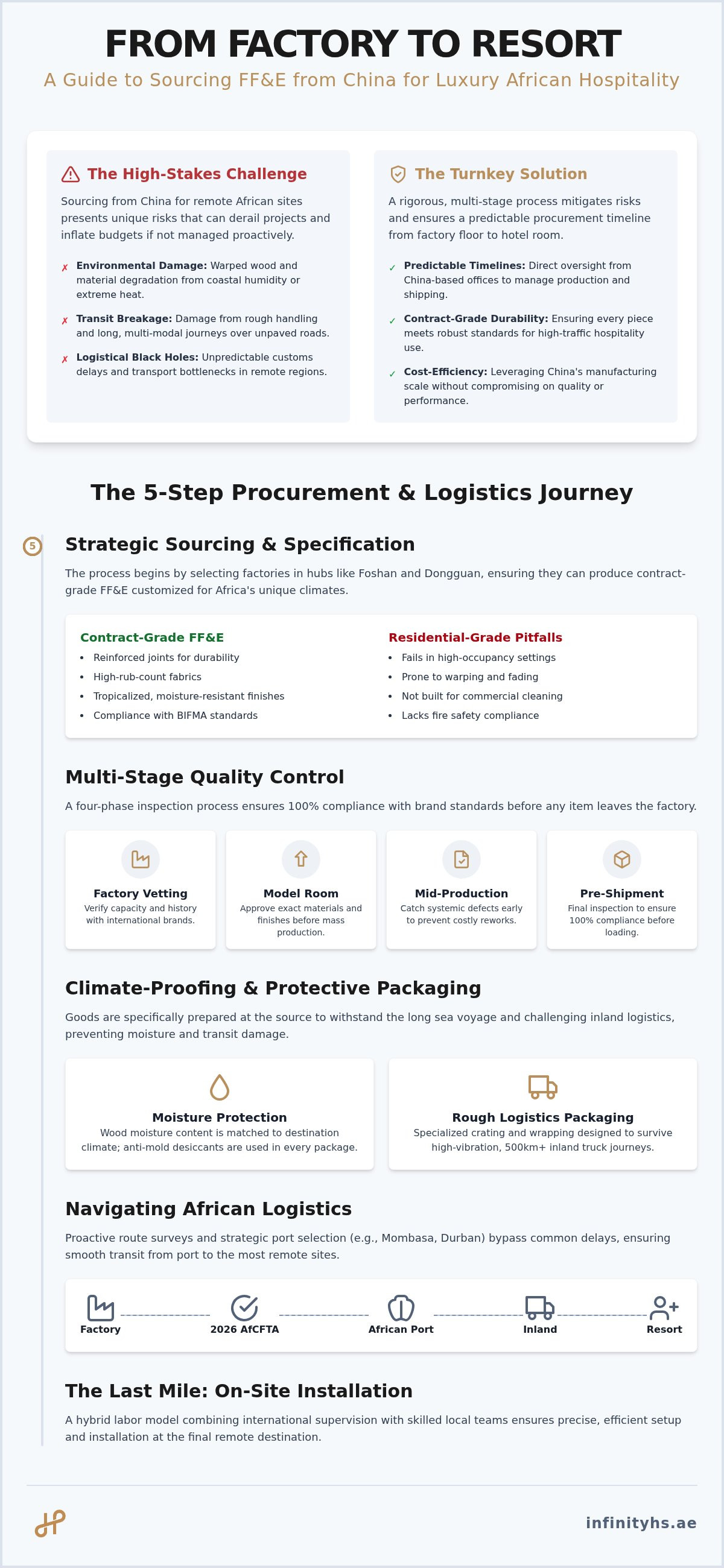
Balancing cost efficiency with performance requires a deep understanding of local environmental stressors like intense heat, high humidity, and pervasive dust. Developers must ensure that manufacturers use specific tropicalized finishes and moisture-resistant substrates. Implementing a rigorous quality control (QC) process is the only way to verify that these specifications are met before the goods leave the factory floor. Remote African FF&E Logistics is a multi-modal challenge involving port, rail, and unpaved road coordination.
Contract-Grade vs. Residential Quality
Residential furniture often fails within months when placed in high-occupancy African resorts. The constant cycle of guest turnover and heavy cleaning requires "contract-grade" construction, which features reinforced joints and high-rub-count fabrics. Material selection is particularly critical in tropical zones to avoid wood warping and fabric fading. Effective quality control for FF&E sourced from China for African hotels focuses on these durability metrics during the production phase. By 2026, hospitality operators must also ensure all items meet updated international fire safety and BIFMA standards to comply with insurance mandates and global brand audits.
The 'Infrastructure Gap' Challenge
Procuring for a remote safari lodge or a coastal resort requires a different playbook than equipping an urban hotel. Remote sites often present "logistical black holes" where traditional tracking fails and transit times become unpredictable. Savvy developers conduct a preliminary route survey to identify potential bottlenecks, such as bridge weight limits or narrow mountain passes, before placing orders. This proactive step prevents oversized crates from becoming stranded at a remote crossing. Success in these regions depends on identifying transport limitations early and adjusting the packaging and dimensions of the FF&E solutions accordingly to ensure a seamless arrival.
Implementing Multi-Stage Quality Control in China Factories
Securing a high-end finish for a luxury resort starts long before the first container is loaded. Success depends on a systematic alignment with China's export quality standards across four distinct production phases. Rigorous quality control for FF&E sourced from China for African hotels begins with vetting factories in manufacturing hubs like Foshan and Dongguan. You must verify their capacity for contract-grade production and their history with international hospitality brands before signing any contracts.
The "Model Room" represents the most critical checkpoint in this cycle. This phase allows you to approve exact materials and finishes before mass production begins. Once production starts, mid-production inspections help catch systemic defects early, preventing costly reworks. Finally, a comprehensive pre-shipment inspection (PSI) ensures 100% compliance with your brand standards. This multi-layered approach provides the security hospitality operators need when managing projects from a distance.
Moisture and Climate Protection at the Source
African climates vary from extreme coastal humidity to the arid heat of the interior. We require factories to test wood moisture content (MC) to ensure it matches the equilibrium moisture content of the final destination. This technical step prevents wood from cracking or swelling after installation. We also mandate the use of anti-mold desiccants and moisture-wicking wraps to protect surfaces during the long sea voyage. True quality control isn't just about aesthetics; it's about stress-testing furniture to survive the high-vibration reality of 500-kilometer inland truck journeys.
Packaging Standards for Rough Logistics
Standard cardboard boxes rarely survive the rough handling at African ports or the transit to remote sites. We move beyond basic packaging by requiring double-crating and reinforced edge protection for all high-end case goods. Delicate items, such as hotel room electronics, require specialized anti-static and shock-proof packaging to maintain their integrity. Bundling these items by room-matrix further simplifies on-site sorting, which saves significant time during the final setup. If you're planning a new build in a challenging location, it's beneficial to discuss your specific site conditions with our China-based team to customize these protection protocols early in the process.
Navigating Logistics: From Chinese Ports to the African Interior
The 2026 trade landscape offers unprecedented opportunities for African developers. China's decision to extend zero-tariff treatment to all African nations with diplomatic relations has significantly reduced the financial barriers to entry. Simultaneously, the African Continental Free Trade Area (AfCFTA) is beginning to streamline cross-border movements, reducing the bureaucratic delays that historically plagued the region. However, the physical movement of goods remains a sophisticated challenge. Successful delivery requires a strategic choice between entry points like the Port of Mombasa for East Africa, the Port of Durban for Southern Africa, or Walvis Bay for West and Central African corridors.
Consolidation is the secret to maintaining a predictable budget. Shipping from dozens of individual vendors in Foshan or Dongguan leads to fragmented tracking and higher costs. We recommend using a single logistics hub in China to consolidate all items into Full Container Loads (FCL). This approach ensures that the rigorous quality control for FF&E sourced from China for African hotels remains consistent across the entire shipment. For many developers, the "Dubai Bridge" serves as a vital intermediary. Utilizing UAE-based logistics offices allows for a 24/7 support loop, providing a stable staging ground between Chinese manufacturing and African job sites.
Customs and Compliance in 2026
Navigating the Certificate of Conformity (CoC) requirements is essential to avoid port storage fees. Each African jurisdiction has specific standards that must be verified before the containers leave China. While some developers prefer Delivered Duty Paid (DDP) terms, this can be risky in emerging markets where local regulations shift rapidly. Instead, focusing on FF&E value engineering can reduce shipping volumes and simplify the compliance process. Accurate documentation ensures that your project remains on schedule and avoids the "logistical black holes" common in remote regions.
Multi-Modal Transport Solutions
The journey rarely ends at the port. Moving goods to the interior requires a seamless transition from sea freight to rail (SGR) or heavy-duty road transport. Large-scale resorts often face the "break-bulk" challenge, where oversized lobby items or grand chandeliers require specialized flat-rack containers or escorted road convoys. We utilize RFID and cloud-based tracking to maintain visibility even in remote areas with limited infrastructure. This level of oversight is necessary to protect the investment you secured during the manufacturing phase. If you're concerned about specific inland routes, you can consult our logistics specialists to map out a secure delivery path for your inventory.
The Last-Mile: On-Site Installation and Setup
The physical arrival of containers at a remote African site is a significant milestone, yet the installation phase presents its own unique set of hurdles. Managing the last-mile for a safari lodge or island resort requires a disciplined, high-precision sequence of events. We prioritize a "heavy-to-light" approach where fixed joinery and heavy case goods are staged and secured before delicate soft goods enter the space. This methodical progression prevents damage to textiles and finishes during the high-activity phase of construction. It also ensures that the quality control for FF&E sourced from China for African hotels remains intact from the factory floor to the guest suite.
Local labor teams provide essential support, but they often lack specialized experience with bespoke Chinese joinery. We solve this by employing a hybrid labor model. This strategy pairs our international supervisors, who possess a deep understanding of the product engineering, with local installation teams. This collaborative oversight ensures that every wardrobe, headboard, and fixture is assembled according to the exact specifications approved during the model room phase. It's a partnership that prioritizes long-term durability over quick completion.
Environmental protection is equally vital during the setup. African humidity can be unforgiving, especially in coastal or jungle locations. We designate "Dry Rooms" on-site, utilizing industrial dehumidifiers to create a controlled staging environment for sensitive wood products and electronics. Even with superior packing, minor transit vibrations can cause small scuffs. Our teams arrive equipped with specialized repair kits to handle on-site "snagging" immediately. This proactive care ensures that every item meets the 2026 standards for luxury hospitality before the first guest arrives.
Staging and Room Placement
- Step 1: Unloading and Staging. We utilize heavy-duty housekeeping trolleys to move items efficiently from the staging area to individual rooms, reducing manual handling risks.
- Step 2: Heavy Installation. Teams focus on installing fixed joinery, such as large wardrobes and integrated headboards, which require precise anchoring and leveling.
- Step 3: Final Decor. Once the heavy lifting is complete, we manage the placement of leather accessories and other delicate room decor to complete the aesthetic vision.
Waste Management in Eco-Sensitive Zones
Remote sites are often located in eco-sensitive regions where traditional waste infrastructure is non-existent. Unpacking a single hotel wing generates massive amounts of timber crating and protective plastic. We implement a "Zero-Waste" protocol, specifically for safari lodges, where all packaging materials are consolidated and back-hauled for responsible recycling. This approach is a stark contrast to hotel FF&E installation and logistics in Jeddah, where urban waste systems are readily accessible. Our commitment to the environment is as meticulous as our commitment to quality.
Partnering with Infinity Hotel Supplies for Turnkey African Logistics
Successfully executing a large-scale hospitality project in Africa requires more than just a sourcing agent; it demands a global partner with boots on the ground. Infinity Hotel Supplies operates a sophisticated network across China, the UAE, and the UK, creating a 24/7 support loop that bridges the gap between manufacturing hubs and remote project sites. Our China-based team provides direct oversight in Foshan and Dongguan, ensuring that the rigorous quality control for FF&E sourced from China for African hotels is maintained at every production stage. This global presence allows us to manage the complex logistical intersection of the Middle East and Africa with established reliability and global competence.
We offer a turnkey procurement methodology designed to eliminate "Opening Anxiety" for developers and operators. This holistic service begins with technical factory matching and extends through consolidation to the final white-glove setup on-site. By managing the entire lifecycle, we ensure that your design vision isn't lost in translation or compromised during transit. Clients also gain direct access to our exclusive premium brands, including high-performance LOVO room electronics and sustainable LUFTER PHYTOGREEN amenities. These solutions ensure your resort meets the highest international standards for guest experiences while maintaining operational efficiency.
Strategic Procurement Planning for 2026
As trade dynamics shift, staying compliant with evolving international brand standards is essential for long-term viability. We assist developers in navigating these technical requirements while offering extensive customization options. Whether you require bespoke custom branding for hotel linens or tailored packaging for bathroom accessories, our team ensures every detail reflects your unique brand identity. Our 2026 planning process integrates the latest AfCFTA benefits and updated safety certifications into your project timeline. You can request a tailored FF&E logistics quote to see how we optimize shipping volumes and reduce landing costs for your specific African project.
Ready to Secure Your Supply Chain?
Navigating the final stretch of a hotel opening doesn't have to be a gamble. Our consultation process for remote site logistics analyzes your specific route limitations and environmental risks before the first container leaves the port. The Infinity advantage combines a visionary understanding of guest expectations with pragmatic execution in the supply chain. We prioritize trust and long-term collaboration, positioning ourselves as a meticulous facilitator of your hotel’s success. It's a steady and business-like approach that delivers stability and excellence in equal measure.
Securing Your African Hospitality Vision in 2026
Delivering a luxury experience in a remote African location requires a procurement strategy that bridges the gap between manufacturing hubs and job sites. Implementing rigorous quality control for FF&E sourced from China for African hotels ensures that your investment is protected from the factory floor through the challenging inland transit. You've seen how multi-stage inspections and climate-proofing are essential to maintain durability in tropical and arid zones. These steps prevent the costly delays and damage that often derail high-end developments.
Since 2014, Infinity Hotel Supplies has specialized in the logistical complexities of the African market. Our global footprint, with offices in China, the UAE, and the UK, offers the professional authority and oversight needed for turnkey solutions. We manage every detail, from sourcing contract-grade furniture to the white-glove installation of premium electronics and guest amenities. This end-to-end methodology provides the stability hospitality operators require for large-scale projects.
Let's turn your development vision into a seamless reality with a partnership grounded in stability and excellence. Your project deserves a reliable ally that values meticulous detail and operational efficiency in equal measure.
Frequently Asked Questions
What are the biggest risks when sourcing FF&E from China for Africa?
The primary risks involve inconsistent manufacturing quality and damage during the complex logistics of inland transit. Without on-site factory vetting, projects often face material substitutions that fail in harsh African climates. Additionally, rough handling at ports and during long-distance trucking can lead to high breakage rates. Implementing rigorous quality control for FF&E sourced from China for African hotels is the only way to mitigate these threats before the goods leave the factory.
How does AfCFTA affect hotel procurement costs in 2026?
The African Continental Free Trade Area (AfCFTA) reduces procurement costs by eliminating internal tariffs and streamlining cross-border customs procedures. In 2026, this framework allows for more efficient movement of goods between regional hubs, such as from the Port of Durban to neighboring landlocked nations. By reducing the time containers spend at borders, developers can significantly lower their indirect logistical expenses and maintain a much more predictable project timeline.
What is the typical lead time for FF&E delivery to a remote African site?
The typical lead time ranges from five to eight months from the initial order to on-site delivery. This duration includes specific phases: factory matching (2-3 weeks), model room approval (4-8 weeks), and bulk production (8-11 weeks). Ocean transit and customs clearance at African ports usually add another 3-8 weeks. Remote sites require an additional buffer for inland transport, which can vary based on seasonal road conditions and local infrastructure limitations.
Should I use local or international installers for a safari lodge project?
We recommend a hybrid labor model that utilizes international supervisors to lead local installation teams. While local teams possess valuable site knowledge, international supervisors ensure that bespoke Chinese joinery is assembled according to technical specifications. This partnership provides the best balance of cost efficiency and technical precision. It ensures that complex headboards and fixed fixtures are installed correctly, preserving the durability promised during the manufacturing phase in China.
How do I protect luxury furniture from high humidity during sea transit?
Protection starts with moisture-resistant packaging and moisture-wicking desiccants placed inside the containers. Manufacturers must also ensure that the wood moisture content is tested and stabilized to match the destination's equilibrium moisture content. Using anti-mold wraps and industrial-grade shrink-wrapping provides an essential barrier against the salt air and high humidity experienced during the sea voyage. These protocols are a vital component of quality control for FF&E sourced from China for African hotels.
What happens if FF&E arrives damaged at a remote location?
Any damage identified during the unloading process must be documented immediately with high-resolution photos for insurance claims. For minor scuffs or vibrations, on-site teams use specialized repair kits included in the shipment to perform "snagging" repairs. If a critical item is structurally compromised, the procurement partner initiates an expedited replacement order. A robust logistics plan always includes a contingency buffer of extra materials for items prone to breakage, such as glass or delicate tiles.
Which African ports are most efficient for hotel project imports in 2026?
Efficiency depends on your project's specific location, but the Port of Mombasa, Port of Durban, and Walvis Bay remain the most reliable entry points. Mombasa serves as the primary gateway for East African developments, while Durban offers sophisticated rail connections for Southern African sites. Walvis Bay has emerged as a strategic hub for West and Central African corridors due to its streamlined customs processes and improved inland road networks for heavy-duty transport.
How can I reduce shipping costs for a large-scale hotel project in Africa?
Consolidating shipments into Full Container Loads (FCL) at a single hub in China is the most effective way to reduce costs. This strategy avoids the high fees associated with multiple small shipments and simplifies the tracking process. Additionally, utilizing value engineering during the design phase can help optimize furniture dimensions to fit more items into each container. Leveraging 2026 trade agreements, such as China's zero-tariff policy for African nations, also provides significant direct savings.

Article by
Infinity Editorial Team
With deep expertise in hospitality product FF&E and OS&E across the Middle East and Africa, Infinity Editorial Team brings insights from Infinity Hotel Supplies, helping developers, hoteliers, and homeowners transform spaces from empty shells to fully furnished, design-ready environments.
Disclaimer
The content published by Infinity Editorial Team is intended for informational purposes only. All articles, guides, and insights are based on industry knowledge and experience in hospitality FF&E and OS&E supply across the Middle East and Africa. Infinity Hotel Supplies does not guarantee specific outcomes and recommends consulting a qualified professional for project-specific requirements.


