

The lowest-priced OS&E proposal can become the hardest to deliver if its specifications, quality checks, or delivery plan do not fit the project. That is why hotel OS&E sourcing in Africa should be assessed as a complete process, not simply a comparison of supplier quotes. Unclear product briefs and unconfirmed delivery arrangements for a specific property can put operational readiness at risk.
A disciplined approach makes sourcing decisions easier. This guide explains how to define OS&E requirements, compare supplier proposals on an equivalent basis, and coordinate quality checks, delivery, and acceptance around the property’s needs and opening schedule. It also shows how to connect product choices to the intended guest experience and daily operations, while flagging project details to confirm before placing orders.
From preparing a clear brief to reviewing sourcing options and planning delivery, each step supports informed decisions. The goal is an OS&E scope that fits the hotel and a coordinated path from initial requirements through receipt and acceptance.
Key Takeaways
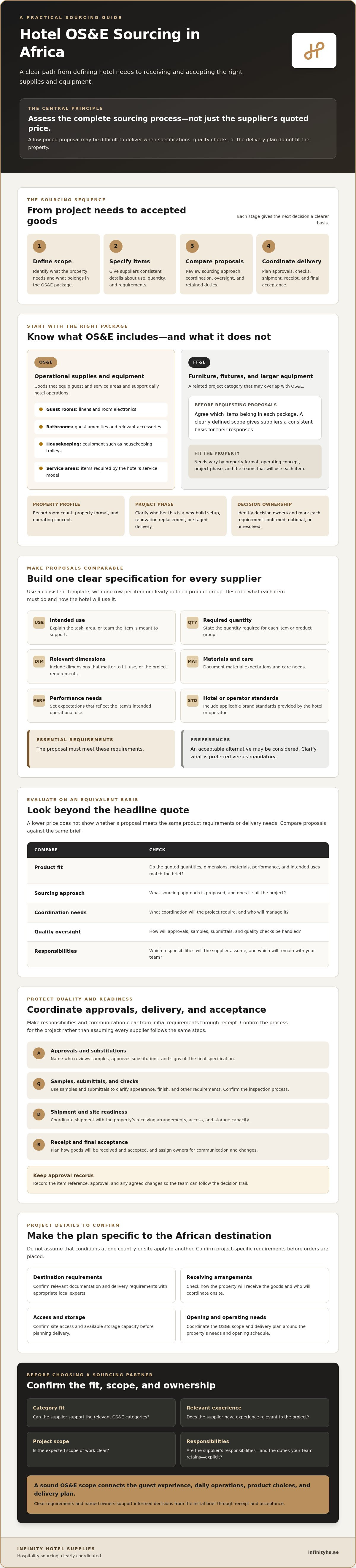
- Define which items fall within OS&E scope, and distinguish them from FF&E to give suppliers a clear project brief.
- Use a consistent specification template so suppliers quote against the same quantities, dimensions, materials, performance needs, and intended uses.
- Evaluate hotel OS&E sourcing in Africa by comparing sourcing approaches, coordination needs, quality oversight, and the responsibilities your team retains.
- Plan approvals, quality checks, shipment coordination, receipt, and final acceptance, with named owners for communication and changes.
- Before selecting a sourcing partner, confirm category fit, relevant experience, project scope, and the responsibilities the supplier will assume.
What Hotel OS&E Sourcing in Africa Covers, and What It Does Not
Hotel OS&E, or operational supplies and equipment, comprises the goods a hotel needs to equip guest and service areas and support daily operations. Common categories include linens, room electronics, guest amenities, and housekeeping equipment. FF&E generally refers to furniture, fixtures, and larger equipment used to furnish hotel spaces. Because the categories can overlap, define which items belong in each project package before requesting proposals.
The right scope depends on the property, not a generic checklist. A full-service hotel, a limited-service property, and a resort may need different guest supplies and operational equipment. The project phase matters too: a new build may require a complete initial setup, while a renovation may call for replacement items or staged delivery. A clear scope is the starting point for a sound procurement process.
For a visual overview of how OS&E and FF&E sourcing fits hospitality projects, watch this video:
Which hotel departments should an OS&E brief cover?
Organize the brief by the areas and teams that will use each item. Start with guest rooms and bathrooms, then include housekeeping and any relevant service areas. A category overview, such as a hotel OS&E essentials guide, can help teams identify likely needs, but the property’s operating plan should determine the final scope.
- Guest rooms: linens and room electronics.
- Bathrooms: amenities and relevant accessories.
- Housekeeping: equipment such as housekeeping trolleys.
- Service areas: items required by the hotel’s specific service model.
Include only categories relevant to the operation, and identify who will use each item. This helps prevent omissions without ordering products the property does not need.
How should the project brief define scope?
Record the room count, property format, operating concept, project phase, and decision owners. Label each requirement as confirmed, optional, or unresolved. This makes approval status visible and gives suppliers a clear basis for their responses.
For hotel OS&E sourcing in Africa, do not assume that one country’s or site’s conditions apply to another. Confirm destination-specific documentation and delivery requirements with appropriate local experts. Check practical site details too, such as receiving arrangements, access, and storage capacity. These project facts affect what can be supplied, when it can be accepted, and who must approve changes.
How to Build OS&E Specifications That Suppliers Can Quote Clearly
A supplier can quote accurately only when the brief explains what each item must do and how the hotel will use it. For hotel OS&E sourcing in Africa, consistent specifications also help teams assess alternatives without mistaking a lower price for an equivalent product. Define the operating need first, then document the requirements and approval route.
What information belongs in an OS&E specification?
Use one row per item or clearly defined product group. Record its intended use, required quantity, relevant dimensions, materials, performance expectations, and care needs. Add any brand standards supplied by the hotel or operator. Separate essential requirements, which a proposal must meet, from preferences, where an acceptable alternative may be considered. For example, state whether a particular material is mandatory or preferred.
Identify who reviews samples, approves substitutions, and signs off the final specification. Samples and submittals can clarify appearance, finish, and other requirements that are difficult to describe in text. Keep dated approval records with the item reference and any agreed changes. Confirm the sample, submittal, and inspection process for the project rather than assuming every supplier follows the same steps.
How can buyers compare supplier proposals fairly?
Give every supplier the same specification and response template. Ask each to identify compliance, exclusions, proposed alternatives, supporting quality information, and delivery assumptions. This makes differences visible and gives the project team a clear basis for follow-up. For amenity categories, a hotel amenities range can help frame the items to specify, while the hotel’s approved requirements should remain the basis for comparison.
Use this workflow to prepare an approval-ready brief:
- Define the operating need. State where and how the item will be used.
- Set the quantity and scope. Connect requested quantities to the approved project requirements.
- Complete the specification template. Include dimensions, materials, performance, care, and intended use.
- Mark must-haves and preferences. State where alternatives can be proposed and what evidence is needed to assess them.
- Assign review and approval owners. Name the people responsible for samples, substitutions, and final sign-off.
- Compare responses line by line. Record gaps, exceptions, evidence, and delivery assumptions before evaluating proposals.
If a requirement is unresolved, label it and ask suppliers to state their assumptions rather than silently filling the gap. This is especially useful when product availability, quality checks, or delivery conditions still need project-specific confirmation. To discuss a project brief and clarify the relevant OS&E scope, contact Infinity Hotel Supplies.
How to Compare OS&E Sourcing Options for an African Hotel
For hotel OS&E sourcing in Africa, the right approach depends on project scale, the hotel team’s capacity, and how much coordination the buyer wants a supplier to manage. A direct category supplier may bring focused expertise, while coordinating several categories through one provider can simplify communication. Project-based support may add structure across agreed stages, but its scope and responsibilities should be defined in advance.
Compare the full delivery scope and handover point, not only the product offer. Ask suppliers to explain what their proposals include and exclude, then compare equivalent responsibilities and assumptions.
| Sourcing approach | Scope | Coordination needs | Quality oversight | Buyer responsibilities |
|---|---|---|---|---|
| Direct category sourcing | One product category, such as linens or room electronics. | Buyer coordinates across suppliers and aligns separate schedules. | Review evidence and approvals category by category. | Manage the brief, comparisons, communication, and delivery dependencies. |
| Coordinated multi-category sourcing | Several OS&E categories under a coordinated scope. | Potentially fewer communication channels, with clear category ownership still needed. | Confirm how specifications, samples, checks, and approvals are handled across categories. | Approve the combined scope and define decision owners and handover expectations. |
| Project-based support | Support for agreed project activities or stages. | Responsibilities and interfaces must be documented before work begins. | Confirm which checks are included and who records or approves results. | Retain oversight of excluded tasks and decisions assigned to the hotel team. |
When does coordinated multi-category sourcing help?
It may help when specifications, approvals, or delivery dependencies cross categories. For example, a hotel may want consistent communication across guest-room electronics and related room supplies. A coordinated brief can make those links easier to manage, but it should not replace specialist category knowledge. Compare the value of consolidated coordination with the expertise and accountability each category requires.
What should a landed-supply comparison include?
Ask suppliers to document delivery assumptions, exclusions, documentation responsibilities, and the point where responsibility transfers to the hotel or another party. Clarify who manages communication if a shipment or specification changes. Check destination-country and site requirements with qualified local advisers, since conditions should not be generalized across Africa. Confirm product availability and delivery scope for the specific project before relying on a proposal.
Choose the model that matches your team’s capacity and required accountability. For broader context on supplier roles, consult a global hotel procurement partner guide, then verify the proposed scope directly with each supplier.
How to Protect Quality and Coordinate OS&E Delivery
Quality control and delivery coordination work best as one documented plan. For hotel OS&E sourcing in Africa, agree what will be checked, who records each decision, and how goods will be received before sourcing or production proceeds. Confirm product availability, quality-check procedures, and destination-specific logistics for the project rather than relying on assumptions about a country or region.
Which quality checkpoints should buyers agree in advance?
Set approval points before confirming an order. A practical sequence moves from specification review to sample approval, confirmation of substitutions, agreed sourcing or production checks, and inspection at receipt. Define the criteria for each checkpoint against the approved requirements. Name the person who can sign off, and keep dated records of approvals, inspection findings, and corrective actions.
Agree how discrepancies will be reported and escalated. The record should identify the item, the difference between the approved specification and what was observed, supporting evidence, and the person responsible for deciding next steps. The designated owner should approve changes in writing before an updated requirement is treated as final.
How can delivery coordination support a hotel opening?
Work backward from the date each area needs to be operational, but do not assume universal lead times. Ask suppliers to confirm a project-specific schedule and its dependencies. Then check that the property can receive, inspect, and store each delivery when it arrives. If space or access is constrained, assess phased deliveries against site readiness and hotel priorities.
- Before dispatch: Confirm the delivery plan, relevant documents, communication contacts, and escalation route.
- Before arrival: Verify site access, receiving arrangements, available storage, and who will inspect the goods.
- At receipt: Record quantities and visible discrepancies, then compare items with approved specifications.
- At acceptance: Document outstanding issues, agreed corrective actions, and the person authorizing final acceptance.
Remote-site constraints may affect access, storage, or the practical sequence of deliveries. Verify these conditions with the project team and appropriate local advisers, including any country-specific documentation or logistics requirements. If housekeeping equipment is in scope, include the site’s handling and storage needs when reviewing housekeeping trolleys.
A clear responsibility matrix helps prevent supplier communication, document control, issue escalation, and change approvals from falling between teams. Confirm which tasks are included in the supplier’s project scope and which remain with the hotel or its local representatives.
Choose an OS&E Sourcing Partner for Your African Hotel Project
A suitable sourcing partner should match the categories in your brief and make responsibilities clear. Assess how the supplier interprets requirements, who owns communication, which quality checks are included, and where its project scope ends. For hotel OS&E sourcing in Africa, confirm that the supplier can address the destination and site conditions for your project. Experience in one market does not automatically establish suitability for another.
Ask prospective suppliers to explain their approach in practical terms. Their answers should help you judge whether their capabilities and proposed involvement fit the hotel’s needs.
What should buyers ask a prospective OS&E supplier?
- How will you review the brief and identify missing or conflicting requirements?
- Who will manage communication, approvals, and progress updates, and how often will the project team receive them?
- Which product categories are within scope, and what quality checks or supporting evidence can you provide for those items?
- What delivery assumptions, documents, and handover points should the hotel plan for?
- Which decisions and tasks remain the responsibility of the hotel or its local representatives?
Request evidence relevant to the proposed scope, such as examples of comparable product categories or an explanation of quality-control procedures. Ask whether examples relate to similar project requirements, and do not infer certifications or country-specific delivery experience unless the supplier can substantiate them. Record agreed inclusions, exclusions, and responsibilities in writing.
Infinity Hotel Supplies is a Dubai-based hospitality supplier founded in 2014, with offices in the UAE, China, and the United Kingdom. Its offerings include OS&E solutions, hotel linens, amenities, room electronics, and housekeeping trolleys. The company describes its capabilities in global sourcing and quality control. Confirm the availability, specifications, checks, and support applicable to your enquiry before defining the supplier’s role.
What information should an initial project enquiry include?
A focused enquiry gives a supplier a sound basis to assess category fit and clarify next steps. Include the property’s country and type, whether the project is a new opening or renovation, the anticipated opening phase, and the product categories under consideration. Attach available specifications, brand standards, and quantities, even if some requirements are still being finalized.
Name the project contacts and indicate who can approve specifications, samples, substitutions, and scope changes. Flag unresolved decisions rather than presenting them as confirmed. This helps identify details to validate, including destination-specific documentation or delivery requirements.
Turn a Clear OS&E Brief Into a Confident Project Plan
Successful hotel OS&E sourcing in Africa starts with a scope shaped around the property’s operating model, not a generic checklist. Clear specifications help suppliers respond on an equivalent basis. Agreed approvals, quality checks, and delivery responsibilities give the project team a practical way to manage decisions through receipt and acceptance.
Choose a sourcing approach that fits the project scale and your team’s capacity. Before confirming a supplier, clarify category coverage, quality-control procedures, delivery assumptions, and which responsibilities remain with your team. Verify country and site requirements for the specific project.
Infinity Hotel Supplies is based in Dubai and has offices in the UAE, China, and the United Kingdom. Its offerings include OS&E solutions, hotel linen, amenities, room electronics, uniforms, and housekeeping equipment. Confirm product availability and project scope for each enquiry.
A well-defined brief and clear ownership help your team make informed decisions and prepare the property for its intended guest experience.
Frequently Asked Questions
What does OS&E include in a hotel?
OS&E includes operational supplies and equipment used to equip hotel spaces and support daily operations. Examples include hotel linens, guest amenities, room electronics, uniforms, housekeeping equipment, and accessories. The exact scope depends on the property’s service model and operating needs. FF&E generally covers furniture, fixtures, and larger equipment used to furnish spaces. Define the boundary between OS&E and FF&E in the project brief to avoid gaps or duplicated items.
How do hotels source OS&E for projects in Africa?
Hotels can source OS&E by defining operating requirements, preparing consistent specifications, and inviting suitable suppliers to respond. Compare proposals by product compliance, exclusions, quality evidence, delivery assumptions, and clearly assigned responsibilities. For hotel OS&E sourcing in Africa, verify the destination country’s and property’s documentation and delivery requirements with qualified local advisers. The right sourcing approach depends on project scale, internal capacity, category needs, and the level of coordination required.
What should an OS&E specification include?
An OS&E specification should identify each item’s intended use, required quantity, relevant dimensions, materials, performance expectations, and care needs. Include any brand standards provided by the hotel or operator, and distinguish mandatory requirements from preferences so suppliers can identify acceptable alternatives. Name the people responsible for reviewing samples, approving substitutions, and signing off final specifications. Clear requirements help suppliers respond consistently and allow the project team to assess proposals against the same criteria.
How can a hotel compare OS&E supplier proposals?
Give each supplier the same specification and response format, then compare proposals line by line. Check which requirements are met, what is excluded, whether alternatives are proposed, and what evidence supports quality claims. Review delivery assumptions, documentation responsibilities, and handover points as well as the products themselves. Record open questions and differences before selecting a proposal. This helps distinguish comparable offers from responses based on different interpretations of the brief.
What should buyers verify before shipping hotel supplies to an African country?
Before confirming shipment, ask the supplier to state delivery assumptions, required documents, exclusions, communication responsibilities, and the point of handover. Verify destination-specific import, documentation, and delivery requirements with qualified local advisers, since conditions can differ across African countries and project sites. Also confirm that the hotel can receive, inspect, and store the goods as planned. Avoid relying on general regional assumptions; check product availability and logistics for the specific project.
How can hotels maintain OS&E quality during sourcing and delivery?
Agree quality criteria and review points before orders are confirmed. These may include specification approval, sample review, authorization of substitutions, sourcing or production checks, and inspection at receipt. Keep dated records of approvals, findings, discrepancies, and corrective actions. Assign an owner to escalate issues and approve changes, and define how the hotel will document final acceptance. Confirm the supplier’s quality-control process and the evidence it can provide for the products in scope.
Can one supplier coordinate multiple OS&E categories for a hotel project?
One supplier may coordinate several OS&E categories, but the available scope and responsibilities must be confirmed for the project. Ask how category specifications, approvals, quality checks, communication, and delivery dependencies will be managed, and identify what remains with the hotel team. Infinity Hotel Supplies offers OS&E solutions and categories including linens, amenities, room electronics, and housekeeping trolleys. Confirm product availability, quality procedures, and the specific support applicable to your enquiry.

Article by
Infinity Editorial Team
With deep expertise in hospitality product FF&E and OS&E across the Middle East and Africa, Infinity Editorial Team brings insights from Infinity Hotel Supplies, helping developers, hoteliers, and homeowners transform spaces from empty shells to fully furnished, design-ready environments.
Disclaimer
The content published by Infinity Editorial Team is intended for informational purposes only. All articles, guides, and insights are based on industry knowledge and experience in hospitality FF&E and OS&E supply across the Middle East and Africa. Infinity Hotel Supplies does not guarantee specific outcomes and recommends consulting a qualified professional for project-specific requirements.


