

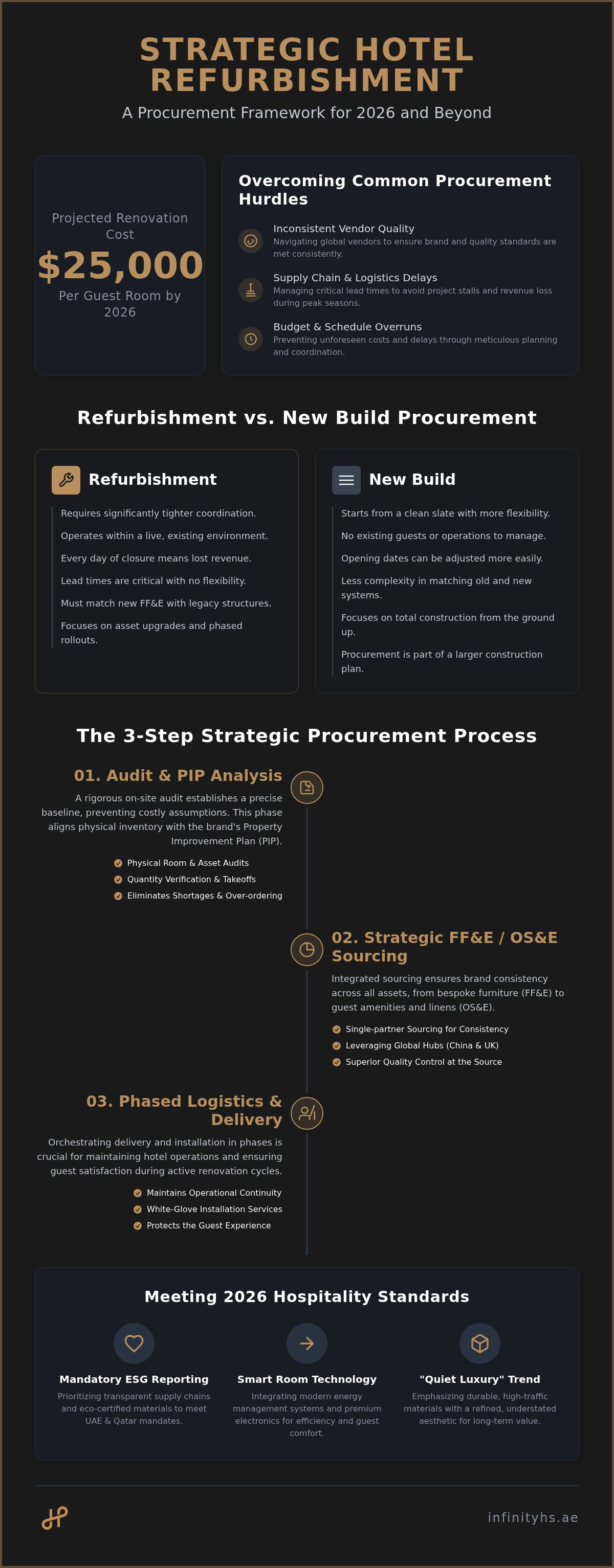
With guest room renovation costs climbing as high as $25,000 per room in 2026, the financial stakes for your property have never been higher. You likely recognize that a refreshed aesthetic is vital for capturing the projected growth in the GCC hospitality market, yet the logistical friction of hotel refurbishment procurement often threatens to derail even the most disciplined budgets. It's a common challenge to face inconsistent quality from global vendors or find your project stalled by supply chain delays just as peak season approaches.
We're here to help you move beyond these traditional pain points with a strategic approach to sourcing and logistics. By following this professional framework, you'll learn how to master the complexities of FF&E and OS&E sourcing while adhering to the latest 2026 ESG reporting mandates and Dubai building safety laws. We'll preview the essential steps for orchestrating seamless, phased renovations that protect the guest experience and deliver a brand-compliant transformation on schedule and within your specified investment parameters.
Key Takeaways
- Understand why hotel refurbishment procurement requires more precise coordination than new construction to successfully manage the nuances of existing asset upgrades.
- Discover how to conduct a rigorous on-site audit and Property Improvement Plan analysis to eliminate mid-renovation shortages and costly over-ordering.
- Identify the strategic benefits of integrating FF&E and OS&E sourcing through a single partner to ensure brand consistency and streamlined vendor management.
- Master the implementation of phased delivery and white-glove logistics to maintain operational continuity and guest satisfaction during active renovation cycles.
- Evaluate the advantages of turnkey solutions for GCC properties, leveraging global sourcing hubs in China and the UK for superior quality control at the source.
Navigating the Complexities of Hotel Refurbishment Procurement
Hotel refurbishment procurement represents a specialized discipline that moves beyond simple purchasing. It involves the meticulous, phased replacement and upgrade of FF&E and OS&E assets to align with evolving brand standards and guest expectations. Unlike greenfield projects, these refurbishments happen within the constraints of an existing architectural footprint and a live operational environment. A robust procurement process ensures that every selection, from bespoke cabinetry to high-performance room electronics, contributes directly to the asset's long-term value. Your procurement partner acts as the guardian of the Property Improvement Plan (PIP), ensuring that every dollar spent translates into measurable ROI through improved guest satisfaction and reduced maintenance costs.
To better understand the logistical hurdles and antiquated processes common in this industry, watch this helpful video:
Refurbishment vs. New Build Procurement
Managing a renovation requires significantly tighter coordination than a new build. You're often working within fixed operational windows where every day of closure translates to lost revenue. Lead times become critical because there's no flexibility to push back an opening date when guests have already booked rooms. Matching new FF&E with existing structural elements presents a unique challenge; you must ensure that modern upgrades don't clash with heritage features or legacy electrical layouts. While furniture often takes center stage, OS&E replenishment is frequently overlooked. Neglecting to update your linens or guest amenities during a major renovation results in a disjointed experience that undermines the visual impact of the new interiors.
The 2026 Hospitality Standards
The 2026 hospitality landscape demands a commitment to sustainability that goes beyond aesthetics. With mandatory ESG reporting now in effect across the UAE and Qatar, your hotel refurbishment procurement strategy must prioritize transparent supply chains and eco-certified materials. We see a definitive shift toward smart room technology, such as LOVO premium electronics, which integrates into modern energy management systems. Today's "Quiet Luxury" trend emphasizes durable, high-traffic materials that offer a refined, understated look. Whether you're selecting LUFTER PHYTOGREEN amenities or sustainable leather accessories, the goal is to balance high-end guest experiences with the pragmatic needs of property maintenance and regulatory compliance.
Step 1: Conducting a Comprehensive Audit and PIP Analysis
Success in hotel refurbishment procurement begins long before the first purchase order is issued. It starts with a rigorous on-site audit that captures the current state of every asset within the property. While new construction relies on clean slates, refurbishments must account for existing conditions that blueprints often fail to reflect. By performing a meticulous inventory of FF&E and OS&E, you establish a baseline that prevents costly assumptions. This process involves inspecting everything from the condition of room electronics to the wear and tear on housekeeping trolleys. Aligning this data with your brand’s Property Improvement Plan (PIP) ensures that every procurement decision serves the broader goal of asset appreciation and guest satisfaction.
Quantity Verification and Takeoffs
Physical room audits are non-negotiable. Relying on legacy floor plans is a common mistake that leads to significant discrepancies in material requirements. You must verify actual dimensions and quantities for every room type to ensure that items like hotel linen and leather accessories are ordered with precision. This phase also requires you to calculate "attic stock" requirements; these are the essential replacements kept on-hand to maintain brand standards after the renovation is complete. Precise physical takeoffs serve as the most effective barrier against budget creep by preventing the expensive logistical disruptions caused by last-minute shortages or over-ordering.
Budgetary Alignment and PIP Reporting
Developing a preliminary budget requires a sophisticated understanding of both product costs and the logistical realities of 2026. Your budget must account for more than just the unit price of FF&E; it needs to include provisions for secure storage, freight, and phased delivery. Distinguishing between "must-have" upgrades required by the PIP and "nice-to-have" aesthetic enhancements allows for better capital allocation. Expert consultants can often identify high-quality, cost-saving alternatives that meet brand specifications while staying within fiscal limits. If you're looking to refine your inventory strategy or need assistance with complex takeoffs, you can discuss your project requirements with our team to ensure total alignment with your PIP goals.
Structuring your budget for a phased rollout is essential for maintaining cash flow. By breaking down the procurement list into logical sequences, you can align expenditures with the construction schedule. This methodical approach ensures that high-impact guest touchpoints, such as amenities and room accessories, are prioritized without overextending the project's financial resources during the early stages of the refurbishment.
Step 2: Sourcing FF&E and OS&E for High-Impact Upgrades
The transition from audit to acquisition is where strategic value is realized. In the context of hotel refurbishment procurement, sourcing is most effective when it treats FF&E and OS&E as a unified guest experience rather than separate silos. While furniture defines the room's architecture, guest-touchpoint items provide the tactile confirmation of quality. A successful procurement strategy leverages vendors who offer a balanced global footprint. This ensures you benefit from international manufacturing efficiencies while receiving the regional support necessary to navigate local logistics and installation challenges.
Every item sourced must adhere to stringent Middle Eastern fire safety and durability regulations. This is especially critical during a refurbishment, as new materials must often be certified to work in harmony with existing building systems. Durability is paramount in high-traffic hospitality environments. Choosing materials that resist wear while maintaining their aesthetic appeal ensures your renovation investment remains viable until the next scheduled refresh cycle. Our approach prioritizes quality control at the source to prevent on-site delays that can derail a phased renovation schedule.
Elevating the Guest Experience with Premium OS&E
Guest perception is often shaped by the items they touch most frequently. Upgrading your hotel linen to higher thread counts or more sustainable fibers is a simple way to match a new, modern room aesthetic without structural changes. Integrating sustainable guest amenities, such as the LUFTER PHYTOGREEN range, signals a commitment to environmental responsibility that resonates with 2026 travelers. These subtle upgrades work in tandem with premium room electronics like LOVO systems. When these elements are sourced holistically, they drive higher guest satisfaction scores and justify increased average daily rates.
Global Sourcing and Quality Assurance
On-the-ground presence in key manufacturing hubs changes the risk profile of your project. Sourcing from China and the UK becomes significantly more reliable when you have dedicated inspectors performing quality checks before items ever leave the factory floor. This level of oversight is vital for custom FF&E manufacturing, where bespoke designs for boutique properties require strict adherence to timelines and material specifications. For a deeper look at how to manage these complex supply chains, explore our guide on being a leading FF&E OS&E supplier Middle East. Managing these manufacturing timelines with precision allows you to maintain the momentum of your refurbishment without the friction of unexpected defects or shipping delays.
Step 3: Orchestrating Phased Logistics and Delivery
Logistics represents the critical bridge between procurement and property transformation. Within the framework of hotel refurbishment procurement, the physical movement of goods must be as meticulously planned as the design itself. Managing international shipments through GCC customs requires a deep understanding of regional regulations and documentation standards. Without a steady hand, high-end assets can easily become trapped in transit, leading to costly delays and operational friction. A strategic partner ensures that every container, whether arriving from London or Shanghai, clears customs with precision and enters the local supply chain without unnecessary bottlenecks.
Consolidating orders off-site is a fundamental requirement for large-scale refurbishments involving multiple global vendors. This approach allows for a unified quality inspection before items reach the property, ensuring that only perfect assets arrive for installation. By managing the "last mile" through a dedicated logistics network, you protect the integrity of delicate FF&E and OS&E items. It's this level of attention to the final stages of the supply chain that separates a successful renovation from one plagued by site-level damage or missing components.
Phased Delivery to Active Properties
Protecting the guest experience is paramount when working in an active hotel. A "Floor-by-Floor" approach is often the most effective strategy, as it allows rooms to be taken out of inventory in manageable blocks. This requires a delivery schedule that's perfectly synchronized with the construction sequence. Utilizing specialized equipment, such as heavy-duty housekeeping trolleys, enables installation teams to move materials through the property with minimal noise and visual clutter. Scheduling these movements during off-peak hours ensures that your current guests remain undisturbed while the property evolves around them.
Logistics and Consolidation Strategy
Strategic consolidation centers act as the central nervous system of a multi-vendor refurbishment project. These facilities allow you to aggregate products from various international sources into a single, cohesive delivery stream. Maintaining local warehousing in Dubai serves as a strategic buffer that effectively reduces lead-time risks by allowing for immediate on-site deployment as soon as room blocks become available. This eliminates the need for on-site storage, which is often limited in existing properties, and ensures that every item arrives in installation-ready condition. Our methodology prioritizes this structured flow to reinforce operational efficiency at every stage of the hotel refurbishment procurement process.
Choosing a Strategic Procurement Partner for GCC Hotels
The Infinity Hotel Supplies Advantage
Infinity Hotel Supplies brings over a decade of specialized expertise to hospitality procurement GCC markets. Since 2014, we've positioned ourselves as a meticulous facilitator of high-end guest experiences, offering a comprehensive range of products that span from bespoke leather accessories to complete turnkey FF&E solutions. Our commitment goes beyond the transaction; we prioritize long-term collaboration and operational stability. Whether you're upgrading a boutique property or a large-scale resort, our global operational footprint provides the security and excellence required for complex, phased renovations. We understand that a refurbishment doesn't end at delivery, which is why we provide ongoing support to ensure your property maintains its premium standards long after the project's completion.
Next Steps for Your Refurbishment
The path to a successful 2026 refurbishment begins with a clear understanding of your current assets and future goals. Requesting a preliminary audit and budget analysis allows you to identify potential cost-saving opportunities before they become logistical challenges. Reviewing case studies of successful Middle Eastern hotel renovations can provide valuable insights into how similar properties have navigated the complexities of the regional supply chain. It's about building a foundation of trust and precision that will carry your property through its next evolution. By aligning with a partner who understands the nuances of the Middle Eastern hospitality landscape, you ensure your renovation is both a visual success and a sound financial investment.
Consult with our procurement experts for your 2026 refurbishment
Elevating Your Property’s Potential for 2026
Mastering hotel refurbishment procurement requires a shift from reactive purchasing to proactive orchestration. You've seen how a meticulous audit prevents budget creep and how the integrated sourcing of FF&E and OS&E creates a unified guest experience. By prioritizing phased logistics and regional expertise, you protect your property's daily operations while building a foundation for long-term ROI. The success of your renovation depends on the precision of your planning and the strength of your global supply chain.
Since 2014, Infinity Hotel Supplies has served as a trusted partner for GCC hospitality operators navigating these complex cycles. Our turnkey management solutions are supported by dedicated sourcing offices in the UAE, UK, and China, ensuring that every asset meets the highest standards of quality and compliance. We manage the intricate details of the procurement lifecycle so you can remain focused on delivering excellence to your guests. Your property's evolution is a significant investment, and we're committed to ensuring it results in a seamless and sophisticated transformation.
We look forward to facilitating your property's next high-impact upgrade with the stability and excellence your brand deserves.
Frequently Asked Questions
What is the difference between FF&E and OS&E in a hotel refurbishment?
FF&E refers to furniture, fixtures, and equipment that aren't permanently attached to the building's structure, such as beds, desks, and lighting. OS&E stands for operating supplies and equipment, encompassing the smaller guest-facing items like linens, amenities, and electronics. In a successful refurbishment, FF&E establishes the room's new architectural identity while OS&E provides the tactile quality guests experience during their stay.
How long does the procurement process typically take for a hotel renovation?
The timeline for hotel refurbishment procurement generally ranges from six to eighteen months depending on the project's scale and complexity. You should allow at least three to six months for the initial audit, sourcing, and manufacturing phases. Factoring in lead times for international shipping and GCC customs clearance is essential to ensure that all assets arrive before your scheduled installation window.
How can I avoid guest disruption during a phased hotel refurbishment?
You can minimize disruption by implementing a floor-by-floor renovation strategy that takes specific room blocks out of inventory in stages. Scheduling deliveries during off-peak hours and utilizing specialized equipment like housekeeping trolleys helps installation teams move through the property quietly. This methodical approach allows your hotel to remain operational and continue generating revenue while the upgrades take place.
Why is a PIP audit necessary for hotel refurbishment procurement?
A Property Improvement Plan (PIP) audit is necessary because it identifies the precise gaps between your current assets and updated brand standards. This rigorous inventory process prevents budget creep by ensuring you only order what's required for compliance and guest satisfaction. It serves as the strategic roadmap for your entire procurement lifecycle, aligning your capital expenditure with the property's long-term value goals.
What are the benefits of outsourcing procurement to a global company?
Outsourcing to a global partner provides you with turnkey management and access to international manufacturing efficiencies in hubs like China and the UK. This model reduces the administrative burden on your internal team while ensuring consistent quality across diverse product categories. A partner with a local UAE presence and a global footprint offers the stability and logistical power needed for large-scale GCC projects.
How do I ensure quality control when sourcing hotel supplies from China?
Ensuring quality when sourcing from China requires dedicated on-the-ground inspectors who perform audits at the factory level before items are shipped. These specialists verify that material specifications and craftsmanship meet your exact brand standards. This proactive oversight at the manufacturing stage is critical for eliminating the risk of receiving defective products that could stall your renovation schedule.
Can I integrate sustainable amenities into a standard hotel refurbishment?
You can easily integrate sustainable amenities by selecting eco-certified product ranges like LUFTER PHYTOGREEN during the sourcing phase. These items allow your property to meet 2026 ESG reporting mandates and traveler demands for environmental responsibility without requiring structural changes. Transitioning to sustainable guest-touchpoints is a high-impact way to modernize your brand image during any refurbishment cycle.
What are the current trends in hotel room electronics for 2026?
Trends for 2026 focus on smart room electronics that integrate with building management systems to improve energy efficiency and guest personalization. High-performance systems like LOVO electronics prioritize seamless connectivity and touchless interfaces. These technologies help properties meet new GHG emission reporting requirements in the UAE while providing the modern, tech-forward environment that today's luxury travelers expect.

Article by
Infinity Editorial Team
With deep expertise in hospitality product FF&E and OS&E across the Middle East and Africa, Infinity Editorial Team brings insights from Infinity Hotel Supplies, helping developers, hoteliers, and homeowners transform spaces from empty shells to fully furnished, design-ready environments.
Disclaimer
The content published by Infinity Editorial Team is intended for informational purposes only. All articles, guides, and insights are based on industry knowledge and experience in hospitality FF&E and OS&E supply across the Middle East and Africa. Infinity Hotel Supplies does not guarantee specific outcomes and recommends consulting a qualified professional for project-specific requirements.


