

Africa's hotel development pipeline has reached a record 123,846 rooms across 675 hotels in 2026, marking an 18.6% increase from last year. While this expansion signals a vibrant future for the continent's hospitality sector, the logistical reality often involves hidden landed costs and unpredictable customs delays that can devastate a project budget. You understand that managing international freight for hotel supplies to Africa is rarely a straightforward process; it is a meticulous orchestration of timing, compliance, and care. Fragile OS&E and premium electronics require more than standard shipping to arrive in pristine condition at remote sites.
This guide provides a professional framework to master these complexities, offering a step-by-step approach to sourcing, consolidation, and clearance. We'll show you how to achieve a predictable delivery schedule while reducing costs through strategic hub management in locations like Dubai and China. By the end of this article, you'll have the expertise to ensure zero-damage arrival for your linens and LOVO electronics, navigating 2026 regulations with absolute confidence. We will examine the latest digital customs trends and the specific requirements for major hubs like Kenya and Nigeria to keep your procurement on track.
Key Takeaways
- Learn how to navigate the unique last-mile challenges of remote African sites by utilizing buyer’s consolidation at global transit hubs in Dubai and China.
- Master the complexities of managing international freight for hotel supplies to Africa by balancing cost-effective sea freight for bulk linens with urgent air freight for high-end LOVO electronics.
- Implement rigorous quality control at the point of origin to eliminate the risk of shipping defective goods to remote developments where replacements are difficult to source.
- Avoid costly customs delays and excessive duties by ensuring precise HS code accuracy and preparing essential compliance documentation before cargo reaches the port.
- Coordinate seamless on-site staging and professional delivery services to align perfectly with phased FF&E and OS&E installation schedules.
The Landscape of African Hospitality Logistics in 2026
Successful hotel openings in Africa depend on a clear distinction between "Project Freight" and a standard "Operational Supply Chain." While operations focus on recurring replenishment of items like hotel amenities, project freight involves the massive, one-time movement of FF&E and OS&E. This requires phased deliveries that must align perfectly with construction milestones. If a shipment of LOVO electronics arrives before the guestrooms are secure, the risk of theft or environmental damage spikes. Unlike retail freight, where goods move directly to a distribution center, hospitality logistics must account for on-site staging and the specific sequence of a hotel build.
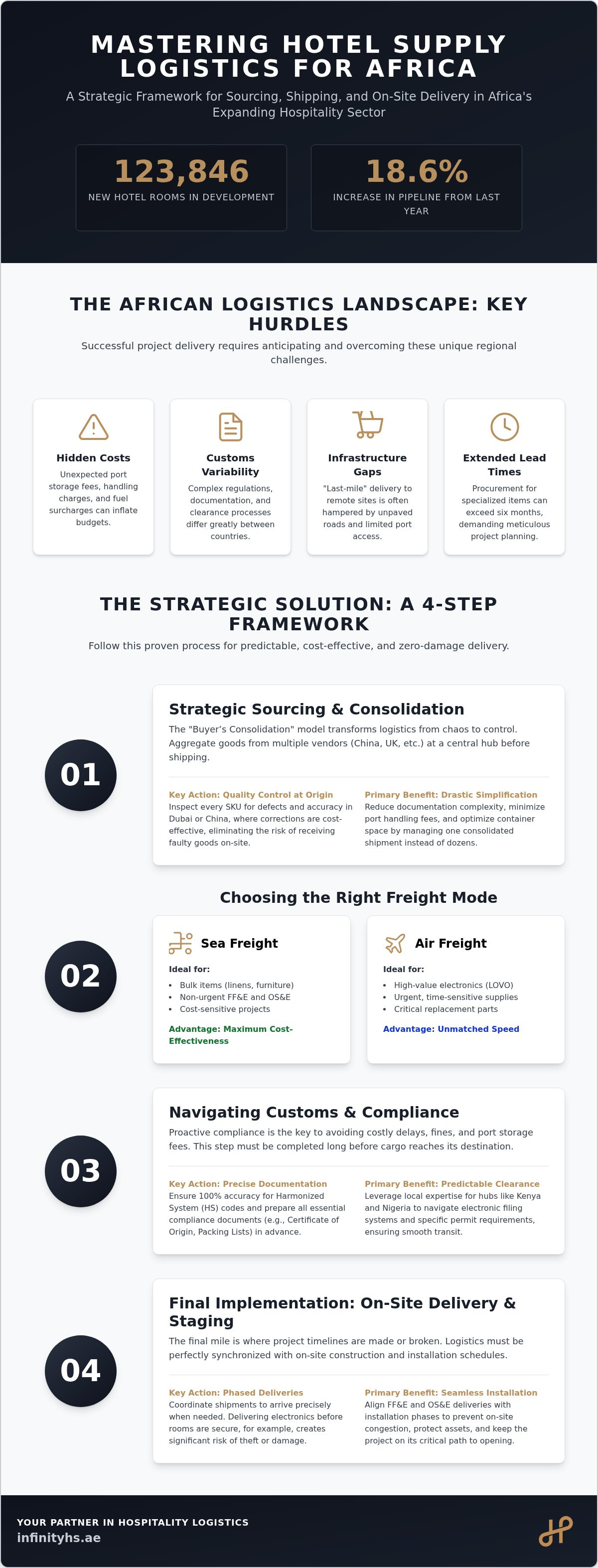
The "last-mile" challenge is particularly acute for remote safari lodges or island resorts. Transporting fragile goods across unpaved terrain or through secondary ports introduces significant risk to the project timeline. Three primary hurdles define this landscape: inconsistent infrastructure, extreme customs variability across borders, and extended lead times that can exceed six months for specialized items. Managing international freight for hotel supplies to Africa requires a strategy that anticipates these delays rather than reacting to them.
Why Africa Requires a Specialized Logistics Strategy
Logistics in 2026 are heavily influenced by the African Continental Free Trade Area (AfCFTA). While this agreement simplifies trade between member states, "hidden" landed costs remain a threat in emerging markets. These costs often stem from port storage fees, local handling charges, and fluctuating fuel surcharges. Relying on local knowledge for inland transportation is essential. A partner who understands the specific permit requirements for heavy loads in Kenya or the electronic filing nuances of Nigeria’s NICIS II system can save weeks of transit time.
The Role of Dubai as a Gateway to Africa
Dubai serves as the premier global consolidation hub for the African hospitality market. Its geographic position allows for meticulous quality control at the origin before goods ever reach a vessel. Infinity Hotel Supplies leverages its UAE headquarters to act as a meticulous facilitator for African projects. By consolidating shipments of hotel linen and furniture in Dubai, operators can verify order accuracy and condition at a transit point where corrections are still cost-effective. This proximity also enables rapid re-supply, ensuring that high-end experiences are never compromised by a broken supply chain.
Step 1: Strategic Sourcing and Consolidation
Effectively managing international freight for hotel supplies to Africa begins with a "Buyer’s Consolidation" strategy. Instead of coordinating dozens of separate shipments from individual vendors, you aggregate linens, electronics, and furniture into a single container at a global transit hub. This approach is anchored by a sourcing triangle involving offices in Dubai, China, and the UK. By consolidating at these strategic points, you drastically reduce documentation complexity and minimize the volume of port handling fees incurred upon arrival in Africa. It's a method that prioritizes order over chaos.
Understanding the U.S. trade and investment policy in Africa helps procurement teams anticipate the broader economic frameworks and trade incentives that govern these shipping lanes. Within this framework, performing quality control at the origin is a non-negotiable step. If a shipment of room electronics arrives in a landlocked destination with a defect, the cost of return and replacement is often prohibitive. We verify every SKU against precise specifications in our UAE or China warehouses before the container is sealed. This meticulousness ensures that what arrives on-site is exactly what you ordered, preserving your project's integrity.
Consolidating OS&E for Maximum Efficiency
Optimizing container space involves more than just stacking boxes; it requires a strategic mix of weight and volume. You can group hotel linens with lighter amenities to maximize every cubic meter of the container. In 2026, moisture-controlled packing is essential for textiles headed to tropical climates. High-grade desiccant packs and specialized vacuum sealing prevent mold and humidity damage during long sea transits. For a deeper look at these protective strategies, read our guide on how to build a resilient hotel supply chain in Africa.
Managing FF&E and Bulk Electronics
Logistics for FF&E and high-value electronics must be phased to match construction milestones. Shipping fragile lighting or custom furniture too early leads to on-site damage or theft during the messy construction phase. We coordinate these deliveries to arrive exactly when the building is ready for secure staging. Utilizing turnkey procurement minimizes vendor-related delays because a single partner manages the lead times for custom-branded products. This holistic service model removes the logistical burden from the hotel operator. If you're planning a new development, you can consult with our logistics experts to streamline your next project.
Step 2: Choosing the Right Freight Modes
Success in managing international freight for hotel supplies to Africa hinges on selecting a mode that balances project timelines with budgetary constraints. While sea freight remains the backbone for massive OS&E and FF&E rollouts, air freight provides a necessary safety net for high-value components. You must also consider Sub-Saharan Africa trade opportunities when mapping out routes to landlocked regions. The decision isn't just about speed; it's about the nature of the cargo and the maturity of the destination's infrastructure.
When to Prioritize Sea Freight for OS&E
Bulk orders like hotel amenities, uniforms, and linens are best suited for Full Container Loads (FCL). FCL offers better security and lower per-unit costs compared to Less than Container Load (LCL) shipments, which often face delays during consolidation and de-consolidation at the port. You should plan for a 45 to 60 day transit window for most African routes. Effective inventory management must account for these lead times to avoid stockouts during the critical pre-opening phase or high-occupancy seasons.
Air Freight for High-Value and Urgent Supplies
For premium LOVO electronics, air freight is the preferred choice to ensure maximum security and minimize handling risks. It's also the primary solution for meeting strict hotel opening deadlines when manufacturing delays occur at the source. While the cost per kilogram is higher, the speed of air transport is indispensable for replenishment orders of guest amenities during peak periods. This mode reduces the capital tied up in "floating inventory" and allows for a more agile response to guest needs.
Cross-border trucking in Africa remains challenging due to infrastructure variability and varying border crossing times. For landlocked destinations, a "Sea-Air" hybrid model often provides the best compromise between cost and speed. You can ship goods by sea to a major gateway like Dubai or Mombasa and then fly the most critical items to the final site. This strategy maintains cost-efficiency while ensuring that the last-mile delivery doesn't derail your project schedule. It's a pragmatic approach for operators who require both stability and flexibility in their supply chain.
Step 3: Navigating Customs and Compliance
Managing international freight for hotel supplies to Africa requires more than just logistical coordination; it demands absolute regulatory precision. Customs authorities in 2026 are increasingly digitized but don't tolerate documentation errors. You must ensure that the Commercial Invoice, Packing List, and Certificate of Origin are perfectly aligned. Any discrepancy between these documents can trigger exhaustive audits, leading to demurrage charges that quickly erode your project's profitability. Engaging a local clearing agent at the destination is the most effective way to navigate these regional nuances, as they possess the local relationships that global firms often lack.
HS Code accuracy remains a cornerstone when managing international freight for hotel supplies to Africa. Assigning the wrong code to room electronics or textiles can result in excessive duties or even cargo seizure. For major hubs like Nigeria and Kenya, Pre-Shipment Inspection (PSI) is a mandatory hurdle. Kenya’s Pre-Export Verification of Conformity (PVoC) program, which saw new contracts awarded in February 2026, requires rigorous testing before goods leave the port of origin. Similarly, Nigeria’s NICIS II electronic filing system necessitates a proactive approach to compliance to avoid costly delays at the port of entry.
Compliance Standards for Hotel Products
Regional standards for hospitality supplies vary significantly across the continent. You must verify that LOVO electronics meet specific voltage and plug configurations for each destination to avoid guest frustration or equipment failure. Guest amenities also face scrutiny regarding labeling and ingredient transparency. Our LUFTER PHYTOGREEN range is formulated to meet these local regulations, ensuring seamless entry into diverse markets. For a deeper dive into specific regional requirements, see our guide on managing import duties for hotel supplies in Nigeria.
Reducing Risk Through Proper Documentation
The Bill of Lading serves as the definitive legal document transferring cargo ownership from the carrier to the receiver. Choosing the right Incoterms is equally vital for defining liability during the long transit to African ports. While CIF (Cost, Insurance, and Freight) is common, many operators prefer DDP (Delivered Duty Paid) to shift the burden of customs clearance to the supplier. This is particularly useful when navigating 2026 digital customs portals, such as ICUMS in Ghana or NICIS II in Nigeria. These platforms have modernized African freight but require a high level of technical accuracy to avoid automated red flags and secondary inspections.
Final Implementation: On-Site Delivery and Staging
The journey from a global transit hub to the final guestroom represents the most critical phase of the procurement lifecycle. Successfully managing international freight for hotel supplies to Africa culminates in a precise on-site delivery and staging process. This requires seamless coordination with the hotel’s project manager to ensure that "White Glove" services are executed correctly. These services move beyond simple drop-shipping; they involve the careful unboxing, inspection, and placement of high-value assets, such as specialized mobility systems from RIHA Industries for accessible guest suites. If the construction schedule shifts, utilizing off-site warehousing provides a some-necessary buffer. This strategy prevents the job site from becoming a congested storage facility, which often leads to accidental damage or loss of smaller OS&E items.
Delivering an entire OS&E package in a single shipment often creates logistical bottlenecks on-site. You should instead implement a phased delivery schedule that aligns with the building’s completion milestones. For instance, heavy equipment and housekeeping trolleys should only arrive once the back-of-house areas are secure and the flooring is finalized. Staging supplies by floor or specific room type allows your installation teams to work systematically without searching through hundreds of mixed boxes. This organized flow reduces labor costs and minimizes the risk of fragile items being moved multiple times before they reach their final destination.
The Infinity Advantage: Turnkey Logistics Management
Infinity Hotel Supplies provides a holistic approach to the hospitality supply chain, managing the entire lifecycle from initial procurement to the final room placement. Our global footprint, with offices in the UAE, China, and the UK, allows us to maintain strict quality control at every transit point. We act as a steady, experienced partner for developers who require reliability in complex markets. This end-to-end methodology removes the burden of vendor management and customs coordination from the operator, allowing you to focus on the guest experience. Partner with Infinity for your next African hotel project to ensure a seamless, professional delivery.
Achieving Logistical Excellence in African Hotel Development
Success in 2026 hinges on moving beyond simple shipping to a strategy of meticulous consolidation and compliance. By leveraging transit hubs in Dubai and China, you can mitigate the risks of damaged goods and unpredictable customs delays. Phased, on-site staging ensures your premium electronics and linens arrive exactly when the site is ready, preserving the high-end guest experience you've envisioned. This structured approach transforms logistics from a project risk into a competitive advantage.
Managing international freight for hotel supplies to Africa is a complex undertaking, but with a turnkey procurement partner, it becomes a predictable and cost-effective process. Our established presence in the UAE, China, and the UK provides the global oversight necessary for large-scale developments. We offer dedicated support for both FF&E and OS&E, ensuring your project remains on schedule and within budget while maintaining the highest standards of quality control.
Your vision for hospitality excellence deserves a supply chain that's just as refined. We're ready to help you navigate these challenges and facilitate your next landmark project with precision and dedication.
Frequently Asked Questions
What are the most common causes of freight delays to Africa?
Freight delays often stem from documentation discrepancies, port congestion, and evolving customs regulations. In 2026, many delays occur due to non-compliance with Pre-Shipment Inspection requirements like Kenya’s PVoC. Managing international freight for hotel supplies to Africa requires proactive coordination between the carrier and local clearing agents. Accurate HS code classification is also vital, as errors here lead to automated red flags in digital customs portals like Ghana’s ICUMS or Nigeria’s NICIS II system.
How can I calculate the total landed cost of my hotel supplies?
Calculating total landed cost involves summing the ex-factory price, international freight, insurance, and all destination-specific duties and taxes. You must account for regional levies, such as Kenya's 2.5% Import Declaration Fee and 2% Railway Development Levy. Local handling charges at the port and inland transportation costs to remote sites also significantly impact the final budget. We recommend a comprehensive "bottom-up" calculation to avoid hidden costs that can blow your project’s financial framework.
Is it better to ship hotel supplies from Dubai or China to Africa?
China is typically the primary source for bulk manufacturing of furniture and textiles, while Dubai serves as the strategic consolidation hub for the region. Shipping from Dubai offers faster transit times to East and North Africa and allows for meticulous quality control of mixed OS&E orders. Utilizing our offices in both regions ensures that you benefit from China's production scale while leveraging Dubai's world-class logistics infrastructure for final staging and rapid re-supply.
What is the difference between FF&E and OS&E in terms of logistics?
Logistics for FF&E (Furniture, Fixtures, and Equipment) focus on bulk, heavy items that require early delivery during the construction phase. Conversely, OS&E (Operating Supplies and Equipment) like hotel linens and LOVO electronics are smaller, more fragile, and often delivered in the final staging weeks. Managing international freight for hotel supplies to Africa requires a phased approach where FF&E is staged in secure warehouses while OS&E is consolidated for "White Glove" room installation.
Do I need a local clearing agent for every African country?
Engaging a local clearing agent is essential for navigating the specific regulatory landscapes of individual African nations. While digital systems like the Single Window platforms are streamlining trade, local expertise is required to manage physical inspections and resolve technical queries on the ground. These agents possess established relationships with port authorities and understand the nuances of local biosecurity or labeling laws, which prevents your cargo from being held in expensive storage.
How does Infinity Hotel Supplies handle quality control for international shipments?
Infinity Hotel Supplies maintains regional offices in the UAE, China, and the UK to facilitate rigorous quality control at the source. Our teams inspect every SKU against project specifications before any container is sealed. This meticulous process eliminates the risk of shipping defective goods to remote African sites where returns are difficult. By verifying the condition of items like LUFTER PHYTOGREEN amenities or housekeeping trolleys at the origin, we ensure project integrity.
What insurance coverage is recommended for international hospitality freight?
We strongly recommend "All-Risk" cargo insurance for all international hospitality shipments. This coverage protects against theft, loss, and physical damage during sea transit or inland trucking over unpaved terrain. Given the high value of items like LOVO electronics and custom furniture, standard carrier liability is usually insufficient. Ensuring your policy includes "concealed damage" clauses is also wise, as it allows for claims after items are unboxed during the on-site staging phase.
How can I track my shipment once it leaves the consolidation hub?
Once your shipment departs a consolidation hub, you can track its progress through the carrier’s digital portal using a Bill of Lading or container number. For turnkey procurement projects, Infinity provides structured updates that align with your hotel’s development timeline. This level of transparency allows your project managers to coordinate labor for on-site delivery and staging. Real-time visibility is crucial for adjusting your installation schedule if port congestion or weather events affect the arrival date.

Article by
Infinity Editorial Team
With deep expertise in hospitality product FF&E and OS&E across the Middle East and Africa, Infinity Editorial Team brings insights from Infinity Hotel Supplies, helping developers, hoteliers, and homeowners transform spaces from empty shells to fully furnished, design-ready environments.
Disclaimer
The content published by Infinity Editorial Team is intended for informational purposes only. All articles, guides, and insights are based on industry knowledge and experience in hospitality FF&E and OS&E supply across the Middle East and Africa. Infinity Hotel Supplies does not guarantee specific outcomes and recommends consulting a qualified professional for project-specific requirements.


