

With Africa's hotel development pipeline reaching a record 123,846 rooms across 675 hotels in 2026, the pressure on procurement teams has never been more intense. Egypt alone leads this expansion with nearly 46,000 rooms in progress, yet the logistical reality remains challenging for many operators. Understanding how to build a resilient hotel supply chain in Africa is no longer just a back-office concern; it's a core requirement for protecting your brand's reputation and bottom line.
You recognize the difficulty of maintaining consistency when international freight times fluctuate and customs regulations in countries like Kenya or Nigeria shift without warning. It's a delicate balance to source high-quality linens and electronics while avoiding the operational downtime caused by sudden stockouts. This 2026 strategic guide promises to solve those complexities. We will examine the shift toward regional logistical hubs, the integration of AI-driven procurement, and the practical steps to secure a stable, cost-effective supply of brand-standard OS&E and FF&E. By the end of this article, you'll have a clear roadmap for managing import duties and vendor quality to ensure your property remains a sanctuary of excellence.
Key Takeaways
- Transition from reactive procurement to a strategic "Just-in-Case" inventory model to safeguard your property against unpredictable global freight disruptions.
- Master how to build a resilient hotel supply chain in Africa by leveraging a hybrid sourcing strategy that combines global manufacturing with regional logistical hubs like Dubai.
- Conduct multi-tier supplier audits to uncover hidden vulnerabilities and ensure your vendors meet the financial stability required for long-term hospitality partnerships.
- Streamline your expansion efforts using turnkey FF&E and OS&E solutions that bridge the gap between international quality standards and complex local import regulations.
- Implement digitalization and geographic diversification to maintain a steady flow of brand-standard amenities and linens, even during periods of regional market volatility.
The State of African Hospitality Supply Chains in 2026
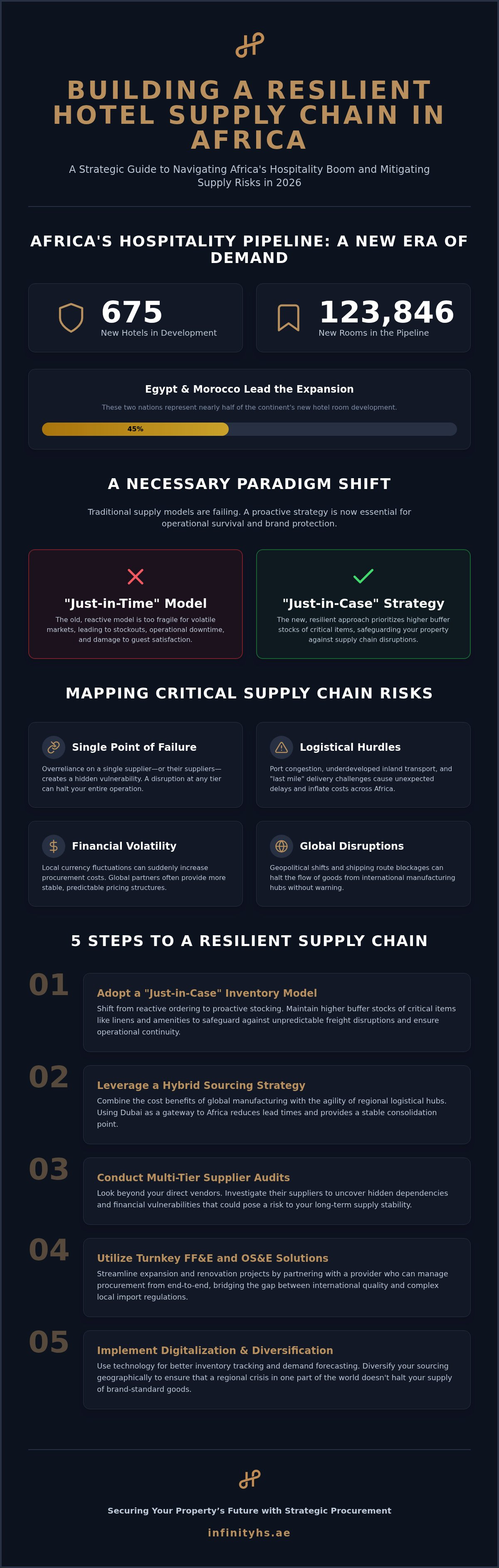
By August 2026, the African hospitality sector has reached a pivotal crossroads. Global geopolitical shifts have forced a total rethink of how properties acquire essential goods. With Africa's hotel development pipeline reaching a record 123,846 rooms across 675 hotels, the demand for reliable procurement is at an all-time high. Understanding how to build a resilient hotel supply chain in Africa is no longer optional for operators in high-growth markets like Egypt and Morocco, which together account for over 45% of total pipeline rooms.
The traditional "Just-in-Time" delivery model, while efficient in stable environments, has proven too fragile for the emerging market realities of 2026. Most successful hoteliers have transitioned to a "Just-in-Case" strategy. This approach prioritizes higher buffer stocks of critical items like room electronics and guest amenities. While the African Continental Free Trade Area (AfCFTA) is beginning to streamline trade through reduced tariffs and harmonized regulations, logistical friction still requires a proactive rather than reactive mindset to avoid operational downtime.
Lessons from Global Disruptions
Overreliance on a single international manufacturing source is a significant risk in the current climate. When global shipping routes face disruption, hotels that depend on a single-tier supplier often face catastrophic stockouts. These shortages do more than just complicate operations; they directly erode guest satisfaction and long-term brand reputation. Building supply chain resilience requires a diversified geographic footprint. By spreading procurement across multiple regions, you ensure that a localized shutdown in one part of the world doesn't result in empty guest rooms in another. Transitioning to this proactive strategy is the first step in securing a property's operational future.
Regional Logistics Hurdles in Africa
Infrastructure gaps continue to create unique bottlenecks across the continent. Port congestion in major hubs and inland transportation delays often extend lead times unexpectedly. For remote resorts or luxury safari lodges, the "last mile" problem is particularly acute, as specialized items like hotel linen must travel through underdeveloped road networks. These challenges demand a more sophisticated approach than standard global models. To explore how to navigate these specific hurdles, view The Strategic Guide to Hospitality Procurement for actionable insights on managing large-scale hospitality projects.
Mapping Risk: Identifying Vulnerabilities in Your Procurement
To understand how to build a resilient hotel supply chain in Africa, you must first look beneath the surface of your primary vendor relationships. A multi-tier supplier audit is essential for uncovering hidden dependencies that could derail your operations. It isn't enough to know your direct supplier; you need to understand where their raw materials originate. For instance, a local vendor might rely on a single textile mill in a region prone to environmental or political instability, creating a "Single Point of Failure" in your procurement chain.
Financial stability is another critical metric when assessing local versus international vendors. While there are significant global efforts to strengthen local supply chains, procurement managers must balance the agility of local sourcing against the currency-hedging capabilities of international partners. In markets like Nigeria or Kenya, local currency volatility can suddenly inflate budgets. Relying on established global providers often offers a more stable pricing structure for large-scale FF&E and OS&E projects.
Category-Specific Risk Assessment
Properties with high occupancy rates face unique pressures regarding Hotel Linen and textiles. These high-turnover items require substantial buffer stocks because any delay in shipment directly impacts your ability to turn rooms. Similarly, managing lead times for room electronics is vital for maintaining brand standards. Because branded technology often involves complex manufacturing cycles, a delay in a single component can stall a full property opening or renovation.
Logistics for Remote and Safari Properties
Safari lodges in Kenya or Botswana face logistical hurdles that city-center hotels rarely encounter. The distance from major ports and the "last mile" delivery over unpaved terrain necessitate a sophisticated approach to warehousing and consolidation. Effective consolidation ensures that multiple categories arrive together, reducing the carbon footprint and transportation costs of remote builds. For remote hotel operations, supply chain visibility is the capacity to maintain real-time oversight of every SKU from the manufacturing floor through complex cross-border logistics until it arrives at the property gate. If you're planning a development in a challenging location, consulting with an experienced procurement partner can help mitigate these specific logistical complexities.
The Hybrid Sourcing Model: Dubai as a Gateway to Africa
In 2026, the gold standard for hospitality procurement has shifted toward a sophisticated hybrid sourcing model. This strategy combines the manufacturing power of global markets with the agility of regional logistical hubs to ensure a steady flow of goods. When considering how to build a resilient hotel supply chain in Africa, leading operators now view Dubai as the primary gateway. This approach allows for the rapid deployment of supplies without sacrificing the stringent quality and scale required by international brands.
Industry leaders frequently discuss the acute supply chain challenges that have historically hindered African hospitality growth, including trade restrictions and infrastructure gaps. A hybrid model mitigates these risks by consolidating orders in a central global hub before final shipping. This consolidation process significantly reduces freight costs and simplifies customs clearance, as diverse categories of FF&E and OS&E can be inspected, documented, and shipped as a unified consignment. It's a methodical way to ensure that nothing is lost in the complex transition between global manufacturers and African property gates.
The Dubai Advantage for African Hotels
Dubai’s strategic proximity to major African ports and its world-class air cargo infrastructure make it an indispensable partner for the continent's hospitality sector. By utilizing a hub in the UAE, hotels can access a comprehensive range of OS&E solutions tailored to specific brand standards. Having established offices in both China and the UAE provides essential "boots-on-the-ground" quality assurance. This physical presence ensures that every housekeeping trolley or piece of room technology undergoes meticulous inspection, guaranteeing that the final delivery meets the high-end expectations of your guests.
Balancing Local Sourcing with International Quality
Building a resilient chain also involves knowing when to look closer to home. Many properties successfully integrate local African craftsmanship for categories like art and decor, which adds authentic character to the guest experience. However, for high-turnover items like hotel amenities and linens, maintaining five-star international standards often requires global partnerships. Selecting the right partners is a critical decision for any procurement team. For a deeper dive into this process, consult our guide on Selecting a Hotel Amenities Supplier to ensure your choices align with your property’s long-term operational and brand goals.
5 Steps to Build a Resilient Supply Chain Strategy
Building a robust framework for procurement requires moving beyond transactional purchasing toward a structured, long-term methodology. In 2026, the most successful properties have integrated these five core pillars to ensure operational continuity. Understanding how to build a resilient hotel supply chain in Africa involves balancing global reach with local expertise to mitigate the risks of a volatile market.
- Digitalize procurement: Implement platforms that offer real-time tracking and inventory management to eliminate manual errors.
- Diversify your supplier base: Avoid overreliance on a single region by sourcing from multiple geographic locations.
- Partner with global experts: Work with firms that have a physical presence in both manufacturing hubs and destination markets to navigate customs.
- Implement PAR Level strategies: Maintain strategic buffer stocks for high-turnover operational supplies to weather shipping delays.
- Foster transparent partnerships: Build relationships based on shared risk and open communication rather than lowest-bidder transactions.
Managing Import Duties and Customs
Navigating the regulatory landscape in markets like Nigeria, Egypt, and South Africa requires meticulous attention to detail. For example, all commercial imports into Egypt in 2026 require an Advance Cargo Information Declaration (ACID) number via the Nafeza platform at least 48 hours before departure. Turnkey procurement solutions reduce this burden by managing the complex documentation and 14% VAT calculations required for smooth clearance. The turnkey advantage for African hotel pre-openings is the seamless consolidation of global procurement and complex local customs navigation into a single stream of accountability, ensuring properties meet their launch dates without logistical delays.
Digitalization and Technology
Data-driven decision-making is the cornerstone of a modern supply chain. By using predictive analytics, procurement teams can identify potential disruptions before they impact the guest experience. Automating reorder points for essential room accessories ensures that you never face a stockout during peak season. This technological integration is particularly effective when combined with precise inventory metrics. For a detailed breakdown of maintaining these balances, refer to our guide on Calculating PAR Levels for Hotel Linen to optimize your storage and capital expenditure.
Securing Your Property’s Future with Infinity Hotel Supplies
Infinity Hotel Supplies serves as the essential bridge between global manufacturing excellence and the unique requirements of the African hospitality market. Since our founding in 2014, we've provided the steady hand needed to manage complex logistical landscapes across the continent. Understanding how to build a resilient hotel supply chain in Africa requires a partner with a global footprint and a deep-seated commitment to excellence. Our offices in Dubai, China, and the UK allow us to maintain rigorous quality control at the source, ensuring that every item delivered to your property meets international brand standards without compromise.
We specialize in turnkey FF&E and OS&E solutions that significantly reduce the operational burden on local management teams. By centralizing sourcing through a single provider, hotel groups can ensure consistency across their entire African portfolio. Whether you're opening a flagship property in Cairo or a boutique resort in the Serengeti, our end-to-end methodology eliminates the uncertainty often associated with cross-border procurement. We manage the finer details of logistics, from factory inspections to customs navigation, so you can focus on the guest experience. This structured approach is particularly vital for properties in remote regions where inconsistent local vendor quality remains a primary pain point.
End-to-End Procurement Excellence
Our role involves more than just shipping products; it's about facilitating high-end experiences through meticulous project management and global sourcing. We oversee the entire lifecycle of your supplies, from the initial sourcing of LOVO premium electronics to final on-site installation. In 2026, sustainability is a core priority for African hoteliers facing increased investor and guest scrutiny. We help properties meet these expectations by implementing LUFTER PHYTOGREEN solutions, which blend luxury amenities with environmental responsibility. To understand the full scope of these services, explore The Role of a Global Hotel Procurement Company in the modern hospitality era.
Expert Support for Every Department
Operational efficiency starts with providing the right equipment for every department. We optimize housekeeping workflows with ergonomic trolleys designed for durability and ease of use in high-occupancy environments. For the guest-facing side, we offer high-quality, customized leather accessories that elevate the aesthetic of luxury suites in emerging markets. Our experience managing logistics for remote African properties, including successful deployments to secluded lodges in Botswana, proves that geographic isolation doesn't have to mean stockouts or substandard supplies. We act as a seasoned global partner, navigating the complex "last mile" challenges and showing you how to build a resilient hotel supply chain in Africa through practical, turnkey solutions.
Contact Infinity Hotel Supplies for a tailored African procurement strategy
Empowering African Hospitality through Strategic Procurement
The record expansion of Africa's hotel pipeline in 2026 demands a shift from traditional purchasing to a sophisticated, risk-aware methodology. Success now depends on a hybrid sourcing model that leverages global manufacturing hubs while utilizing regional gateways like Dubai for rapid deployment. By mapping multi-tier vulnerabilities and implementing digital inventory tracking, properties can effectively eliminate the threat of stockouts and inconsistent vendor quality.
Mastering how to build a resilient hotel supply chain in Africa is the definitive way to protect your brand's reputation in high-growth markets. Since 2014, Infinity Hotel Supplies has acted as a meticulous facilitator of excellence, offering turnkey OS&E and FF&E solutions. With offices in the UAE, China, and the UK, we provide total quality control and specialized logistics support even for the most remote African locations. Our partnership ensures your property remains a sanctuary of stability and luxury for every guest.
We look forward to helping you navigate the complexities of the African market and securing a prosperous future for your hospitality development projects.
Frequently Asked Questions
What are the biggest supply chain risks for hotels in Africa?
The primary risks include port congestion in major hubs, inland transportation delays, and extreme currency fluctuations in markets like Nigeria or Kenya. These factors often lead to unpredictable lead times and sudden price spikes for essential imports. Properties must also contend with infrastructure gaps that complicate the "last mile" delivery to remote sites. Building a strategy around how to build a resilient hotel supply chain in Africa requires accounting for these localized hurdles through diversified sourcing.
How can African hotels manage high import duties on OS&E?
Managing high duties requires a combination of early documentation and utilizing free trade agreements where applicable. In Egypt, for instance, the 2026 Nafeza platform requires an ACID number 48 hours before departure to avoid costly penalties. Partnering with a turnkey provider allows you to consolidate diverse OS&E categories into fewer shipments. This approach simplifies the calculation of VAT and customs fees, ensuring that your landed costs remain within the projected budget.
Is it better to source hotel linens locally or internationally in Africa?
For five-star properties, international sourcing remains the standard for ensuring consistent thread counts and long-term durability. While local textiles may offer faster initial delivery, they often lack the technical specifications required for industrial laundry cycles. Sourcing internationally through a partner with quality control offices in manufacturing hubs ensures that every shipment of hotel linen meets your specific brand standards. This consistency is vital for maintaining guest satisfaction across any multi-property portfolio.
How do I calculate the right PAR levels for a remote resort?
Remote resorts should typically maintain a higher PAR level of 4 or 5 to account for extended lead times and potential transportation disruptions. Standard city hotels might operate on a 3-PAR system, but geographic isolation increases the risk of stockouts. You must factor in the time required for international transit, customs clearance, and the final inland leg. Maintaining these higher levels protects your property from operational downtime when local infrastructure faces temporary challenges.
What is the role of a procurement hub like Dubai for African hospitality?
Ensuring quality control requires having a physical presence in manufacturing hubs like China and the United Kingdom. Infinity Hotel Supplies maintains global offices to conduct pre-shipment inspections and factory audits on your behalf. This "boots-on-the-ground" approach ensures that products like LOVO electronics or custom furniture meet your specifications before they leave the factory. It eliminates the risk of receiving substandard goods that are costly and difficult to return from African destinations.
What are the benefits of turnkey procurement for new hotel builds in Africa?
Turnkey procurement provides a single point of accountability for the entire FF&E and OS&E lifecycle. This model is particularly beneficial for new builds as it handles everything from initial sourcing to final installation and customs navigation. It reduces the administrative burden on hotel owners and ensures that all departments, from housekeeping to guest rooms, are equipped on schedule. This holistic methodology is essential for properties aiming for a seamless, on-time opening in complex markets.
How does the AfCFTA impact hotel supplies in 2026?
In 2026, the African Continental Free Trade Area (AfCFTA) has significantly streamlined intra-African trade by reducing tariffs on a wide range of hospitality goods. While global sourcing remains necessary for specialized technology, AfCFTA makes it more cost-effective to move supplies between regional hubs. This agreement encourages the development of localized distribution centers, which helps in understanding how to build a resilient hotel supply chain in Africa. It fosters a more integrated and efficient trade environment.

Article by
Infinity Editorial Team
With deep expertise in hospitality product FF&E and OS&E across the Middle East and Africa, Infinity Editorial Team brings insights from Infinity Hotel Supplies, helping developers, hoteliers, and homeowners transform spaces from empty shells to fully furnished, design-ready environments.
Disclaimer
The content published by Infinity Editorial Team is intended for informational purposes only. All articles, guides, and insights are based on industry knowledge and experience in hospitality FF&E and OS&E supply across the Middle East and Africa. Infinity Hotel Supplies does not guarantee specific outcomes and recommends consulting a qualified professional for project-specific requirements.


