

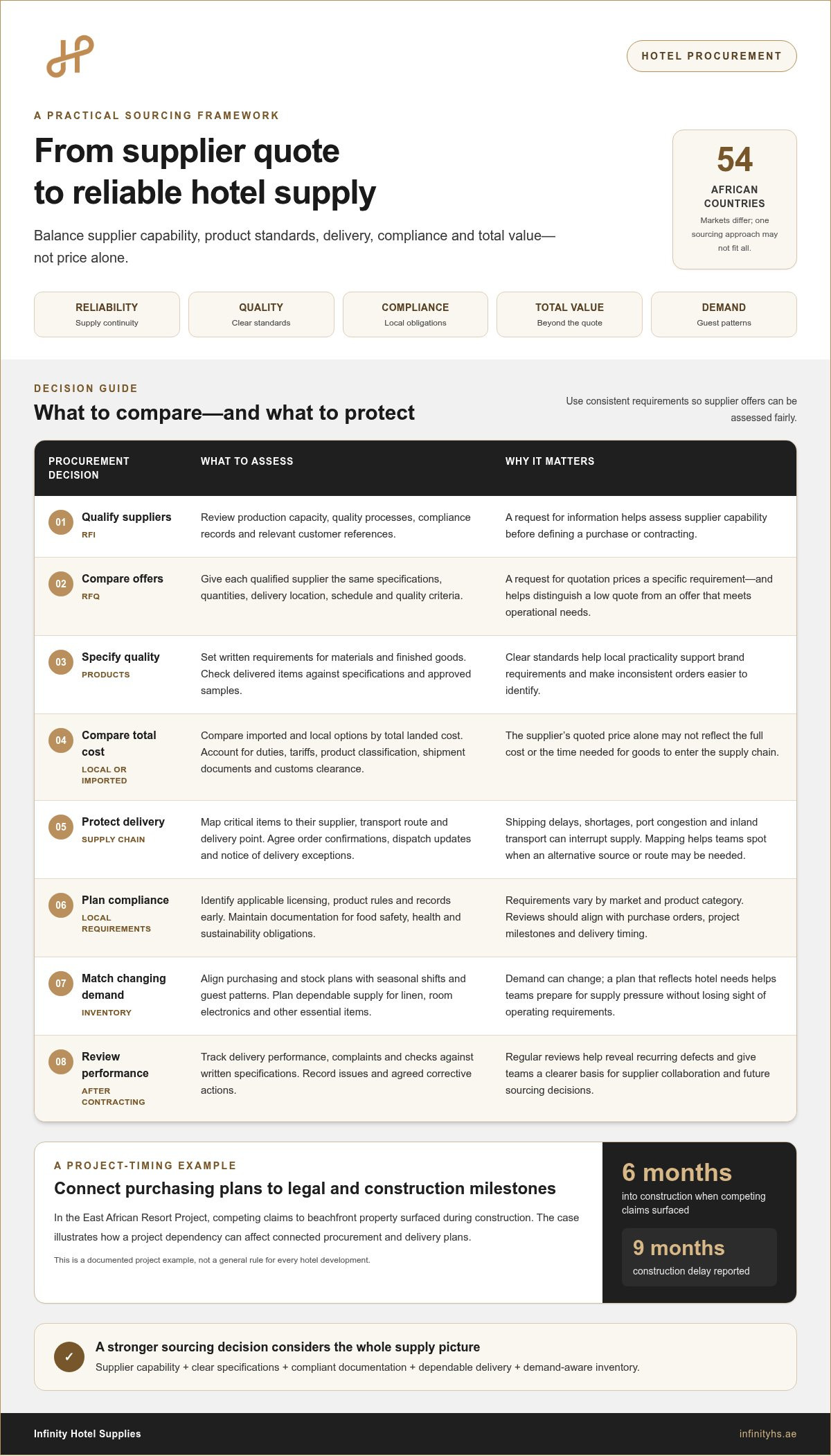
The challenges of hotel procurement in emerging African markets are rarely solved by choosing the lowest bid. Across Africa’s 54 countries, hotel teams must balance supplier reliability, local regulations, product quality, price negotiation and demand that can shift with seasons and guest patterns. A sourcing decision that works in one market may not suit another.
Reliable supply supports smooth hotel operations. Delays or shortages can disrupt daily work, while inconsistent quality can affect guest experience and brand standards. Procurement teams must also manage costs while accounting for local conditions and compliance requirements.
This article examines how supplier relationships, regulation, local quality needs, negotiation, and changing demand shape procurement in emerging African markets. Practical steps for supplier oversight, product specifications, and inventory planning can help hotels make more resilient purchasing decisions.
Key Takeaways
- Assess supplier capacity, quality controls, communication, and delivery performance to build relationships that hold up under supply pressure.
- Keep procurement records and operating practices aligned with applicable local requirements, including food safety, health, and sustainability considerations.
- Set clear specifications for materials and finished goods so local practicality supports, rather than weakens, brand standards.
- Negotiate on total value, covering quality, delivery schedules, stock levels, and volume flexibility alongside price.
- Match purchasing and inventory plans to changing guest patterns; hotel linen, room electronics, and other essential supplies need dependable planning.
Supplier relationship management
Supplier relationships influence the reliability, quality, and continuity of hotel supplies. Clear expectations, documented performance, and regular communication help procurement teams manage these priorities across African markets.
Communication and Delivery Reliability
Effective supplier communication means receiving accurate order updates and meeting agreed delivery schedules. Delayed housekeeping or room supplies can disrupt hotel operations, so establish a channel for order confirmations, dispatch updates, and delivery exceptions. Ask for prompt notice of shipment changes so your team can adjust stock plans before essential items run low.
Performance and Quality Inconsistency
Supplier performance and quality can vary between orders, affecting delivery, product condition, and service. For example, linen that differs from an approved sample may create uneven guest experiences and require replacement. Track delivery performance, complaints, and checks against written specifications. Regular reviews help identify recurring defects and agree corrective actions before the next order.
Supplier Requests for Information and Quotations
A request for information (RFI) helps a hotel assess a supplier’s capabilities before defining a purchase. A request for quotation (RFQ) asks qualified suppliers to price a specific requirement. For a fair comparison, give each supplier the same product specifications, quantities, delivery location, schedule, and quality criteria. An RFQ for guest-room items, for example, should distinguish required materials and performance standards from preferences.
Use RFI responses to assess production capacity, quality processes, compliance records, and relevant customer references. In South Africa, this due diligence can help procurement teams evaluate suppliers before contracting. Comparing responses systematically makes it easier to distinguish a low quotation from an offer that meets the hotel’s operational needs.
Supply-Chain Disruption and Phased Development
Shipping delays, shortages, port congestion, and complex inland transport can interrupt hotel supply. Buyers in South Africa and across the region can plan for these risks by mapping critical items to their supplier, transport route, and delivery point. This makes it easier to identify when an alternative route or supply source may be needed.
Phased hotel development adds a planning challenge: specialist items may need to arrive before installation or opening milestones. Developers can consider procuring these items early to improve delivery and cost planning. Separate project orders by phase and align purchase schedules with construction progress. This reduces the risk of late specialist goods holding up a completed area.
Supplier management continues after a contract is signed. Monitor deliveries, check quality, and record issues alongside agreed corrective actions. Digital procurement tools can help track suppliers, contracts, spending, and risks. Include sustainability and ethical sourcing criteria in supplier assessments when relevant to the purchase. These records give hotel teams a clearer basis for collaboration and future sourcing decisions.
State intervention, legal compliance, and enforcement
Procurement rules differ across African markets, so hotel teams should understand local obligations before committing funds. Documentation, product requirements, and clearance procedures can all affect supply-chain timing and costs.
Local Licensing and Regulatory Complexity
Local licensing and regulatory requirements cover the approvals and operating rules that apply to a hotel and its purchases. These can vary by country and product category, making early review important. Assign a compliance lead to map relevant obligations, responsibilities, and records before issuing purchase orders. Requirements related to food safety, health, and sustainability call for ongoing documentation and operational discipline.
State Intervention and Enforcement
State intervention can affect procurement through approvals, enforcement, and decisions involving land or infrastructure. A documented example illustrates why project teams should monitor these risks throughout development: competing claims to beachfront property surfaced six months into construction of the East African Resort Project and delayed construction by nine months.
That case concerns a development dispute, not a general rule for every hotel project. It does, however, show why procurement schedules should align with legal reviews and construction milestones. Record key dependencies, assign responsibility for tracking them, and plan for orders tied to site handover or opening dates. A delay in one approval can affect several connected purchasing decisions.
Import Duties and Customs Clearance
Import duties and tariffs add to the landed cost of imported hotel goods, while customs clearance affects when they enter the supply chain. The impact depends on the destination market, product classification, shipment documents, and clearance process. Compare imported and locally sourced options by total landed cost, not just the supplier’s quoted price, and account for possible delays in the delivery schedule.
Before dispatch, procurement and finance teams can align each shipment’s item description, invoice, and shipping records. Clear documentation helps prevent avoidable processing issues. A delayed shipment may also disrupt installation or opening plans.
Supplier Fraud and Payment Risks
Supplier fraud and payment risks include false supplier identities, counterfeit goods, corrupt requests, and payments made without proper controls. An invalid order can waste funds and disrupt hotel operations. Where practical, separate supplier setup, purchase approval, goods receipt, and payment duties. Verify changes to bank details through a known contact channel, not solely by replying to a new email.
For quality assurance, compare delivered goods with approved specifications and retain purchase, delivery, and inspection records. Escalate unexplained payment requests through established internal controls. These steps create a clear audit trail without assuming every supplier presents a risk.
Keep a market-specific compliance file for each project, including licensing records, shipment documents, approvals, and payment evidence. Review it when the project location, product scope, or delivery sequence changes. Discussing hotel supply requirements can also help align purchasing needs with project plans.
Local materials and quality requirements
Hotel teams must balance global brand standards with local materials, operating conditions, and project budgets. Sustainable sourcing may include locally produced furniture, textiles, and guest supplies when they meet documented specifications and quality requirements.
Locally Sourced and Sustainable Options
Locally sourced and sustainable procurement means assessing nearby products against environmental, ethical, and performance criteria. A local option may support continuity of supply, but it needs to suit the hotel’s use and standards.
Start by separating essential requirements from preferred attributes. For furniture, compare material durability, finish, repair needs, and consistency across rooms. For textiles, define performance, colour tolerance, and care requirements. Ask suppliers about material origins and production practices, then record the evidence behind your decision. Treat sustainability as a defined specification, not a label to accept without review.
Local sourcing also requires practical planning. Match order quantities and delivery schedules to supplier capacity, and consider whether replacement items will be available later. This matters for phased openings, where the same finish or fabric may be needed after the first installation. If local products do not meet a crucial performance requirement, compare alternatives by overall operational fit rather than location alone.
Product Quality and Consistency
Product quality and consistency describe how reliably goods meet hotel specifications across suppliers and repeat orders. Variation matters because a mismatched component can affect room appearance, maintenance, and guest experience.
Set measurable acceptance criteria for each product category. A room furnishing specification might identify dimensions, materials, finish, and permitted variation. A textile brief can define colour references, construction, and durability expectations. Keep an approved sample or reference image with the purchase record so receiving teams can compare delivered goods against the same standard.
Quality can vary between batches even when the supplier remains unchanged. For example, a replacement order may use a different finish or fabric shade. Document the discrepancy, its impact, and the agreed remedy. Many South African suppliers comply with ISO certifications, international quality standards, and industry-specific compliance requirements. Buyers should still match any supplier credentials to the requirements of the particular purchase.
Quality Assurance
Quality assurance means checking that materials, components, and finished goods meet agreed requirements. Consistent oversight during production and delivery helps ensure that written specifications are followed.
Define inspection points before ordering: review samples, check production evidence where relevant, and inspect goods on receipt. A hotel can compare delivered items with approved specifications, record defects, and separate nonconforming goods from accepted stock. Clear records help identify recurring issues across suppliers and support focused reviews.
Set requirements for raw materials and components as well as finished products. For example, document acceptable material properties before approving a furniture or textile order. Include responsible sourcing criteria when relevant, and retain supporting records with the purchase file. This approach helps procurement teams respond to disruptions while protecting product standards and sustainability goals.
Cost-effective sourcing and price negotiation
There is no universal winner between local sourcing and imports on cost or quality. Compare each option against the specification, delivery needs, currency exposure, and total value before choosing.
Comparing Local Sourcing and Imports
Comparing local sourcing with imports means assessing each purchase against the same hotel requirements. This matters because the lowest quoted price may not be the best operational choice.
For locally sourced furniture or textiles, assess specifications, supplier capacity, delivery arrangements, and replacement availability. For imported room equipment, include transport, customs clearance, currency exposure, and delivery timing. Compare equivalent products, not a basic local item with a higher-specification import.
Quality depends on the supplier, materials, production controls, and agreed standards, not simply on where a product is made. A local textile may suit a hotel’s replacement needs, while an imported alternative may better match a particular brand specification. Compare samples and documented requirements before reviewing quotations.
Assess total value by considering expected service life, maintenance needs, consistency across rooms, and supply continuity. Local sourcing may simplify communication or replenishment, while imported goods may offer a specification that is harder to source locally. These advantages vary by product and market, so define the hotel’s priorities before choosing.
Negotiating Procurement Prices
Price negotiation means agreeing commercial terms alongside product requirements and delivery expectations. Savings lose value if quality, supply, or service falls short.
Before negotiating, research supplier markets, compare equivalent quotations, and assess industry trends and supply risks. Geopolitical changes can affect availability and cost, so record the assumptions behind each offer. In South Africa, buyers exposed to rand volatility can monitor currency trends, consider hedging strategies, and negotiate long-term contracts.
Negotiations can cover more than unit price. Discuss delivery schedules, seasonal volume changes, minimum stock agreements, warranties and returns, contract duration, and discount tiers. A hotel expecting seasonal demand, for example, can negotiate volume flexibility and delivery timing rather than commit to stock it cannot use promptly.
Compare offers using consistent product specifications and quantities. Assess price alongside delivery reliability, quality requirements, and the potential cost of disruption. Consolidated orders, economies of scale, and alternative sourcing can support savings when they preserve required standards. Document the agreed terms clearly, including what happens when quantities, schedules, or product requirements change.
These practices help procurement teams reach balanced agreements that manage expenditure while protecting hotel operations and guest experience.
Demand unpredictability
Changing guest patterns make hotel demand difficult to forecast. Procurement teams need to connect occupancy trends, booking information, seasonality, and stock decisions before ordering.
A hotel’s demand can shift with travel seasons, local events, business travel, and changing guest preferences. COVID-19 also spurred more Africans to focus on domestic travel, illustrating how travel patterns can change. For procurement, the effect reaches beyond room supplies: housekeeping items, amenities, and equipment all depend on how many guests arrive and how long they stay. A forecast based only on last year’s purchases may miss a shift in booking patterns or a new source of demand.
Regional occupancy figures show why broad assumptions can mislead. As of mid-2023, Sub-Saharan Africa’s hotel occupancy was 2 percent below its 2019 level, while North Africa’s was 13 percent below. Africa’s consolidated year-to-date occupancy stood at 55 percent as of September 2023, compared with 57 percent during the same period in 2019. These historical figures describe different regions and periods, not a single demand pattern for every hotel.
Build forecasts around signals from each property. Compare booking pace, occupancy, cancellations, event calendars, and recent consumption for major supply categories. If group bookings rise at a conference hotel, the team can adjust planned purchases for guest-room and housekeeping needs. If cancellations increase, procurement can delay non-urgent replenishment while protecting stock for daily operations.
Inventory controls help balance shortages against excess stock. Set minimum and maximum levels for critical items, then link reorder points to usage and supplier lead times. Review exceptions regularly: a sudden rise in amenity consumption may reflect higher occupancy, a change in guest mix, or waste. Investigate the cause before changing the next order. Automated inventory systems and data analytics can improve visibility and support evidence-based purchasing.
Forecasting also improves purchasing discipline. Separate fixed requirements from demand-sensitive items, and review seasonal assumptions before committing to a large order. For a planned opening or expansion, phase purchases to match deliveries with completed rooms and operational milestones. This helps avoid storing goods too early or running short when a new area opens.
Environmental priorities can also influence demand planning. Track guest preferences and product use, then consider whether lower-waste options fit the hotel’s service standards. Monitor waste alongside consumption so sustainability decisions reflect actual operations. Regular reviews of forecasts, stock variances, and guest trends give managers a practical basis for adjusting orders.
Use these planning insights to align future purchases with your property’s operating needs.
Infinity Hotel Supplies: Hotel Linen
Infinity Hotel Supplies offers hotel linen for properties planning guest-room supply, replacement, or consistent standards across rooms. When procurement priorities include durability, appearance, and reliable replenishment, a clearly defined linen requirement helps match purchasing decisions to operating needs.
Define intended use, preferred feel, colour expectations, and care requirements before ordering. These details help align linen selection with the guest experience and housekeeping practices. For a new opening or room refresh, fit quantities and delivery timing to the project schedule. For ongoing operations, review linen needs against occupancy patterns and replacement plans.
Explore hotel linen options with Infinity Hotel Supplies and discuss your property’s requirements with the team.
Turn Procurement Priorities into the Next Project Step
The challenges of hotel procurement in emerging African markets call for decisions grounded in each property’s operating realities. Use your project priorities to guide product choices, specifications, and supply planning. A clear brief helps keep purchasing aligned with the guest experience you intend to deliver.
For hotels assessing product requirements, Infinity Hotel Supplies offers Hotel Linen, LOVO Premium Electronics, and LUFTER PHYTOGREEN. These product categories can support guest-room supply and other property needs. Identify what fits your project scope, then define the requirements that matter most to your team.
Build the next stage around a practical, well-defined purchasing brief. A focused discussion with Infinity Hotel Supplies can help you consider how relevant hotel products fit your requirements and plans.
Contact Infinity Hotel Supplies to discuss your hotel requirements.
Clear priorities and careful planning can help procurement decisions support a consistent experience for guests and staff.
Frequently Asked Questions
What are the main hotel procurement challenges in emerging African markets?
Procurement challenges combine market differences with the connected needs of hotel projects. A purchasing decision can affect room readiness, operating budgets, and guest experience at once. A substitute product, for example, may require design approval, staff updates, and revised installation plans. Involve operations, finance, and project leads early so decisions account for the property as a whole.
What are typical lead times and shipping costs for hotel supplies in major African markets?
Lead times and shipping costs vary according to product, origin, shipment size, route, and destination. A bulky furniture order and a small replacement shipment have different transport requirements. To compare quotations, use the same product quantities, delivery location, shipment terms, and required arrival date. Separate production, transport, and final delivery estimates in the project schedule to show which stage drives timing and help teams plan installation.
How reliable are local suppliers for hotel furniture, fixtures, equipment, food, and linens?
Local supplier reliability depends on the business, product category, and order requirements. Where project timing allows, assess fit with an initial order, then compare delivered goods with the purchase specification. For furniture, inspect finish and assembly; for food, assess the agreed condition on receipt. Record whether the supplier can support repeat orders and maintain the requirements that matter to the property.
How do foreign exchange volatility and payment restrictions affect hotel purchasing in Africa?
Exchange-rate changes can alter the local-currency amount needed to settle a purchase, while payment restrictions may affect when funds reach a supplier. This can create a gap between budget approval and order release. Finance teams can model the effect of currency changes on planned purchases and align approvals with payment milestones. Clear invoice records also help reconcile approved amounts, transfers, and supplier order documentation.
What procurement regulations, licensing rules, and taxes apply to hotels in key African countries?
Requirements depend on the country, hotel activities, and goods being purchased. Instead of relying on one regional checklist, organize requirements by property and transaction. Separate hotel operating approvals from product-specific obligations, import documentation, and tax treatment. For groups operating across the GCC, Middle East, and Africa, assign local responsibility for each property and record which requirements apply to its purchases. This helps prevent assumptions from one market carrying over to another.
How do infrastructure gaps, including port congestion and road conditions, disrupt hotel supply chains?
Transport bottlenecks can affect arrival times, delivery sequences, and a hotel’s ability to receive goods on site. A property with limited storage, for example, may need deliveries coordinated with room readiness rather than sent all at once. Include site access, receiving capacity, and handover responsibilities in the project plan. This helps teams manage final delivery, even after goods reach the destination market.
How can hotels reduce procurement costs and supply disruptions in emerging African markets?
Hotels can prevent recurring urgent purchases by addressing their causes in the procurement process. Review purchase records for repeated specification changes, late approvals, and unplanned substitutions. Then agree who approves changes and how operations receives updated product details. For a multi-property group, a shared record of approved alternatives can also support a consistent response when a preferred item cannot meet project timing or operational requirements.

Article by
Infinity Editorial Team
With deep expertise in hospitality product FF&E and OS&E across the Middle East and Africa, Infinity Editorial Team brings insights from Infinity Hotel Supplies, helping developers, hoteliers, and homeowners transform spaces from empty shells to fully furnished, design-ready environments.
Disclaimer
The content published by Infinity Editorial Team is intended for informational purposes only. All articles, guides, and insights are based on industry knowledge and experience in hospitality FF&E and OS&E supply across the Middle East and Africa. Infinity Hotel Supplies does not guarantee specific outcomes and recommends consulting a qualified professional for project-specific requirements.


