

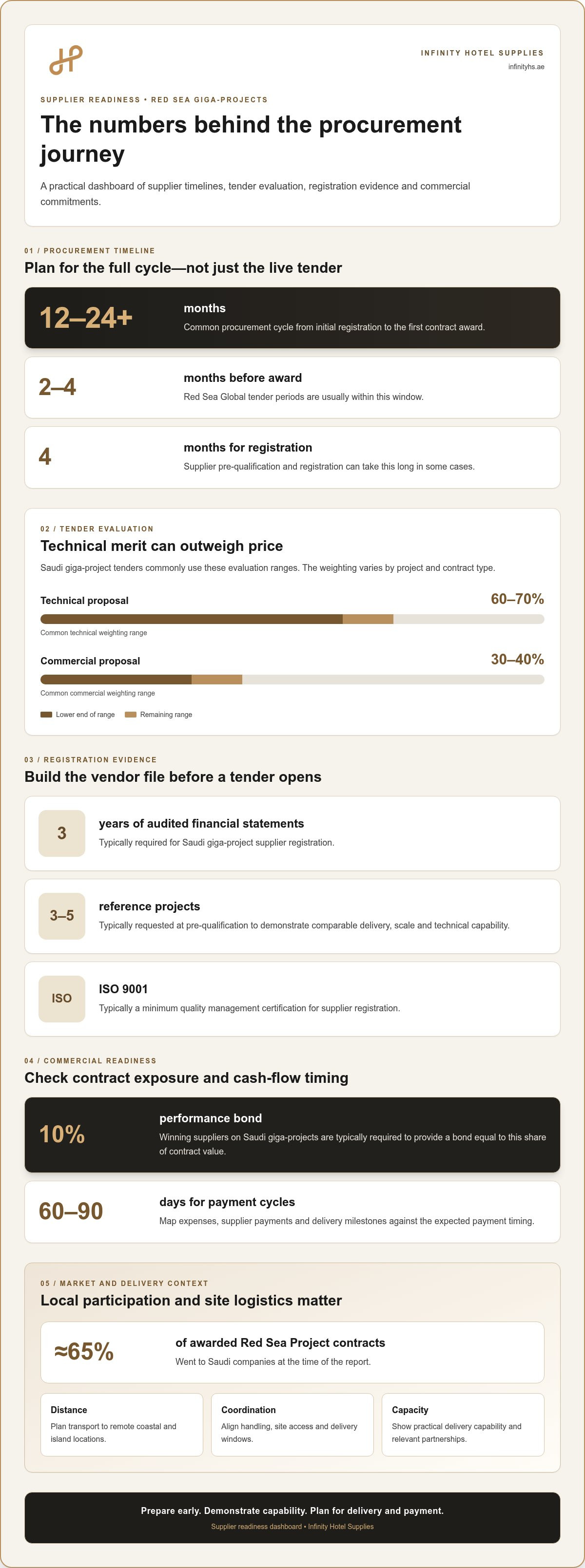
Supplier readiness can shape the timetable as much as the tender itself. For hotel procurement for Red Sea giga projects, procurement cycles commonly take 12 to 24 months or longer from initial registration to the first contract award, while Red Sea Global’s tender periods are usually between two and four months before contract award.
Early preparation is essential. Supplier registration and pre-qualification can take four months in some cases, according to Red Sea Global. Bidders should also consider financial capacity, project references, technical requirements and the challenges of supplying a large-scale destination in a remote location.
This guide explains how qualification and registration work, what financial and operational readiness means in practice, and why tender schedules can vary. It also explores how market conditions influence supplier decisions, from demonstrating relevant delivery experience to planning for the demands of a complex hospitality project. With a clearer view of each stage, hotel operators and suppliers can set more realistic expectations, prepare a stronger submission and align product planning with the project’s procurement timeline.
Key Takeaways
- Prepare evidence of delivery capacity, financial resilience and relevant project experience before pursuing a tender.
- Treat supplier registration as an early readiness stage, with financial records, references and quality systems organized in advance.
- Build tender plans around both technical compliance and commercial evaluation, not price alone.
- Assess how safety standards and localization expectations affect your submission and supply-chain approach.
- Match product schedules and delivery planning to the project’s scale, site conditions and operator requirements.
Supplier capacity and procurement market risks in Saudi Arabia
Main risks include delivery capacity, logistics, bid competitiveness and cash flow. Saudi giga-project tenders commonly weigh technical proposals at 60-70 percent and commercial proposals at 30-40 percent, while payment cycles can run 60 to 90 days.
Supply Chain and Logistics
Supply chain and logistics cover how products move from suppliers to project sites, ready for installation or use. Along the Red Sea coast, distance, island locations and coordinated delivery schedules make transport planning central to hotel procurement for Red Sea giga projects.
Red Sea Global says it began holding procurement roadshows in March 2023, starting with an event in Qatar that led to contract awards worth 2.5bn Saudi riyals. The response highlights the value of engaging early and building delivery partnerships that can demonstrate practical capacity. For international suppliers, a local partner can help coordinate site access, handling and communication across a project’s supply chain.
Consider the stainless steel villa for Sheybarah Island: it was being manufactured in Sharjah and was due to reach the project site weighing about 100 tonnes. That example shows why buyers and suppliers need to plan packaging, transport, lifting, delivery windows and site coordination around each item’s requirements.
Local participation also shapes the market. Around 65% of awarded Red Sea Project contracts went to Saudi companies at the time of the report. International suppliers can differentiate through clear evidence of capacity, reliable delivery plans and partnerships that support national participation. Proposals should also show how specifications and supply decisions align with project priorities, including regenerative tourism and residential development.
Procurement Risks, Contract Terms, and Payments
Procurement risks, contract terms and payment schedules shape suppliers’ performance obligations, evaluation and working capital needs. Understanding these factors helps teams assess commercial exposure and plan resources around delivery and payment milestones.
Technical merit can carry more weight than price: Saudi giga-project bid evaluations commonly assign 60-70 percent to technical proposals and 30-40 percent to commercial proposals, with variation by project and contract type. Suppliers should connect technical evidence to the tender scope, then make pricing assumptions, exclusions and delivery responsibilities clear.
Contract capacity also includes security requirements. Winning suppliers on Saudi giga-projects are typically required to provide performance bonds equal to 10 percent of the contract value. This obligation can affect available working capital, so teams should account for it when assessing whether they can support the contract alongside other commitments.
Payment cycles can extend from 60 to 90 days. Suppliers should map expected expenses against contract milestones, procurement commitments and payment terms before submitting a bid. A practical review considers cash reserves, the timing of supplier payments and the effect of delayed approvals on delivery. These checks help distinguish a technically strong opportunity from one the business can finance and fulfil responsibly.
Supplier pre-qualification, registration and tender timelines
Requirements vary by developer, contract package and destination, even within Saudi Arabia’s giga-project programme. Red Sea Global develops both the Red Sea and AMAALA destinations, while other giga-projects set their own supplier processes and tender schedules.
Supplier registration and documentation
Registration establishes a supplier’s identity, financial standing and ability to perform. Red Sea Global’s supplier pre-qualification and registration process can take four months in some cases, so international suppliers should prepare their records before a relevant tender is published.
Saudi giga-project supplier registration typically requires audited financial statements for the last three years. Pre-qualification typically calls for three to five reference projects, giving evaluators evidence of comparable delivery, scale and technical capability. Prepare concise project summaries that explain your role, scope and outcomes.
ISO 9001 is typically a minimum quality management certification for Saudi giga-project supplier registration. Keep the certificate details consistent across registration forms and supporting documents. A mismatch between company names, registration records and financial statements can slow the administrative review, even when the supplier’s experience fits the package.
Organize a core vendor file with company information, audited accounts, relevant project references and quality documentation. Then tailor the submission to each tender’s scope. A hotel wellness package, for example, may require hospitality operations experience, while an airport-related package may call for a different record of delivery and coordination.
Vendor registration and tender timing
Vendor registration is the administrative gateway that allows a supplier to be considered for project opportunities. Saudi giga-project procurement cycles commonly take 12 to 24 months or longer from initial registration to the first contract award. This timeframe includes more than the live tender, so suppliers should treat registration as an early market-entry stage.
Red Sea Global tender periods are usually between two and four months before contract award. During that time, teams need to interpret specifications, coordinate technical input, price the scope and submit a compliant bid. Preparing standard company documents and assigning bid responsibilities in advance leaves more time for project-specific decisions.
Red Sea Global’s shared role in the Red Sea and AMAALA destinations does not mean every package has identical requirements. Scope, operator needs, destination conditions and evaluation criteria shape each submission. Other Saudi giga-projects may have separate registration routes and tender calendars, so map each opportunity by contracting entity and package.
Suppliers serving communities across the Kingdom can strengthen their submissions by matching references to the work offered, rather than presenting a broad catalogue. Relevant experience helps reviewers assess capacity against the tender, whether the destination is a coastal resort, residential development or airport-linked hospitality project.
Procurement timelines
Procurement schedules follow construction milestones, operator handovers and opening plans. For a tourism destination such as the Red Sea, suppliers should map each package against design approvals, site readiness and delivery requirements. This connects purchasing decisions to the wider Vision 2030 ambition for luxury tourism while keeping conservation priorities in view.
The Red Sea Project’s Phase One plan for 2024-2026 included 16 hotels at the Red Sea destination and nine resorts at AMAALA Triple Bay. That sequence gives suppliers a practical framework: identify which properties are advancing, then align product approvals, manufacturing and delivery with each project package. A single resort opening can involve distinct purchasing schedules across guest rooms and shared spaces.
AMAALA’s first hotel handovers to operators were scheduled for the first quarter of 2026. Red Sea Global stated in April 2026 that all 27 Phase One properties across the Red Sea and AMAALA should be operational by the end of the second quarter of 2026. For suppliers, handover dates signal when approved goods may need to move from project storage into operational readiness.
Plan backwards from the buyer’s key milestone. Start with the required delivery window, then map specification approval, samples, production, inspection and transport. For example, room textiles and electronics may follow separate approval paths, even when both are for the same hotel opening. Keeping these workstreams visible helps teams identify dependencies before a late design decision affects a shipment.
The Red Sea destination is planned to include more than 40 hotels and more than 12,000 hotel rooms. This scale makes phased demand planning essential. Suppliers should distinguish between forecast demand and awarded scope, then connect commitments to named properties and delivery batches. That discipline reduces the risk of treating a destination-wide target as one simultaneous order.
AMAALA’s first phase was scheduled to open in early 2026 with nine resorts and 1,267 rooms. Its planned sequence gives suppliers a useful example of how room counts, operator handovers and resort opening plans can shape procurement packages. A wellness resort, for instance, may require different product coordination from another hotel within the same destination.
Use a milestone register for every tender or awarded package. Record the property, approval status, order release, production readiness and required site delivery, then update it when project dates change. For Red Sea Global’s developments, this approach links supplier commitments to real construction and operator milestones, rather than relying only on broad completion targets for 2030.
What Saudi regulations, standards, and localization rules apply to hotel suppliers?
For Saudi giga-projects, distinguish project tender requirements from national regulations. Tender documents define the package’s technical, safety and localization criteria, so map each requirement to supporting evidence before submitting. This helps avoid treating one project’s conditions as rules that apply across the Kingdom.
Safety management is a specific qualification area: suppliers must demonstrate certified safety management systems meeting ISO 45001 or an equivalent standard. Keep the certificate and supporting system documents aligned with the bidding entity’s legal name. For a hotel package, connect the evidence to the work being proposed, such as product handling, site delivery or installation responsibilities.
Localization requires careful attention. Tender documents set the participation criteria and evidence requirements for each package. Identify the contracting entity, review its stated local participation terms and document any partner’s role precisely. Requirements can differ between Red Sea Global, AMAALA and other developments, so do not assume one project’s approach applies elsewhere.
- Build a compliance matrix: list each tender requirement, its evidence document, owner and submission status.
- Separate mandatory criteria from scored criteria: track each category as the tender defines it.
- Document local participation accurately: distinguish supplier location, manufacturing origin and partner responsibilities.
- Match safety evidence to scope: connect ISO 45001 or equivalent documentation to the supplier’s actual role.
For example, a supplier bidding to deliver guest-room goods should make product documentation, quality controls and delivery responsibilities easy to assess. If a Saudi partner has a defined role, state it clearly and support it with relevant tender evidence. This gives evaluators a direct view of who is responsible for each part of the submission.
Before submitting, review the tender schedule and attachments line by line. Confirm that company details, certificate information and localization evidence appear in the required format. A project-specific review can catch inconsistencies between the proposed scope and supporting documents, particularly when preparing bids for multiple destinations.
Project identity and location offer useful context when suppliers organize a hotel bid, but they do not replace the package’s own requirements. Red Sea Global is the developer of the Red Sea Project in Saudi Arabia and is owned by the Public Investment Fund. The Red Sea Project is in Tabuk province in north-west Saudi Arabia, approximately 500 km north of Jeddah and 700 km south of NEOM. Red Sea Global is also a developer involved in delivering the tourism strand of Saudi Arabia’s Vision 2030, a plan to diversify the country’s economy socially, culturally and economically. These details can help suppliers identify which development and contracting context a tender concerns, and keep project-specific evidence clearly associated with that bid.
For overseas companies, Red Sea Global’s overseas team-building process for suppliers was described as easier than it had been in 2012 for overseas companies setting up in Saudi Arabia. That observation is context, not a substitute for checking the tender’s stated localization terms. Amaala extends across more than 2,600 miles along Saudi Arabia’s western coast and is located about 435 miles north of Jeddah, Saudi Arabia. Suppliers considering hotel work across these developments should keep each opportunity’s scope and participation evidence distinct. A clear record of the project, proposed package and any partner responsibilities can help prevent documents prepared for one development from being treated as evidence for another. Apply the tender’s own criteria to each submission rather than inferring requirements from a destination’s location or developer.
Which local and international suppliers serve Red Sea hotel projects?
Red Sea hotel projects involve a broad contracting ecosystem, but developers, hotel operators and product suppliers have distinct roles. Red Sea Global develops the Red Sea and AMAALA destinations; hotel operators shape property standards, while suppliers provide goods within defined contract packages. Separating these roles helps buyers identify who is responsible for specifications, approvals and purchasing decisions.
That figure describes project-wide contract activity, not a directory of hotel-product vendors. Buyers should match each opportunity to its contracting entity and scope. A hotel-room package, for example, may have different purchasing ownership from a destination-wide infrastructure contract.
Local and international suppliers may bring different capabilities. A Saudi supplier may understand local project coordination, while an overseas manufacturer may have experience in a specialized product category. Neither is automatically the right fit. Compare each company’s documented role, relevant hospitality references, production capacity and ability to meet the tender’s delivery plan.
Supplier mapping works best by product category and project stage. For a resort, create separate entries for guest-room textiles, room electronics and amenities. Record the buyer, specification owner, approval path and proposed supplier for each. This avoids assuming one company supplies every category or that the hotel operator controls every purchase.
- Identify the buyer: distinguish the developer, operator and contracting entity for each package.
- Map the scope: connect each supplier to specific goods or responsibilities.
- Compare evidence: assess relevant references, capacity and tender compliance.
- Clarify accountability: identify who manages product approvals, quality checks and delivery coordination.
Do not confuse hotel brands with suppliers. A brand selected for a property may set guest-experience standards, but that does not determine which vendor supplies its products. For example, an operator’s room specification can guide product selection, while the project contract determines who buys and delivers the approved items.
For international suppliers, a Saudi partner can take on defined local responsibilities when the tender structure allows. State each party’s role clearly, including who provides the goods and who handles coordination. Local suppliers should show how their products match the hotel’s specifications. In either case, a precise scope helps the buyer assess capability without relying on broad claims.
Build a supplier map for each hotel package and update it as specifications and contract ownership develop. This gives procurement teams a clearer view of the participants, each supplier’s contribution and the division of responsibilities across Red Sea hotel projects.
Red Sea Global develops the Red Sea and AMAALA destinations. Hotel operators shape property standards, while the contracting entity determines purchasing and delivery responsibilities for each package.
Suppliers may include Saudi companies with local project-coordination capabilities and overseas manufacturers experienced in specialized product categories. Assess them by product scope, relevant hospitality references, production capacity and ability to meet tender requirements.
Infinity Hotel Supplies: Hotel Linen
Infinity Hotel Supplies provides hotel linen for guest rooms and hospitality operations. For Red Sea projects, align linen selection with room specifications, operator standards, approval requirements and phased delivery schedules. Clear product schedules help coordinate purchasing with each property’s handover plan.
For broader guest-room requirements, Infinity Hotel Supplies also offers LOVO Premium Electronics, LUFTER PHYTOGREEN and leather accessories. These products can help buyers coordinate requirements across different hotel spaces, with each package aligned to its intended use.
If your project team is planning hotel linen or related guest-room products, contact Infinity Hotel Supplies to discuss your requirements.
Turn procurement planning into a clear next step
Strong hotel procurement for Red Sea giga projects connects tender requirements with each property’s operational needs. As plans develop, define who owns each specification and how approvals fit the project schedule. This creates a practical link between procurement planning and the guest experience the hotel intends to deliver.
As the project moves from planning into execution, keep a shared record of specification decisions, approval status and scope changes. A clear decision trail helps procurement and operations teams stay aligned as property requirements develop.
At your next planning review, identify unresolved product requirements and assign responsibility for each decision.
Contact Infinity Hotel Supplies.
Clear priorities and a considered supply plan help your team move forward with confidence.
Frequently Asked Questions
How does hotel procurement work for Red Sea giga projects?
Hotel procurement for Red Sea giga projects connects project specifications with operator needs, supplier submissions and property delivery plans. Buyers divide requirements into packages, such as guest-room goods or operational supplies, then assess proposals against each package’s technical and commercial criteria. For example, a resort opening may need separate approvals for room textiles and electronics. Teams serving projects across Saudi Arabia and the wider GCC should align product schedules with the relevant operator and destination.
What are the logistics, import duties, and delivery requirements for project sites?
Logistics planning should connect each product’s origin and transport route to the site’s receiving plan. Import duties depend on factors such as product classification and origin, so include them in the shipment’s landed-cost assessment rather than treating them as a fixed project-wide amount. For a Red Sea site, coordinate shipment documentation, packaging, delivery windows, unloading arrangements and receiving responsibilities with the tender scope. Clear ownership helps prevent goods arriving before the site can accept them.

Article by
Infinity Editorial Team
With deep expertise in hospitality product FF&E and OS&E across the Middle East and Africa, Infinity Editorial Team brings insights from Infinity Hotel Supplies, helping developers, hoteliers, and homeowners transform spaces from empty shells to fully furnished, design-ready environments.
Disclaimer
The content published by Infinity Editorial Team is intended for informational purposes only. All articles, guides, and insights are based on industry knowledge and experience in hospitality FF&E and OS&E supply across the Middle East and Africa. Infinity Hotel Supplies does not guarantee specific outcomes and recommends consulting a qualified professional for project-specific requirements.


