

A low purchase price alone is a poor guide to hotel linen value. Commercial hotel linen procurement in the GCC calls for a closer look at supplier reliability, product performance and the cost of ownership over time, alongside the initial specification.
Hotels need linen that supports a consistent guest experience and works for daily operations. This guide explains how to assess supplier risk, compare ownership costs, and set requirements for bedding, towels, bathrobes, pillows, duvets, and branded textiles. It covers practical specifications, from materials and dimensions to colour, finish, and quantities, so purchasing decisions reflect your property’s standards and needs. Use these criteria to compare proposals beyond the purchase price and clarify what matters before placing an order.
Key Takeaways
- Put dimensions, finishes, branding, order quantities, and production terms in the specification to reduce ambiguity between proposals.
- Compare lifecycle costs, including replacements and handling, rather than judging a linen order by its purchase price alone.
- Match bedding, towels, robes, pillows, and duvets to guest expectations and the demands of repeated use.
- Plan custom sourcing around production requirements and delivery coordination, and assess import requirements by destination country.
- Explore Infinity Hotel Supplies’ Hotel Linen offering alongside relevant guest-room products when shaping a coordinated supply plan.
Custom product specifications, sizes, colors, and branding
Clear specifications turn a hotel linen brief into requirements that can be compared across proposals. For GCC projects, document samples, quantities, timing, and finishes so all parties have the same reference before an order proceeds.
Product Specifications and Dimensions
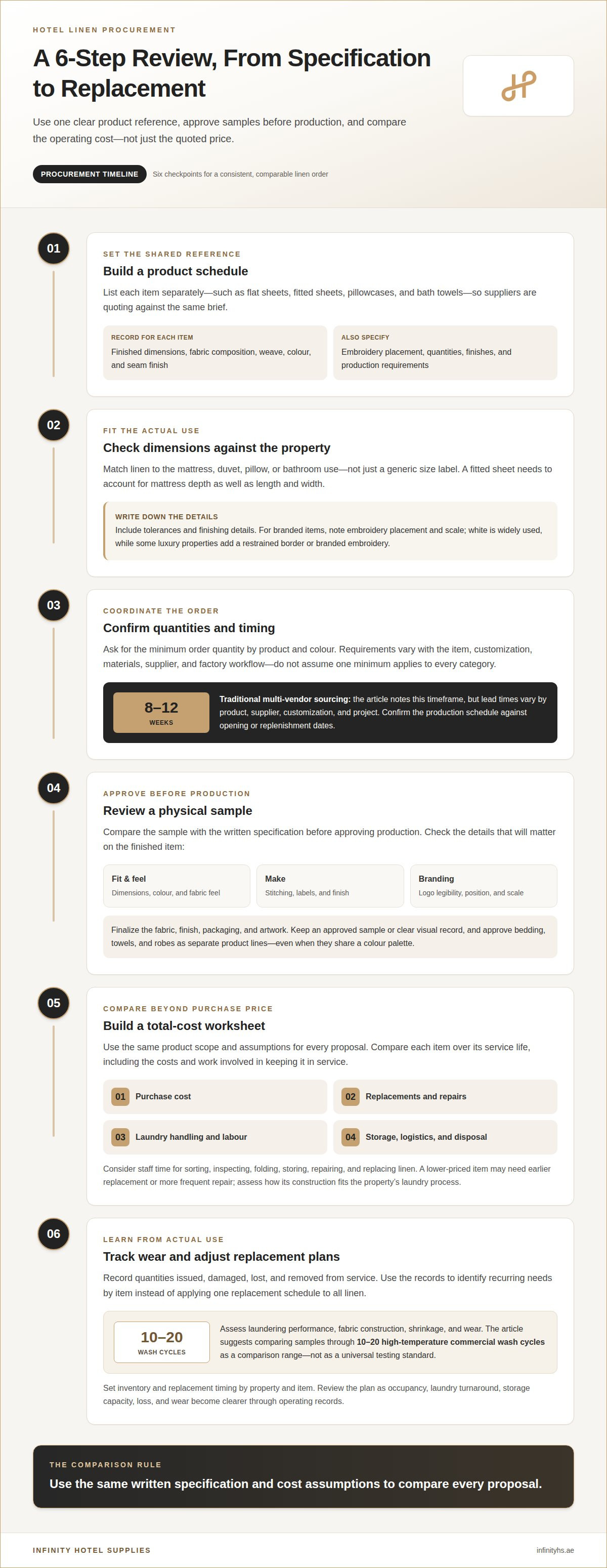
Start with a product schedule for each item, such as a flat sheet, fitted sheet, pillowcase, or bath towel. Record finished dimensions, fabric composition, weave, color, seam finish, and any embroidery placement. For Saudi hotel linen projects, confirm selected materials, dimensions, finish, quantities, availability, and commercial requirements in writing. This step gives every party one reference for reviewing the proposed hospitality linen.
Match dimensions to the actual mattress, duvet, pillow, or bathroom use rather than relying on a generic size label. A fitted sheet, for example, must account for mattress depth as well as length and width. Record tolerances and finishing details in the specification. White is widely used for hotel linen, while a luxury property may add a restrained border or branded embroidery.
Production timing and minimum order quantities depend on the item, customization, materials, supplier, and factory workflow. Traditional multi-vendor sourcing may take 8-12 weeks, but lead times vary by product, supplier, customization, and project. Confirm the production schedule with suppliers and align it with opening or replenishment dates. Ask for the minimum quantity by product and color, then consider whether consolidating sizes or finishes can support a more efficient wholesale order. Avoid assuming that one supplier’s minimum applies across every category.
Samples and Pre-Production Approval
Review a physical sample against the written specification before approving production. Compare dimensions, colour, feel, stitching, label placement, and embroidery scale. For a branded pillowcase, confirm that the logo is legible and correctly positioned on the finished item. Record approved changes in the final specification so the sample and production reference remain aligned.
Pre-production approval should settle the exact fabric, finish, packaging, and branding artwork for each item. Keep an approved sample or clear visual record for comparison during production. This helps avoid rework after late colour or logo changes. For coordinated hotel linen, approve bedding, towels, and robes as separate product lines, even when they share a colour palette.
Production runs more smoothly when specifications, quantities, artwork, and delivery requirements are resolved together. Late revisions can affect material planning and production flow, while a consolidated schedule gives manufacturers a clearer view of the wholesale order. Costs depend on choices such as material, customization, order volume, packaging, and freight. Compare proposals against the same specification, not just the quoted item price.
Total cost of ownership
What are typical linen inventory levels and replacement cycles for hotels in the GCC? There is no single level or cycle for every property. Set inventory according to occupancy, laundry turnaround, storage capacity, loss, and wear. Replace items when their condition or performance no longer meets operational needs.
For commercial hotel linen procurement in the GCC, assess each item over its service life, not only at purchase. A lower-priced sheet may need earlier replacement if its quality becomes inconsistent or it needs frequent repair. Compare purchase cost with replacement needs, laundry impact, handling, storage, and disposal. Apply the same assumptions to every proposal so the comparison reflects differences in the offers.
Start replacement planning with an item-level record. Track quantities issued, damaged, lost, and removed from service, then use the records to identify recurring needs. If pillowcases need replacing more often than duvet covers, for example, review their construction and handling separately. This helps hotel teams base decisions on actual use instead of applying one schedule to all linen.
A supplier’s offer reflects its cost structure and margin. Costs can include manufacturing, raw materials, customization, quality checks, packaging, freight, and operating expenses. A vendor’s margin is part of the commercial proposal, but does not show value on its own. For GCC hotel linen procurement, compare the product scope and service assumptions alongside the total proposal.
Labour costs also shape the operational picture. Staff time may go toward sorting, inspecting, folding, storing, repairing, and replacing linen. Laundry handling matters too: items that are difficult to manage can add work over repeated cycles. Consider how the design and construction fit your property’s laundry process rather than treating manufacturing quality as the only cost factor.
For each project, build a worksheet with one row per product and columns for purchase, replacements, laundry handling, labour, and logistics. Keep assumptions consistent across proposals. Order costs depend on specifications, quantities, customization, and delivery requirements; pricing is provided through a quote request.
Set inventory and replacement timing by property and item rather than applying a fixed GCC-wide benchmark. Review the plan as operating records reveal changes in occupancy, laundry turnaround, loss, and wear.
Bedding, towels, bathrobes, pillows, duvets, and guest textiles
Assess durability through laundering performance, fabric construction, shrinkage, and wear. Compare thread count and fabric weight alongside samples tested through 10-20 high-temperature commercial wash cycles, using this as a comparison range rather than a universal testing standard.
Bedding and Towel Categories
Separate the schedule into sheets, pillowcases, duvet covers, bath towels, hand towels, and bath mats. Each textile serves a different purpose, so compare dimensions, construction, and feel within its category. A fitted sheet must suit the mattress depth, while a bath sheet needs to provide suitable coverage for guests. A clear category schedule helps you compare equivalent products.
For bedding, consider 100% long-staple cotton as one material specification, then assess the weave and finished feel. Pillows and duvets also need distinct decisions about size, fill, and cover construction. Record those requirements separately from sheets and covers, so a guest-room set remains coordinated without treating every item as interchangeable.
Towel Absorbency and Plushness
Hotel towels balance absorbency, softness, and practical drying time. A bath-linen weight of 500 to 650 GSM can help frame comparisons, but weight alone does not establish performance. Review the towel’s thickness, surface feel, and absorbency together. For bathrobes, assess the cotton fabric and texture against the intended guest experience, from lightweight coverage to a more plush feel.
Compare bath towels and hand towels as separate products because their sizes and uses differ. Assess whether each sample feels comfortable after laundering, not just straight out of the packaging. Check a robe sample for comfort, fit, and finish too. These practical checks connect feel to use rather than relying only on a product description.
Durability and Laundering Performance
Hotel textiles need to withstand hundreds of industrial laundry cycles. Assess sample performance under the property’s laundering process, including temperatures between 60°C and 80°C where these reflect the property’s actual wash settings; this range is not universal. Look for severe shrinkage, pilling, or loss of whiteness after washing. Track the sample’s measurements and appearance before and after laundering, then compare the results with the specification.
Shrinkage affects fit and appearance, so measure the textile before and after the test. A 3-5% shrinkage range can serve as a procurement benchmark, but it is not a universal limit; check it against the product specification and fit requirements. Evaluate seams, hems, and surface condition at the same time. This gives teams a more complete view of durability than inspecting a new sheet or towel before its first wash.
Thread Count and Fabric Weight
Thread count is one technical specification, not a complete measure of quality. Assess it alongside cotton type, fabric weave, and shrinkage. For example, compare two sheet samples with different weaves by touch and after laundering. This helps determine whether the fabric’s comfort and finish suit the property’s service expectations.
Fabric weight matters differently across bedding and bath textiles. A towel’s GSM describes weight per area, while sheet selection also depends on weave and hand feel. Compare specifications within the same product category, then review the sample’s performance after 10-20 commercial wash cycles, treating this as a comparison range rather than a universal requirement. That process connects technical figures with real textile behavior.
Custom hotel linen procurement
Custom sourcing connects product requirements with manufacturing, international shipment, and delivery planning. Align technical specifications, destination requirements, and commercial terms before production begins.
Import Duties, VAT, and Customs Requirements
Build a landed-cost worksheet for each destination, such as the UAE or Saudi Arabia. Separate product value, freight, insurance, customs-related charges, VAT, and clearance costs. Applicable charges depend on the destination and shipment details, so do not apply one GCC-wide assumption to every project.
Keep the shipment file consistent with the commercial order. Include product descriptions, quantities, declared values, country of origin, and transport documents in the planning record. Describe sheets and bathrobes as distinct textile categories rather than using one broad “linen” label. Clear records help teams coordinate sourcing, delivery, and customs processing.
Compare landed cost, not only the supplier’s ex-works or delivered price. An offer can change once freight, handling, taxes, and clearance are included. Use the same destination, product mix, and delivery basis across proposals. This makes international offers easier to compare without assuming a duty rate or VAT treatment.
Textile Standards and Certifications
Which textile standards and certifications apply to hotel linen procurement in the GCC? Set requirements by destination country, product type, and the hotel’s written specification. A certificate and a performance test serve different purposes, so define what each document must demonstrate for the project.
Build a document matrix for each product line, such as sheets, towels, or robes. Record the requested standard or certification, issuing organization, product coverage, and document validity details. A certificate covering one fabric, for example, should not automatically be treated as evidence for every textile in an order. Match paperwork to the exact goods being sourced.
Then connect documentary requirements with practical quality controls. A sample review can assess color, construction, and finish, while test records can address specified performance characteristics. Keep approved documents, samples, and purchase specifications together in one project file. This gives international sourcing teams a clear reference when reviewing production and preparing delivery.
For a custom order, define the destination, required documents, delivery basis, and product schedule before comparing offers. This helps identify missing costs and mismatched requirements early, while giving the project team a consistent reference for sourcing and shipment planning.
What are the import duties, VAT, and customs requirements for importing hotel linens into GCC countries?
Import charges for hotel linen cannot be estimated from “GCC” alone. For each shipment, identify the destination country, product classification, origin, customs value, and delivery terms. These details affect duty assessment and VAT treatment. Calculate landed costs separately for shipments to the UAE and Saudi Arabia.
Start by classifying each product accurately. Sheets, towels, and bathrobes may need distinct product descriptions and tariff classifications. Classification affects duty calculations, so do not assign one code to an entire mixed linen order without review. Record the material, intended use, and item type for each line before calculating expected import charges.
Assess VAT by destination rather than treating it as one regional rate. Record the country of import and the transaction details used for the calculation. Show VAT separately from customs duties, freight, insurance, and clearance costs. This gives finance teams a clearer landed-cost view and makes proposals easier to compare on consistent terms.
Prepare a shipment file that connects the commercial order to the goods being transported. It can include the commercial invoice, packing list, transport document, origin details, and clear descriptions for each linen category. List bath towels separately from duvet covers, for example, with quantities and declared values matching the invoice and packing list.
Before dispatch, use this sequence for each destination:
- Confirm the destination country and the shipment’s delivery terms.
- Match every linen item to an accurate product description and classification.
- Compile invoice, packing, transport, and origin information consistently.
- Calculate duty, VAT, freight, and clearance as separate landed-cost components.
- Review the completed file against the shipment details before release.
This process helps identify cost or document mismatches before goods move. A mixed order containing sheets and robes, for instance, needs line-item descriptions for both categories. Keep the classification rationale and cost breakdown with the project records. They provide a practical reference for future replenishment shipments to the same destination.
Share your GCC linen shipment requirements
Infinity Hotel Supplies: Hotel Linen
Infinity Hotel Supplies supplies Hotel Linen, making it a relevant partner for hotels planning an order or reviewing guest-room textiles. The checks above help define what your property needs; a clear product brief connects those requirements to the right categories. This is particularly useful when purchasing teams are coordinating linen with other guest-room requirements.
For a linen enquiry, identify the products required and your property’s priorities. Bedding, towels, bathrobes, pillows, duvets, and branded textiles can each have different specifications and uses. Separating these categories in the brief clarifies the scope of the request. You can also note design preferences, quantities, destination, and delivery context without assuming every item has the same requirements.
Other relevant offerings can support adjacent hotel needs:
- LOVO Premium Electronics for hotel electronics requirements.
- LUFTER PHYTOGREEN as a separate product consideration.
- Leather Accessories for hotels considering complementary guest-facing details.
Keep the discussion focused on your project’s priorities. A property preparing guest rooms, for example, may be sourcing bedding and bathrobes while deciding whether electronics or leather accessories belong in the same purchasing plan. These are distinct product categories, each to be considered according to its role and the property’s requirements.
A concise enquiry can describe your hotel’s linen categories, preferred specifications, branding needs, and destination. Product samples or an existing schedule can help communicate the intended look and use. For a new opening, outline planned room requirements; for replenishment, identify which items need reordering or review. This gives the conversation a clear starting point without treating every order as identical.
Infinity Hotel Supplies is a practical point of contact when your hotel is ready to discuss Hotel Linen or related offerings. Share the product categories and project priorities that matter most to guide the discussion. Contact Infinity Hotel Supplies to discuss your requirements.
Make Your Next Linen Decision a Stronger One
Use the next purchasing cycle to create a shared reference for teams involved in guest-room standards and operations. A concise, maintained brief can keep requirements aligned as a property opens, refreshes rooms, or replaces worn textiles. It also gives decision-makers a consistent basis for reviewing future proposals.
For commercial hotel linen procurement across GCC properties, make each decision part of a broader operating plan rather than an isolated purchase. Keep the brief relevant as guest expectations, room needs, and internal priorities evolve. This helps teams move forward with clarity while preserving the standards that define the hotel experience.
Infinity Hotel Supplies can support your next step when your team is ready to discuss its requirements. Share your project priorities to start a focused conversation about the way forward.
Thoughtful planning helps your team approach its next hospitality project with confidence.
Frequently Asked Questions
How to Choose the Right Hotel Linen Supplier?
Choose a supplier whose process fits your hotel’s purchasing and approval structure. Before an order proceeds, agree internally on who approves the product, artwork, quantities, and purchase order. For a multi-property group, decide whether each property can select its own options or should follow a shared standard. These decisions reduce conflicting instructions and make repeat purchasing easier to manage.
What companies are included as top suppliers?
This guide does not rank suppliers. It explains why Infinity Hotel Supplies is relevant to hotel linen requirements in the GCC. “Top” can mean different things across hotel projects, so assess supplier suitability against your purchasing needs rather than a universal ranking. The guide supports informed decisions rather than comparing named companies.
What’s this procurement report about?
This guide is a practical reference for hotel teams planning linen purchases in the GCC. It helps structure decisions across product selection, commercial review, custom sourcing, and shipment planning. Use it to prepare for an internal purchasing discussion or align operations and finance before a project begins. It is not a market-share study, supplier ranking, or country-specific customs ruling.
Which suppliers sell commercial hotel linens in GCC countries?
Infinity Hotel Supplies supplies Hotel Linen to hospitality properties in the GCC. Its range also includes other hotel-related products, but the right discussion depends on your purchasing scope. For a group with several properties, establish whether the same product decisions apply across locations or whether each site has distinct requirements.
What types and specifications of hotel linen are commonly procured in the GCC?
Hotels procure linen according to their room layouts, operating models, and guest-service standards. Create a property-level item schedule that maps each approved product to the room type or outlet where it will be used. This helps prevent similar-looking products from being ordered for the wrong area and gives store teams a consistent reference when receiving replenishment stock.
Which hotel linen suppliers in the GCC offer custom branding and embroidery?
Infinity Hotel Supplies offers Hotel Linen, and branding is part of its hospitality product range. For a branded-linen project, include the intended brand treatment in the purchasing brief and specify which items require it. This keeps branded textiles distinct from plain stock in internal approvals and purchase records. This guide does not provide a supplier-by-supplier ranking of embroidery capabilities.
What risks affect hotel linen sourcing in the GCC, including shipping delays, price changes, and supply disruptions?
Hotels can reduce disruption by assigning an owner to monitor order milestones and communicate changes to operations. Record approved substitutions and their effect on room standards rather than allowing informal changes at receiving. For a phased opening, coordinate linen acceptance with room-readiness decisions so deliveries can be allocated first to areas scheduled for handover.

Article by
Infinity Editorial Team
With deep expertise in hospitality product FF&E and OS&E across the Middle East and Africa, Infinity Editorial Team brings insights from Infinity Hotel Supplies, helping developers, hoteliers, and homeowners transform spaces from empty shells to fully furnished, design-ready environments.
Disclaimer
The content published by Infinity Editorial Team is intended for informational purposes only. All articles, guides, and insights are based on industry knowledge and experience in hospitality FF&E and OS&E supply across the Middle East and Africa. Infinity Hotel Supplies does not guarantee specific outcomes and recommends consulting a qualified professional for project-specific requirements.


