

A hotel renovation FF&E budget is shaped by more than room count: the mix of spaces, quality level and project scope all affect the total. For a full-scope hotel renovation, FF&E typically accounts for 25% to 40% of the total budget. That makes an area-by-area estimate essential, not just a per-room figure.
It’s easy to focus on guest rooms first, but lobbies, restaurants, event spaces, and back-of-house areas also need to be included. A sound hotel renovation FF&E budget accounts for each space’s requirements, along with delivery, installation, and a contingency for unexpected costs.
This guide explains typical FF&E costs by hotel tier and area, how to build a more complete renovation estimate, and when to plan procurement. You’ll also see how project scope, durability, brand expectations and logistics can influence spending, so you can make informed decisions before costs and timelines become harder to manage.
Key Takeaways
- Build estimates by area, including guest rooms, public spaces, restaurants, fitness areas, and event rooms, rather than budgeting for rooms alone.
- Include freight, installation, removal, and other project costs in the estimate so the product budget reflects the full scope.
- Allow a 10-15% contingency for scope changes and unexpected expenses, adjusting the project plan to account for the property’s condition.
- Start procurement early: spec-grade hotel FF&E procurement should begin no later than 9 months before the target opening date.
What Are Typical Hotel FF&E Costs?
Typical FF&E costs depend on hotel tier, room count, design choices, and which areas the renovation covers. For a full-scope renovation, FF&E commonly accounts for 25% to 40% of the total budget, so the hotel renovation FF&E budget should include more than furniture purchases.
Furniture Grade and Catalog Choices
Catalog, spec-grade, and custom furniture differ in how closely they match a project’s design and performance requirements. Catalog items use existing designs, while spec-grade selections meet project needs without bespoke detailing. Custom hotel furniture can cost 30% to 60% more than spec-grade furniture.
That premium matters when brand standards call for distinctive dimensions, finishes, or branded details. Compare each choice with guest expectations, daily use, cleaning needs, and replacement requirements. A lower purchase cost may not suit a high-traffic property if the material wears quickly.
Design, Materials, and Labor Costs
FF&E costs include the planning and work needed to specify, produce, and install furniture and equipment. Furniture typically makes up 30% to 40% of hotel FF&E, while complex layouts can require more development, delivery coordination, and installation time.
Material selection affects appearance, durability, and ongoing maintenance. For example, lobby seating should be specified for frequent guest use and cleaning, not just visual appeal. Track design fees, customizations, product costs, and installation labor as separate budget lines to make the breakdown easier to manage.
Freight, Installation, and Hidden Expenses
Freight, warehousing, installation, sales tax, and removal of existing items can add costs beyond quoted product prices. Unplanned expenses can add 20% to 30% to hotel furniture and equipment prices, making a line-by-line scope important before orders are placed.
China-sourced FF&E is typically 30% to 55% less expensive than comparable locally sourced products at equivalent specification grades. Logistics, customs duties, and quality-control costs typically add 8% to 15% to China-sourced FF&E costs. Compare the full delivered and installed cost, not the product price alone.
Refresh Versus Full Renovation Costs
A soft-goods-only refresh is budgeted at 15% to 25% of full FF&E cost per key; a full renovation covers a broader replacement scope. For a full-scope hotel renovation, FF&E commonly takes 25% to 40% of the total budget.
Location also affects planning: renovations in major U.S. metropolitan areas, including New York, Los Angeles, Chicago, and Miami, may cost 20% to 40% more than national averages. Include delivery and installation in the area breakdown, then track vendor quotes against the approved scope to catch variances early.
Procurement timelines and delivery planning
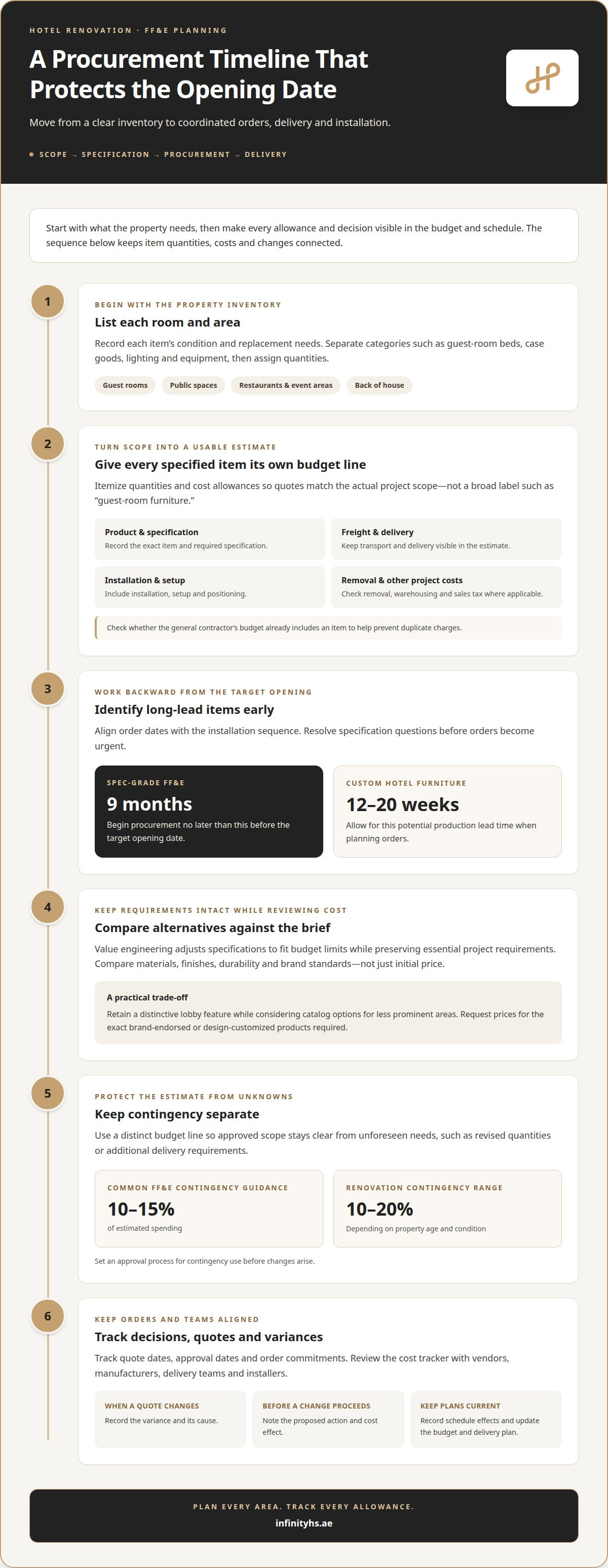
Procurement planning connects the approved scope with quantities, ordering, delivery, and installation. Estimate quantities using an inventory by room and area, and record each item’s condition and replacement needs.
This inventory helps distinguish a selective refresh from a broader replacement. For example, list guest-room beds, case goods, lighting, and equipment separately, then assign quantities and replacement requirements to each category.
Advance Planning and Itemized Budgets
An itemized budget assigns each specified item its own quantity and cost allowance. This matters because quotes need to match the project scope, not a broad category such as “guest-room furniture.”
Spec-grade FF&E procurement should start no later than 9 months before the target opening date. Custom hotel furniture may require 12 to 20 weeks, so identify custom items early and align order dates with the installation sequence.
Separate product, freight, delivery, installation, setup, and positioning costs. This makes omissions easier to spot and helps prevent duplicate charges when a general contractor’s budget already includes an item.
Value engineering adjusts specifications to fit budget limits while preserving essential project requirements. Compare alternatives by material, finish, durability, and brand standards rather than choosing solely by initial price.
For example, a project team could retain a distinctive lobby feature while choosing catalog options for less prominent areas. Request prices for the exact brand-endorsed or design-customized products required. Pricing several unsuitable alternatives can delay decisions and complicate approvals.
Plan for price changes by tracking quote dates, approval dates, and order commitments. Supplier pricing research and quotes can take longer when manufacturers face talent shortages. Early coordination gives teams time to resolve specification questions before orders become urgent.
Review the cost tracker with vendors, manufacturers, delivery teams, and installers. If a quote or schedule changes, record the variance, its cause, and the proposed action before it affects other orders.
Contingency Planning
A procurement contingency is an allowance for scope changes and unexpected expenses. Common FF&E contingency guidance is 10% to 15% of estimated spending. Renovation contingencies may range from 10% to 20%, depending on property age and condition.
Keep the contingency allowance as a separate budget line. This distinguishes approved scope from unforeseen needs, such as revised quantities or additional delivery requirements.
Set an approval process for contingency use. Record the change, reason, cost effect, and schedule effect, then update the itemized budget and delivery plan so vendors work from the same decisions.
Guest-room, suite, and public-area cost breakdowns
Room type, hotel tier, and shared spaces all shape the FF&E total. An area-by-area breakdown shows where the budget goes and which choices matter most to guests.
Room and Public-Area Cost Breakdowns
Area breakdowns assign separate allowances to standard rooms, suites, and public spaces. This matters because suites typically cost 2.0 to 3.5 times as much per key as standard rooms.
Guest rooms typically account for 55% to 65% of total FF&E spending across hotel tiers. Public areas typically represent 15% to 20% in full-service hotels. Include lobby seating, restaurant furniture, and common-area electronics in those shared-space estimates, alongside specialized facility equipment such as surveillance setups from CCTVSecurityPros - Professional Security Cameras and Systems for monitoring grounds and public entrances.
A suite’s larger footprint or additional furnishings can make it more expensive than a standard room. List each room type separately, then group shared areas such as conference rooms and fitness centers. This makes cost drivers visible instead of hiding them in one hotel-wide average.
Sample Hotel Budget Examples
These figures show how allocations can be planned by area rather than treated as a single, undifferentiated total.
Use that total as a framework for organizing room and public-area scopes, not as an added cost on top of the sample allocations.
The area list should also capture restaurants, fitness centers, and event rooms. Each space has distinct furniture and equipment needs, so an itemized scope helps prevent those requirements from disappearing inside a guest-room estimate.
Costs by Hotel Type and Size
These ranges reflect different standards, specifications, and guest expectations. Hotel tier is a useful starting point, but room mix and public-space scope also shape the total. A midscale hotel with suites or extensive shared spaces needs a different breakdown from one dominated by standard rooms.
Room count determines the scale of the overall requirement: larger hotels generally need a larger FF&E budget. Multiply the relevant per-room planning range by the room count, then account separately for suites and public areas. This gives the team a clearer basis for evaluating scope and priorities.
Contingency budgeting
A contingency reserve gives the renovation team room to address unforeseen changes without obscuring the approved FF&E scope. Keep it separate from item costs so decision-makers can see which funds support planned purchases and which remain available for emerging needs.
Build the reserve worksheet around identifiable risks, not a general cushion. For each risk, record the affected area, likely trigger, cost category, approval owner, and current status. A guest-room layout change, for example, could affect quantities, delivery coordination, and installation requirements.
Use the worksheet to distinguish new requirements from errors or omissions. If a manufacturer revises a specification, document whether the change stems from a design decision, a product issue, or a scope adjustment. That distinction helps the team choose an appropriate response instead of automatically drawing from the reserve.
- Scope changes: describe the requested revision and identify who approved it.
- Site conditions: record discoveries that affect the planned installation area.
- Product changes: note specification or quotation revisions and their cause.
- Schedule impacts: document how a change affects delivery or installation coordination.
Assign a clear approval route before the project begins. The project lead can review the cause, affected budget line, and schedule implications before authorizing a draw. This creates a consistent decision record for designers, contractors, and purchasing teams.
Review reserve activity during regular project meetings. Record each approved use, the remaining balance, and the decision rationale, then update the forecast. If a change affects several areas, note each affected line separately rather than hiding the impact in one broad adjustment.
Clear communication keeps the development team and suppliers aligned. Share approved changes with the manufacturer, delivery teams, and installers so each party works from the same scope. A documented contingency process helps the team respond deliberately while protecting the renovation’s core requirements.
Hotel FF&E budgets should include contingencies for scope changes and other unexpected expenses.
Budgeting for hotel construction and renovation
A hotel project budget should separate construction costs from furniture, fixtures, and equipment. This distinction matters because an FF&E allowance based on total development cost differs from one built around renovation scope. For planning, FF&E commonly represents 8% to 12% of total development cost.
Room-level construction estimates offer another reference point. The corresponding FF&E estimates are 8% of midscale construction costs and 7% of luxury construction costs.
Renovation budgets require a different scope and strategy compared to new builds. These are comprehensive renovation costs rather than FF&E-only amounts. Keep those categories separate to avoid treating a complete room renovation figure as a simple furniture allowance.
Start the renovation project with a scope map for every affected area. A guest room may require headboards, case goods, lighting, and fixtures, while a lobby could include seating and artwork. List removal and disposal of existing furnishings separately. Then assign each item to FF&E, construction, or another project line.
Coordination prevents duplicate costs. A general contractor’s estimate may already include items also priced by an FF&E provider. Review the scope with designers, architects, contractors, installers, and project personnel, then align each quote with the exact item and quantity in the approved budget.
For a clear review, separate the project worksheet into these cost groups:
- Design and soft costs: include design and architectural fees, plus project management.
- FF&E: list furniture, fixtures, equipment, and customizations by area.
- Delivery and installation: account for freight, warehousing, and installation charges.
- Construction and labor: keep hard construction and renovation labor distinct from product costs.
This breakdown helps decision-makers compare a luxury specification with a midscale alternative without confusing product choices with construction scope. Match quotes to the same specifications, quantities, and delivery assumptions, then track differences and address them before approving changes.
Discuss your hotel renovation requirements with our team to streamline your planning process.
Infinity Hotel Supplies
Infinity Hotel Supplies helps hotel teams align product selection with renovation scope and guest-room requirements. Its offerings include Hotel Linen, room electronics, Leather Accessories, and LUFTER PHYTOGREEN, allowing teams to consider several hospitality product categories within one FF&E plan.
Turn to Infinity Hotel Supplies when your project scope is taking shape and you need to plan product requirements across hotel spaces. Clear quantities, specifications, and delivery needs help connect those selections to the wider budget and schedule.
Contact Infinity Hotel Supplies to discuss your hotel renovation requirements.
Put Your Renovation Scope Into Action
The next step is to turn your hotel renovation FF&E budget into a clear sourcing brief. Set out the spaces in scope, item quantities, specifications, delivery requirements, and decisions awaiting approval. A shared brief gives the project team a practical reference as selections move forward.
Infinity Hotel Supplies offers Hotel Linen, LOVO Premium Electronics, and LUFTER PHYTOGREEN. These product categories can be considered alongside your project requirements when planning room and operational needs. Match selections to their intended use, design direction, and renovation schedule.
A well-organized brief gives the next project conversation a clear starting point. Bring your priorities together and move forward with a deliberate sourcing plan.
Contact Infinity Hotel Supplies to discuss your hotel renovation requirements.
Frequently Asked Questions
What Is Included in Hotel FF&E?
Hotel FF&E includes movable furniture, fixtures, and equipment used to operate guest and public spaces. Examples include beds, desks, seating, lighting, room electronics, and restaurant furnishings. A renovation scope may also cover equipment for meeting rooms or fitness areas. Structural work and permanent building systems usually belong in construction scopes, so clearly assigning each item helps prevent gaps or duplicate budget lines.
What Makes Hotel FF&E Cost Higher?
Custom dimensions, branded finishes, premium materials, and detailed specifications can raise FF&E costs. For example, a bespoke headboard designed around a room’s layout requires different development from a catalog item. A large suite may also need more furnishings than a standard room. Freight, difficult site access, and complex installation requirements affect delivered cost, while durability and maintenance needs influence a selection’s value over time.
What does FF&E include in a hotel renovation budget?
A renovation FF&E budget includes the furniture, fixtures, and equipment being purchased or replaced within the approved project scope. It can cover guest-room items, lobby and restaurant furnishings, lighting, and equipment for shared spaces. The budget should identify what remains in place and what gets replaced. For example, retaining desks while replacing beds changes quantities and avoids treating every room as a complete furnishing package.
What is the average hotel FF&E renovation cost per room in the U.S.?
This range is a planning reference, not a universal average, because hotel tier and renovation scope change the specification. A room receiving selected replacements differs from one receiving a full FF&E package. For hotels in the GCC, Middle East, and Africa, use local project conditions rather than applying U.S. figures directly, or consult regional fit-out and interior specialists such as rightsolutionuae.com for market-specific guidance.
How much does hotel FF&E cost by property type and star rating?
Treat these as property-type benchmarks. Room mix, public-area scope, brand requirements, and the level of customization determine where a project sits within its range.
What are current hotel furniture, fixtures, and equipment price ranges?
Individual furniture components have their own planning ranges. These are component estimates, not the complete cost of furnishing a room. Add the other specified furniture and equipment, then account separately for delivery and installation to understand the full project requirement.
What additional costs should a hotel FF&E budget include, such as shipping, installation, and storage?
Include freight, warehousing, installation labor, setup, positioning, applicable sales tax, and removal or disposal of replaced items. Also plan for attic stock, which is reserve inventory held for future replacements; hotels may keep about 1% of FF&E in storage for damaged or broken items. Assign storage responsibility and costs clearly, especially when deliveries arrive before rooms are ready for installation.
What steps are involved in planning and sourcing hotel renovation FF&E?
Begin by defining the renovation scope and listing items and quantities by room type and shared area. Next, assign each cost and deliverable to an accountable party, using a Responsibility Matrix to clarify ownership. Match quotes to the approved specifications, then coordinate delivery, installation, and receiving inspections. At handover, compare delivered and installed items with the agreed scope and record any issues for prompt resolution.

Article by
Infinity Editorial Team
With deep expertise in hospitality product FF&E and OS&E across the Middle East and Africa, Infinity Editorial Team brings insights from Infinity Hotel Supplies, helping developers, hoteliers, and homeowners transform spaces from empty shells to fully furnished, design-ready environments.
Disclaimer
The content published by Infinity Editorial Team is intended for informational purposes only. All articles, guides, and insights are based on industry knowledge and experience in hospitality FF&E and OS&E supply across the Middle East and Africa. Infinity Hotel Supplies does not guarantee specific outcomes and recommends consulting a qualified professional for project-specific requirements.


