

The delivery schedule is shaped well before outdoor furniture reaches a resort. There is no single production and delivery lead time for sourcing outdoor furniture for resorts in the Middle East. Timing depends on the materials, order scope, manufacturing readiness, and shipping coordination. Planning around these factors gives resort teams a more useful timeline than relying on a standard turnaround.
For resort terraces, furniture must suit both the setting and the way guests use it. Material choices affect the specification, while quantities and product details influence production planning. Make these decisions alongside delivery planning, rather than waiting until the order is ready to ship.
This guide explains what can affect lead times and pricing, how to assess materials for resort use, and how to coordinate shipping and after-sales support. It also covers outdoor dining furniture for terraces, helping hospitality teams connect design choices with the practical demands of a large-scale project.
Key Takeaways
- Compare teak and acacia against the resort’s setting, maintenance needs, and intended use before finalizing specifications.
- Build a realistic delivery schedule by accounting for factory capacity, order details, and shipping coordination.
- Assess suppliers through their manufacturing strengths, quality-control processes, and approach to after-sales support.
- Plan terrace dining around guest flow, furniture dimensions, and how the space will be used.
- Use a structured supplier assessment to align product requirements, delivery planning, and project priorities.
Supplier questions about pricing, materials, and lead times
For a resort project, compare furniture by specification, not appearance alone. Ask suppliers to explain how materials, finishes, order details, and shipping plans affect the estimate and schedule.
Pricing and Lead-Time Questions
Pricing depends on the project and is provided after a quote request. Order volume, materials, finish, dimensions, and delivery scope all shape the estimate. Ask for costs to be itemized by furniture type so you can compare chairs, tables, and accessories separately. For lead times, request a schedule that distinguishes sample approval, production, packing, and shipping. This shows where a specification change could affect delivery.
- Share quantities, dimensions, finish preferences, and delivery destination.
- Ask which decisions must be finalized before production begins.
- Request updates tied to production milestones and shipping handover.
Wood Material Options
Teak and acacia have different appearances and care requirements. Teak is valued for its natural durability and can suit exposed outdoor settings. Acacia has a distinctive grain and usually benefits from consistent protective care. Compare samples in the intended setting, assessing colour, surface feel, joinery, and finish together. Choose wood that suits both the resort’s design and its maintenance plan.
Specify whether the wood will be exposed or placed beneath a covered terrace. This affects finish selection and care expectations. For example, a dining table beside a pool may need a finish suited to routine cleaning and frequent guest use. Ask the supplier for care guidance specific to the wood and finish combination.
Weather Resistance and Finishes
Outdoor furniture must suit the site’s weather exposure, including direct sun, windblown dust, and moisture. Commercial-grade selection also takes account of frequent use, cleaning routines, and the repair or replacement of individual components. Ask for the material and finish specification for each item instead of relying on broad terms such as “weather-resistant.” This makes it easier to compare frames, woven surfaces, cushions, and hardware consistently.
Review finish samples alongside frame and cushion materials. Confirm how each surface should be cleaned and maintained, and whether the finish is intended for exposed or sheltered placement. If the terrace has both sunny and covered zones, map each furniture type to its location before approving the specification. This aligns appearance with practical use.
What is the production and delivery lead time?
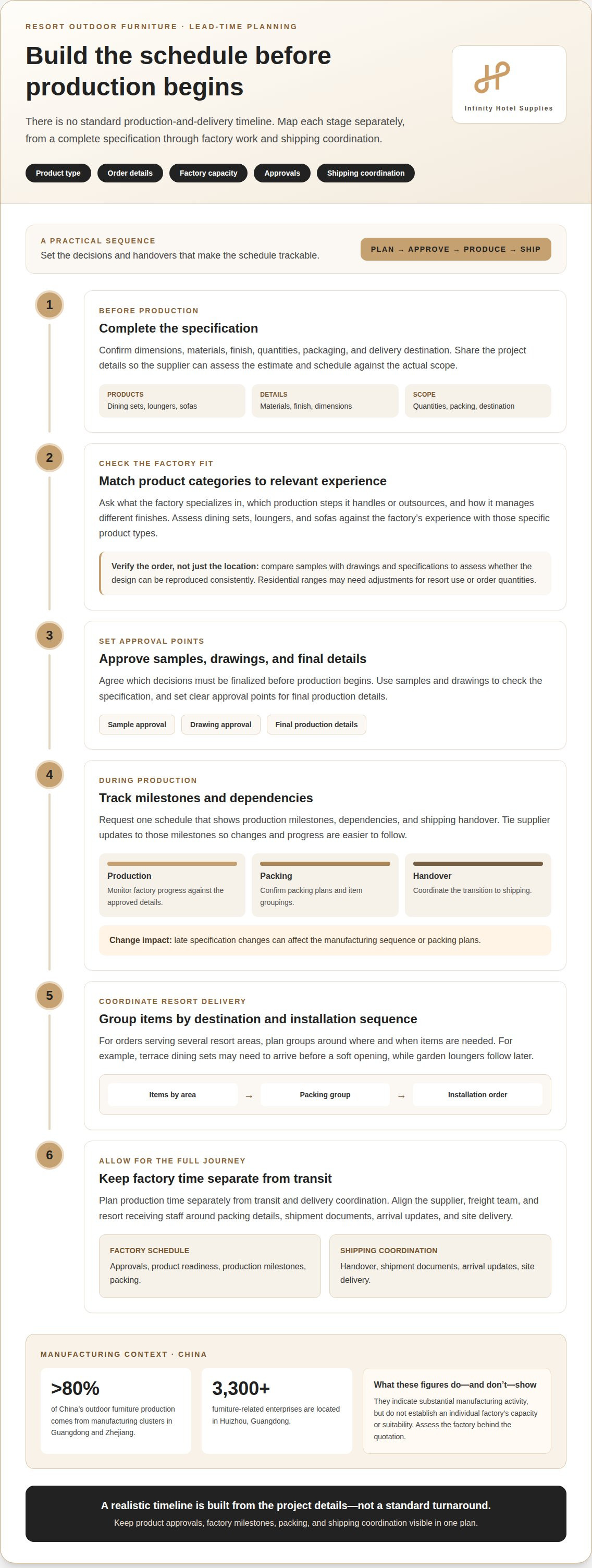
There is no standard production and delivery lead time for resort furniture. The schedule depends on product type, order details, factory capacity, approvals, packing, and shipping coordination. When sourcing outdoor furniture for resorts in the Middle East, map these stages separately. This makes the timeline easier to manage if specifications or delivery plans change.
China’s outdoor furniture manufacturing clusters in Guangdong and Zhejiang contribute over 80% of the country’s outdoor furniture production. Huizhou, in Guangdong, has over 3,300 furniture-related enterprises. These figures point to substantial manufacturing activity, but they don’t establish any individual factory’s capacity or suitability. Assess the factory behind the quotation, not only its location.
Supplier strengths often depend on product specialization. One manufacturer may focus on rattan seating, while another produces wooden garden dining sets or metal frames. Ask which production steps the factory handles, which it outsources, and how it manages different finishes. For a resort order, compare samples with the drawings and specifications to assess whether the required design can be reproduced consistently.
Factory capabilities matter across product categories. Dining sets require coordinated tables and chairs, while loungers and outdoor sofas have different construction details. Divide the order into categories, then match each to the factory’s relevant experience. A residential garden range, such as the patio collections offered by rengard.co.uk, may need specification adjustments to suit a resort’s use or order quantities. Request samples and a clear breakdown of what each represents.
Lead-time planning starts with a complete specification. Confirm dimensions, materials, finish, quantities, packaging, and delivery destination before production begins. Set approval points for samples, drawings, and final production details. Late changes can affect the manufacturing sequence or packing plans. Keep production time separate from transit and delivery coordination so the schedule allows for both factory work and shipping.
For an order serving several resort areas, group items by destination and installation sequence. Terrace dining sets, for example, may need to arrive before a soft opening, while garden loungers follow later. Ask the supplier to show production milestones, dependencies, and shipping handover in one schedule. This provides a practical basis for tracking progress without assuming every product follows the same timeline.
Contact the team to discuss project timing and supply priorities.
Supplier coordination, shipping, and after-sales support
Compare suppliers across four areas: product fit, quality controls, logistics, and support after delivery. A written assessment connects furniture specifications with resort operations.
Shipping and Supplier Coordination
Assign one coordination lead to align the supplier, freight team, and resort receiving staff. The plan should connect production release, packing details, shipment documents, arrival updates, and site delivery. For example, group aluminum lounge chairs by terrace or installation area, then label packages to match the resort layout. This reduces confusion during receiving and helps teams route items correctly.
Compare suppliers by how clearly they communicate schedule changes and shipment milestones. A logistics plan should identify who shares updates, handles document changes, and resolves delivery discrepancies. Include the destination, unloading arrangements, and receiving hours in the project plan. These details help prevent a shipment arriving before the resort can accept or store it.
After-Sales Support and Sourcing Risks
Counterfeits, corrosion, transit damage, delays, and warranty disputes can disrupt resort operations. Reduce these risks by documenting the approved manufacturer, product specifications, finish, and order details. At delivery, compare received items with the approved schedule and record visible damage before installation. For corrosion concerns, assess the material and finish against actual exposure and the maintenance routine.
After-sales support should explain how the supplier handles defects, replacement components, repair requests, and warranty claims. Record the process, required evidence, and contact route in the order documentation. Clear records help distinguish a manufacturing issue from transit damage or wear during use.
Durability, Warranties, and Maintenance
Resort-grade brands differ in construction, finish, warranty coverage, and care requirements. Compare the written warranty’s covered components, exclusions, claim process, and remedy instead of relying on a broad durability claim. Check, for example, whether frames, woven panels, cushions, and finishes are treated separately. A clear comparison makes ongoing maintenance and potential replacement needs easier to plan.
Match maintenance instructions to the resort’s cleaning routines and staffing. Ask for care guidance for each material, including aluminum frames and upholstery. Assess comfort and durability using representative samples, checking joints, surfaces, and moving parts. This makes the comparison practical for the intended lounge or dining use.
Standards and Import Requirements
Fire-safety, building, and sustainability requirements depend on the destination jurisdiction, project, and furniture placement. For a hotel terrace, align product documentation with applicable local requirements and request supporting material information from the supplier. Do not assume one certificate addresses every requirement.
In the UAE, Saudi Arabia, Qatar, and Oman, import duties, VAT, and customs treatment depend on the destination, product classification, and shipment documentation. Ask the logistics team to map these items for each shipment before dispatch. Requirements can differ between markets, so do not apply one country’s paperwork or tax assumptions to another.
Outdoor dining furniture for terraces and resorts
Outdoor dining spaces shape the guest experience and daily service flow. Plan furniture around the terrace layout, meal service, and local exposure.
Dining Furniture for Outdoor Terraces
Start with the terrace plan: map table locations, circulation routes, shade, and service access. A garden dining set with a 150 × 80 × 73 cm table offers one example for assessing fit, but dimensions must suit the actual site. Measure clearances around chairs when they’re occupied, and consider how staff move between tables.
Choose dining sets as coordinated groups, then review table surfaces, chair frames, and finishes together. A set with an 800 × 800 × 730 mm tempered-glass-topped table illustrates how specifications can vary between designs. For tailored replacement surfaces, specialist fabricators such as Glass Mirror House supply toughened safety glass cut to size for outdoor and patio tables. Compare samples against the terrace palette and intended hospitality style, from relaxed garden dining to a more formal hotel setting.
Dining furniture accounted for 35.1% of the global outdoor furniture market in 2025. For resort planning, translate demand into the actual service model: breakfast turnover may call for easy chair movement, while destination dining may prioritize a defined layout. List each terrace’s capacity, table configuration, and storage needs before finalizing the schedule.
Maintenance and Replacement Costs
Maintenance and replacement costs in desert and coastal climates depend on exposure, materials, finishes, cleaning routines, and use intensity. Build the budget by separating routine care, replacement parts, and full-item replacement. A coastal terrace with exposed metal frames, for example, needs a different maintenance assessment from a shaded garden with timber furniture.
Track each furniture type by location and care requirements. Record the finish, cleaning method, inspection frequency, and recurring wear on cushions, joints, or table surfaces. This gives the team a practical basis for estimating maintenance resources without applying one cost assumption to every terrace.
Plan replacements by component where the design allows. If a chair cushion wears before its frame, a compatible replacement may avoid replacing the whole chair. During specification, record finish details and component references for dining tables and chairs. Review these records during routine inspections, then use observed wear to refine future purchasing and maintenance plans.
Which outdoor furniture suppliers and manufacturers serve resorts in the Middle East?
Resorts in the Middle East can work with furniture manufacturers, regional distributors, or hospitality suppliers. These providers have different roles: a manufacturer produces specified items, while a distributor may consolidate products from several sources. When fitting out a new resort, identify who owns the product specification and who handles each handover.
International manufacturers may suit projects with distinctive designs or product requirements, while regional suppliers can provide a local commercial point of contact. The right route depends on the purchasing structure, delivery destination, and need for different furniture categories. A resort refurbishing one pool terrace, for example, may have different coordination needs from a property furnishing several guest areas.
Shortlist suppliers by the role they can fulfil, not by broad claims about serving hotels. Review catalogues for the categories required, then map each item to its proposed source. If the order combines dining furniture and loungers, establish whether one supplier can provide both or whether separate manufacturers are involved. This clarifies where specifications and approvals need to align.
For each candidate, document the commercial and communication setup before proceeding. Record the contracting party, the party responsible for product details, and the contact responsible for order updates. If a distributor works with a separate factory, note how product questions and changes are passed between them. A simple responsibility map helps the resort team understand who handles each project decision.
Use a shortlist matrix to compare providers against the resort’s actual requirements:
- Supplier role: Record whether the business manufactures, distributes, or supplies hospitality projects.
- Range alignment: Note which required furniture categories appear in its proposal.
- Accountability: Identify the party responsible for specifications and order communication.
- Project fit: Match the proposed supply route to the property’s purchasing and delivery plan.
Keep the assessment tied to the project scope. For a phased resort refurbishment, compare how each proposed supplier route supports the purchasing sequence across the areas being upgraded. A documented comparison clarifies the decision and helps the team select suppliers whose roles fit the project requirements.
Infinity Hotel Supplies
Comprehensive hotel supply partners can support resort teams coordinating outdoor dining plans with wider operational requirements. While furniture specifications shape the terrace, guest experience also depends on the products used throughout the property. A coordinated project brief helps keep these needs connected without overlooking the distinct requirements of each area.
For the outdoor furniture decision, carry forward the details established during planning: intended locations, furniture categories, selected materials, delivery destination, and schedule priorities. These clarify the resort’s requirements and keep the furniture scope distinct from other hotel supplies. They also help teams identify which related purchasing decisions belong in the same project discussion.
Resort procurement often involves various operational categories, including hotel linen, premium electronics, specialized greenery, and leather accessories. These categories support different parts of hotel operations, not outdoor furniture itself. A resort developing terrace dining alongside a guestroom refresh, for example, may need to consider room electronics or hotel linen separately. Keeping the scopes clear helps procurement teams assess each requirement on its own terms.
Start with a concise project brief. Include the property type, areas under development, intended opening or refresh schedule, and supply categories being considered. Then separate outdoor furniture requirements from related hotel product needs. This helps identify where specific product categories fit, while retaining the material, manufacturing, and logistics criteria that guide furniture decisions.
Resort teams can use this approach when planning phased improvements. A terrace update may run alongside guestroom changes, but each workstream has different specifications and delivery dependencies. Listing the products needed for each area gives internal teams a clearer view of priorities. It also keeps discussions focused, whether the immediate need concerns terrace planning or another hotel supply category.
For a resort project, the next step is a focused conversation about the property’s requirements and related hotel supplies. Bring the project scope, destination, and priority product categories to the discussion. Operational partners can support the categories they offer, while outdoor furniture planning remains guided by the specifications and supplier criteria outlined above.
Contact your procurement and supply partners to discuss your resort’s comprehensive hotel supply requirements.
Turn your project brief into a coordinated plan
Turn your resort’s priorities into a clear project brief. Set out the spaces to furnish, the guest experience you want to create, and the decisions needed before opening or refurbishment. This gives your team a practical starting point for the next stage.
Keep outdoor furniture requirements distinct from other project needs, while noting decisions that affect the wider schedule. A concise brief helps teams align priorities and keep discussions focused as plans develop.
Thoughtful sourcing outdoor furniture for resorts in the Middle East starts with a clear view of the property’s needs and project priorities. Use that brief to guide the next conversation and move forward with purpose.
Contact Infinity Hotel Supplies to discuss your project requirements.
Frequently Asked Questions
Are the outdoor cushions waterproof and durable?
Outdoor cushions are not automatically waterproof. Performance depends on fabric, seams, filling, and construction. For a resort, specify whether cushions will remain outdoors or be stored after service, then request care instructions for the exact product. Review how covers are cleaned and whether replacement covers or components are available. A sample lets the team assess comfort, stitching, and suitability for the planned use before approving a larger order.
How does the furniture perform in strong winds?
Wind performance depends on furniture weight, shape, placement, and terrace exposure. Loose cushions and lightweight pieces can move, so include a wind-management plan in the layout. For example, designate sheltered storage for movable chairs when the space is not in use. Where furniture needs anchoring, have the project team assess the site and specify a suitable fixing method for the surface and installation.
Is the furniture suitable for seaside and salt spray environments?
Suitability depends on the frame material, hardware, surface finish, and maintenance plan. A seaside location exposes furniture to salt spray, so request product-specific information about corrosion resistance and recommended care. Compare details across the frame, fasteners, and fittings rather than judging the frame alone. Plan regular inspections for surface changes, especially around joints and connections, and follow the manufacturer’s cleaning guidance.
What outdoor furniture materials are best for resorts in the Middle East’s heat, UV exposure, sand, and humidity?
No single material is best for every resort site. Exposure and maintenance needs shape the choice. Compare teak, acacia, aluminum, and woven materials against the planned location, finish, cleaning routine, and guest use. A shaded dining terrace and an exposed poolside area, for example, may need different specifications. Review samples against the project’s colour palette, and assess finishes and cushions as part of each complete furniture item.
What are typical prices for commercial outdoor furniture for Middle Eastern resorts?
There is no reliable typical price for a resort order because specifications and project scope vary. Pricing depends on material, dimensions, finish, product type, order quantities, and delivery requirements. Request a project-specific quote using a defined furniture schedule and specifications. This makes the estimate more meaningful than comparing broad category prices, since dining chairs can differ in construction, materials, and finishing.
What are the lead times, shipping costs, and delivery options for importing outdoor furniture to the Middle East?
Production and delivery schedules, shipping costs, and delivery arrangements depend on the order, origin, destination, and shipment plan. Ask for production timing and transit planning as separate items, then clarify the delivery point and receiving arrangements. For a resort with several outdoor areas, decide whether deliveries should be grouped or phased. This can affect packing, coordination, and when each area receives its furniture.
How should resorts evaluate suppliers, request samples, and specify outdoor furniture for procurement?
Evaluate suppliers against the same written specification and sample-approval process. Include product dimensions, materials, finishes, intended location, and care requirements in the schedule. Request samples that represent the proposed materials and finish, then compare them with the project brief. Before placing the order, record the approved sample reference and any agreed product details. This gives the resort and supplier a shared basis for reviewing delivered items.

Article by
Infinity Editorial Team
With deep expertise in hospitality product FF&E and OS&E across the Middle East and Africa, Infinity Editorial Team brings insights from Infinity Hotel Supplies, helping developers, hoteliers, and homeowners transform spaces from empty shells to fully furnished, design-ready environments.
Disclaimer
The content published by Infinity Editorial Team is intended for informational purposes only. All articles, guides, and insights are based on industry knowledge and experience in hospitality FF&E and OS&E supply across the Middle East and Africa. Infinity Hotel Supplies does not guarantee specific outcomes and recommends consulting a qualified professional for project-specific requirements.


