

A tender invitation is only one step in hotel procurement for the NEOM project. Companies must complete initial supplier registration before they can be invited to tenders, although an approved supplier marked “In registration Mode” may receive an invitation before completing full registration. For hospitality and residential projects, procurement planning must also align furnishings, equipment, operating supplies and site delivery with the project’s requirements.
That distinction matters: FF&E and OS&E serve different needs, and each tender or RFX invitation sets its own scope and submission requirements. This guide explains how the categories apply to NEOM projects, what supplier registration and tender invitations involve, and how to prepare a clear, relevant response. It also covers sourcing, project specifications and delivery planning, including sustainability requirements when they appear in the brief.
Key Takeaways
- Separate FF&E from OS&E in project planning so furnishings, equipment and operating supplies can be scoped clearly for hospitality and residential spaces.
- Organize sourcing around the tender’s categories and project specifications, including sustainability requirements when they apply.
- Plan remote-site delivery alongside crew mobilisation and accommodation to align supply with the project schedule.
- Complete NEOM supplier registration and keep the company profile current; registration alone doesn’t guarantee a tender invitation.
- Review each tender or RFX invitation for its scope, required materials and submission steps, since these define how to prepare a relevant response.
FF&E and OS&E procurement for NEOM hospitality and residential projects
For NEOM hospitality and residential projects, FF&E and OS&E packages should follow the project scope, specifications and delivery plan. Use the tender or RFX documents as the working brief, not a generic hotel checklist.
Sustainability and Local Content Requirements
NEOM sustainability requirements can include certified timber, low-emission finishes and recycled-content materials when the project specifies them. Local content criteria also need to be read from the relevant tender, rather than assumed to apply identically across every package. Compare each material schedule with stated performance and origin requirements, then document how proposed items address them. Saudi Vision 2030 provides wider context, but the tender defines the purchasing criteria.
Procurement Entities and Contractors
NEOM selects suitable suppliers from its database, while the project documents define the package and evaluation process. The tender should identify the contracting entity, project team or appointed contractor managing procurement. Do not assume other Saudi giga-projects follow the same rules: review each project’s registration process, scope and bid instructions separately. NEOM’s requirements apply to its specific procurement, not to every Saudi development.
Hotel and Resort Products and Services
There is no universal product list for every NEOM hotel or resort. The scope depends on the property, room schedules and operating requirements in the tender. FF&E may include room furnishings and fixed equipment; OS&E may include operational supplies and equipment used to serve guests. Map each requested item to its specification, quantity, finish and delivery point. Residential packages may have different schedules from hotel rooms.
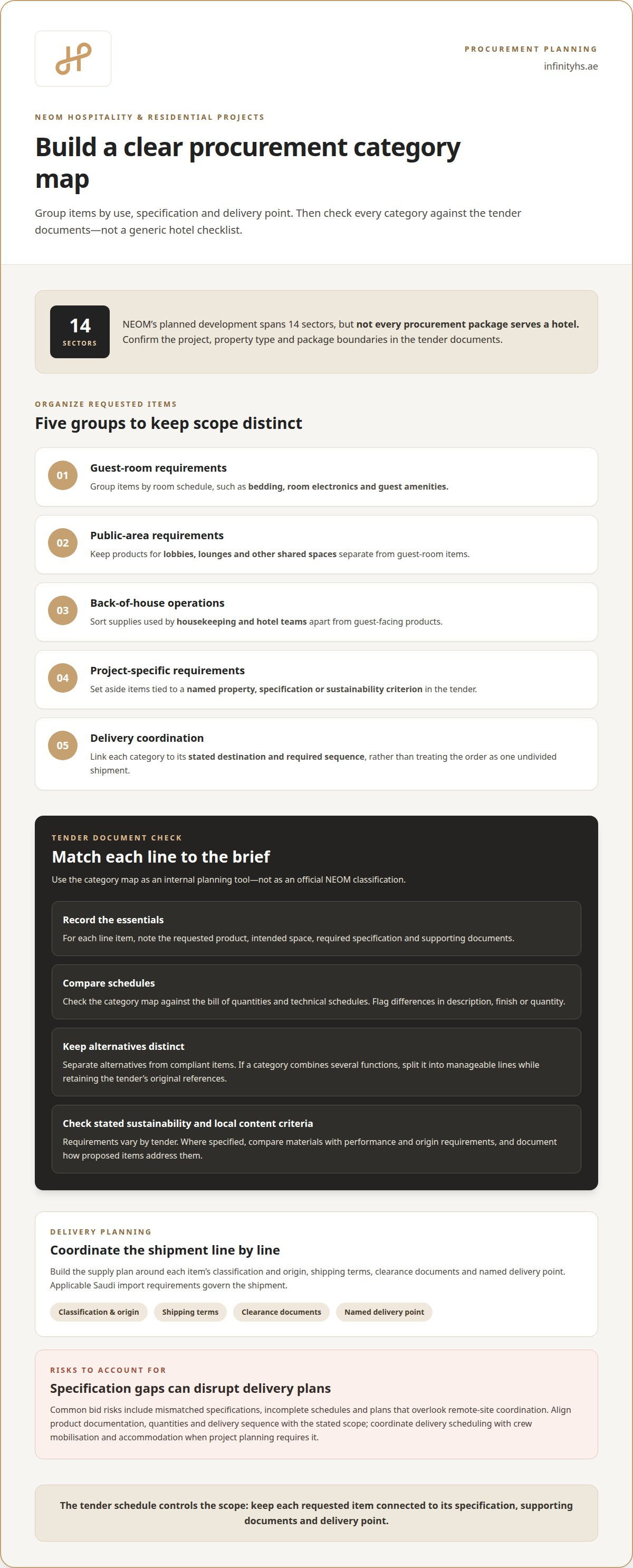
Customs duties, import procedures and logistics depend on the goods and tender arrangements. Build the supply plan around each item’s classification and origin, shipping terms, clearance documents and named delivery point. The applicable Saudi import requirements govern the shipment.
Supplier Bidding Risks and Challenges
Common bid risks include mismatched specifications, incomplete schedules and delivery plans that overlook remote-site coordination. NEOM project planning may require crew mobilisation and accommodation alongside delivery scheduling. For each package, align product documentation, quantities and delivery sequence with the stated scope. Identify substitutions that could affect finishes or sustainability criteria. A strong response addresses the RFX requirements rather than relying on a standard hotel procurement template.
Procurement categories
Hotel procurement for the NEOM project depends on the specific property, package scope and tender schedule. NEOM’s planned development spans 14 sectors, but not every procurement package serves a hotel. A supplier should identify the project, property type and package boundaries in the tender documents. Then group requested items by use, specification and delivery point. This prevents hotel operating supplies from being confused with infrastructure or construction requirements.
A practical category map can help organize a response. Use it as an internal planning tool, not as an official NEOM classification. For each line item, record the requested product, intended space, required specification and supporting documents. For example, group guest-room items separately from back-of-house supplies.
- Guest-room requirements: Group items by room schedule, such as bedding, room electronics and guest amenities.
- Public-area requirements: Separate products for lobbies, lounges and other shared spaces from guest-room items.
- Back-of-house operations: Sort supplies used by housekeeping and hotel teams apart from guest-facing products.
- Project-specific requirements: Create a separate group for tender items tied to a named property, specification or sustainability criterion.
- Delivery coordination: Link each category to its stated destination and required sequence, rather than treating the order as one undivided shipment.
Next, compare the category map with the bill of quantities and technical schedules. Flag any line where the description, finish or quantity differs between documents. Keep alternatives separate from compliant items so the response clearly shows which products meet the specification. If a category combines several functions, split it into manageable lines while retaining the tender’s original references. This gives procurement teams a clearer basis for reviewing scope and supplier responses.
For hotel projects, a bulk amenities package may be grouped by guest use and the tender’s stated requirements. This helps align product selection with the property’s operating needs without treating every room or project as identical. Across the GCC, Middle East and Africa, category labels can cover different specifications, so the tender schedule remains the controlling reference. A careful map also helps identify gaps before submitting a bid.
A supplier supporting hotel procurement for the NEOM project can use this structure to prepare a category-by-category response, then align product documentation and delivery details with each package. Start with the tender’s stated requirements and link every category to its specific scope.
Tender and RFX invitations
Access to NEOM tenders follows supplier registration and selection. Each invitation then sets the opportunity’s scope, response format and submission deadline.
To qualify, a company completes NEOM’s initial supplier registration with company details and supporting documents, accepts the terms, and completes a supplier questionnaire after approval. Registration is free but does not guarantee an invitation. Keep relevant goods and services current in the profile. An existing GEP account does not replace NEOM registration.
Available Tender Opportunities
After selection, suppliers receive access to relevant procurement opportunities and invitations. A hotel-related RFX may cover a defined supply package, while other NEOM opportunities may involve infrastructure or project operations. Read each notice for its scope, technical schedules, response format and deadline. This helps suppliers focus on packages that match their capabilities and sustainability documentation.
An approved supplier marked “In registration Mode” may receive an invitation to a related tender or RFX before completing full registration. Treat it as a defined opportunity, not general approval for every package. First review the requested category and submission instructions, then prepare a response addressing the named requirements.
- Match the invitation to the goods or services requested.
- Check schedules, specifications and required supporting documents.
- Record the submission deadline and required response format.
Contract, Payment, and Delivery Terms
NEOM contract terms, payment schedules and delivery requirements are set out in the specific tender and contract documents. No single schedule applies to every hotel supplier. Before preparing a bid, review the stated payment milestones, acceptance conditions, delivery location, sequencing and responsibilities for each step.
For example, a package with staged deliveries needs a response that aligns quantities and timing with each stage. A sustainable-materials requirement also belongs in the technical response, alongside product documentation. Do not assume terms from one NEOM contract apply to another. Use the current invitation and its attachments as the controlling instructions.
A disciplined response process keeps registration and bidding distinct. First, maintain an accurate NEOM profile. Then review each invitation against the company’s relevant categories and map every requirement to a clear response, supporting document or delivery detail. If an RFX requests clarification, follow its stated channel and deadline. This structure helps suppliers respond precisely without mistaking an invitation for a contract award.
For historical context, NEOM’s Saudi Arabia worker accommodation tender had a bid submission deadline of 5th February. That deadline applied to that past opportunity and is not actionable for current bids. For any current NEOM tender, use its own documents to confirm the required format, scope, supporting material and submission deadline.
Keep the invitation and schedules together during bid preparation so you can check requirements against the response. A final review should confirm that requested documents are included, technical requirements are addressed and the submission follows the specified format. Assess any clarification or change against the tender’s current instructions before sending the response. This keeps the bid focused on the opportunity’s requirements and avoids assumptions based on other packages.
What hotel procurement opportunities are available for the NEOM project?
NEOM procurement opportunities can relate to hospitality assets, residential accommodation and the infrastructure supporting them. The specific packages depend on project scope and tender releases, so a planned destination should not be mistaken for an open hotel tender. As historical context, NEOM’s Sindalah destination opened in December 2024, while Trojena was planned with six districts. Each project phase can have distinct requirements and procurement timelines.
Hotel-related opportunities may cover room fit-out, operating supplies and shared spaces. A tender might request a defined package, such as guest-room furnishings, room equipment, or supplies for housekeeping and guest services. Other opportunities may focus on a particular resort or accommodation project. The tender documents identify the actual scope, technical criteria and delivery location. Organize your capabilities around those documents rather than assuming every NEOM project needs the same package.
- Guest accommodation: Review room schedules and item lists for furniture, equipment and operating supplies.
- Resort operations: Look for packages serving guest areas, housekeeping or other named hotel functions.
- Residential projects: Separate residential requirements from hotel specifications, even when both involve furnished accommodation.
- Supporting works: Distinguish hotel supply packages from construction and infrastructure procurement.
As historical context, The Line was described as focusing on its first 2.4-kilometre starter segment, while Sindalah represents a distinct island destination. These examples point to different project contexts, not a shared product schedule. A supplier assessing an opportunity should identify the named asset, contracting party, package category and tender stage before preparing a response. That process helps prevent a residential or infrastructure notice from being misread as a hotel supply request.
For practical screening, create an opportunity record for each notice. Capture the project name, requested category, submission deadline, delivery point and required documents. Then compare the scope with the supplier’s products and project capacity. A hotel package can be relevant even when it forms only one part of a broader development, but the bid should address that package precisely. NEOM’s 14-sector development means procurement notices can cover varied needs, so the project name alone does not define the opportunity.
Which NEOM entities or contractors manage hotel procurement?
NEOM’s procurement function selects suitable suppliers from its database and issues invitations to relevant tenders. The purchasing entity for a hotel package depends on the tender documents. They identify the contracting party, package scope, submission route and project contact. Use these details to direct questions and prepare the response.
NEOM does not share details about other companies working on its projects with suppliers. The tender notice and attachments are therefore important for identifying who manages a particular opportunity. Do not assume that a contractor involved in construction or logistics also controls hotel supply decisions. Instead, distinguish the project owner, procurement team, contract administrator and delivery contact wherever the documents name them.
- NEOM procurement: Manages supplier selection from its database and invitations to relevant opportunities.
- Project or contracting entity: The tender identifies the party responsible for the specific package and contractual requirements.
- Appointed contractor: Where a contractor is named, follow the stated procurement route and contact responsibilities.
- Logistics partners: Their role concerns supply movement unless the tender assigns broader responsibilities.
For example, NEOM and DSV established a logistics joint venture in October 2023. NEOM owns 51% and DSV owns 49% of that venture. Its stated connection is logistics, so suppliers should not infer that it awards hotel FF&E or OS&E contracts. The hotel package’s procurement authority remains the entity named in that specific tender.
Review the documents before bidding. First, record the legal entity named as buyer or contracting party. Next, identify who receives submissions and handles clarifications. Then separate procurement responsibilities from delivery coordination. If a notice names a project contractor, use the tender instructions to understand its role instead of assuming it represents every NEOM procurement activity. This also helps prevent commercial or technical material from going to an unrelated contact.
Register directly with NEOM; an existing GEP account does not replace this registration. Keep the profile’s goods and services relevant and up to date. Registration supports platform access, while NEOM procurement selects suitable suppliers for relevant invitations. The project documents then define the responsible entity, scope and next steps for each hotel supply opportunity.
For project-specific questions, use the contact route provided in the relevant tender documents.
Other procurement examples do not establish who controls a NEOM hotel package. Red Sea Global procurement includes marine operations, luxury hospitality management, sustainability systems and food supply. That scope belongs to the stated Red Sea Global procurement context; it does not identify a NEOM contracting party or change the need to follow the package tender. Keep each organisation and its scope clearly linked when comparing opportunities.
A forum contributor wrote that NEOM had contractor accommodation until hotels were in place. Treat this as the contributor’s account, not as identification of a hotel buyer, procurement authority, contractor or award route. It does not establish who would procure hotel goods or services. For a live opportunity, rely on the buyer and responsibilities stated in that specific tender, rather than applying assumptions about accommodation arrangements to a separate hotel package.
Infinity Hotel Supplies
Infinity Hotel Supplies can support NEOM hospitality projects that need products within its supply range. It provides relevant hotel products; it does not replace NEOM’s registration, tender selection or contracting process. The tender documents remain the reference for scope, specifications and delivery requirements.
For a package that includes hotel linen, room electronics or amenities, first match the requested categories to the project schedule. Clear item descriptions keep product discussions focused on the spaces and uses named in the tender. This is especially useful when a project separates guest-room, residential and operational requirements into different packages.
Relevant product categories include:
- Hotel Linen: for hospitality packages that specify linen products.
- Room Electronics: for packages requesting electronics for hotel rooms.
- LOVO Premium Electronics: an electronics offering for relevant hospitality requirements.
- Hotel amenities: including custom hotel amenities where the project calls for them.
- Leather Accessories: for packages that include these hospitality accessories.
- Hotel Uniforms: for staff apparel requirements within a hotel package.
To make an enquiry useful, outline the project type, requested categories and relevant tender specifications. Include product schedules or item descriptions where available, along with stated quantities, finishes or delivery details. This gives the discussion a clear project context without assuming that one hotel’s requirements apply to another.
Infinity Hotel Supplies is relevant when the required package aligns with its product categories. For example, a hotel project seeking linen and room electronics can discuss those requirements together, while a separate amenities package can be handled according to its own scope. Product selection should follow the tender specifications and the project’s stated needs.
For NEOM projects, keep procurement responsibilities clear: NEOM manages supplier selection and invitations, while the tender defines how to bid. Infinity Hotel Supplies can support product supply where its categories fit. Contact Infinity Hotel Supplies to discuss your hospitality project requirements.
Build the next step around project fit
For hotel procurement for the NEOM project, connect product decisions to the experience and operations each space must support. A clear view of project priorities helps teams focus on relevant categories instead of treating every opportunity as a standard hotel package. Keep intended use, specifications and project requirements central as plans develop.
Infinity Hotel Supplies offers Hotel Linen, LOVO Premium Electronics and LUFTER PHYTOGREEN. These products may suit projects whose requirements align with those categories. Start a focused conversation with the type of hospitality or residential project, the categories under consideration and the priorities shaping the supply plan.
Use that context to discuss how the product scope fits the project’s needs and what to cover next. A well-defined starting point makes the conversation more specific and useful.
Get in touch with Infinity Hotel Supplies to discuss your project requirements.
Frequently Asked Questions
Where are NEOM hotel procurement tenders published, and how can suppliers apply?
NEOM makes relevant tender invitations and materials available through its supplier platform. To apply for a specific opportunity, use the submission route and instructions in that invitation. Organize the response around the tender’s item schedule: label each section to match the requested package and keep supporting documents with the relevant items. This makes the submission easier to review and helps prevent unrelated materials from obscuring the offer.
What customs duties, import rules, and logistics requirements apply to supplying hotels in NEOM, Saudi Arabia?
Customs duties, import procedures and logistics depend on the goods and tender arrangements. Plan around each item’s classification and origin, shipping terms, clearance documents and named delivery point. Applicable Saudi import requirements govern the shipment.

Article by
Infinity Editorial Team
With deep expertise in hospitality product FF&E and OS&E across the Middle East and Africa, Infinity Editorial Team brings insights from Infinity Hotel Supplies, helping developers, hoteliers, and homeowners transform spaces from empty shells to fully furnished, design-ready environments.
Disclaimer
The content published by Infinity Editorial Team is intended for informational purposes only. All articles, guides, and insights are based on industry knowledge and experience in hospitality FF&E and OS&E supply across the Middle East and Africa. Infinity Hotel Supplies does not guarantee specific outcomes and recommends consulting a qualified professional for project-specific requirements.


