

The lowest-wattage fitting is not automatically the most cost-effective choice for a hotel. Choosing cost-effective hotel lighting solutions in Dubai means weighing energy use against fixture lifespan, replacement needs and the quality of light guests experience.
It is understandable to focus on electricity savings: lighting operates across guest rooms, corridors, lobbies and shared spaces, often for long periods. But a sound decision also accounts for maintenance access, suitable specifications and how each area needs to look and function.
This article explains how LED lifespan affects replacement frequency, how energy-efficient lighting can reduce consumption and which technical details matter when selecting fittings and controls. It also covers the distinct demands of hotel public spaces, where comfort, visibility and reliable operation all matter. Use these factors to assess lighting as a whole, rather than judging it by fixture price or energy rating alone.
Key Takeaways
- Compare LED lifespan and maintenance access to understand how fixture choices can affect replacement frequency and disruption.
- LEDs can reduce energy use by up to 60% compared with traditional lighting, but actual savings depend on the lighting setup and how it is used.
- Plan public-space lighting around each area’s needs, balancing visibility, guest comfort and the atmosphere you want to create.
- Assess light output, colour quality, glare, dimming and environmental suitability together when reviewing specifications.
- Give lobbies and reception areas a distinct lighting plan that supports clear visual tasks while creating a welcoming first impression.
1. LED lifespan and replacement costs
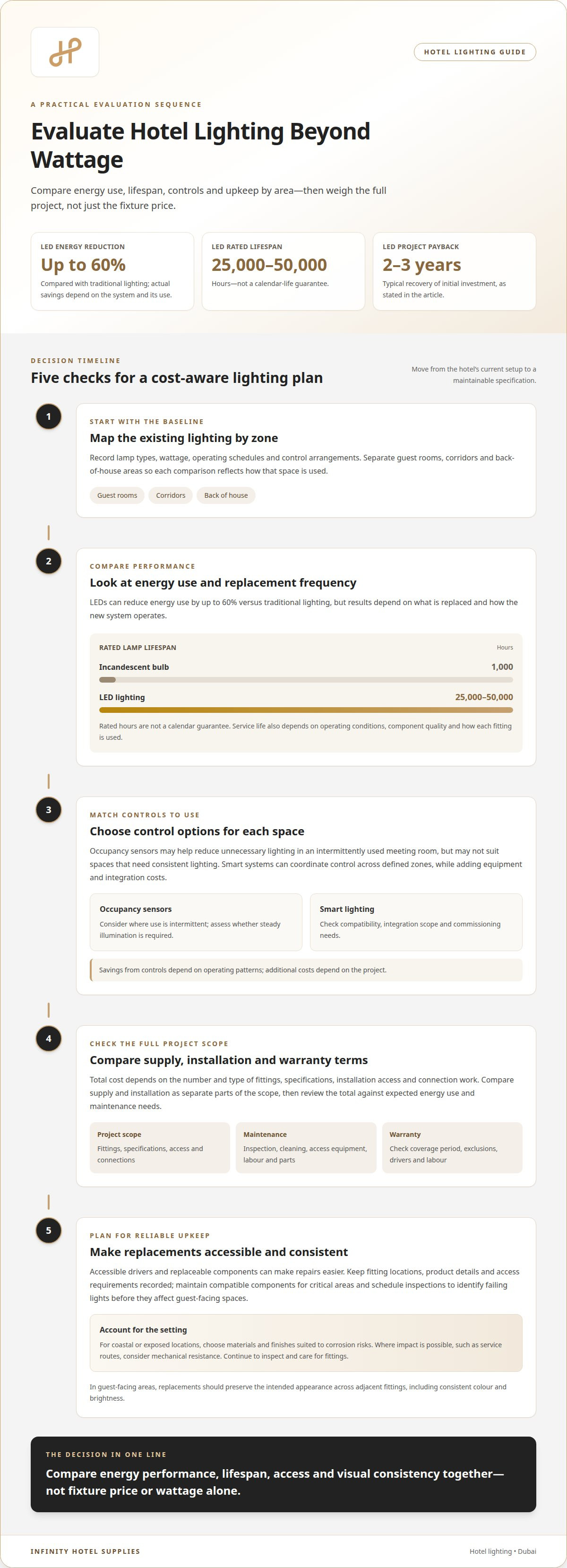
Hotel LEDs can last between 25,000 and 50,000 hours, reducing how often teams replace lamps. Treat that range as a rated lifespan, not a calendar guarantee. Actual service life depends on operating conditions, component quality and the way each fitting is used. A light in a frequently used corridor has a different duty cycle from one switched on briefly in a storage room.
For a practical estimate, match the product’s rated hours to the hotel’s operating schedule. Group fittings by location, such as guest rooms, corridors and back-of-house areas, to identify where replacement work could interrupt service most. A planned schedule for high-use areas can help maintenance teams coordinate work around occupancy and avoid scattered callouts.
What are typical hotel LED lighting costs in Dubai, including supply and installation? The total depends on the number and type of fittings, their specifications, installation access and the work required for connections. Compare supply and installation as separate parts of the project scope, then assess the total against expected energy use and maintenance needs.
Purchase price alone can hide the cost of maintaining a lighting system. If a driver is behind a hard-to-reach ceiling, even a straightforward component change may require extra access work. Specify accessible drivers and replaceable components where practical. For example, a fitting designed for component replacement can make a failed driver easier to address without replacing the entire fixture.
What maintenance costs, warranties, and risks should hotels consider when choosing lighting? Account for inspection, cleaning, access equipment, labour and replacement components. Review each warranty’s coverage period, exclusions, and treatment of drivers and labour, as terms vary by product. Also consider downtime, difficult access and potential mechanical impact where relevant.
Maintenance planning matters across Dubai’s varied hotel settings. In coastal or exposed locations, choose materials and finishes suited to corrosion risks. Where impact is possible, such as along service routes, consider mechanical resistance. These choices can reduce avoidable damage, but do not remove the need for inspection and care.
Build the specification around maintenance as well as energy performance. Record fitting locations, product details and access requirements so staff can identify the right replacement. Keep compatible components available for critical areas, and schedule inspections to spot failing lights before they affect guest-facing spaces. This makes replacement work more orderly and helps protect the hotel’s lighting investment.
For luxury properties, consistent illumination also shapes the guest experience. Replacements should maintain the intended appearance across adjacent fittings, rather than creating mismatched colour or brightness. Consider lifespan, access, component replacement and visual consistency together when assessing hotel lighting.
2. LEDs compared with traditional lighting
LEDs use less energy than traditional lighting, but the decision involves more than lamp wattage. Compare electricity use, operating hours, control options and installation requirements across each lighting zone. A guest room, for example, has different usage patterns from a continuously lit corridor. Start with the existing system and the hotel’s operating schedule.
LED lighting can reduce energy use by up to 60% compared with traditional lighting options. The result depends on the equipment being replaced and how the new system operates. Replacing inefficient lamps while retaining suitable fittings may involve different work from changing fittings and controls throughout a property. Assess each area separately rather than applying one expected saving to every room or public space.
How do LED, smart lighting, and occupancy sensors compare in upfront cost and payback period? LED projects typically recover their initial investment within 2-3 years, while smart controls and occupancy sensors add equipment and integration costs that depend on the project. Their savings depend on operating patterns: sensors can reduce unnecessary lighting in suitable spaces, while smart systems can coordinate control across defined zones.
Traditional incandescent and fluorescent lighting also differ from LEDs in replacement frequency. Incandescent bulbs last 1,000 hours, compared with 25,000 to 50,000 hours for LED lighting. That contrast can mean fewer replacement events with LEDs, although maintenance also depends on access, product design and operating conditions. Consider both the energy bill and the staff time involved in recurring lamp changes.
Controls matter because a lower-energy lamp does not automatically prevent lights from running in an empty space. Occupancy sensors, for example, may suit an intermittently used meeting room but may be unsuitable where lighting needs to remain consistent. Smart lighting can offer more flexible control, but its additional components require compatible drivers, controls and commissioning. Match each approach to the room’s use and operational needs.
For a sound comparison, establish a baseline before selecting equipment. Record existing lamp types, wattage, operating schedules and control arrangements by zone. Compare proposed options using the same assumptions for hours of use and areas covered. This makes projected energy reductions easier to interpret and helps identify whether controls, replacement lamps or broader upgrades drive the result.
For cost-effective hotel lighting solutions in Dubai, assess energy performance alongside installation scope and control complexity. A property upgrading a few high-use areas may take a different approach from one replacing lighting throughout the hotel. A project discussion can help clarify the scope and relevant specifications.
Maintaining hotel lighting systems with LEDs can cut energy consumption by up to 80% compared with traditional bulbs. Traditional incandescent and fluorescent bulbs last between 1,000 and 4,000 hours.
3. Lighting for hotel public spaces
Match each space to its tasks: guest rooms need comfortable, controllable light; lobbies need clear wayfinding and a welcoming arrival; restaurants need adaptable ambience and visible tables. Outdoor paths and entrances need well-directed illumination suited to exposure, moisture and the intended installation.
Hotel public areas rarely share the same lighting requirements. In a corridor, consistent illumination helps guests identify room doors and move through the space. A restaurant, by contrast, may need separate lighting for tables, service counters and circulation routes. Plan each zone around its use instead of applying one fitting or brightness level throughout the property.
In a lobby, consider the reception desk, seating and entrance as distinct tasks within one space. Staff need usable light at the desk, while guests benefit from clear sightlines to seating and lifts. Layered lighting can support these activities without making every area equally bright. Consider glare, especially where guests look toward screens or reflective surfaces.
In restaurants, controls can help adjust the atmosphere while preserving visibility for dining and service. Place light where it serves a clear purpose, such as illuminating tables or circulation routes. Guest rooms need a different balance: bedside, reading and general lighting should work together, with controls conveniently placed for guests. Room type matters as much as fixture selection.
Dubai suppliers may include specialist lighting distributors and hospitality product suppliers. Compare proposals by project scope, fixture specifications, control compatibility and installation requirements, not just quoted product price. A consistent scope makes it easier to assess what each proposal covers, including fittings, drivers and controls.
For UAE incentives or rebates, base the project case on energy and operating considerations, not assumed support. Any incentive depends on an active programme, its eligibility criteria and the specific upgrade. Keep potential rebates separate from projected savings until the applicable terms fit the hotel’s project.
Outdoor areas need particular attention to installation conditions. Check that the fitting’s IP protection suits expected dust or moisture, and that its materials and finishes suit coastal or exposed locations. On a walkway, beam direction and mounting position affect where light falls and whether it causes glare. For a façade, consider how the lighting affects nearby views.
Build a zone-by-zone schedule before selecting products. Record each area’s function, operating pattern, desired atmosphere, control needs and exposure. Then assess light output, beam distribution, colour consistency and glare control against those requirements. This gives project teams a clear basis for comparing options across guest rooms, lobbies, restaurants and outdoor areas.
4. Lighting specifications and photometric performance
A lighting schedule should detail more than fixture type and wattage. For each area, record lumen output, beam distribution, intensity and fitting position. Include photometric files so the design team can assess how light falls across a lobby, corridor or guest room. These details help identify dark patches, excessive brightness and unsuitable coverage before installation.
Lumen output describes the amount of light emitted, while beam distribution shows where it goes. A narrow beam can highlight a reception feature but may leave nearby circulation areas unevenly lit. A wider distribution may suit a corridor or general room lighting. Compare photometric files with the intended mounting position and layout.
Colour specifications shape how materials and finishes appear. Record correlated colour temperature, colour rendering index and colour consistency for each lighting zone. Mismatched lamps beside one another, for example, can make adjoining surfaces look different. A consistent specification helps maintain a coherent appearance across a restaurant, lobby or guest room without requiring identical lighting everywhere.
Glare control depends on optical shielding, viewing angles and mounting position. A downlight aimed toward a guest’s usual line of sight may feel uncomfortable, even if its output suits the room. Review the fixture from standing and seated positions. At reception, consider screen reflections and the direction staff face when speaking with guests.
Controls need a technical review of their own. Confirm the dimming range, flicker performance and compatibility between drivers and control protocols. A fitting that dims smoothly in a meeting room may behave differently with an incompatible control system. Specify the intended control method alongside driver requirements, then assess performance across the full dimming range.
Environmental and electrical conditions also shape specification choices. Check that IP protection suits dust, moisture and the intended installation. Review rated ambient temperature and operating limits, particularly for enclosed fittings or exposed locations. Confirm electrical compatibility with supply characteristics and applicable product requirements. At coastal sites, assess whether materials and finishes resist corrosion; along service routes, consider mechanical impact resistance.
For projects involving Dubai Municipality and DEWA, address applicable product requirements and electrical compatibility with supply characteristics in the project specification. The review should also account for photometric performance, controls and installation conditions. Do not assume one output or fitting specification suits every hospitality space.
Use a simple review sequence: define each area’s purpose, select the required light distribution, then assess colour, glare and controls. Finally, compare environmental and electrical requirements with the fitting data. A lobby feature light and a guest-room reading light, for example, need different beams and viewing considerations, even if both use LED technology.
5. Lobby and reception lighting
A lobby welcomes arriving guests, guides movement and supports staff at reception. Plan lighting around these activities instead of treating the entire space as one zone. The entrance, reception desk, seating area and lift route, for example, each need a clear visual purpose. A coordinated plan can unify the lobby’s appearance while distinguishing its functions.
Start at the reception desk. Staff need light to read documents, use screens and speak with guests, while the desk often anchors the lobby visually. Position fittings to illuminate the work surface without creating screen reflections or shining directly into people’s eyes. Review the light from both sides of the counter, including the approach from the entrance.
Consider ambient, task and accent lighting as complementary layers. General illumination supports movement through the lobby. Task lighting serves specific work, such as reading at a concierge desk. Accent lighting can draw attention to a feature wall or artwork. Keep each layer purposeful: decorative fittings should not obstruct sightlines or leave important areas poorly lit.
Seating and circulation need different treatment. Guests reading in a lounge chair need a different light position from people walking toward lifts or restaurants. Use the seating layout to identify reading areas and conversation spaces, then avoid placing bright sources where guests will look directly at them. In connected corridors, maintain a visual transition that helps guests follow the route without abrupt brightness changes.
Lobby lighting also affects daily operations. Choose fittings maintenance staff can access without moving reception furniture or disturbing guests. Keep drivers and replaceable components accessible where the design allows. For a high ceiling, consider how teams will reach fittings for cleaning and service. Include access requirements when reviewing the fixture layout.
Specify the intended appearance as well as the equipment. Record light output, beam direction, colour consistency, dimming behaviour and glare considerations for reception, seating and circulation zones. For instance, a feature light aimed at a textured wall should distribute light evenly across it. A reception fitting needs a different beam and mounting position suited to desk work.
Before installation, review the plan from guest and staff viewpoints. Walk the route from entrance to desk, seating and lifts, then assess whether signs, faces and work surfaces remain clearly visible. Test dimming across the intended settings, and check that adjacent fittings look consistent. This practical review connects the design intent with the lobby’s everyday use.
Discuss your hotel lobby lighting requirements with a hospitality project adviser.
Infinity Hotel Supplies
Infinity Hotel Supplies supports hotel teams coordinating lighting decisions with broader room and guest-experience requirements. When a refurbishment also involves room electronics, amenities or accessories, aligning product choices with the project scope can help keep planning coherent.
Its hospitality product range includes Hotel Linen, LOVO Premium Electronics, LUFTER PHYTOGREEN and Leather Accessories. These products address needs beyond lighting, making them relevant when a hotel upgrade includes several guest-facing elements. For a lighting-only project, use the technical criteria in this guide to shape the specification and scope.
For support with related hotel product requirements, contact Infinity Hotel Supplies to discuss your project.
Turn your lighting priorities into a project plan
The next step is to turn your hotel’s priorities into a clear project brief. Identify the spaces that need attention first, operational constraints that could affect the work, and the guest experience each area should support. This helps align design, facilities and management decisions before selecting products or setting a project sequence.
For cost-effective hotel lighting solutions in Dubai, treat the lighting plan as part of the property’s wider operating strategy. A phased approach can help teams coordinate decisions with refurbishment plans and daily hotel activity. Set out the intended outcomes for each phase, then use them to guide planning discussions and assess how the project fits the hotel’s priorities.
A considered brief gives your team a stronger foundation for the decisions ahead. Start with the spaces where a coordinated change can best support your hotel’s operations and guest experience.
Contact Infinity Hotel Supplies for advice about your hotel lighting project.
Move forward with clarity and shape a lighting plan around the way your hotel works.
Frequently Asked Questions
What energy savings can hotels expect?
Hotels can reduce energy use by 25-50% through energy-efficient practices, including lighting improvements. Results depend on how much of a property’s energy use comes from lighting and which measures are included. For example, replacing older lamps in continuously used areas may affect consumption differently from upgrading occasional-use spaces. Track lighting separately where possible to distinguish lighting changes from other energy-saving measures.
What are the most cost-effective hotel lighting options in Dubai?
LED lighting paired with suitable controls is a practical option for hotels seeking lower energy consumption and fewer lamp changes. Choose controls according to each space: occupancy sensors may suit intermittently used rooms, while dimming can support flexible use in reception or dining areas. Compare complete system requirements, including driver and control compatibility, rather than choosing fittings by lamp price alone. This helps align the choice with hotel operations and guest needs.
How much can hotels in Dubai save by replacing conventional lights with LEDs?
LED lighting can reduce lighting energy consumption by up to 75% compared with traditional bulbs. This figure applies to lighting energy, not total hotel energy use or guaranteed bill savings. To estimate a hotel’s own result, compare the old and new lighting loads alongside operating hours. The electricity bill impact also depends on the hotel’s energy charges and the scale of the replacement. A zone-by-zone assessment can show where an upgrade may have the greatest effect.
What are typical hotel LED lighting costs in Dubai, including supply and installation?
Costs depend on the number and type of fittings, their specifications, installation access and connection work. Compare supply and installation separately, then assess the total against expected energy use and maintenance needs.
Which Dubai suppliers offer hotel lighting solutions at competitive prices?
Dubai suppliers may include specialist lighting distributors and hospitality product suppliers. Compare proposals by project scope, fixture specifications, control compatibility and installation requirements.

Article by
Infinity Editorial Team
With deep expertise in hospitality product FF&E and OS&E across the Middle East and Africa, Infinity Editorial Team brings insights from Infinity Hotel Supplies, helping developers, hoteliers, and homeowners transform spaces from empty shells to fully furnished, design-ready environments.
Disclaimer
The content published by Infinity Editorial Team is intended for informational purposes only. All articles, guides, and insights are based on industry knowledge and experience in hospitality FF&E and OS&E supply across the Middle East and Africa. Infinity Hotel Supplies does not guarantee specific outcomes and recommends consulting a qualified professional for project-specific requirements.


