

A hotel FF&E order can look complete on paper and still cause problems if product specifications, sourcing, quality checks, and delivery plans are not coordinated. Choosing a hotel FF&E supplier in Saudi Arabia means looking beyond the product list to how well the supplier’s scope fits the project.
Price and product range matter, but a hotel opening or renovation also depends on consistent specifications across categories and clear procurement responsibilities. A defined process helps teams align furniture, fixtures, and equipment with project requirements and the sequence in which spaces will be ready.
This guide compares product-focused vendors with suppliers that offer broader project support, explains the key stages of procurement coordination, and outlines what to include in a project brief. It also explains how Infinity Hotel Supplies’ FF&E solutions and wider hospitality product range can support sourcing, quality control, and logistics management for hotel projects in Saudi Arabia and across the GCC, Middle East, and Africa.
Key Takeaways
- Understand why project coordination matters alongside product supply when planning hotel FF&E procurement in Saudi Arabia.
- Follow a clear procurement sequence, from defining scope and sourcing to quality review, logistics, and closeout.
- Compare product-only, specialist-category, and turnkey supplier models by who owns each project task.
- Build a practical supplier brief with project stage, quantities, specifications, approvals, and open decisions.
- See how a hotel FF&E supplier in Saudi Arabia can support project needs through broader product coverage and coordinated sourcing, quality control, and logistics.
Why a Hotel FF&E Supplier in Saudi Arabia Needs Project-Level Coordination
FF&E procurement turns an approved hotel design and equipment brief into sourced, quality-reviewed items ready for the project’s planned installation and use. A supplier may provide products, while project-level coordination connects requirements, approvals, quality checks, and delivery sequence. Assess a hotel FF&E supplier in Saudi Arabia against the project’s scope and coordination needs, not just the size of its catalogue.
A product order is only one part of preparing a property. If room furniture, lighting, and equipment are specified or approved separately, differences in finish, function, or delivery timing can affect consistency across guest rooms and shared spaces. Clear ownership helps teams identify decisions early and track changes before they affect other categories or schedules.
What does a hotel FF&E supplier coordinate?
Coordination carries requirements from approval through sourcing and quality control. The team works from documented specifications, records approvals, and reviews sourced items against those requirements. It also considers how categories fit together. For example, guest-room furniture and room electronics may need aligned dimensions, finishes, or placement. The project scope determines which categories, checks, and responsibilities are included.
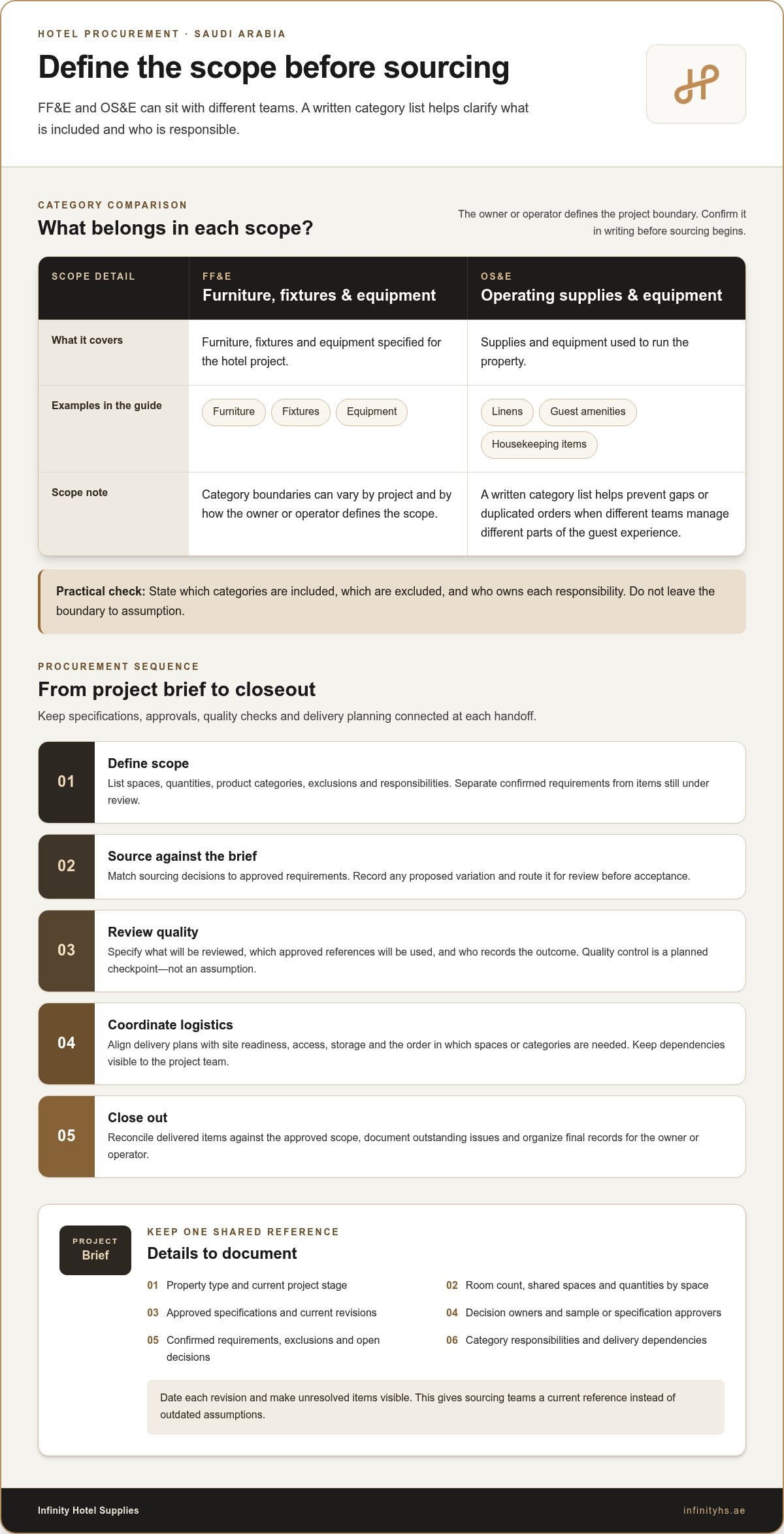
FF&E commonly means furniture, fixtures, and equipment. OS&E means operating supplies and equipment used to run the property, such as linens, guest amenities, and housekeeping items. The boundary can vary by project and by how the owner or operator defines the scope. A written category list helps prevent gaps or duplicated orders, especially when different teams manage different parts of the guest experience.
Why Saudi hotel projects need a clear procurement brief
A hotel project brings together owners, operators, designers, procurement teams, and site teams. Each may review a different part of the specification or timeline. A clear brief gives everyone a shared reference: what is approved, what remains open, who owns each decision, and when a change needs review. This makes handoffs easier to manage without assuming every stakeholder has the same priorities.
Location, property type, and project stage also shape sourcing priorities. A resort, city hotel, and serviced property may have different operational needs. A project at concept stage will have more open choices than one preparing for installation. These differences affect which categories need early definition, what information suppliers need, and how teams sequence approvals and deliveries across Saudi Arabia and the wider region.
As a practical starting point, separate confirmed requirements from open decisions. Record quantities by space, approved specifications, responsible approvers, and the current project stage. Mark unresolved items clearly rather than treating assumptions as final. This keeps sourcing aligned as decisions develop and gives suppliers a precise basis for coordination.
These principles underpin effective hospitality procurement solutions: clear scope, controlled specifications, quality review, and planned sequencing. Since category boundaries can differ, define them in plain language in the brief before sourcing begins.
How Hotel FF&E Procurement Project Management Works in KSA
A well-managed procurement workflow turns project requirements into approved products that are reviewed against the brief and coordinated with the project schedule. Each stage needs a clear owner and documented decisions. For a hotel FF&E supplier in Saudi Arabia, this structure connects sourcing and quality review to the needs of the specific property, whether it is a new development or a renovation.
From project scope to approved specifications
Start with the property type, room count, shared spaces, and current project stage. Bring finish, performance, brand, and operational requirements together in one working brief. Name the decision owners for each category, state who approves samples or specifications, and date each revision. This helps sourcing teams work from the current version instead of outdated assumptions.
Use the brief to guide a sequence of decisions and handoffs:
- Define scope: List spaces, quantities, product categories, exclusions, and responsibilities. Separate confirmed requirements from items still under review.
- Source against the brief: Match sourcing decisions to approved requirements. If a proposed item differs, record the variation and route it for review before accepting it.
- Review quality: Specify what will be reviewed, which approved references will be used, and who records the outcome. Quality control is a planned checkpoint in procurement, not an assumption that products will match the brief.
- Coordinate logistics: Align delivery plans with site readiness, access, storage, and the order in which spaces or categories are needed. Keep dependencies visible to the project team.
- Close out: Reconcile delivered items against the approved scope, document outstanding issues, and organize final records for the owner or operator.
Sourcing, quality control, and logistics coordination
Keep specifications connected to every sourcing decision. A change to a room item can affect quantities, finishes, or coordination with related products. Log the reason for the change, its approver, the date, and the affected categories. A traceable decision history helps prevent one approved change from creating inconsistencies elsewhere and supports communication across design, operations, and site delivery teams.
New developments and renovations have different coordination priorities. A new hotel may need purchasing decisions sequenced as design information and site readiness develop. A renovation may involve existing conditions, phased access, or rooms that remain in operation. In both cases, project stage should shape sourcing priorities and delivery sequence. One schedule should not be assumed to fit every property.
The label global hotel procurement company says little on its own about project control. A more useful test is whether the workflow connects approved specifications, quality review, and logistics to named decision owners. For hotel teams developing an FF&E scope, share your project requirements with Infinity Hotel Supplies.
How to Compare Hotel FF&E Supplier Models for Saudi Projects
Supplier models differ in how much work they cover and who coordinates between categories. A product-only supplier focuses on fulfilling defined orders. A category specialist concentrates on a particular group of products. Turnkey procurement coordination connects sourcing, quality control, and logistics across an agreed project scope. The best fit depends on project complexity, internal capacity, and how many categories need to work together.
| Supplier model | Scope ownership | Sourcing | Quality control | Logistics | Communication |
|---|---|---|---|---|---|
| Product-only supply | Buyer defines the order and coordinates its place in the wider project. | Focused on the specified products. | Centered on the supplied order and agreed requirements. | Buyer aligns delivery with other vendors and site plans. | Primarily between buyer and supplier for that order. |
| Specialist category sourcing | Buyer manages links between the specialist category and other scopes. | Focused sourcing expertise within a defined category. | Review is concentrated on that category’s requirements. | Buyer coordinates timing with other categories and site needs. | Focused on category decisions, approvals, and updates. |
| Turnkey procurement coordination | Supplier coordinates the agreed categories and procurement activities. | Can cover sourcing across the defined project scope. | Quality review is managed as part of the agreed workflow. | Logistics planning is coordinated across included categories. | Project communication follows agreed roles and reporting. |
This table is a decision aid, not a universal definition of supplier contracts. Responsibilities vary by project agreement, so make ownership explicit before comparing proposals. A hotel FF&E supplier in Saudi Arabia may provide products, coordinate selected categories, or support a broader procurement scope. The key is a clear division of responsibilities.
When is a product supplier enough?
Product-only supply can suit a well-defined order with established specifications, stable quantities, and an internal team able to manage approvals and schedules. For example, a buyer sourcing one clearly specified category may prefer a focused vendor. The buyer then aligns that order with other suppliers, tracks approvals, resolves changes, and ensures timing fits the project plan.
A category specialist can also suit a narrow requirement where focused sourcing is useful, while the hotel team retains overall coordination. This model works best when category boundaries are clear and the buyer has capacity to manage handoffs. If several specialist orders depend on the same rooms or delivery sequence, the coordination workload can grow quickly.
When does turnkey procurement support make sense?
Broader coordination can suit projects with multiple categories, decision-makers, or interdependent deliveries. Under an agreed scope, sourcing, quality control, and logistics management can be handled through one coordinated project approach. This gives the project team a shared view of category status and responsibilities, while design and operational approvals remain with their designated owners.
When considering turnkey OS&E packages for Riyadh hotels, keep the project’s FF&E and OS&E boundaries clear. For FF&E requirements that span categories, share your project scope with Infinity Hotel Supplies to discuss a coordinated approach.
How to Prepare a Hotel FF&E Supplier Brief for Saudi Arabia
A clear brief gives a supplier a practical basis for understanding your hotel project, defining the requested scope, and discussing responsibilities. It also helps your internal team see which details are approved and which still need a decision. For a hotel FF&E supplier in Saudi Arabia, include enough context to connect product requirements with the property, project stage, and delivery priorities.
An actionable procurement brief identifies the property, project stage, spaces, quantities, approved requirements, decision owners, and delivery priorities. Use it as a starting point, then attach the references and schedules that explain each item in detail.
Information to include in the project brief
Organize the brief so suppliers and stakeholders can find key information quickly. Include:
- Project context: Property type, location, project stage, and whether the work is a new development or renovation.
- Spaces and scope: Guest rooms, shared areas, and other spaces in scope, with requested product categories and any exclusions.
- Quantities: Room counts and item quantities by space or category. Note where figures are estimates rather than approved totals.
- Specifications: Approved finishes, performance needs, brand requirements, and relevant drawings, schedules, or reference documents.
- Approvals: Decision-makers by category, approval steps, and who can authorize a change to the brief.
- Communication: The preferred channel for updates, the person responsible for consolidating feedback, and how revisions will be recorded.
Separate confirmed requirements from open design or operational decisions. For example, mark an approved room item as fixed and identify an undecided shared-space requirement as pending review. This helps prevent a provisional choice from being treated as final and shows suppliers where a decision is needed before the scope progresses.
How to assess supplier fit against the brief
Use the brief to compare the proposed scope with the work your project needs. Clarify who owns sourcing for each category, how quality control relates to approved references, and how logistics planning connects to site readiness and delivery priorities. Responsibilities should match the categories included and leave no gaps between product orders and overall project coordination.
Include a milestone schedule with the dates or stages that matter to the project, such as specification approval, site readiness, phased room access, or the intended opening sequence. Note which deliveries are critical and which can follow later. For a renovation, distinguish areas that can be accessed from those that remain in use. For a new development, align procurement discussions with the current design and construction stage. These details help suppliers respond to the actual sequence instead of assuming every item has the same priority.
Before sharing the brief, check that quantities use consistent units, attachments carry revision dates, open decisions have owners, and changes have a clear approval path. A well-structured brief supports focused discussions and gives the project team a shared reference as requirements develop.
How Infinity Hotel Supplies Supports Hotel FF&E Projects in Saudi Arabia
Infinity Hotel Supplies is a Dubai-based hospitality supplier founded in 2014, serving hotels across the GCC and Middle East. For hotel FF&E projects in Saudi Arabia, product range is only one part of project fit. Buyers also need to understand how sourcing, quality control, and logistics management support the categories and responsibilities defined in the project scope.
Infinity provides turnkey procurement solutions that bring sourcing, quality control, and logistics management into a coordinated approach. Its offices in the UAE, China, and the United Kingdom support global sourcing and quality-control capabilities for hotel projects in Saudi Arabia and the wider GCC, Middle East, and Africa.
The range of hospitality products can support needs across several categories, while each project may require only selected items or defined support activities. A clear brief helps align product needs with sourcing, quality review, and logistics responsibilities.
A hospitality supply range for project requirements
Hotel projects can involve requirements across guest rooms and operational areas. Infinity’s hospitality product range includes hotel linen, room electronics, amenities, uniforms, and accessories. Buyers can identify relevant hotel room electronics and hotel amenities as part of category planning, then specify quantities, approved requirements, and the spaces those products serve.
Category breadth can make it easier to plan related needs together, but it does not mean every category belongs in one procurement scope. Define what the project needs, who approves each item, and which coordination activities are expected. This keeps the supply discussion practical, whether the brief covers one category or several.
Plan the next step for your Saudi hotel project
Start with the project’s location and stage, the spaces and categories in scope, available specifications, and any important coordination needs. Identify decisions that remain open. These details shape the sourcing and procurement approach, including how product categories and quality-control activities fit within the agreed scope.
With a clear brief, the project team can begin a focused discussion about product requirements and relevant coordination. Include available quantities, references, approvals, and delivery priorities. This gives the conversation a practical foundation and helps keep the proposed approach aligned with the hotel’s needs.
Move Your Hotel Project Forward with a Clear Scope
Turn your project priorities into a shared working brief. Identify what is fixed, where decisions remain open, and which items depend on other approvals or site milestones. That clarity keeps discussions focused and helps align the supplier’s responsibilities with your team’s needs.
When assessing a hotel FF&E supplier in Saudi Arabia, look for an approach that fits the scope you have defined, not simply a broad product list. A well-prepared brief gives both sides a stronger foundation for discussing requirements, coordination, and next steps.
Bring your project stage, location, scope, specifications, and coordination priorities into the conversation. Discuss your hotel FF&E project with Infinity Hotel Supplies to plan a practical approach around your requirements.
Frequently Asked Questions
Is a hotel FF&E supplier the same as a hotel procurement project manager?
No. A supplier provides specified products, while a project manager coordinates activities such as sourcing, quality control, and logistics. One organization may take on both roles when the project scope assigns those responsibilities. Map each activity to an owner and identify who resolves exceptions, such as a proposed substitution. This gives buyers a clearer basis for comparing proposals than the supplier’s title alone.
Can one supplier support FF&E requirements for a hotel project in Saudi Arabia?
Yes. A hotel FF&E supplier with a broad hospitality range can support several categories, but one point of contact does not automatically mean that supplier owns every project interface. A consolidated supply scope may still leave the hotel team responsible for connecting product decisions to room schedules or operator approvals. Define category boundaries and handoffs, then match the supplier model to your team’s capacity.
What information should I prepare before requesting a hotel FF&E proposal?
Share the property location and type, project stage, spaces and categories, quantities, available specifications, approval route, and timeline priorities. Group files by space or category and label figures as final or provisional. Ask proposals to state their inclusions and assumptions against the same brief. This makes it easier to distinguish scope differences from differences caused by incomplete or inconsistent inputs.
How does quality control fit into hotel FF&E procurement?
Quality control should have a defined place between product selection and acceptance. Reviewing a proposed item against an approved reference differs from checking goods when they arrive, since each addresses a different stage. Record discrepancies and their status so the team can see whether an item was accepted, corrected, or remains unresolved. The project scope should identify who decides how to handle an issue and how that decision is documented.
How much does hotel FF&E procurement project management cost in Saudi Arabia?
There is no single fee that fits every project. Cost depends on the agreed scope, product categories, sourcing needs, and coordination responsibilities. To compare proposals fairly, separate product pricing from any project-management fee and review which activities each amount covers, including how changes or added categories are treated. A scope-based discussion can clarify the commercial structure without relying on a generic market range.
What happens if hotel FF&E specifications change during procurement?
Treat a specification change as a new decision affecting the procurement record, not as a verbal note. Identify the rooms and categories affected, then determine whether the change alters the product source, acceptance reference, or planned delivery sequence. Keep the previous approved version for traceability and route the revision to the designated approver before teams act on it. This impact check can reveal dependencies that a simple redline may miss.

Article by
Infinity Editorial Team
With deep expertise in hospitality product FF&E and OS&E across the Middle East and Africa, Infinity Editorial Team brings insights from Infinity Hotel Supplies, helping developers, hoteliers, and homeowners transform spaces from empty shells to fully furnished, design-ready environments.
Disclaimer
The content published by Infinity Editorial Team is intended for informational purposes only. All articles, guides, and insights are based on industry knowledge and experience in hospitality FF&E and OS&E supply across the Middle East and Africa. Infinity Hotel Supplies does not guarantee specific outcomes and recommends consulting a qualified professional for project-specific requirements.


