

What if the biggest sourcing risk isn’t the furnishing itself, but a specification that doesn’t match how it will be used? Sourcing fire-retardant hotel furnishings in UAE projects means accounting for different requirements for curtains, upholstered seating and other items. Unclear terminology can also make supplier claims harder to compare.
A fire-performance claim doesn’t automatically apply to every furnishing type. Supporting evidence needs to match the product, its intended use and the project’s requirements, including any authority review. This guide explains how to prepare a clear sourcing brief, compare product documents consistently and reduce avoidable delays during approval and delivery.
You’ll learn what to specify, how to distinguish relevant test evidence from broad claims, and how to coordinate furnishings with the wider hotel procurement plan. Infinity Hotel Supplies supports hospitality projects through sourcing, quality control and logistics coordination, connecting product categories with project requirements without overstating a furnishing’s performance.
Key Takeaways
- Define each furnishing’s intended location and use before setting its fire-performance requirements.
- When sourcing fire-retardant hotel furnishings in UAE projects, match the evidence to the exact product construction and intended application.
- Compare supplier submissions by product identity, materials, test method, report scope and issue date, and record any limitations.
- Build a furnishing schedule that records category, quantity, location, finish and required supporting documents.
- Coordinate sourcing, quality control and logistics as part of the wider hotel project plan.
What Fire-Retardant Hotel Furnishings Mean for UAE Projects
Fire-retardant describes how a material or product performs under specified test conditions. It doesn’t mean the item is fireproof or incapable of burning. For hotel projects, the term can relate to upholstered furniture, curtains, decorative materials and selected soft furnishings. Each category has a different construction and use.
Requirements depend on the project scope, where an item will be installed, how guests or staff will use it, and the applicable authority direction. A furnishing claim is meaningful only when its supporting evidence covers the relevant product and intended application. When sourcing fire-retardant hotel furnishings in UAE projects, assess documents against the actual specification rather than treating a general claim as proof for every item.
Which hotel furnishing categories may need review?
Keep furnishing categories separate in the project schedule. A curtain in a public area, an upholstered guest-room chair, a decorative wall finish and bedding have distinct materials and uses. A test conducted on one textile or construction doesn’t automatically demonstrate the performance of another product.
For each item, record its location, function, material or construction details, and the project specification it must meet. This mapping keeps product evidence relevant during review and reduces confusion when similar fabrics or finishes appear across different furnishings.
Fire-retardant, flame-resistant and fireproof: what is the difference?
These terms aren’t interchangeable guarantees of fire safety. “Fire-retardant” and “flame-resistant” describe performance claims that depend on defined materials, test methods and conditions. A result applies to the scope assessed. Don’t extend it to a different product assembly or assume it covers every use. For background on fabric treatments and performance, see Understanding Fire-Retardant Fabrics.
A test result supports a specific performance claim under defined conditions; it does not make a furnishing universally fireproof.
A finished furnishing may combine several components, such as cover fabric, filling and backing. A document relating only to one component may not describe the complete item. Compare the report’s stated scope with the product construction and intended location, then align the evidence with the project specification and applicable authority direction.
How to Evaluate Fire-Performance Evidence for UAE Hotel Furnishings
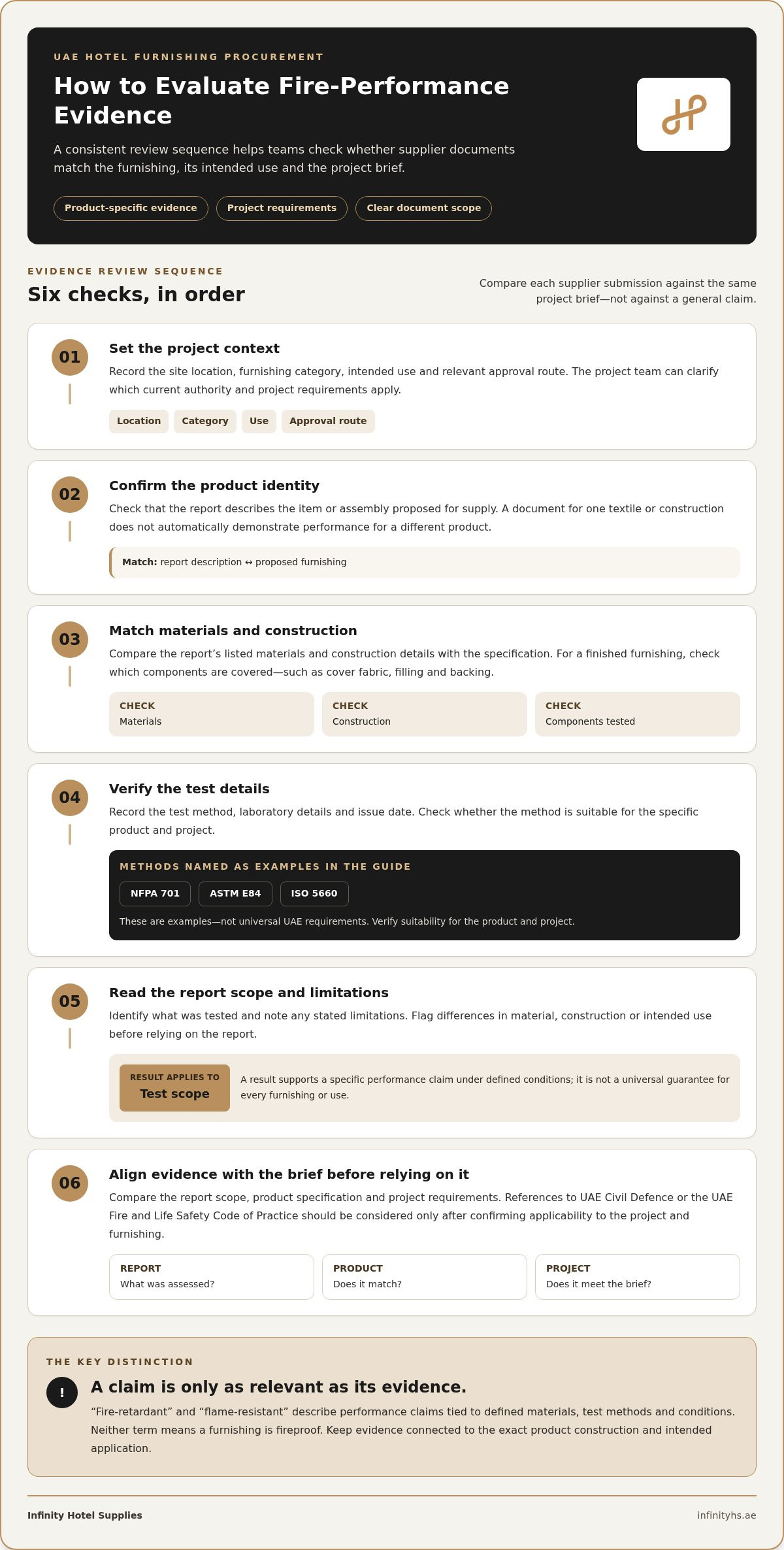
A product claim is useful only if its supporting report relates to the item being specified. For sourcing fire-retardant hotel furnishings in UAE projects, review the evidence in a consistent order: identify the product, confirm its material composition, note the test method, read the report scope and limitations, and check the issue date. Then compare those details with the proposed furnishing and project brief.
What should a furnishing test report identify?
Start with the report’s description of the tested material or assembly. Check whether it identifies relevant construction details, including the components covered by the test, and whether these match the proposed hotel product. A report for fabric alone may not describe a finished furnishing made with different backing, filling or other components.
Next, record the test method, laboratory details, issue date and any stated limitations. Treat references such as NFPA 701, ASTM E84 or ISO 5660 as examples of methods whose suitability must be verified for the specific product and project, not as universal UAE requirements. Flag differences in material, construction or intended use for review before relying on the report.
How should UAE project requirements shape the evidence review?
Set the project context before judging a document. Include the site location, furnishing category, intended use and relevant approval route in the procurement brief. The appointed project team can then clarify which current authority and project requirements apply, and whether a cited test method or report addresses them.
Consider references to UAE Civil Defence or the UAE Fire and Life Safety Code of Practice only after confirming their applicability to the project and furnishing in question. Don’t treat a standard name on a document as proof that the item meets every project requirement. The report scope, product specification and approval process need to align.
For a practical review, organize each submission under these checks:
- Product identity: Does the report describe the item or assembly proposed for supply?
- Composition: Do the listed materials and construction match the specification?
- Test details: Is the method identified, and is its application appropriate?
- Report scope: What was tested, and what limitations are stated?
- Document date: Is the issue date clear and suitable for the project review?
This sequence helps procurement and project teams compare submissions on a like-for-like basis. Infinity Hotel Supplies coordinates sourcing, quality control and logistics within broader hotel projects, keeping product documentation connected to the relevant furnishing scope and procurement plan.
Compare Furnishing Materials and Supplier Submissions Without Guesswork
Compare every submission against the same project brief. A curtain fabric and an upholstered chair cover may both be textiles, but they serve different functions. Don’t treat them as equivalent because they share a fibre name or general fire-performance claim. When sourcing fire-retardant hotel furnishings in UAE projects, assess each proposed product configuration alongside its intended location, evidence and operational needs.
How do furnishing type and intended use affect comparison?
Keep curtains, upholstery, decorative materials and soft furnishings in separate comparison rows. Note whether each item is intended for a guestroom, corridor or public area when the project scope identifies that location. Record cleaning requirements, likely replacement needs and visual-brand criteria alongside performance evidence. The material examples below are illustrative only; no fibre, finish or construction is inherently compliant.
| Product category | Intended location | Material or construction | Evidence to compare | Limitations to record | Maintenance considerations |
|---|---|---|---|---|---|
| Curtains | As specified, such as a guestroom or public area | Proposed fabric and lining | Documentation for the supplied curtain materials and construction | Whether evidence covers the complete proposed configuration | Cleaning method and replacement needs |
| Upholstered furniture | As specified, such as a guestroom or corridor | Cover, filling, backing and assembly details | Evidence matching the tested assembly to the proposed item | Components or uses excluded from the report | Cleaning, wear and re-covering considerations |
| Decorative materials | Specified wall or other application | Proposed finish and substrate | Evidence relevant to the material and its intended application | Installation assumptions and report scope | Surface care and repair approach |
| Bedding and other soft furnishings | As defined in the project schedule | Specified textile and product construction | Product-specific documents relevant to the intended use | Differences between tested sample and supplied item | Laundering or cleaning requirements and replacement cycles |
Which supplier-submission details reveal meaningful differences?
Place submissions side by side and compare product identification, stated composition, construction, test evidence, exclusions and installation assumptions. Record evidence limitations plainly. A limitation is not, by itself, proof of failure or approval. For hotel linen and related soft furnishings, also consider how material choices, care requirements and replacement planning fit the property’s operational needs.
Fire-performance documentation must match the exact proposed product configuration, not simply a similar material. If a supplier proposes a substitute, compare its documentation as a separate submission against the original specification. This makes differences visible and helps the project team make like-for-like decisions without overstating what a report demonstrates.
A Practical UAE Sourcing Workflow for Fire-Retardant Furnishings
A structured workflow connects the project brief to product evidence, approved samples and delivery planning. When sourcing fire-retardant hotel furnishings in UAE projects, this sequence helps teams identify open decisions early and keep purchasing records aligned as specifications develop. It can also connect furnishing decisions with broader hospitality purchasing plans across the UAE, GCC, Middle East and Africa.
How should buyers prepare a sourcing brief?
Start with the property type, project stage, furnishing schedule and intended application for each item. State the evidence format and project review process required by the team, without assuming a universal document standard. Separate confirmed specifications from open design decisions and authority-related questions so unresolved items remain visible rather than becoming implied requirements.
Then set out a clear sequence:
- Define the scope: List furnishing categories and identify what sits inside or outside the purchasing package.
- Map requirements: Record location, use and applicable project direction for each category.
- Prepare specifications: Describe quantity, dimensions, finish, construction and supporting documents required for review.
- Review evidence and samples: Compare documents with the proposed product and assess samples against the approved specification.
- Coordinate procurement: Align purchasing, quality-control checkpoints and logistics with the project programme.
Use one schedule as the working reference. Include each furnishing category, quantity, location, finish and required supporting documents. Add fields for sample status, document review, approval notes and delivery coordination. This gives project, procurement and operations teams a shared record without treating an unresolved decision as approval.
How can a team reduce procurement and coordination friction?
Keep the product schedule, approved samples and evidence records linked by a consistent item reference. If a proposed product or construction changes, update the relevant records and review the evidence against the revised specification. This makes substitutions traceable and helps prevent a sample, document and purchase order from describing different configurations.
Plan quality-control and logistics milestones around the overall project programme. Where furnishing scope overlaps operational supplies and equipment, include those requirements in the same coordination plan so purchasing and delivery schedules remain aligned.
Infinity Hotel Supplies brings sourcing, quality control and logistics coordination into broader hotel project solutions. A well-organized brief helps connect these activities to the furnishing schedule and project requirements.
Prepare your furnishing scope and project requirements to begin a focused discussion about sourcing and coordination.
How Infinity Hotel Supplies Supports Hotel Furnishing Procurement in the UAE
Hotel furnishing projects bring together product specifications, documentation, samples and delivery coordination. Infinity Hotel Supplies is a Dubai-based hospitality supplier founded in 2014. The company supports hotel projects through sourcing, quality control and logistics as part of broader project solutions.
For sourcing fire-retardant hotel furnishings in UAE projects, this means connecting the furnishing schedule with project requirements and supporting product information. Relevant categories may include hotel linen and broader FF&E or OS&E requirements, depending on the project scope. Product performance claims still need to be assessed against documentation for the exact proposed item and its intended application.
What does coordinated hotel sourcing bring to a UAE project?
A shared project schedule can align furnishing categories, product references, evidence records and logistics milestones. This gives project teams a common view of what is being sourced, which documents relate to each item, and how the work fits into the wider programme. Quality-control coordination can support consistency across a property order by keeping product details and review records connected as the project progresses.
The value lies in coordination, not in treating different furnishings as interchangeable. A document or sample should remain linked to the specific product configuration it represents. If a product detail changes, keeping the relevant schedule and records aligned helps teams review that change in context.
What should hotel teams prepare before discussing a project?
A concise project brief helps make the discussion practical. Include the project location, furnishing categories, quantities and target programme. Bring the applicable specifications, project or authority direction, and any existing product documentation. If design or approval decisions remain open, identify them separately so the team can distinguish agreed requirements from items still under review.
- Project context: Property location, project stage and target programme.
- Furnishing scope: Categories, quantities, intended locations and finishes.
- Project requirements: Applicable specifications and relevant review direction.
- Existing records: Available product details, samples and supporting documents.
Discuss your hotel sourcing requirements and project coordination with Infinity Hotel Supplies.
Build a Clearer Furnishing Sourcing Plan
Successful sourcing fire-retardant hotel furnishings in UAE projects starts with clear specifications and evidence that matches each product’s intended use. Keep furnishing categories distinct and compare supplier documents against the exact proposed construction. A schedule that connects product details, documentation, samples and delivery milestones helps teams coordinate decisions and reduce avoidable friction.
Infinity Hotel Supplies is a Dubai-based hospitality supplier with offices in the UAE, China and the United Kingdom. Its sourcing, quality-control and logistics support forms part of broader hotel procurement projects, connecting furnishing requirements with project coordination without making unsupported fire-performance claims.
Bring your project location, furnishing scope, quantities, target programme and available documentation to the discussion. A well-prepared brief gives the team a practical foundation for aligning product requirements and next steps.
Discuss your hotel furnishing sourcing requirements with Infinity Hotel Supplies.
With clear information and coordinated planning, your team can move forward with greater confidence and a more orderly sourcing process.
Frequently Asked Questions
What does fire-retardant mean for hotel furnishings?
Fire-retardant describes how a material or product performs under specified test conditions; it doesn’t mean the furnishing is fireproof. The claim applies only to the material or assembly and conditions covered by its supporting evidence. For example, documentation for a fabric alone may not describe a finished upholstered item with different components. Match each report to the proposed product, its construction and intended use.
Are fire-retardant furnishings required in every UAE hotel?
Requirements depend on the project, furnishing type, intended location and applicable authority direction. A single answer for every UAE hotel could be misleading. Project teams should identify the relevant review route and confirm current requirements for the specific property and items in scope. This is especially important for projects across the GCC and wider Middle East, where one project’s specifications shouldn’t automatically be assumed to apply to another.
Can one fire test certificate cover different hotel furnishing products?
Not automatically. A report for curtains, a fabric sample or one upholstered assembly shouldn’t be assumed to cover other product categories or constructions. Check what the report identifies, which components were tested, the method used, its stated limitations and whether the proposed product matches the tested sample. If the material, backing, filling or assembly differs, treat that as a separate point for project review.
What documents should I request when sourcing fire-retardant hotel furnishings?
Request product-specific documentation that identifies the item or tested assembly, its material composition and construction, the test method, laboratory details, report date and stated limitations. Provide the project specification and intended application so the evidence can be reviewed in context. When sourcing fire-retardant hotel furnishings in UAE projects, keep each document linked to the relevant furnishing schedule entry rather than filing reports without a clear product reference.
How do I compare fire-retardant furnishing suppliers in the UAE?
Compare submissions against the same project brief. Review product identification, composition, construction, test evidence, exclusions, sample details and logistics coordination side by side. Keep curtains, upholstery and other furnishing categories separate because their uses and documentation may differ. Infinity Hotel Supplies supports hotel project sourcing through quality-control and logistics coordination, connecting product information with the broader project schedule without making unverified fire-rating claims.
How much do fire-retardant hotel furnishings cost in the UAE?
There isn’t one reliable price for all fire-retardant hotel furnishings. The project scope, product category, material, construction, quantities, finish and supporting documentation can all affect the specification and sourcing decision. To develop a project-specific estimate, prepare a schedule showing the items, locations, quantities and required evidence. Avoid comparing prices for products with different constructions or documentation as if they were equivalent.
Can hotel furnishings be both fire-retardant and suitable for the design brief?
Yes, design and documented performance can be considered together during specification and sourcing. Set out the required appearance, finish, intended location and product use, then assess proposed options against the project’s applicable requirements and supporting evidence. Review samples alongside their documentation, and make sure any change to a material or construction remains visible to the project team. This helps balance visual consistency with evidence relevant to the supplied item.

Article by
Infinity Editorial Team
With deep expertise in hospitality product FF&E and OS&E across the Middle East and Africa, Infinity Editorial Team brings insights from Infinity Hotel Supplies, helping developers, hoteliers, and homeowners transform spaces from empty shells to fully furnished, design-ready environments.
Disclaimer
The content published by Infinity Editorial Team is intended for informational purposes only. All articles, guides, and insights are based on industry knowledge and experience in hospitality FF&E and OS&E supply across the Middle East and Africa. Infinity Hotel Supplies does not guarantee specific outcomes and recommends consulting a qualified professional for project-specific requirements.


