

What if African décor feels authentic not because of its pattern, but because its maker, origin, and cultural context are understood? A striking object can still feel generic or disconnected when it’s chosen for appearance alone. And even a luxury hotel linen wholesale supplier can address only one part of a guest-room brief: décor also needs to reflect the property and perform reliably in daily operations.
Hotel teams already know that a cohesive guest experience depends on more than beautiful individual pieces. The challenge is bringing local character into the design with care, while keeping quality, consistency, and project logistics in view.
This guide offers a practical framework for assessing African décor options, understanding provenance and cultural context, and judging how each choice fits your hotel’s design and operational requirements. It also explores how to plan for maker communication, product quality, and delivery coordination, so your decisions support a distinctive, guest-ready environment from concept through installation.
Key Takeaways
- Assess each piece in a clear sequence, from maker and origin to material, finish, intended use, and supporting documentation.
- Record the source and an approved description for culturally specific décor to keep its context clear across design and guest-facing materials.
- Compare direct, curated, and project-coordinated sourcing by how each supports provenance visibility, quality control, communication, and delivery.
- Build a procurement brief that aligns the design concept, item schedule, quality criteria, sample approvals, and stakeholder sign-off.
- Coordinate décor within the wider hotel supply plan, alongside requirements for a luxury hotel linen wholesale supplier and other FF&E or OS&E needs.
Why Authentic African Décor Matters in Luxury Hotels
African décor can give a hotel a stronger sense of place, but visual impact alone doesn’t make a piece authentic. A credible design choice reflects what is known about its origin, maker, materials, and cultural context. Authentic hotel décor is selected with verifiable context and respect for its makers, then integrated thoughtfully into the property’s design. No single style represents an entire continent.
That distinction matters in luxury hospitality. A broadly labelled “African theme” can flatten diverse histories and creative traditions into a set of repeated motifs. Purposeful curation instead asks why an object belongs in this property, what can be accurately said about it, and how it contributes to the guest experience. A luxury hotel linen wholesale supplier may support the room’s tactile design, but textiles and decorative objects each need a clear role in the overall concept.
For a related perspective on the range of forms and histories, explore this overview of African art.
A short video on wholesale hotel linen buying offers useful context on how textiles contribute to hospitality environments:
What does authenticity mean in a hotel design brief?
Separate documented information from appearance and promotional wording. A pattern may look familiar to a design team, but resemblance doesn’t establish where it was made or what it means. Record the maker or source, the material, the regional origin when known, and the context that supports any cultural description. Use precise, modest language: describe what the documentation supports, and avoid assigning a broad cultural identity to an item without evidence.
Clear descriptions help designers, procurement teams, and guest-facing staff communicate consistently. They also make it easier to distinguish a considered selection from a decorative theme built on unsupported labels. If context is limited, describe the object through verified attributes such as its material, form, or place of production rather than inventing a cultural story.
Where can African décor contribute to the guest experience?
Give each space a distinct design purpose. An arrival area may call for a considered focal piece; guest rooms benefit from details that feel integrated rather than staged; dining areas can use objects that support the atmosphere without competing with service; and shared spaces can offer moments of discovery. The right choice depends on the property’s location, intended audience, and interior concept, not on a checklist of regional motifs.
Review proposed pieces alongside lighting, finishes, furniture, and textiles so the environment reads as coherent. Coordinate room textiles with the décor’s material palette, while keeping each choice suited to its own role. Above all, treat objects as one part of a guest experience, not a substitute for meaningful local engagement or a claim to represent a whole culture.
How to Assess Provenance, Cultural Context, and Quality
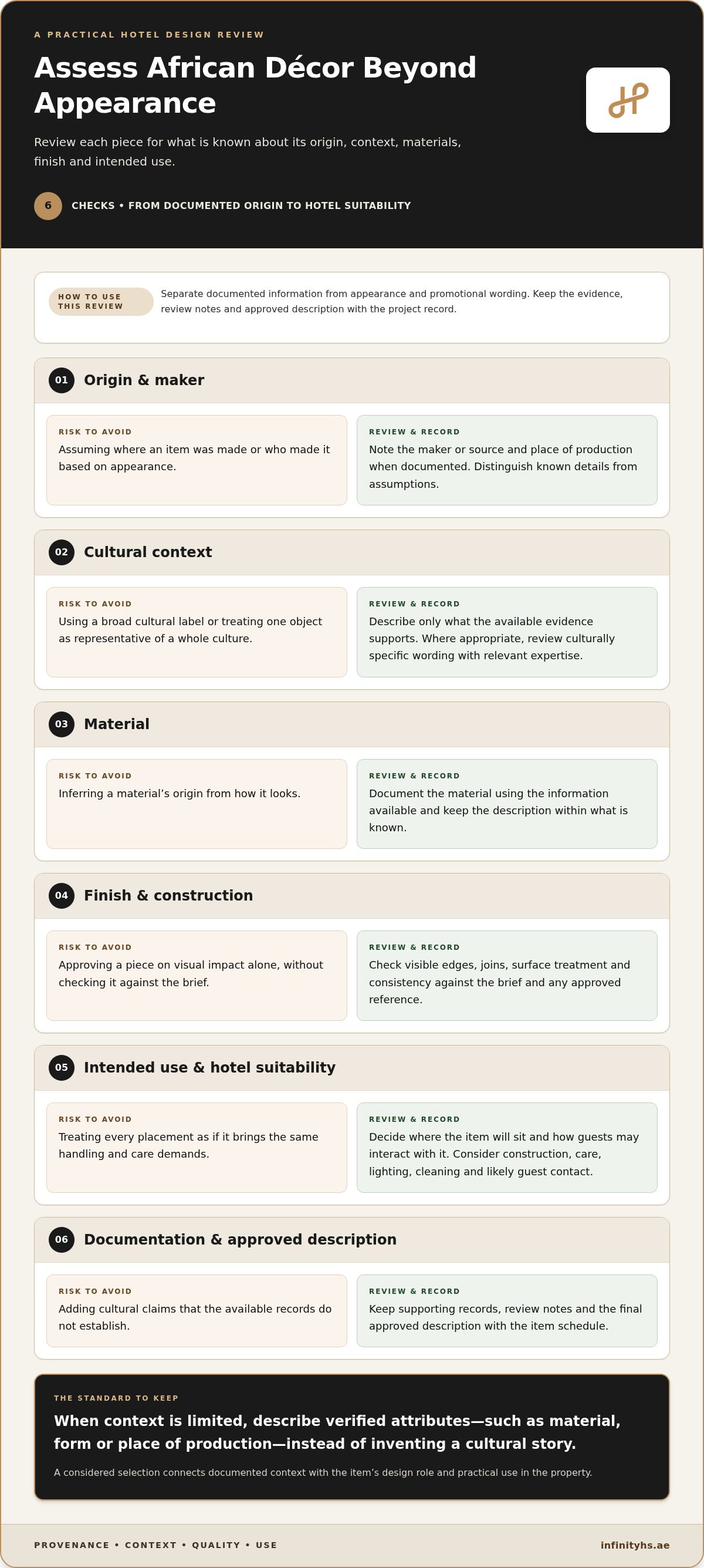
Assess a décor item as both a cultural reference and a hospitality product. A polished finish or compelling story doesn’t establish where an object came from, who made it, or whether it suits a hotel environment. Use a consistent review before approving an item, and keep evidence, design decisions, and guest-facing descriptions together in the project record.
Verifiable provenance is supported by traceable maker, origin, or product records; an unsubstantiated authenticity claim relies on broad labels or visual resemblance without evidence.
- Origin and maker: Record the maker or source and the place of production when documented. Distinguish a known workshop or region from an assumption based on appearance.
- Cultural context: Note what the available evidence supports about an item’s context. The characteristics of African art are varied, so avoid treating a single object or description as representative of a whole culture.
- Material: Document the material using the information available, and avoid inferring its origin from its appearance.
- Finish: Review visible details such as edges, joins, surface treatment, and consistency against the brief and any approved reference.
- Intended use: Decide where the item will sit, how guests may interact with it, and what level of handling that placement involves.
- Documentation: Keep the supporting records, review notes, and final approved description with the item schedule.
What evidence supports a credible provenance claim?
Useful records can include maker or workshop information, origin details, and product documentation, when available. Compare those records with the proposed description. If a source establishes the material and place of production but says nothing about a cultural tradition, keep the description to the facts rather than adding an interpretation.
For culturally specific references, review wording with relevant cultural or design expertise where appropriate. Record any agreed description alongside its supporting evidence so the design team and guest-facing staff can use consistent language.
How should hotels evaluate quality and suitability?
Quality depends on placement and use, not on a luxury label alone. Consider construction, finish, care needs, lighting, cleaning, and likely guest contact. A piece displayed out of reach may face different demands from an object guests regularly touch. Define acceptance criteria in the project brief, then assess samples or references against those criteria before approval.
- Specify the intended location and the conditions the item will encounter.
- Record the expected finish and the details reviewers should inspect.
- Describe care requirements and how they fit the hotel’s operating routine.
- Consider how the item’s materials and finish relate to nearby room textiles while keeping its own use and care requirements clear.
This documented review makes quality decisions easier to communicate across design and hotel operations. Include the agreed criteria in the project brief before moving into sourcing discussions.
Comparing African Décor Sourcing Approaches for Hotel Projects
There’s no single sourcing route that fits every hotel project. The right approach depends on the brief: whether it prioritizes a specific maker or origin, a cohesive selection across several spaces, or coordination with wider project requirements. Compare each route against the same criteria, then define responsibilities for approvals, quality review, communication, and delivery planning.
The options below describe general approaches, not guaranteed outcomes. Provenance visibility and production arrangements depend on the specific makers, sources, and project scope.
| Sourcing approach | Suitable project conditions | Potential advantages | Planning considerations |
|---|---|---|---|
| Direct maker sourcing | The brief calls for a particular maker, workshop, or documented origin. | Direct communication may give the design team clearer access to maker information and item-specific context. | Coordinate specifications, approvals, quantities, payment arrangements, and delivery planning. Don’t assume a maker has capacity for every order size or handles export arrangements. |
| Curated sourcing | The project needs a considered selection of pieces that work together across defined spaces. | A defined concept can help align materials, forms, and descriptions while keeping the selection coherent. | Set provenance and quality criteria for each item. A curated presentation alone doesn’t establish origin or cultural context. |
| Project-coordinated sourcing | Décor choices must be planned alongside multiple hotel requirements or project stages. | Coordinated review can connect item approvals, quality-control steps, and logistics planning across the project. | Clarify decision owners, documentation, approval points, and how sourcing details fit the wider project schedule. |
When does direct maker sourcing suit a hotel?
Direct sourcing can suit a brief built around a particular maker or a documented place of origin. It can support a closer exchange about an item’s materials and production, where that information is available. The hotel team still needs to coordinate specifications, sample or reference approvals, quantities, and delivery. Confirm responsibilities in the project plan rather than assuming production capacity or shipping arrangements.
When can curated or coordinated sourcing help?
Curated sourcing can help a team compare several pieces against one design concept; project coordination becomes useful when those choices connect to broader hotel requirements. A shared brief gives reviewers consistent criteria for origin records, visual references, finish, and approval. For wider purchasing needs, a hotel procurement strategy should also clarify how décor decisions align with other project requirements and who owns each approval.
For example, a hotel may coordinate décor approvals with room finishes and the specifications managed by a luxury hotel linen wholesale supplier. That doesn’t make linen and décor interchangeable. It helps the team see how separate choices contribute to a consistent guest environment and where each item sits in the project plan.
Choose by scope, not by label. A focused commission may call for direct maker engagement, while a multi-space project may need stronger coordination across selection, review, and logistics. The practical route is the one that makes evidence, responsibilities, and delivery requirements clear for the specific project.
Build a Practical African Décor Procurement Brief
A clear brief turns a design direction into decisions that designers, hotel teams, and suppliers can review consistently. It should explain what the property wants guests to experience, where each item will be used, what evidence supports its description, and how the team will approve quality and delivery. Keep the brief specific enough to guide selection, while allowing documented maker and material details to inform the final choice.
What information should the project brief contain?
Start with the property concept, guest profile, intended spaces, and design references. Then create an item schedule that identifies each proposed piece, its location, required quantity, and role in the room or shared area. For each culturally specific item, state what provenance records and approved description the team expects, distinguishing required facts from design preferences.
- Design intent: Record the concept, guest experience, reference images, and relevant finishes or materials.
- Item and location: List the item category, proposed space, quantity, placement, and intended function.
- Provenance and description: Specify the supporting maker, origin, or product information required, and document approved wording.
- Quality and care: Define finish expectations, intended use, maintenance needs, and acceptance criteria.
- Project control: Name decision-makers, approval milestones, delivery responsibilities, and how changes will be recorded.
These details help teams assess proposals against agreed requirements rather than relying on informal assumptions.
How can teams review samples and approve selections?
Use a consistent review sequence. Compare each sample or visual reference with the written brief, assess its finish and suitability for the intended placement, and consider whether its care needs fit the hotel’s operating routine. Record decisions promptly. If an item changes, update the schedule and circulate the revised description and reference so stakeholders work from the same approved version.
- Review the sample, image, or product reference against the brief.
- Record comments on material, dimensions, finish, placement, and care.
- Approve, revise, or decline the selection, noting the decision-maker and date.
- Share the approved reference and description with relevant project stakeholders.
Coordinate décor with room textiles by considering how colour, texture, and placement work together, while keeping each item’s use and care requirements distinct. Include textile selections as a related design input in the room plan, without turning the décor brief into a linen specification. This keeps the focus on how each element contributes to the overall presentation.
A current item schedule and recorded approvals give the project team a practical reference as selections move forward.
Coordinate Hotel Décor Sourcing with Infinity Hotel Supplies
A completed décor brief can connect design intent with the practical demands of a wider hotel project. Infinity Hotel Supplies brings global sourcing, quality-control capabilities, logistics support, and turnkey FF&E and OS&E solutions to hotel projects. These capabilities provide a framework for coordinating requirements across a project without treating décor selection as a separate design service.
Keep the project record current as decisions move forward. Include the approved concept, item schedule, review responsibilities, and delivery considerations so teams can work from aligned requirements. This is especially useful when décor decisions sit alongside room textiles and other guest-facing elements. A luxury hotel linen wholesale supplier supports a distinct part of the room plan, so clarify how its requirements relate to the décor schedule without merging their specifications.
How can project coordination support a consistent result?
A shared brief gives design, operations, and project teams a common reference for product review and planning. Record which requirements apply to each item, who owns each approval, and how revisions should be circulated. Quality control and logistics can then be considered in relation to the project’s defined scope and sequence.
Documented requirements help teams make more consistent project decisions. They also make it easier to track approved selections as related hotel supply needs progress through the project.
What should hotels prepare before discussing a project?
Gather the information that will help clarify the property’s priorities and coordination needs. A concise, organized project package gives the discussion a useful starting point:
- Property concept: Summarize the design direction, guest experience, and relevant property details.
- Spaces and item schedule: Identify intended locations, proposed décor categories, and quantities where known.
- Documentation and quality: Note available provenance records, approved descriptions, finish expectations, and care requirements.
- Project coordination: List decision-makers, approval steps, schedule constraints, and delivery considerations.
With these details prepared, hotels can discuss how global sourcing, quality control, logistics support, and broader hotel supply requirements relate to their project scope. Infinity Hotel Supplies welcomes a conversation about your hotel project and its coordination needs.
Shape a Guest Experience with Purpose
Turn your design intent into a brief that gives each selected piece a clear role in the guest experience. A considered approach can bring local character into the property while keeping the design coherent and respectful.
As you refine the plan, consider how décor relates to the wider room concept, including requirements for a luxury hotel linen wholesale supplier. Keep those specifications distinct, but align them with the same guest-facing vision.
For hotel project discussions, bring your concept, item schedule, documentation needs, quality criteria, and timing considerations together so the next steps can reflect your property’s priorities.
Move forward with a clear brief and confidence in the decisions shaping your hotel’s guest experience.
Frequently Asked Questions
How can a hotel verify that African décor is authentic?
Verify authenticity by matching the maker, stated origin, and cultural description to records tied to the specific item. A product sheet, invoice, or maker profile can help support those claims, but repeating a description doesn’t prove it. If a piece is said to represent a particular community, don’t use that wording in guest materials until evidence supports it. Record any gaps plainly instead of filling them with assumptions.
What should a hotel include in an African décor sourcing brief?
Include the property concept, guest profile, spaces, item schedule, and quantities or dimensions where known. Specify what provenance information is required, what quality and care criteria matter for each placement, and who approves descriptions and samples. Add delivery planning needs and identify how the team will record changes. For example, note whether a reception piece must be reviewed by design and operations before the item schedule is finalized.
Is locally made décor always the most authentic choice for a hotel?
No. A place of production alone doesn’t establish an item’s cultural meaning, maker identity, or suitability for a hotel. Review the available context and records, then describe only what they support. A locally made object may be a strong choice when it connects credibly to the project, but location shouldn’t stand in for evidence. Conversely, an item made elsewhere may still have a documented history and meaningful context.
How can luxury hotels use African décor without cultural stereotyping?
Use specific, evidence-based descriptions and avoid presenting one object, pattern, or material as representative of Africa as a whole. Consider why a piece belongs in a particular hotel space and whether its explanation respects the documented context. Before publishing a label or guest-room note, have relevant cultural or design expertise review the wording where appropriate. Avoid broad theme language that suggests a single design vocabulary represents many distinct communities.
Can African décor work across different hotel design styles?
Yes. Select pieces for how their form, material, finish, and scale relate to the property’s existing concept, rather than applying a fixed theme. A restrained selection can sit within a contemporary interior, while a more layered scheme may suit another setting if the overall brief supports it. Coordinate choices with room textiles and the requirements shared with a luxury hotel linen wholesale supplier, without making décor and linen serve the same purpose.
How should hotels compare décor sourcing approaches?
Compare each route against the project’s actual needs: how clearly it reveals provenance, coordinates with the design, supports quality review, enables communication, and organizes logistics. Direct maker sourcing may fit a brief centered on a particular creator; a curated route may help align items across spaces. For a wider hotel project, coordinated sourcing can connect décor decisions with other requirements. Compare responsibilities and documentation, not just the sourcing label.
What should hotels check before approving décor samples?
Compare each sample with the approved brief and reference, then assess its finish, intended placement, expected guest contact, and care needs. Confirm that its product description and available provenance information match the project record. If a physical sample differs from its image, note the difference and request a documented decision rather than relying on memory. Record the final approval, including the reviewer and selected reference, so teams use the same version.

Article by
Infinity Editorial Team
With deep expertise in hospitality product FF&E and OS&E across the Middle East and Africa, Infinity Editorial Team brings insights from Infinity Hotel Supplies, helping developers, hoteliers, and homeowners transform spaces from empty shells to fully furnished, design-ready environments.
Disclaimer
The content published by Infinity Editorial Team is intended for informational purposes only. All articles, guides, and insights are based on industry knowledge and experience in hospitality FF&E and OS&E supply across the Middle East and Africa. Infinity Hotel Supplies does not guarantee specific outcomes and recommends consulting a qualified professional for project-specific requirements.


