

What if the trolley that speeds up one room turn slows down another? Sourcing ergonomic housekeeping equipment is not simply a matter of choosing a cart or tool that looks efficient. The right fit depends on who uses it, what tasks they perform, and how equipment moves through the property.
Housekeeping teams work across different room layouts, storage areas, and daily routines. Equipment that does not suit staff heights or movement patterns can make routine tasks harder. Procurement teams also need choices that work across departments or properties, rather than for one isolated task.
This guide offers a practical framework for evaluating equipment against real housekeeping work. You will learn how to assess usability, movement, storage, and upkeep, then bring those factors together in a consistent sourcing process. It also explains how housekeeping trolleys fit into a broader hotel operations plan, helping teams make considered decisions for properties in the GCC, Middle East, and Africa.
Key Takeaways
- Start sourcing ergonomic housekeeping equipment by mapping real tasks, staff movement, and property layouts rather than choosing by appearance alone.
- Gather input from executive housekeepers, room attendants, and procurement teams to build requirements around daily work.
- Compare housekeeping trolleys and other equipment by task suitability, handling, layout fit, storage, and upkeep.
- Use a coordinated sourcing sequence to align housekeeping, procurement, operations, and project stakeholders before rollout.
- Connect property-specific requirements with housekeeping trolley and broader OS&E solutions for a consistent approach across hotel teams.
Why ergonomic housekeeping equipment matters to hotel operations
Ergonomic housekeeping equipment is selected and arranged around the demands of a task, the movements it requires, and how a person interacts with it. The aim is to fit the work to the user, rather than expect every user to adapt to the equipment. This reflects the core idea of ergonomics: considering how people interact with tools and their working environment.
For hotel teams, that means looking beyond appearance or purchase price. Assess how staff access supplies, reach work areas, handle linen, and move equipment along service routes. These details matter when sourcing ergonomic housekeeping equipment because a setup suited to one task or floor plan may not suit another.
For a practical view of the equipment used in hotel housekeeping, watch this overview:
Which housekeeping tasks create the clearest equipment needs?
Start with the work sequence, not a catalogue. Room attendants collect supplies, replenish guest items, handle linen, clean surfaces, and move between rooms. Each action has different demands: reaching for supplies, bending to access lower storage, pushing a loaded trolley, turning through a doorway, or repeatedly picking up and setting down items.
Separate tasks by operating area. Routine room servicing follows a room-to-room sequence, while public-area cleaning may involve longer routes and different spaces. Back-of-house work can include collecting or distributing supplies between storage and service areas. Map where staff change direction, pass through narrow areas, or pause to restock so the equipment brief reflects the full routine.
- Room servicing: Consider access to frequently used supplies and the sequence of replenishment, cleaning, and linen handling.
- Public areas: Map routes, transitions between spaces, and how equipment can move without disrupting guest-facing operations.
- Back-of-house: Review how supplies are collected, stored, and transferred between work areas.
How does equipment fit affect daily hotel work?
Fit affects how smoothly staff can reach items, organise supplies, manoeuvre equipment, and move through the property. A trolley that suits room servicing, for example, may be awkward in a corridor with tight turns or a compact service area. A setup that keeps routine supplies accessible can also reduce unnecessary searching and rearranging.
Assess equipment in the property’s actual context: room layouts, corridors, lifts, storage points, and service routines. Ask staff to identify where they reach, bend, push, or repeatedly handle supplies. Use those observations to define practical requirements for housekeeping trolley options. Ergonomic suitability can guide a better-informed choice, but it cannot guarantee injury prevention or faster room turns. Its value lies in matching equipment decisions to real tasks and site conditions.
How to assess ergonomic housekeeping equipment before sourcing
A structured assessment turns day-to-day observations into clear purchasing criteria. When sourcing ergonomic housekeeping equipment for hotels across the GCC, Middle East, and Africa, account for differences in room layouts, service routes, storage arrangements, and operating routines. Standardising equipment can support consistency, but each choice still needs to work in the property’s actual environment.
Start with staff tasks, movement, and property layout
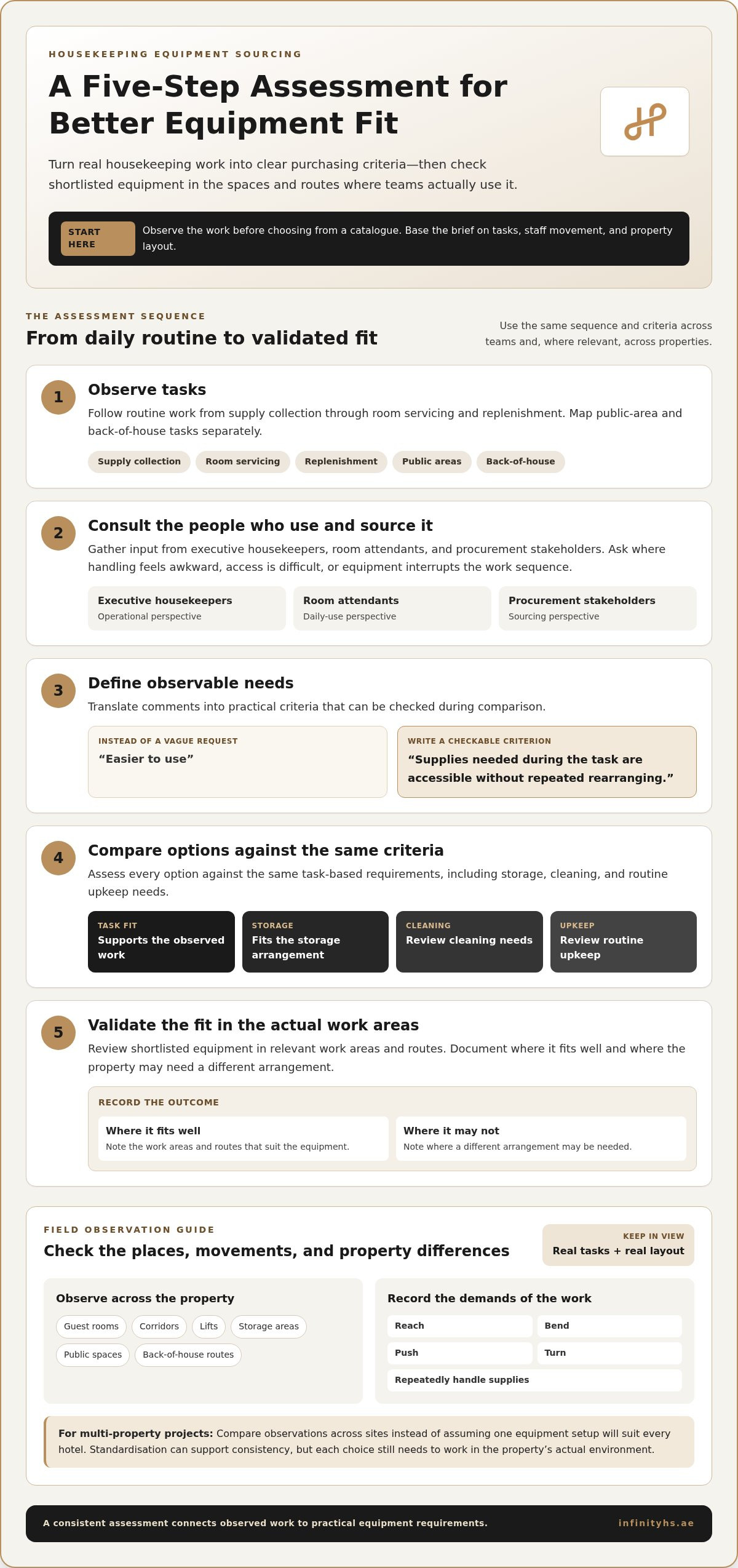
Observe representative work in guest rooms, corridors, lifts, storage areas, public spaces, and back-of-house routes. Record where staff need to reach, bend, push, turn, or handle supplies repeatedly. Note pinch points such as tight turns and congested storage areas. For multi-property projects, compare observations across sites instead of assuming one setup will suit every hotel.
Use a five-step assessment process
- Observe tasks. Follow routine work from supply collection through room servicing and replenishment. Map public-area and back-of-house tasks separately.
- Consult users. Gather input from executive housekeepers, room attendants, and procurement stakeholders. Ask where handling feels awkward, access is difficult, or equipment interrupts the work sequence.
- Define needs. Translate comments into observable criteria. For example, replace “easier to use” with “supplies needed during the task are accessible without repeated rearranging.”
- Compare options. Assess each option against the same task-based criteria, including storage, cleaning, and routine upkeep needs.
- Validate fit. Review shortlisted equipment in the relevant work areas and routes. Document where it fits well and where the property may need a different arrangement.
The UCLA Ergonomics guidance on custodial equipment offers relevant selection considerations for cleaning tools. Use guidance to inform the assessment, then verify ergonomic claims or technical measures against reliable product documentation before including them in a specification or comparison.
Use a shared comparison table to keep discussions consistent across teams:
| Assessment area | What to record |
|---|---|
| Task fit | Which routine tasks the equipment supports, and where it may not suit the workflow. |
| Handling | How users reach, push, turn, and access items during observed tasks. |
| Layout and storage | Fit with corridors, lifts, service routes, and designated storage areas. |
| Cleaning | How the equipment can be cleaned as part of the property’s normal practices. |
| Maintenance | What routine upkeep is needed and how the relevant team can manage it. |
Turn staff feedback into workable criteria
Invite users to describe specific moments, not just preferences. “The supplies are hard to reach when the trolley is parked by this doorway” gives the team a location and task to assess. Record who raised the issue, where it occurs, and what observable condition would improve the fit. This gives procurement a practical basis for comparing options and communicating requirements.
A clear brief and shared evaluation criteria help teams make equipment decisions grounded in each property’s needs.
How to compare ergonomic housekeeping trolleys and equipment options
Compare equipment against the work it needs to support, not just its appearance or a single headline specification. A trolley that suits one room-servicing routine may be less practical for another property’s corridors, lift access, storage areas, or supply process. When sourcing ergonomic housekeeping equipment, assess each option against the same tasks and routes, then include staff feedback in the decision.
What should hotels compare when sourcing housekeeping trolleys?
Begin with the supplies and tasks planned for each service routine. Consider whether staff can organise and access the items they need, and whether the trolley can move along the routes used during the shift. Review corridors, lifts, room entrances, and storage spaces together. A trolley’s practical fit depends on the full route, not just the room.
- Task suitability: Does the setup support the supplies and sequence of work for the relevant routine?
- User handling: Can staff access items and manage the trolley during observed tasks without unnecessary rearranging?
- Layout fit: How does it move through the property’s corridors, lifts, and room entrances?
- Storage: Can it be positioned and stored in the spaces the team actually uses?
- Upkeep: Can teams clean and maintain it as part of established routines?
Keep each criterion grounded in observation. For example, record whether staff need to reposition supplies to reach frequently used items, or whether turns on a particular route affect manoeuvrability. These are evaluation findings, not product features. Also consider how trolley requirements fit within the hotel’s wider operational plan.
How should teams assess alternative equipment configurations?
Use a consistent comparison method. Have users assess each option against the same tasks, routes, and workflow questions. Record what they observe separately from specifications supplied by the manufacturer or supplier. This helps teams avoid treating an impression, such as “easier to handle,” as a verified technical claim.
Document trade-offs clearly. A configuration intended to accommodate more supplies may need closer review for manoeuvrability and storage. A setup that fits a compact route, by contrast, may not support the team’s replenishment routine. Staff feedback helps identify which trade-offs matter in practice, while verified specifications establish the product details procurement can compare.
- Observed: How users move and access supplies during a defined task.
- Documented: Supplier-provided specifications and product information.
- To resolve: Any gap between the property’s needs and the documented product details.
Apply this comparison across each relevant service routine, rather than choosing an option based on one task alone. A written record of criteria, observations, and verified product details gives procurement and housekeeping teams a shared basis for the final decision.
How to source ergonomic housekeeping equipment across hotel teams
A coordinated sourcing process helps hotels turn staff observations into requirements that procurement and operations can act on. It also makes decisions easier to compare across properties without assuming every hotel has the same layout or service model. For projects across the GCC, Middle East, and Africa, include each property’s operational needs and project scope in the brief, then align stakeholders before selecting equipment for wider use.
Build a clear equipment brief for procurement
Bring housekeeping, procurement, operations, and project stakeholders together early. Housekeeping can describe daily routines and staff feedback; procurement can structure requirements and comparisons; operations can flag site constraints; and project teams can align decisions with the wider project scope. A shared brief gives each group a consistent basis for review.
Include the property type, service routines, staff observations, equipment routes, and storage constraints. Define desired outcomes in practical terms, such as accessible supplies during a routine or suitable movement through a service route. Avoid writing assumed product specifications into the brief. Separate operational requirements from technical details that suppliers must document.
- Common requirements: Identify needs shared across properties, such as the tasks equipment must support or the information required for evaluation.
- Site-specific needs: Record differences in room layouts, corridor access, storage, and service routines.
- Project context: Note where requirements depend on a new opening, refurbishment, or operational change.
Plan evaluation and implementation across properties
Once the brief is agreed, follow a defined sequence: compare options against the criteria, evaluate shortlisted choices in relevant work settings where feasible, gather feedback, and plan the rollout. Use the same evaluation tasks across sites where possible, while allowing each property to record local constraints. This helps distinguish shared requirements from exceptions that need a separate decision.
Collect structured feedback from room attendants, executive housekeepers, procurement, and operations after evaluation. Ask what supported the planned routine, where movement or access felt difficult, and what storage or upkeep considerations emerged. Record observations separately from supplier-provided specifications so the team can make decisions using clear, traceable information.
Before ordering, align the selected approach with project scope and operational requirements. Confirm which properties share a common requirement, where a different configuration may be needed, and how teams will communicate the decision during rollout. For regional programmes, include coordination across markets in the project plan without assuming one delivery sequence or property setup will fit every site.
This method supports consistent decisions while leaving room for genuine operational differences. It also gives procurement a clearer basis for coordinating housekeeping trolley requirements as part of wider hotel OS&E planning.
Use the resulting brief to guide a measured rollout and keep each property’s operational needs in view.
How Infinity Hotel Supplies supports housekeeping equipment sourcing
Effective sourcing begins with the property’s operating needs. Infinity Hotel Supplies supplies housekeeping trolleys alongside broader OS&E solutions. Hotel teams can consider housekeeping equipment in relation to wider operational requirements, rather than treating every purchase as a separate decision.
When sourcing ergonomic housekeeping equipment, a focused brief connects staff observations and property needs with project priorities. Infinity Hotel Supplies operates across markets with offices in the UAE, China, and the United Kingdom, supporting its global sourcing and quality control capabilities.
Bring equipment requirements into a coordinated sourcing process
Task observations and staff feedback help shape a focused sourcing brief. Include the routines the equipment must support, the relevant routes and storage context, and the criteria the team will use to assess options. This keeps the discussion grounded in the property’s work instead of broad preferences or assumed product features.
Housekeeping equipment can also be considered alongside wider OS&E requirements for a hotel project. When teams coordinate operational supplies across departments, broader OS&E solutions can be part of the same planning conversation. A clear scope helps stakeholders distinguish shared needs from requirements specific to one property or project.
Infinity Hotel Supplies’ housekeeping trolley offering can be considered within this wider operational context. Teams can bring together the property brief, staff input, and project priorities to establish a consistent basis for discussing equipment requirements across sites.
What to include in a housekeeping equipment enquiry
A concise enquiry gives the sourcing discussion a practical starting point. Include the details that clarify the property’s work and project context:
- Property context: Hotel type, project stage, and whether requirements cover one property or multiple sites.
- Workflows: Room-servicing routines and relevant public-area or back-of-house tasks.
- Layout: Notes on corridors, lifts, room entrances, routes, and storage areas.
- Priorities: Staff observations and criteria for task suitability, handling, organisation, and upkeep.
- Project scope: Operational requirements, stakeholder input, and any standards shared across properties.
With this information, teams can discuss requirements in a structured way and keep the conversation focused on operational fit. Share your hotel’s housekeeping equipment requirements with the Infinity Hotel Supplies team to begin the discussion.
Make the Next Equipment Decision More Informed
Let each sourcing decision strengthen the next one. After equipment enters service, invite housekeeping teams to share what works well and where daily routines still create friction. Their observations can help refine future requirements and keep decisions connected to the way hotel operations run.
A thoughtful approach to sourcing ergonomic housekeeping equipment continues beyond an initial purchase. Keep communication open between users and decision-makers as property needs change, and use practical feedback to guide future evaluations.
With clear priorities and a collaborative approach, your team can make its next equipment decision with greater confidence.
Frequently Asked Questions
What makes housekeeping equipment ergonomic for hotel staff?
Ergonomic equipment supports the way staff perform their tasks and interact with tools during a shift. Assess whether users can access commonly needed supplies, move equipment along service routes, and organise items for their routine without awkward adjustments. Observe more than one staff member using the equipment, since reach and handling preferences can vary across a team.
How can a hotel evaluate whether a housekeeping trolley suits its staff?
Evaluate it where staff will use it, not only in a storeroom or meeting room. Have room attendants follow a representative service routine and note where they need to stop, reposition supplies, or change their usual sequence. Include staff who work different shifts or room types, then compare their observations to see whether the trolley supports a range of daily tasks.
Can one housekeeping trolley work across every hotel department?
Not necessarily. Room attendants, public-area teams, and back-of-house staff may follow different routines and move through different spaces. A trolley that suits guest-room servicing may not fit another department’s tasks or storage arrangements. Before standardising, compare requirements by department. Where needs differ, use a consistent decision framework to select suitable equipment categories without forcing one setup across every work area.
How should hotels compare housekeeping equipment suppliers?
Compare how clearly each offering can be assessed against your written requirements, including task fit, available product information, property context, and project coordination needs. Keep supplier-provided specifications separate from observations made by your staff. Infinity Hotel Supplies offers housekeeping trolleys and OS&E solutions, allowing teams to consider housekeeping equipment as part of a broader operational supply plan.
How can hotels introduce new housekeeping equipment across multiple properties?
Start with an evaluation at a property that represents the project’s common needs, then record feedback in a shared format. Before extending the approach, identify which findings apply across sites and which depend on local room layouts, routes, or service routines. Assign a clear owner to update the approved requirements so property teams work from the same guidance as the rollout progresses.
What information should a hotel include when sourcing housekeeping equipment?
Include the property location and type, departments involved, typical service routines, relevant room and route layouts, storage conditions, and project scope. Add staff observations and the criteria the team will use to assess equipment, such as access, movement, and upkeep. For GCC, Middle East, Africa, or multi-market projects, note which requirements are shared across properties and which reflect local operating conditions. This makes sourcing ergonomic housekeeping equipment more focused.
To discuss housekeeping trolleys and wider OS&E requirements for your hotel, contact the Infinity Hotel Supplies team.

Article by
Infinity Editorial Team
With deep expertise in hospitality product FF&E and OS&E across the Middle East and Africa, Infinity Editorial Team brings insights from Infinity Hotel Supplies, helping developers, hoteliers, and homeowners transform spaces from empty shells to fully furnished, design-ready environments.
Disclaimer
The content published by Infinity Editorial Team is intended for informational purposes only. All articles, guides, and insights are based on industry knowledge and experience in hospitality FF&E and OS&E supply across the Middle East and Africa. Infinity Hotel Supplies does not guarantee specific outcomes and recommends consulting a qualified professional for project-specific requirements.


