

A purchasing decision that solves an immediate problem can create a bigger one later if it does not fit the property’s plans. That is the practical hotel asset management and procurement link: asset priorities shape what a hotel buys, while product selection, sourcing, and delivery affect how well those assets support the property over time. Owners may focus on long-term value, while operating teams need products that meet current guest and staff needs. Both perspectives matter.
Aligning them takes more than comparing prices. It requires a repeatable process that connects property plans with operational requirements, sets replacement priorities, and involves the right stakeholders before purchasing decisions are final.
This article explains how asset management and procurement play distinct but connected roles, then outlines a practical process for translating asset priorities into purchasing decisions. It also covers how coordinated sourcing, quality control, and logistics can support hotel projects across categories such as linen, room electronics, amenities, FF&E, and OS&E.
Key Takeaways
- Use the hotel asset management and procurement link to connect long-term property priorities with practical purchasing requirements.
- Coordinate needs assessment and product specifications early to reduce gaps between project plans and day-to-day operations.
- Compare reactive, centralised, and lifecycle-aligned purchasing approaches to identify where decision-making can improve.
- Assign an owner to each purchasing decision and agree on approval steps before requesting proposals.
- Include sourcing, quality control, and logistics in planning for coordinated hotel projects.
Hotel Asset Management and Procurement: Why the Link Matters
A hotel’s long-term value depends on more than its location and financial performance. The condition, suitability, and consistency of products across the property also affect guest experience and staff workflows. That is where the hotel asset management and procurement link becomes practical: ownership priorities need to guide purchasing, and purchasing outcomes influence how well products support the property over time.
Hotel asset management oversees a property’s performance, physical condition, and long-term investment priorities. It differs from daily operations and purchasing administration, but it needs to account for both. A useful general foundation is Asset management, which covers the broader practice of managing assets to meet defined objectives. In a hotel, those objectives need to translate into decisions that work for the building, its guests, and its operating teams.
To see how procurement and supply chain decisions work in a hotel setting, watch this conversation:
What does hotel asset management cover?
At the owner level, asset management considers whether the property is performing as intended, where its condition needs attention, and which investments support its priorities. It sets direction. Hotel operations manage daily service, while purchasing teams handle the administration and execution of buying.
Consider a guest room with worn linen or inconsistent room electronics. The operating team can identify the immediate issue, while ownership considers whether it points to a wider replacement priority. Product requirements then need to reflect the property’s operating needs and standards. A single room can show how long-term oversight connects with the daily guest experience.
Where does procurement enter the asset lifecycle?
Procurement turns agreed needs into specifications, product selection, sourcing, quality control, and delivery. Ownership priorities set the direction; operators explain how products need to work in practice; procurement carries those requirements into the supply process. A clear handoff helps prevent a product from meeting a project brief on paper but falling short in daily use.
Procurement supports hotel asset stewardship by turning property priorities into suitable, quality-checked products for their intended operational use. This applies to new projects, where many requirements need to come together, and ongoing replacements, where teams need to maintain consistency while keeping lifecycle priorities in view.
For example, replacing a product category across guest rooms involves more than identifying worn items. Teams need to align replacements with property standards, operational use, and the level of consistency they want to maintain. Defining those needs early helps ensure sourcing decisions address the purpose of the purchase, not just the most visible immediate problem.
This connection gives owners and operators a shared basis for decisions. Asset management clarifies what the property needs to protect or improve; procurement translates that direction into product and delivery requirements. Together, they help purchasing support the hotel’s ongoing performance, not just its next order.
How Hotel Procurement Supports Assets from Planning to Replacement
A property priority can guide a purchase only if it reaches the people defining, sourcing, and receiving the products. A clear process connects the original objective to the delivered item, then uses operational feedback to inform future decisions. That is how the hotel asset management and procurement link works throughout a project lifecycle, not only when a purchase is approved.
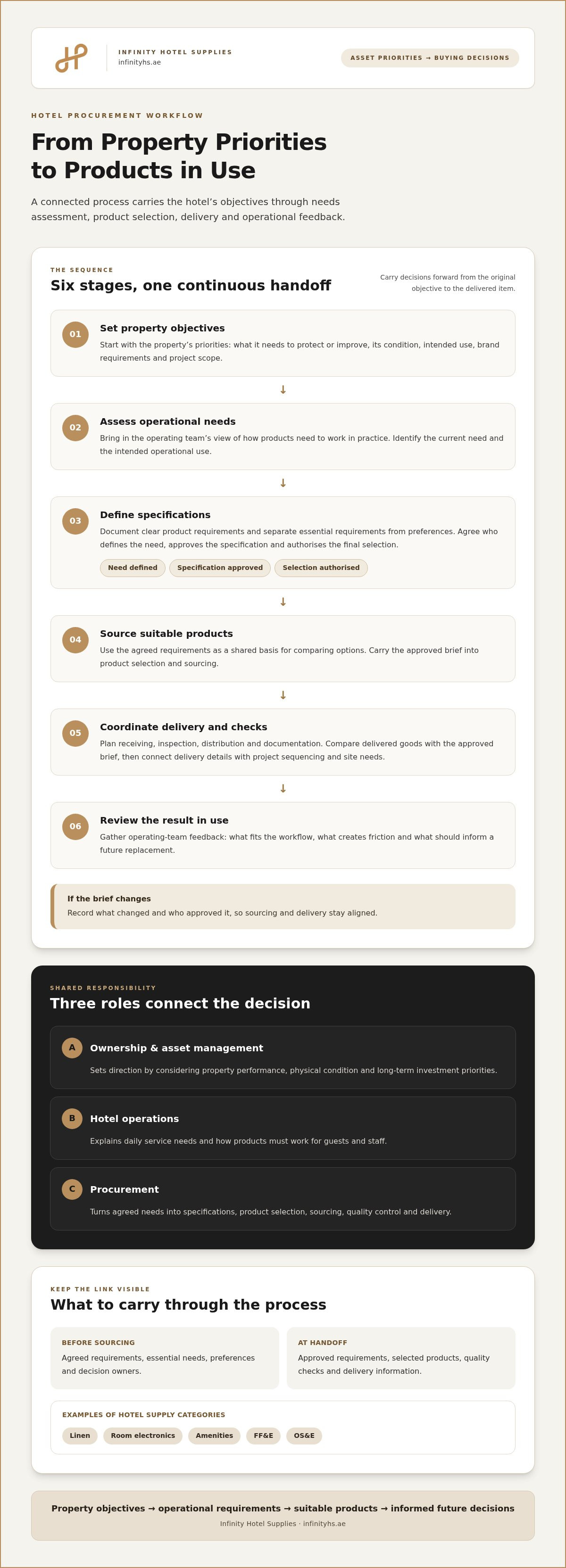
The sequence is straightforward: set property objectives, assess needs, define specifications, source suitable products, coordinate delivery, and review the result. Each stage should carry forward earlier decisions. If the brief changes, record what changed and who approved it so sourcing and delivery stay aligned.
From asset priorities to a usable procurement brief
Translate the property’s condition, intended use, brand requirements, and project scope into clear product requirements. For example, a guest-room refresh involving room electronics should specify where products will be used, which operational needs they must meet, and what consistency the property expects. This gives decision-makers a shared basis for comparing options.
Before sourcing begins, identify who defines the need, who approves the specification, and who authorises the final selection. Separate essential requirements from preferences, then document both. This makes proposals easier to assess consistently and reduces the risk of a late change based on a preference that was never agreed as a project requirement.
From delivery to operational feedback
Procurement coordination continues after product selection. Plan receiving, inspection, distribution, and documentation so delivered goods can be compared with the approved brief and sent to their intended locations. Quality control helps identify discrepancies during handoff, while logistics planning connects delivery details with project sequencing and site needs.
Keep records of approved requirements, selected products, relevant quality checks, delivery information, and any changes. These records help teams see what was specified and supplied, rather than relying on memory when a similar purchase comes up. Once products are in use, gather feedback from the operating team: what fits the workflow, what creates friction, and what should inform a future replacement?
Hotel procurement connects asset priorities to products through planning, specification, sourcing, delivery, and operational review. This lifecycle view gives owners, operators, and sourcing teams a practical way to keep project intent connected to day-to-day use.
For projects involving coordinated product categories, Infinity Hotel Supplies supports sourcing, quality control, and logistics around hospitality requirements. Bring the project scope and operational priorities together to shape a focused supply brief.
Centralised, Reactive, or Lifecycle-Aligned Hotel Procurement?
Hotels can organise purchasing in different ways. A property responding to an immediate need may buy reactively, while a group may centralise sourcing to coordinate standards across locations. Lifecycle-aligned procurement takes a longer view, connecting purchasing decisions to asset priorities and operating needs. These approaches can overlap; the right balance depends on the property structure, project scope, and decision rights.
The comparison below outlines typical trade-offs. Results depend on how each hotel assigns responsibilities and communicates requirements.
| Approach | Consistency | Stakeholder coordination | Visibility | Operational fit |
|---|---|---|---|---|
| Reactive purchasing | Can vary between orders | Often focuses on the immediate request | May provide a limited view of upcoming needs | Responds to urgent replacement needs |
| Centralised sourcing | Can support shared standards | Creates a common purchasing route | Can make group requirements easier to review together | Needs room for property-specific requirements |
| Lifecycle-aligned procurement | Connects specifications with longer-term priorities | Brings ownership, operations, and sourcing into planning | Links current purchases with planned needs and review | Balances asset priorities with practical use |
What changes between reactive and planned purchasing?
Reactive purchasing starts with a problem, such as a damaged item that needs prompt replacement. That response may suit an isolated need, but repeated decisions without shared requirements can create variation across rooms or properties. Planned purchasing anticipates needs through asset planning, giving teams time to agree on specifications and coordinate sourcing. For example, a hotel can set shared linen requirements across rooms while accounting for how each property operates.
When does central coordination help a hotel group?
Central coordination can help when a group needs shared standards, a clearer view of requirements across properties, or a consistent sourcing approach. However, a central specification should not erase local operating needs. Property teams can flag differences in room use, project scope, or practical requirements, then seek approval for appropriate variations. This keeps common standards useful rather than rigid.
For properties operating across the GCC or wider Middle East, the same principle applies: group-level requirements can guide consistency, while individual project teams account for their own site and operating context. The region alone does not determine the purchasing model; ownership structure, approval rights, and project scope matter more.
The hotel asset management and procurement link is strongest when decision-makers can see why a purchase is needed, how it fits property priorities, and who approves exceptions. A smaller property may value direct local decisions. A multi-property group may need central visibility. Lifecycle alignment can work with either structure, provided ownership priorities, operator input, and purchasing authority are clearly connected.
A Practical Workflow for Aligning Hotel Asset Plans and Procurement
A repeatable workflow helps a hotel carry asset priorities into purchasing decisions without losing sight of daily operating needs. The hotel asset management and procurement link becomes clearer when each stage has an owner, an approval point, and a record of the decision. Use this five-step process to turn a property plan into a coordinated sourcing and delivery brief.
- Establish priorities. Identify the property or project objective, such as maintaining room standards, replacing worn items, or coordinating a refurbishment. The asset owner or project lead should clarify what the purchase needs to support.
- Assess needs. Ask operating teams how products are used, where current items fall short, and which site or workflow constraints matter. Group requirements by category, such as FF&E, OS&E, linen, or room electronics.
- Set requirements. Document intended use, project scope, room standards, essential criteria, and preferences. Assign responsibility for defining the brief and approving changes before sourcing begins.
- Source and coordinate. Evaluate options against the agreed requirements, then plan quality checks, delivery, and distribution around project sequencing and site readiness.
- Review. Record what was specified and supplied, collect operator feedback after products enter use, and apply those findings to future purchasing or replacement plans.
Build requirements around property and operating needs
A useful brief connects the property’s objective with practical use. For each category, record where the product will be used, who relies on it, and which operating constraints affect selection or delivery. For room electronics, for example, align the project scope and room standards with the operator’s needs before comparing options. This gives stakeholders a common basis for review.
Define decision rights early. Name who prepares requirements, who reviews them, and who gives final approval. The project owner can then distinguish essential criteria from preferences, reducing ambiguity when proposals are assessed. The same disciplined approach can guide hospitality procurement across product categories and project stages.
Coordinate sourcing, quality control, and logistics
Clear specifications give sourcing teams a consistent reference for comparing products and planning quality review. Agree on how delivered items will be checked against the approved brief, who records discrepancies, and how changes are handled. Delivery plans should reflect project sequencing, receiving arrangements, and whether the site is ready to accept and distribute products. These details matter for hotel amenities as well as larger project categories.
Keep the brief, approvals, product records, quality checks, delivery details, and feedback together. This documentation gives future teams a traceable view of the decisions behind each purchase. It also helps connect a replacement request to the product’s intended use and the property’s established requirements.
Align your hotel project requirements with sourcing, quality control, and logistics support.
Discuss your hotel project requirements
Connecting Hotel Asset Priorities with a Hospitality Supply Partner
Owners set property priorities, operators understand how products perform in daily use, and sourcing teams translate agreed needs into product and delivery requirements. When these groups work from the same brief, purchasing decisions stay connected to project scope and operating priorities. A hospitality supply partner can support that coordination by bringing relevant product categories, sourcing, quality control, and logistics into the project discussion.
Infinity Hotel Supplies supports hotel projects across categories including hotel linen, amenities, room electronics, FF&E, and OS&E. Its global sourcing capabilities and project support include quality control and logistics. This breadth can help teams organise related requirements together while keeping each category tied to its intended use and project needs.
What coordinated hospitality sourcing can cover
A project may involve guest-room products, shared-area requirements, or operating supplies and equipment. Grouping needs by category gives owners and operators a clearer view of what is in scope, what needs coordination, and which requirements belong to each team. For example, hotel linen and OS&E serve different functions, but both need to fit the property’s operating priorities and project plan.
Clear category requirements also help teams discuss shared standards without treating every product as interchangeable. A linen brief can describe intended use and property context; an OS&E brief can identify the operating areas and needs it must support. Hotel linen requirements can be considered alongside other project categories, with quality review and delivery coordination planned as part of the wider scope.
For broader context, the strategic guide to hospitality procurement solutions can help frame how sourcing decisions fit within a coordinated project approach. The key is to connect each category to a defined need, rather than treat a collection of purchases as one undifferentiated order.
Prepare for a productive project discussion
Before a project discussion, bring together the information that helps shape a useful brief. A concise summary can include:
- Project scope: whether the requirement relates to a new project, refurbishment, or ongoing replacement.
- Property context: the areas involved and the standards the project needs to support.
- Product categories: such as hotel linen, amenities, room electronics, FF&E, or OS&E.
- Operational priorities: how teams expect products to be used and any relevant site or delivery considerations.
This information helps organise requirements around the project’s actual needs. It also gives sourcing, quality control, and logistics discussions a shared reference, from the initial category brief through delivery coordination. The aim is not to replace owner or operator decision-making, but to carry those decisions clearly into supply planning.
With aligned requirements, owners, operators, and sourcing teams can work toward shared project priorities while keeping product categories and delivery needs visible. Discuss your hotel project requirements with Infinity Hotel Supplies.
Discuss your hotel project requirements
Turn Property Priorities into Your Next Project Brief
The hotel asset management and procurement link is most useful when it shapes decisions before a purchasing request reaches the sourcing stage. For your next project, treat the brief as a working document: clarify what the property needs, invite operational input, and give decision-makers a clear basis for approving requirements and reviewing delivery.
That discipline also helps teams use what they learn. Capture feedback after products enter service, note where project requirements changed, and carry those insights into future planning. Over time, this creates a clearer connection between property priorities and the purchasing decisions made to support them.
Whether you are planning a new project or organising upcoming replacements, a focused discussion can bring the relevant categories, stakeholders, and delivery considerations into view. Start with the property context and the outcomes you want the project to support. From there, you can move forward with a coordinated brief and shared direction.
Discuss your hotel project requirements
Take the next step by discussing your hotel project requirements with Infinity Hotel Supplies.
Frequently Asked Questions
What is the difference between hotel asset management and hotel procurement?
Hotel asset management focuses on the property’s condition, performance, and investment direction; procurement turns approved needs into purchasing and supply decisions. For example, an asset plan may identify a need to refresh guest rooms, while procurement coordinates product requirements for that work. The functions have different responsibilities, but their decisions should connect so purchases reflect property priorities and the realities of hotel operations.
How can procurement decisions support a hotel asset management plan?
Procurement supports an asset plan by using its priorities to guide product requirements, sourcing, and delivery. Make the hotel asset management and procurement link practical by tying each purchase to a documented need, such as a room refresh or replacement programme. Teams can then record why an item was selected and gather feedback after use. That information gives future planning a clearer operational basis.
What information should a hotel include in a procurement brief?
A useful brief should identify the project’s purpose, property areas involved, required product categories, intended use, and relevant room or brand standards. Add expected quantities or locations if known, project phasing, delivery-site constraints, and the person responsible for approvals. References such as existing product descriptions or project documents can also help. Keep mandatory criteria separate from preferences so evaluations remain consistent.
Can hotel procurement be coordinated across multiple properties?
Yes. A hotel group can set shared category requirements and approval processes while allowing property teams to document local needs. For a group operating across GCC countries, the Middle East, or Africa, this approach can help teams compare requirements across locations without assuming every site has the same project scope or operating conditions. Define which decisions sit centrally and which require property-level input before sourcing starts.
How should hotels track products after procurement and delivery?
Hotels can maintain product records that connect each delivered item to its category, property area, project, and approved requirements. At receipt, log the quantity received and note discrepancies or visible damage for follow-up. Where relevant, record identifying details such as a serial number. Assign responsibility for updating records when products move, are replaced, or leave service so later reviews use current information.
What is the difference between FF&E and OS&E in hotel projects?
FF&E means furniture, fixtures, and equipment, generally referring to furnishings and equipment used to outfit hotel spaces. OS&E means operating supplies and equipment, the items teams use to operate and serve guests. The categories can overlap in project planning, so classify requirements consistently in the brief. For example, room furnishings and supplies used in daily service may need separate lists, approvals, and delivery coordination.
When should procurement teams be involved in a hotel renovation?
Bring procurement into the renovation during early planning, before product decisions and project sequencing are fixed. Early involvement gives the team time to understand the scope, coordinate with operators on practical requirements, and connect product selection with site readiness and delivery planning. If procurement joins only after specifications are settled, teams may have less opportunity to flag category coordination or delivery details that affect the project schedule.

Article by
Infinity Editorial Team
With deep expertise in hospitality product FF&E and OS&E across the Middle East and Africa, Infinity Editorial Team brings insights from Infinity Hotel Supplies, helping developers, hoteliers, and homeowners transform spaces from empty shells to fully furnished, design-ready environments.
Disclaimer
The content published by Infinity Editorial Team is intended for informational purposes only. All articles, guides, and insights are based on industry knowledge and experience in hospitality FF&E and OS&E supply across the Middle East and Africa. Infinity Hotel Supplies does not guarantee specific outcomes and recommends consulting a qualified professional for project-specific requirements.


