

Could a curtain package look consistent on a schedule yet leave some rooms brighter, less comfortable or out of step with the design intent? Sourcing blackout curtains for hotels in the GCC starts with defining what each room needs, not comparing fabric samples in isolation. Blackout and dimout describe different levels of light control, and the fabric is only part of the decision: track design, curtain coverage and light gaps matter too.
Hotel teams need guest comfort, durability and appearance to work together. The challenge is turning those priorities into specifications that remain consistent across rooms and delivery batches. A clear sourcing brief makes the process easier to manage and gives everyone a shared basis for approvals.
This guide explains how to match curtain performance to room function, document fabric and project requirements, and assess suppliers against quality and delivery checkpoints. It also covers how coordinated sourcing, quality control and logistics can support wider hotel project requirements across the GCC, the Middle East and Africa.
Key Takeaways
- Start with a room-by-room brief that captures the intended balance of darkness, privacy and design.
- Compare fabric, lining or construction, appearance and documented performance against project requirements.
- For sourcing blackout curtains for hotels in the GCC, treat sample approval, production consistency, inspection records and communication as separate checkpoints.
- Use an ordered project checklist to coordinate window surveys, shipment planning, site access and phased room handovers.
- Use approved room-level specifications as the reference for sourcing, quality control and logistics throughout the project.
Define the blackout curtain requirement for each GCC hotel room
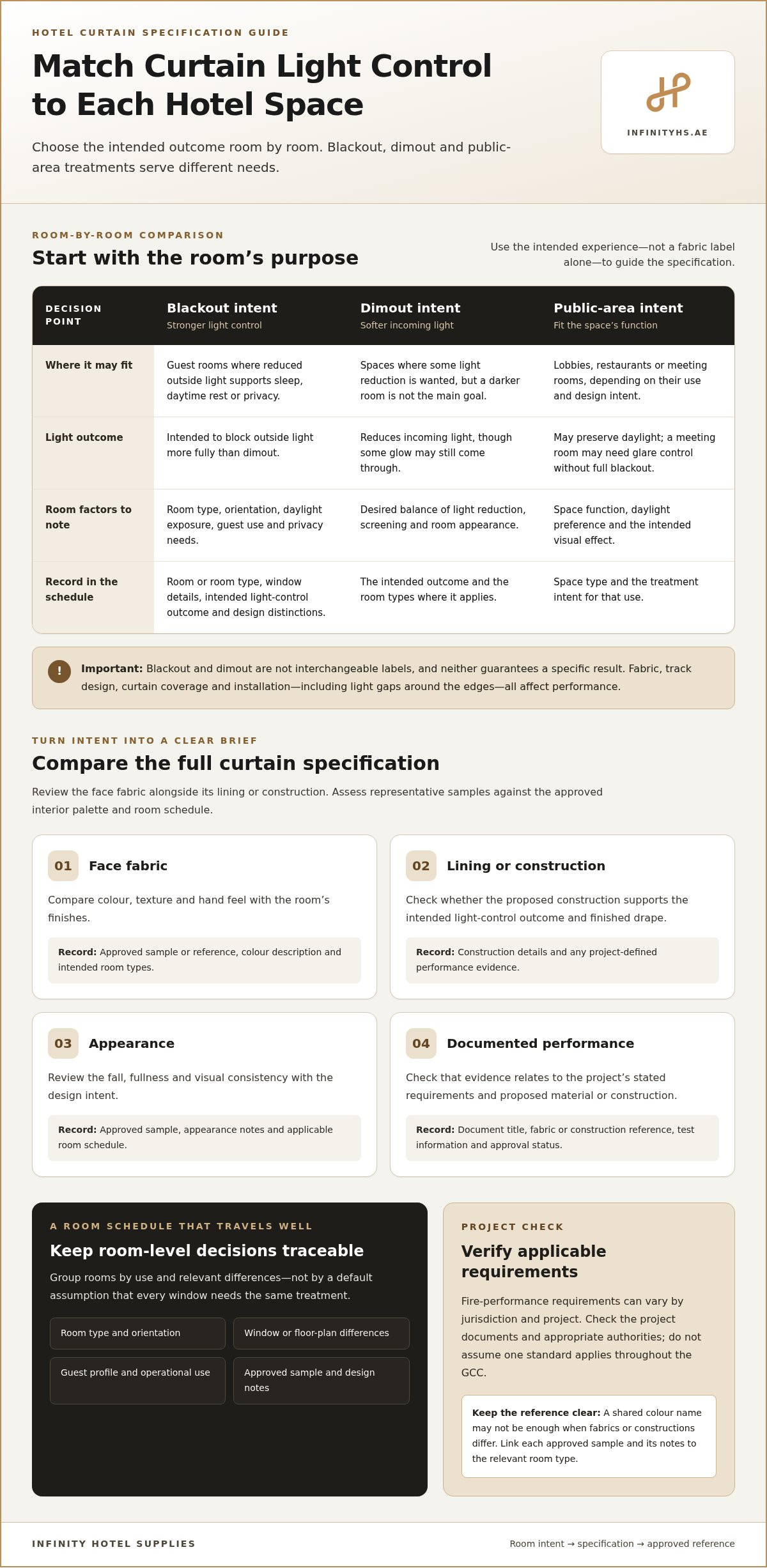
A blackout curtain is intended to block outside light more fully than a dimout treatment, which reduces incoming light but may still allow some glow through. Neither label guarantees a particular result. Performance depends on the specified fabric and installation, including how the curtain covers the window and whether light can enter around its edges.
For hotel teams sourcing blackout curtains for hotels in the GCC, first decide where stronger light control supports the guest experience and where it does not. Sleeping rooms may need more light control for overnight sleep or daytime rest. Privacy is also a consideration when rooms face nearby buildings or public spaces. A lobby, restaurant or meeting room, by contrast, may benefit from daylight and a more open appearance.
Room orientation and local daylight exposure should inform the brief. To see how blackout curtains are commonly presented for hotel rooms, watch this overview:
Blackout or dimout: which outcome does the room need?
Choose according to room use and the intended level of light control. Do not treat blackout and dimout as interchangeable fabric names.
- Blackout intent: Consider this for guest rooms where reducing outside light supports sleep, daytime rest or privacy.
- Dimout intent: Consider this where softer daylight and a degree of screening matter more than creating a dark room.
- Public-area intent: Choose a treatment for the space’s function. A meeting room, for example, may need glare control without full blackout.
State the intended outcome in the room schedule. Avoid promising complete darkness based on a fabric label alone: the fabric, track, coverage and installation all affect the result.
Map room function, daylight and guest expectations
Group rooms by factors that affect how they are used instead of applying one treatment across the property by default. A west-facing guest room, for example, may have different afternoon daylight exposure from an interior-facing room. Treat orientation as a design consideration, not a guarantee of a particular heat or comfort outcome.
- Record room type, orientation and relevant window or floor-plan differences.
- Note guest profile and operational use, including whether daytime rest is an expected use of the room.
- Separate guest rooms from public spaces and identify where blackout, dimout or another lighter treatment is intended.
Make those decisions actionable in a room schedule. Include the room or room type, window details, intended light-control outcome and any design distinctions. This gives the project team a shared reference and helps prevent different expectations from emerging across similar rooms.
Specify blackout curtain fabric, construction and project performance
Once the room schedule sets the intended light-control outcome, translate it into a fabric and construction brief. A useful specification covers opacity, appearance, installation and the evidence required for approval. When sourcing blackout curtains for hotels in the GCC, this detail helps keep expectations clear across project teams and delivery batches.
Compare fabric construction and appearance
Review the face fabric alongside its lining or other construction. Together, they affect the treatment’s appearance and drape, while installation affects how it covers the window. Fabric weight or width alone does not prove blackout performance. Assess representative samples against the approved interior palette, including colour, texture, hand feel and drape.
| Specification area | What to compare | What to record |
|---|---|---|
| Face fabric | Colour, texture, hand feel and relationship to the room’s finishes | Approved sample or reference, colour description and intended room types |
| Lining or construction | Whether the proposed construction supports the intended light-control outcome and finished drape | Construction details and any project-defined performance evidence |
| Appearance | Fall, fullness and visual consistency with the design intent | Approved sample, appearance notes and applicable room schedule |
| Documented performance | Evidence relevant to the project’s stated requirements | Document title, fabric or construction reference, test information and approval status |
Keep different room types or design schemes distinct in the schedule. A shared colour name may not be enough to control consistency if the fabric or construction differs. Record the approved sample reference and project-specific notes alongside each applicable room type.
Document fire performance and acceptance criteria
Before reviewing supplier evidence, gather the documents that define the project’s expectations: the room schedule, approved finish information, specification or tender documents, and applicable country and project requirements. Fire-performance requirements can vary by jurisdiction and project. Verify the relevant criteria against current project documents and appropriate authorities; do not assume one standard applies throughout the GCC.
- Separate evidence from assurances: Record whether documentation contains test results and identifies the tested material or construction. A general statement about performance is not a substitute.
- Keep records traceable: Connect each document to the proposed fabric or construction reference and retain its review and approval status.
- Set measurable acceptance criteria only when supported: If project documents specify a method, threshold or other measurable requirement, carry it into the brief. Otherwise, do not invent a numerical target. Document the agreed approval basis and responsible reviewer.
This structured brief aligns fabric selection, visual approval and documented performance before procurement decisions are made. Keep the approved specification and supporting evidence together so the project team can refer to the same requirements during review.
Compare blackout curtain sourcing options for GCC hotel projects
The sourcing model affects more than where curtains are made. It determines who coordinates specifications, samples, records and shipments, and how those steps fit the hotel’s wider project programme. For sourcing blackout curtains for hotels in the GCC, compare the options against the project’s scope and coordination needs rather than assuming one route is always best.
Choose a sourcing model that fits the project
| Sourcing model | May suit | Coordination considerations |
|---|---|---|
| Direct manufacturing | A defined curtain scope where the project team can manage technical details and communication directly | Keep specifications, sample approvals, production updates, inspection records and shipment planning aligned between the factory and project team. |
| Regional supply | Projects where regional coordination or delivery planning is central to the sourcing decision | Clarify how product documentation, approved samples and communication connect to the project’s requirements and schedule. |
| Project-led procurement | Hotel projects coordinating curtains with other FF&E or OS&E requirements | Coordinate the curtain specification, approvals, quality checks and logistics with linked project decisions, while keeping each product’s requirements distinct. |
Factory-direct buying can provide a direct communication path for a tightly defined order, but the hotel team may need to manage more of the coordination itself. Regional supply may align with a project’s delivery plan, while project-led procurement can organize decisions across categories. The right fit depends on order scope, internal project capacity and how responsibilities are assigned. Compare delivery plans with the programme, and avoid fixed lead-time assumptions until the project schedule and shipping details are understood.
Evaluate suppliers using evidence, not headline claims
Assess each supplier against separate checkpoints. A strong presentation or broad capability statement does not replace traceable project evidence. A structured procurement plan helps connect curtain decisions with wider hotel project requirements.
- Specification control: Compare the specification sheet with the hotel’s approved requirements, including fabric and construction references.
- Sample approval: Keep a record of the sample reviewed, its approval status and any comments that affect the final selection.
- Production consistency: Establish how the approved colour and construction will be referenced across production and delivery batches.
- Inspection records: Review records for relevance to the specified material, construction and project checkpoints.
- Communication: Identify who provides updates, shares documents and escalates changes that could affect approvals or the programme.
Supplier claims, certificates and trade terms need context. Check that each document applies to the proposed material or construction and addresses a requirement in the project documents. Clarify trade terms against the transaction and shipment plan rather than treating a term or certificate as proof that every project need is covered. Infinity Hotel Supplies supports wider hotel project requirements with global sourcing, quality-control capabilities and logistics coordination, helping teams plan connected decisions with clear responsibilities.
Use a practical GCC project checklist before approving curtains
Approval is easier to manage when each decision has an owner, a reference document and a place in the project sequence. For sourcing blackout curtains for hotels in the GCC, connect the room schedule and approved sample to delivery, inspection and handover plans. This makes it easier to spot gaps before curtains reach the site.
Coordinate the curtain package with the hotel’s wider room scheme, including complementary textiles. Reviewing hotel linen specifications alongside room finishes can help teams align colour and design intent without treating separate products as if they share the same specifications.
Prepare the room schedule and approved sample
Start with verified project information. Record room identifiers and window details, then assign the intended treatment to each room type. Document who owns measurement, sample approval, installation coordination and final acceptance. These responsibilities and installation details are project-specific, so state them rather than relying on assumptions.
- Survey the windows: Record dimensions, window configuration and relevant site conditions for each room or consistent room group. Identify who takes and approves the measurements.
- Build the room schedule: Link room identifiers to orientation, selected treatment, fabric or construction reference and any design variation. Flag rooms that differ from the standard schedule.
- Review project requirements: Bring approved design information and applicable performance documents together. Note any requirements that affect selection or acceptance.
- Approve a representative sample: Assess colour, texture, drape and appearance against the room scheme and documented project criteria. Record the decision and any conditions or changes.
- Control the reference: Keep the approved sample and matching specification available to the project team. Use them as shared references for production review and later inspection.
Coordinate delivery, inspection and installation
Approval does not end at the sample stage. Link shipment sequencing to site readiness, access arrangements and planned room handovers. A phased handover may require deliveries and inspections to follow the project’s release sequence rather than arrive as one uncoordinated batch.
- Plan site access: Record delivery access, receiving arrangements, storage needs and the responsible site contact in the project plan.
- Align shipment and room sequence: Map expected deliveries to site readiness and the handover programme. Keep the plan tied to confirmed project milestones rather than fixed lead-time assumptions.
- Inspect received goods: Compare items with approved samples, quantities and project documentation. Record the inspection date, findings and any affected room identifiers.
- Resolve discrepancies: Log differences, assign an owner and track corrective actions to closure before the relevant rooms are signed off.
A clear record from survey through inspection gives the hotel team a traceable basis for approval and handover. Assigning owners to each checkpoint keeps decisions moving and makes unresolved items visible before room sign-off.
Coordinate hotel curtain sourcing through a project-led procurement partner
Approved room-level specifications should remain the reference point from sourcing through quality checks and project coordination. They give the team a consistent basis for comparing requirements, tracking approvals and managing changes, while helping prevent room-by-room decisions from drifting away from the agreed design intent.
This structure is especially useful when curtains sit within a wider hotel supply programme. A coordinated plan can connect room schedules, purchasing milestones, documentation and logistics without treating every product category as if it shares the same specification. For teams sourcing blackout curtains for hotels in the GCC, the aim is clear ownership at each stage, from brief preparation to delivery coordination.
Bring the curtain brief into the wider hotel project
Infinity Hotel Supplies provides turnkey procurement solutions for hotel projects, including sourcing, quality control and logistics management for FF&E and OS&E requirements. Its global sourcing, quality-control capabilities and logistics coordination can help organize linked project requirements and checkpoints. The company operates from offices in the UAE, China and the United Kingdom. Curtain decisions should remain tied to the project’s approved brief and documentation.
Use the room schedule as a controlled reference when connecting curtain requirements with other purchasing decisions. If a room package includes multiple categories, record each item’s specification, approval status and delivery milestone separately. This keeps responsibilities visible and helps teams coordinate the overall project without assuming that one approval covers unrelated products.
Prepare a focused project enquiry
A concise project enquiry gives the team a useful starting point for discussing scope and coordination. Share practical context, not just a product description. Include what is known, identify open decisions and attach the project references that guide selection and acceptance.
- Property and location: Identify the hotel and its project location.
- Project stage: Note whether the work is at planning, specification, purchasing or delivery coordination stage.
- Room schedule: Include room types, identifiers, relevant window information and intended treatments.
- Scope and programme: State the room count, procurement schedule and any phased handover milestones.
- Supporting documents: Share the visual brief, approved references and applicable project documentation where available.
These details keep the discussion anchored to the project’s actual requirements. They also help distinguish confirmed decisions from items that still need project-team review, such as measurement responsibility, installation details or documentation review. Keep revisions traceable so the current room schedule and approved references remain clear to everyone involved.
Infinity Hotel Supplies brings together hotel supply, global sourcing, quality-control capabilities and logistics coordination for hospitality projects. A well-prepared brief helps connect these capabilities to the project scope while keeping room-level requirements central. Share your project information to discuss coordinated hotel supply requirements.
Discuss your hotel procurement requirements
Move your curtain brief into the next project stage
Turn planning decisions into a working procurement brief. Keep the current room schedule, approved references, documentation requirements and key milestones together, and assign an owner to each open item. This gives the project team a clear starting point as the work moves forward.
A well-defined brief also connects sourcing blackout curtains for hotels in the GCC with the wider project programme. Use it to align purchasing discussions with room readiness and handover priorities, while keeping room-specific requirements visible as plans evolve. If the scope changes, update the shared references so the team works from the same information.
Bring your project context and priorities into the next conversation. A clear starting brief helps make the next steps more focused and coordinated.
Discuss your hotel procurement requirements
With a considered plan, your team can move ahead with clarity and confidence.
Frequently Asked Questions
What should hotels look for when sourcing blackout curtains?
Match the intended light control to room use, then assess appearance, construction, installation details and relevant project documentation. For sourcing blackout curtains for hotels in the GCC, include property-specific factors such as window orientation, room types and the project’s approval process. For example, a guest room facing strong afternoon sun may have different priorities from an interior-facing room. Link the chosen outcome and its reference sample to the room schedule.
What is the difference between blackout and dimout curtains?
Blackout treatments are intended to block more incoming light, while dimout treatments reduce light without necessarily making a room dark. The right choice depends on the guest experience the hotel wants to support. A room intended for daytime rest may need stronger light control than a lounge designed to retain a softer daylight feel. Labels alone do not establish the installed result, so consider the full window treatment and how it will be fitted.
How can a hotel verify blackout curtain performance?
Use project-defined evidence and an agreed review method rather than relying on a product label. Check that test documents apply to the proposed material or construction, then record the approval basis in the project file. If the project has a measurable acceptance criterion, use it for evaluation. A site review of an installed representative room can also reveal practical issues, such as light entering around the treatment.
Do blackout curtains need to meet fire-safety requirements in the GCC?
Hotels should treat fire performance as a project requirement to verify, not assume a single rule applies across every GCC country or property. Requirements may depend on the location, project documents and the relevant authority’s direction. Before approving a curtain specification, identify the applicable requirement in current project records and verify it with the appropriate authority. Keep the relevant evidence linked to the specified material or construction for review and handover.
Can blackout curtains help reduce heat and sunlight in hotel rooms?
They can limit direct sunlight entering through a window, depending on the selected construction, coverage and installation. This may help manage brightness and solar exposure, but a blackout label does not guarantee a particular room temperature or energy result. Glazing, orientation and other building conditions also matter. If thermal performance is a project goal, state it separately and use only project-supported evidence to assess the proposed treatment.
How should hotels compare curtain samples with the approved room design?
Review samples in the room or a setting that reflects its actual finishes and lighting, rather than judging them in isolation. Compare the sample with adjacent fabrics, wall finishes and other approved materials. Record the selected reference, colour description and design comments, then share that record with the people responsible for approval and inspection. This gives later reviews a clear visual basis and helps reduce subjective disagreements.
What information should a hotel include in a blackout curtain procurement brief?
Include the property location, room schedule, window measurements, intended treatment by room type, approved design references and project-supported performance requirements. Add the project stage, delivery milestones, site access arrangements and phased handover needs where relevant. Identify who owns measurement, sample approval, document review, inspection and installation coordination. A clear brief helps the team distinguish confirmed decisions from open items and keeps responsibilities visible as the programme develops.

Article by
Infinity Editorial Team
With deep expertise in hospitality product FF&E and OS&E across the Middle East and Africa, Infinity Editorial Team brings insights from Infinity Hotel Supplies, helping developers, hoteliers, and homeowners transform spaces from empty shells to fully furnished, design-ready environments.
Disclaimer
The content published by Infinity Editorial Team is intended for informational purposes only. All articles, guides, and insights are based on industry knowledge and experience in hospitality FF&E and OS&E supply across the Middle East and Africa. Infinity Hotel Supplies does not guarantee specific outcomes and recommends consulting a qualified professional for project-specific requirements.


