

What if the biggest risk in a hotel-room electronics order isn’t the device, but a gap between its specification and the room it must serve? Sourcing hotel room electronics in KSA starts with clear room-by-room requirements, so product choices, quantities and delivery plans fit the wider project from the outset.
Choosing suitable guest-room products is only one part of the work. Bulk orders also need consistent specifications and coordination with FF&E and OS&E plans. This guide explains how to define your electronics scope, compare sourcing approaches and prepare procurement for project delivery.
You’ll learn how to map electronics to room types, document requirements and plan quality control and logistics alongside the hotel fit-out. Infinity Hotel Supplies supports hospitality projects with room-electronics sourcing, bulk orders, quality control and logistics management, helping teams connect product decisions with project requirements.
Key Takeaways
- Build a room-by-room brief that captures guest needs, shared-area equipment, quantities and project phases.
- Translate room types and use cases into clear specifications, separating essential requirements from preferred features and design choices.
- Compare sourcing approaches by how they handle scope, specification alignment, quality control, logistics and communication.
- Plan sourcing hotel room electronics in KSA as part of the wider hotel project, with decision owners and delivery coordination defined early.
- Hospitality-focused sourcing support can connect bulk room-electronics orders with quality control and logistics management.
Why hotel room electronics sourcing in KSA needs a project brief
Room electronics affect how guests use their rooms, how hotel teams support daily operations and how smoothly a fit-out progresses. A vague scope can leave a product suitable for one room type but not another, omit shared spaces or push decisions into later purchasing stages. A project brief gives each team a common reference before sourcing begins.
For sourcing hotel room electronics in KSA, define the scope by location, purpose, quantity and project phase. Separate guest-room requirements from public-area and back-of-house equipment, then identify which items belong to each room type or delivery stage. Product sourcing is one part of the picture, not a complete room-technology or hotel automation strategy. The broader system may require decisions and coordination beyond the electronics purchasing brief.
A general overview of hotel room facilities and amenities can help frame guest-facing needs, but each property should establish its own scope.
For a visual overview of hotel automation, watch this video:
Which hotel room electronics belong in the sourcing scope?
Group requirements by function, such as entertainment, convenience and everyday use. Then separate items for individual rooms from equipment intended for public areas or back-of-house operations. For every item, record its location and purpose. This clarifies ownership and prevents room quantities from being mixed with unrelated project requirements.
Build a room matrix with room type, required function, quantity and project phase. A standard room and a suite may share some requirements but differ in others. Mark each item as required, preferred or a property-specific design choice. This gives the sourcing team a consistent basis for comparing selections without treating every preference as essential.
How KSA property context shapes the brief
Record the property location, intended guest profile, room types, opening or renovation phase and applicable brand standards. These details help the team decide whether one specification suits the whole property or whether room categories need separate selections. For a project in Riyadh, Jeddah or elsewhere in KSA, use the actual site context rather than assumptions about the market.
Include a verification step for local documentation and technical requirements. These can depend on the product and current rules, so the project team should review applicable details with relevant Saudi authorities and use current product documentation. Keep evidence and decisions with the brief so procurement, operations, design and project management work from the same approved scope.
A well-structured brief also records quantities by room type and phase, identifies who approves changes, and notes dependencies with wider FF&E and OS&E planning. This helps prevent omissions and inconsistent selections, while giving the project team a controlled way to assess scope changes before they affect purchasing.
Turn hotel room needs into clear electronics specifications
A useful specification turns the project brief into requirements teams can assess, approve and purchase against. It records what each room type needs, how each item will be used, and which requirements are mandatory, preferred or design-led. Clear documentation lets procurement compare proposals on the same basis instead of weighing unlike selections.
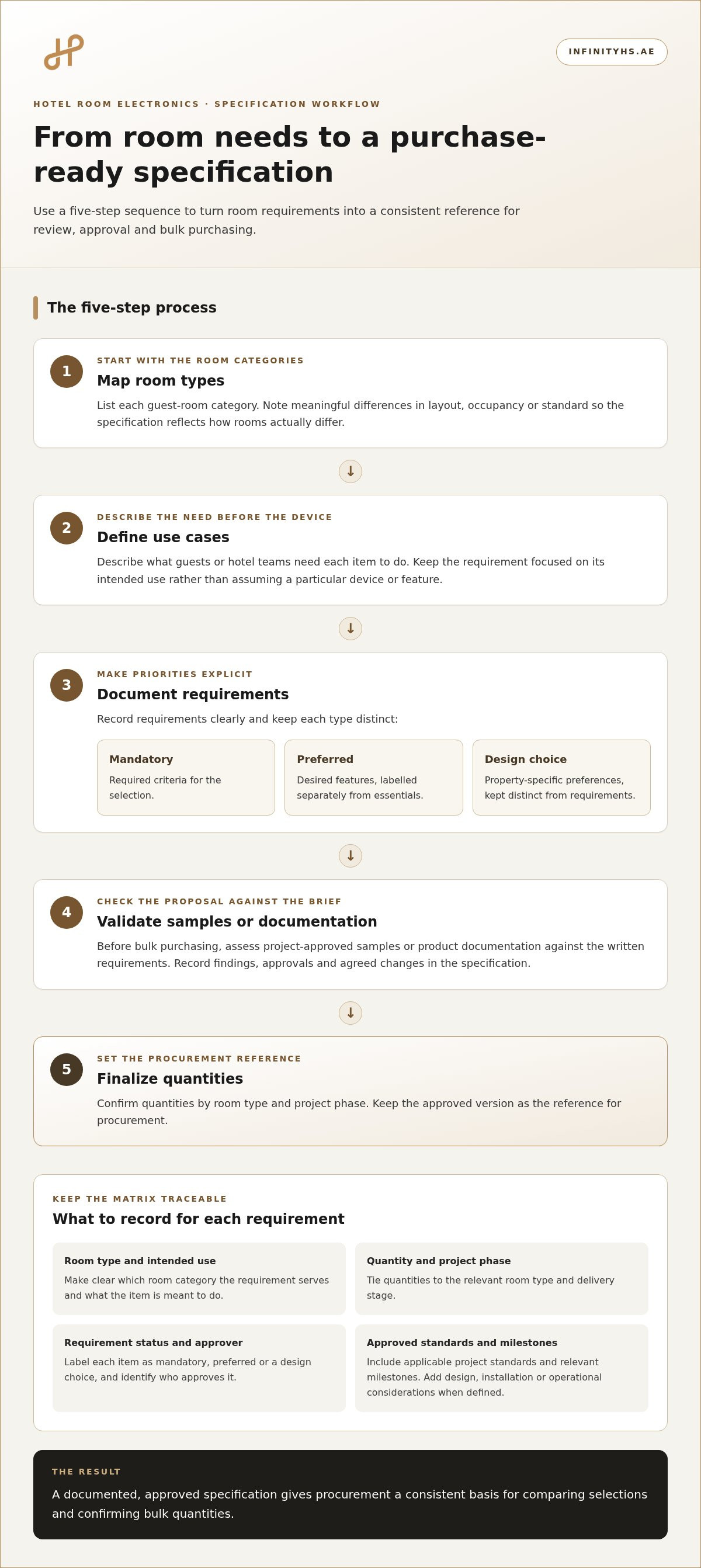
Use this five-step sequence to develop the specification:
- Map room types. List each guest-room category and note meaningful differences in layout, occupancy or standard.
- Define use cases. Describe what guests or hotel teams need each item to do, without assuming a particular device or feature.
- Document requirements. Record mandatory criteria separately from preferred features and property-specific design choices.
- Validate samples. Assess project-approved samples or product documentation against the written brief before bulk purchasing.
- Finalize quantities. Confirm quantities by room type and project phase, then keep the approved version as the procurement reference.
For KSA projects, base statements about technical requirements on current product information and applicable authority guidance. The U.S. International Trade Administration’s overview of Saudi Arabia ICT market and technology trends offers broader market context, but it does not replace product-specific verification.
Build a room-by-room requirements matrix
Use one row for each room type and requirement. Include intended use, quantity, approved project standards and relevant milestones. Add design, installation or operational considerations when the project team has defined them. This separates assumptions from decisions and makes it easier to trace each selection back to a requirement. Keep hotel room electronics distinct from other project scopes in the matrix.
Give each requirement a status, such as mandatory, preferred or design choice, and identify who approves it. A brand standard belongs in the mandatory column only if the project has formally adopted it. Keep design preferences clearly labelled so they do not become unplanned requirements in every proposal. Consistent labels make like-for-like comparisons more reliable.
Validate product fit before bulk procurement
Before confirming bulk quantities, compare project-approved samples or documentation with the written requirements. Review consistency across the proposed selection, ease of use in the intended guest-room context and alignment with the property’s concept. Record findings, approvals and agreed changes in the same specification set. Base compatibility statements on verified product information, not assumptions about a product category or appearance.
Once approved, use the specification as the reference for proposals, sample decisions and quantity updates. This helps teams spot deviations early and keep procurement aligned with the guest-room brief. Infinity Hotel Supplies supports room-electronics sourcing and bulk orders for hospitality projects.
Compare hotel electronics sourcing approaches for a KSA project
The right sourcing model depends on project complexity, purchasing scope and the capacity of your in-house procurement team. A marketplace can support early discovery; direct purchasing can suit a defined product scope; hospitality-focused procurement support can coordinate sourcing and related project requirements. No approach automatically guarantees lower costs, faster delivery or better results. Compare the responsibilities and processes behind each option.
What to compare beyond a product listing
Assess how each proposed scope maps to approved hotel requirements, what documentation supports the proposal, who manages quality-control steps and how order coordination and logistics planning fit project milestones. Clear communication matters when several teams need to review selections or approve changes. Apply the same criteria to every sourcing approach so the comparison reflects the work involved, not just the product information presented.
| Comparison area | Marketplace-led discovery | Direct product purchasing | Hospitality-focused procurement support |
|---|---|---|---|
| Scope ownership | The hotel team organizes listings into its project scope. | The hotel team defines and manages the product scope with the seller. | Scope coordination can align room-electronics requirements with wider hotel purchasing needs. |
| Specification alignment | The buyer compares listings against the approved brief. | The buyer and seller align the selected product with stated requirements. | Sourcing is guided by the hotel brief and project context. |
| Quality control | The buyer sets review steps and tracks findings. | Responsibilities are established between the buyer and seller. | Quality control can be coordinated as part of the sourcing process. |
| Logistics coordination | The hotel coordinates order planning across selected purchases. | Coordination follows the purchasing arrangement. | Logistics management can be considered alongside the wider project schedule. |
| Communication | The hotel consolidates information across listings and contacts. | Communication centers on the direct purchase. | Project-related sourcing and coordination can be handled within a hospitality-focused relationship. |
When hospitality-focused procurement support can help
Coordinated support can be useful when room electronics share deadlines with other hotel product categories or when internal teams need a structured point of coordination. Infinity Hotel Supplies supports hospitality projects through sourcing, quality control and logistics management, alongside room-electronics and bulk-order offerings. These services help organize procurement around project requirements without promising a particular delivery result.
For a broader view of coordinated hotel purchasing, see Hospitality Procurement Solutions: A Strategic Guide for 2026. Use the comparison to decide which tasks your team can manage directly and where project-focused coordination fits. For sourcing hotel room electronics in KSA, choose an approach whose scope, responsibilities and communication processes match the property’s needs and your team’s capacity. The same project-planning principles apply to hotel procurement across the GCC, Middle East and Africa, while local requirements should be verified for each project.
Plan bulk hotel room electronics procurement from brief to delivery
Bulk purchasing works best when each decision has an owner, a record and a place in the project schedule. Treat procurement as a sequence of approvals: confirm the brief and scope, proceed to purchasing, plan quality-control checkpoints, then coordinate logistics and receiving. This gives project teams a shared view of dependencies without relying on assumed lead times or delivery commitments.
For sourcing hotel room electronics in KSA, build verification of current Saudi documentation and import requirements into the plan. Requirements can depend on the products involved, so use current guidance from relevant Saudi authorities and product documentation. Keep this review distinct from quality control: one concerns applicable requirements, while the other checks the order against the project’s approved criteria.
- Approve the brief and scope. Confirm room schedules, product requirements, quantities and exclusions before purchasing begins.
- Assign decision owners. Procurement manages purchasing records; operations reviews practical needs; design reviews alignment with the approved concept; and project management coordinates decisions against milestones. Adapt these roles to the property’s structure.
- Record approvals and revisions. Maintain a shared record of the current specification, decisions, responsible approvers and change history.
- Plan quality-control checkpoints. Set out how the project will review samples or documentation and compare ordered items with approved criteria.
- Coordinate logistics and receiving. Align shipment information, receiving arrangements and phased requirements with the property’s schedule.
Coordinate approvals, quantities, and project milestones
Base order quantities on confirmed room schedules and the approved scope, not early estimates that may change as design or construction progresses. Use one shared procurement record to identify the current specification and log each revision, decision and approval. Set review points around the property’s opening or renovation milestones, allowing the team to resolve scope questions before they affect the next decision.
Make approvals explicit. A project manager can track outstanding decisions while designated owners sign off on their areas. If a room schedule changes, record the affected quantities and update the approved version before changing the order basis. This gives procurement and operations a consistent reference and helps prevent an outdated specification from guiding a later purchase.
Protect consistency through quality control and logistics planning
Quality control is a planned review against project criteria, not a claim of certification. Define what the team will compare, who will review it and how findings or approved variations will be recorded. Coordinate logistics information with project milestones and site receiving arrangements so the team can plan for each delivery phase without assuming a particular timeline.
For related upgrade-planning context, see Upgrading Hotel Room Electronics in Dubai: The 2026 Strategic Guide. Infinity Hotel Supplies supports hotel electronics sourcing with quality control and logistics management. Include these responsibilities in a project plan that connects the approved scope with purchasing and delivery coordination.
Source hotel room electronics in KSA with Infinity Hotel Supplies
A defined project scope gives sourcing a practical starting point. Infinity Hotel Supplies works with hospitality teams on room electronics and bulk orders, with sourcing, quality control and logistics management supporting project requirements from specification through coordination. Founded in 2014, the company has offices in the UAE, China and the UK, providing an international base for its hospitality supply work.
For project teams sourcing hotel room electronics in KSA, the goal is to connect room-level needs with a coordinated purchasing plan. Share the approved brief, room schedules and project priorities so the scope can be understood in the context of the property, its phases and wider hotel requirements. Infinity’s offering includes LOVO Premium Electronics, alongside room-electronics sourcing and bulk orders. Assess product selections against project requirements using the relevant product information.
A hospitality-focused partner for room-electronics procurement
Hospitality projects bring together guest-room standards, operational considerations and purchasing milestones. A hospitality-focused supplier can work from the project’s documented scope and support sourcing, quality control and logistics management as part of procurement. Infinity’s offices in the UAE, China and the UK connect its regional presence with international operations. For the broader context of coordinated hotel purchasing, see Hospitality Procurement Solutions: A Strategic Guide for 2026.
Keep the enquiry grounded in decisions the team has made. A concise room schedule, clear requirements and identified priorities give the discussion a useful foundation. If the project is still developing, distinguish approved decisions from items under review. This helps define the sourcing scope without treating early preferences as final specifications.
Prepare a useful project enquiry
Organize the project information your team can share:
- Property context: location, room types and whether the work is a new opening or renovation.
- Project phase: current stage and relevant opening or upgrade milestones.
- Room schedule: confirmed room quantities and any variations by category.
- Documented requirements: approved standards, specifications and sample decisions, where available.
- Procurement priorities: the scope to source, quality-control considerations and logistics coordination needs.
These details connect the discussion to project priorities instead of assumptions. They also help distinguish the electronics scope from other hotel purchasing needs while keeping the wider project context visible.
Discuss your hotel room-electronics sourcing requirements with Infinity Hotel Supplies to plan the scope, bulk order and project coordination.
Carry your project decisions into the next stage
As the project moves from planning into execution, keep the approved room-electronics scope connected to the property’s operating vision. A clear handover from project teams to hotel operations can preserve important decisions, including the intended use of selected items and any approved variations. This gives the team responsible for the property a useful reference beyond purchasing.
Before closing each procurement milestone, make sure the latest decisions are easy to trace and relevant teams know where to find them. That continuity makes sourcing hotel room electronics in KSA a considered part of the property’s broader guest experience, rather than an isolated purchasing task.
Frequently Asked Questions
How do hotels source room electronics for a project in KSA?
Hotels can start sourcing hotel room electronics in KSA by turning the property’s room schedule and guest needs into a defined purchasing scope. Decide which team owns product decisions, approvals and order coordination, then compare sourcing routes against those responsibilities. For a multi-phase opening, document which requirements apply to each phase. This keeps purchasing decisions connected to the property plan without assuming every room or delivery stage is identical.
What should a hotel include in a room-electronics sourcing brief?
Include the property context, room categories, intended uses, estimated quantities, approved standards, project milestones and decision owners. Add reference documents or sample approvals that explain requirements, and clearly mark unresolved items so they aren’t treated as final. For example, specify whether a requirement applies to every room type or only a designated category. A dated version and clear approval record help teams identify which brief guides purchasing decisions.
Can hotel room electronics be ordered in bulk for a Saudi hotel?
Yes. Bulk orders can be planned around the hotel’s confirmed room schedule and purchasing phases. Group quantities by room category, then record variations or phased requirements to make the order basis clear. Infinity Hotel Supplies offers bulk orders for hotel room electronics. For properties in Saudi Arabia and the wider GCC, coordinating quantities with the project schedule helps keep purchasing records aligned with the rooms being prepared.
How do hotels compare room-electronics suppliers?
Use the same request and evaluation criteria for each proposal. Compare how clearly the offered scope addresses the hotel’s documented needs, what supporting product information is provided, and how quality-control, logistics and communication responsibilities are described. Record gaps or assumptions rather than treating them as included. A side-by-side comparison helps procurement, operations and project stakeholders discuss differences before making a selection.
What Saudi requirements apply to importing hotel room electronics?
Applicable requirements depend on the product and its classification, so verify current documentation and conformity requirements with relevant Saudi authorities before arranging an import. Identify the exact products and gather their current technical documents, then check applicable guidance through official channels such as SASO and the SABER platform. Build this verification into the project plan, and don’t rely on general electronics guidance as a substitute for product-specific review.
When should a hotel start sourcing room electronics?
Start once the project team can define the room categories and key requirements, early enough to include product review and approvals in the property’s schedule. New builds and renovations may have different decision points, so connect sourcing stages to design sign-off, room readiness and opening plans. If some details remain undecided, record them as open items and assign owners rather than delaying all scope planning until every choice is final.

Article by
Infinity Editorial Team
With deep expertise in hospitality product FF&E and OS&E across the Middle East and Africa, Infinity Editorial Team brings insights from Infinity Hotel Supplies, helping developers, hoteliers, and homeowners transform spaces from empty shells to fully furnished, design-ready environments.
Disclaimer
The content published by Infinity Editorial Team is intended for informational purposes only. All articles, guides, and insights are based on industry knowledge and experience in hospitality FF&E and OS&E supply across the Middle East and Africa. Infinity Hotel Supplies does not guarantee specific outcomes and recommends consulting a qualified professional for project-specific requirements.


