

What if the biggest risk in a hotel fit-out isn’t choosing the wrong furniture, but splitting scope, sourcing, quality control and delivery across disconnected workstreams? For projects across Africa, site access and transport conditions can make coordination especially important. That’s why turnkey FF&E solutions for hotels in Africa should start with a clear, property-specific plan.
It can be difficult to distinguish FF&E from OS&E and other project requirements, or to decide whether a coordinated approach is a better fit than managing multiple suppliers separately. A defined scope connects purchasing decisions to the hotel’s design intent and operating needs, while giving the team a shared record of responsibilities, specifications and delivery assumptions.
This guide explains how to define an FF&E scope, compare procurement approaches and plan around conditions at the property. Infinity Hotel Supplies provides turnkey procurement support through sourcing, quality control and logistics management. Its hospitality product range includes hotel linen, room electronics, lighting, uniforms and accessories, which can be organised around each project’s requirements.
Key Takeaways
- Separate FF&E from OS&E and other project workstreams to create a scope that reflects the property’s operating needs.
- Use a clear project brief and bill of quantities to organise categories, quantities and specifications from the outset.
- Compare coordinated procurement with separate suppliers by considering scope visibility, communication and the workload your team can manage.
- Build an Africa-ready hotel FF&E checklist around property areas, room counts, brand requirements and decision owners.
- Turnkey FF&E solutions for hotels in Africa can connect sourcing, quality control and logistics management within a project-specific plan.
Why turnkey FF&E planning matters for hotels in Africa
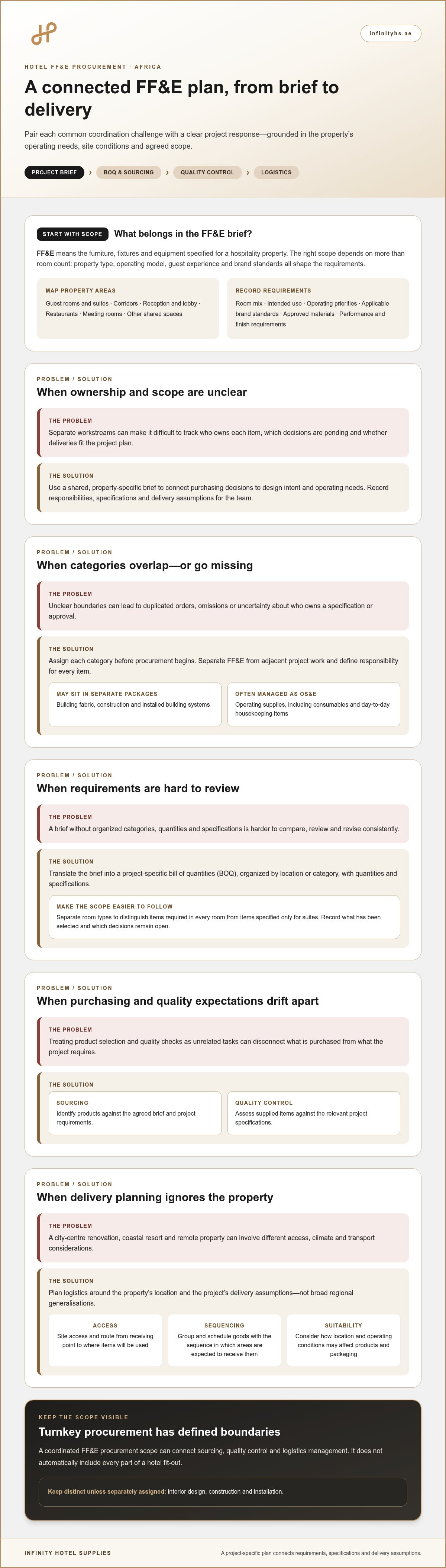
When scope, purchasing and delivery sit in separate workstreams, hotel teams can lose track of who owns each item, which decisions are pending and whether deliveries fit the project plan. That complexity matters on any hotel development. For projects across Africa, the plan also needs to reflect the property’s location, site conditions and operating context.
FF&E means the furniture, fixtures and equipment specified for a hospitality property. The right scope depends on more than room count. Project type, operating model, intended guest experience and brand standards all influence what to include and how to specify each category.
A guest-room example helps show how these decisions shape the brief:
What hotel FF&E covers in a project brief
Map the property’s areas first: guest rooms and suites, corridors, reception, lobby, restaurants, meeting rooms and other shared spaces. For each area, list the furnishings, fixtures and equipment needed to support its layout and intended use. A full-service hotel, for example, may require a different combination of public-area and back-of-house items than a limited-service property.
Then distinguish FF&E from adjacent work. Building fabric, construction and installed building systems may sit in separate project packages. Operating supplies, including consumables and day-to-day housekeeping items, may be managed as OS&E. Boundaries vary by project, so assign each category before procurement begins. This helps prevent duplicated orders, omissions and uncertainty about who owns a specification or approval.
Why African hotel projects need context-led planning
Africa includes a wide range of site conditions. A city-centre renovation, a coastal resort and a property in a remote location can involve different access, climate and transport considerations. These factors may affect product suitability, packaging, delivery sequencing and the route from the receiving point to the space where an item will be used.
Relate those considerations to the hotel’s operating model. Guest capacity, service style, maintenance routines and how each area will be used can guide decisions about materials and equipment. Site access and project sequencing should also inform delivery planning alongside construction and other workstreams. Record relevant assumptions in the brief instead of relying on broad regional generalisations.
Project conditions should shape each hotel’s FF&E plan. A context-led scope gives the team a practical basis for comparing requirements, assigning responsibilities and coordinating decisions. It makes the brief more specific: not only what the hotel needs, but where each item will be used and what the operation requires of it.
What a turnkey FF&E solution can coordinate from brief to delivery
Turnkey FF&E solutions for hotels in Africa work best when each procurement step follows a shared project brief. The sequence connects hotel requirements to product selection, quality control and logistics planning, while keeping responsibilities visible as decisions move from the project team to supply.
That coordination is practical, not just administrative. A discussion of African Hospitality Supply Chain Challenges highlights why supply considerations matter to hotel projects. A clear scope helps teams make decisions with the property’s location, priorities and delivery assumptions in view.
Turn the hotel brief into a workable FF&E scope
Begin with the property type, room mix and shared spaces, then record the operational priorities for each area. Guest-room requirements may vary by room type, while reception, dining and meeting areas each serve distinct functions. Include applicable brand standards, approved materials, performance expectations and finish requirements so products can be assessed against the same brief.
Translate those requirements into a project-specific bill of quantities (BOQ). Organise items by location or category, with quantities and specifications, so the scope is easier to review and revise. For example, separating room types helps distinguish items required in every room from those specified only for suites. A well-structured BOQ also records what has been selected and what decisions remain open.
Connect sourcing, quality control and logistics
Once the brief and BOQ are aligned, sourcing identifies products against the agreed requirements. Quality control assesses supplied items against the relevant project specifications. Coordinating these activities keeps purchasing decisions and quality expectations connected rather than treating them as unrelated tasks.
Logistics planning takes account of the property’s location and the project’s delivery assumptions, including how items are grouped and scheduled for the site. The plan should use information available to the team, such as site access and the sequence in which areas are expected to receive goods. This supports coordination without assuming every destination follows the same route or schedule.
A turnkey procurement scope links product selection, quality control and logistics. It does not automatically include every part of a hotel fit-out. Define the boundaries: sourcing, quality control and logistics management can sit within the FF&E procurement scope, while interior design, construction and installation remain distinct workstreams unless separately assigned within the project.
Category alignment also helps clarify what belongs in the FF&E package and what is handled separately as an operating supply. For instance, teams can identify hotel room electronics as a defined category, then document the relevant quantities and requirements in the BOQ. This makes the category easier to coordinate with room layouts and the wider supply plan.
For a project-specific discussion of scope, sourcing, quality control and logistics, connect with Infinity’s hotel supply team.
Turnkey or separate suppliers: compare the FF&E procurement models
No single procurement structure suits every hotel. The right fit depends on the number of categories and property areas involved, project complexity and how much coordination the hotel team can manage internally. A consolidated approach can connect procurement activities. Separate suppliers can also work well when the team has the capacity and category knowledge to coordinate them.
Use this comparison to identify the trade-offs before deciding:
| Coordinated procurement | Separate suppliers | |
|---|---|---|
| Coordination | Activities can be organised within a shared project workflow. | The hotel team aligns schedules, decisions and handoffs between suppliers. |
| Scope visibility | A consolidated view can help connect categories and project requirements. | Visibility depends on how consistently the team maintains information across suppliers. |
| Communication | Project communication can follow a more centralised route. | Teams communicate across multiple supplier relationships and internal owners. |
| Internal workload | Can suit teams seeking a more consolidated procurement workflow. | Requires internal capacity to manage coordination and category interfaces. |
Neither model guarantees a better result on its own. Separate suppliers may suit an established team with strong procurement processes and category expertise, particularly when responsibilities are clearly divided. Coordinated sourcing may be a better fit when the project includes several product categories or property areas, or when sourcing, quality control and logistics management need to work within one procurement scope.
When a coordinated procurement approach may fit
Consider coordination if the project spans guest rooms, shared spaces and operational areas, or if several categories need to meet common requirements. A clearly defined scope connects product selection to quality control and logistics planning, while making dependencies and decision ownership easier to track. For a broader framework, consult Hospitality Procurement Solutions: A Strategic Guide for 2026.
Before selecting a model, assess the team’s available time, procurement experience and ability to maintain one current record of decisions. If internal specialists can manage supplier interfaces, separate suppliers may be appropriate. If the project needs a consolidated workflow, turnkey FF&E solutions for hotels in Africa provide a structure for coordinating the procurement scope.
How FF&E and OS&E interact without becoming the same scope
FF&E generally refers to furniture, fixtures and equipment specified for the property. OS&E covers operating supplies and equipment needed to run hotel services. The boundary can vary by project. Hotel linen, for instance, may be handled in a supply package separate from furniture, depending on the brief and team responsibilities.
Map category ownership before purchasing begins. Record which package covers each item, who approves its requirements and how it relates to other project work. This reduces the risk of duplicated orders or gaps between project and operating needs. For more operational-supply context, see Operational Supplies and Equipment (OS&E): The Essential Guide for Hotel Operations in 2026.
Prepare an Africa hotel FF&E brief with this decision checklist
A useful brief turns project priorities into clear, reviewable requirements. Before finalising a procurement scope, gather the information that will guide product selection, quantities, approvals and delivery coordination. For turnkey FF&E solutions for hotels in Africa, make the brief specific to the property and destination rather than relying on assumptions that may not fit the site.
Information to gather before procurement planning
Start with the project stage, whether it is a new opening, renovation or refurbishment, and the objectives shaping the work. Bring together relevant property plans, room schedules and brand guidance. Record who owns each decision, including approvals for specifications, samples, quantities and scope changes. Naming decision owners early helps the team resolve questions while keeping the agreed requirements visible.
Questions that make scope and delivery assumptions clearer
Use this checklist to assemble a practical brief. Keep the answers in one working document, and flag unresolved items so they do not become hidden assumptions during procurement.
- What is the project and its current stage? Note the property type, whether the work is a new development or an existing-hotel upgrade, the relevant plans and the opening or renovation objectives.
- Which areas are in scope? List guest rooms, suites, corridors and shared spaces such as reception, dining and meeting areas. Record the room mix and counts by type, not only a total room number.
- Which product categories are required? Make a category list for each area and identify what belongs in the FF&E scope versus adjacent operating supplies or other project packages. In guest rooms, for example, specify whether hotel room accessories are part of the package.
- What standards should each item meet? Document brand requirements, approved materials, finish expectations and any performance criteria supplied by the project team. Include item descriptions and distinguish fixed requirements from preferences still open to review.
- How should quantities and approvals be recorded? Assign a quantity to each item and location. Identify the people responsible for approving specifications, samples and changes, and describe how revisions to the scope will be recorded.
- What site and delivery conditions matter? State the destination, site access details relevant to receiving goods, climate considerations that may affect product choices and the project’s delivery assumptions. Note coordination requirements with the site team without presuming country-specific rules or a standard route.
- What remains outside the FF&E package? Name related workstreams and their owners, including construction, design, installation or operating supplies where they are managed separately. Clear boundaries help prevent duplicated or overlooked responsibilities.
A complete brief connects property needs, approved specifications and delivery conditions. Review it with the project’s decision-makers before procurement planning advances. If room schedules, plans or requirements change, update the relevant quantities and assumptions together so teams work from the same scope.
How Infinity supports turnkey hotel FF&E procurement in Africa
Infinity Hotel Supplies is a Dubai-based hospitality supplier founded in 2014, serving hotels across Africa, the Middle East and worldwide. Its turnkey procurement solutions bring sourcing, quality control and logistics management into a project-specific scope. This connects those activities to the property’s requirements instead of applying a fixed package to projects with different priorities and site conditions.
A global sourcing footprint for hospitality projects
Infinity’s offices in the UAE, China and the United Kingdom support its global sourcing and quality control capabilities. The company supplies hospitality products and coordinates relevant categories within a defined project brief. Depending on the property’s requirements, the overall plan can include hotel linen, room electronics, leather accessories, uniforms, lighting and hotel accessories.
Coordination starts with the information the project team has established: which property areas are included, what requirements apply to each category and how decisions will be approved. Sourcing follows the agreed requirements, quality control assesses items against the project’s specifications, and logistics management is planned around the destination and delivery assumptions. Keeping these activities connected helps teams maintain visibility from product selection through delivery planning.
For example, a project may require products for guest rooms as well as public and operational areas. Categories and quantities can be organised around the property’s priorities, while the procurement scope clarifies where responsibility sits. This work focuses on supply coordination. Design, construction and installation remain separate workstreams unless assigned independently within the project.
Move from project brief to a tailored procurement discussion
Start with a concise project overview: the property type, project stage, location and priority product categories, along with any available room schedules or brand requirements. If the full brief is still developing, outline what has been decided and which areas or specifications remain in progress. This gives the discussion a practical starting point without requiring every procurement detail to be final.
Infinity shapes the relevant turnkey scope around the project’s needs, connecting sourcing, quality control and logistics management to the agreed requirements. The scope is project-specific, not a universal package that automatically includes every workstream. Clear priorities also help distinguish immediate category needs from items still subject to internal review.
To plan turnkey FF&E solutions for hotels in Africa, bring together the property details, priority categories and key project assumptions. This gives the procurement discussion a clear basis for defining requirements and coordination needs.
Set your hotel project up for a confident next step
A procurement brief is most valuable when it helps the project team make decisions, not simply record them. Use it to align stakeholders on priorities, keep approvals moving and make changes visible as the project develops. For turnkey FF&E solutions for hotels in Africa, that clarity connects procurement decisions to the property and its operating needs.
You don’t need every detail resolved before taking the next step. Bring forward the essentials: the project’s current stage, location, priority categories and key requirements already agreed. Infinity can use this information to shape a project-specific scope and define where sourcing, quality control and logistics management fit.
With a clear starting point and the right coordination around it, your team can move ahead with greater confidence and keep the guest experience at the heart of the project.
Frequently Asked Questions
What does a turnkey FF&E solution for a hotel typically include?
A turnkey FF&E solution typically coordinates product sourcing, quality control and logistics management within an agreed hotel project scope. The categories and responsibilities depend on the property brief, so define what is included and how approved requirements will guide product assessment. For turnkey FF&E solutions for hotels in Africa, include destination-specific delivery assumptions in the planning. Design, construction and installation remain separate workstreams unless assigned independently.
How is FF&E different from OS&E in a hotel project?
FF&E generally covers furnishings, fixtures and equipment specified for the property, while OS&E refers to supplies and equipment used in hotel operations. A guest-room furnishing, for example, may be planned as FF&E, while day-to-day operating items may fall under OS&E. The boundary can vary by project. Clarify which package owns each category, especially for items needed for opening and replenishment during operations.
How much do turnkey FF&E solutions for hotels in Africa cost?
There is no single standard cost for turnkey FF&E solutions for hotels in Africa; the project scope determines what needs to be priced. The number of property areas, room mix, selected categories, required specifications, sourcing and logistics needs all affect the procurement brief. Organise the item list, quantities and approved requirements, then discuss the project as a defined scope rather than relying on a generic estimate.
Can one procurement partner support hotel projects in multiple African countries?
Yes. Infinity Hotel Supplies works with hotels worldwide, including projects in Africa, and can coordinate procurement requirements around each property and destination. Keep separate project information for each site, including category requirements, delivery assumptions and decision owners. This helps teams coordinate shared brand standards while preserving local project details. Do not treat one destination’s site conditions or delivery plan as a default for another.
What should a hotel include in an FF&E procurement brief?
Include the property type, project stage, room schedule, property plans and areas covered. Add a category list with item descriptions, quantities and required finishes, along with applicable brand standards and the people responsible for approvals. For example, note whether a specification applies to every guest room or only selected room types. Include the destination and relevant receiving-site information so procurement and delivery planning use consistent assumptions.
What happens if a hotel changes its FF&E scope during procurement?
Record the proposed change and review which items, quantities, specifications and approvals it affects before updating the working scope. A revision to one room type, for example, may require the team to reassess related quantities or category requirements. Keep the bill of quantities and decision record aligned, and communicate the change to the people responsible for sourcing, quality control and logistics. This makes the revised basis clear for the next project decisions.

Article by
Infinity Editorial Team
With deep expertise in hospitality product FF&E and OS&E across the Middle East and Africa, Infinity Editorial Team brings insights from Infinity Hotel Supplies, helping developers, hoteliers, and homeowners transform spaces from empty shells to fully furnished, design-ready environments.
Disclaimer
The content published by Infinity Editorial Team is intended for informational purposes only. All articles, guides, and insights are based on industry knowledge and experience in hospitality FF&E and OS&E supply across the Middle East and Africa. Infinity Hotel Supplies does not guarantee specific outcomes and recommends consulting a qualified professional for project-specific requirements.


