

What if bringing more hotel products under one supplier made procurement easier to manage, without making it harder to control? A one stop hotel supply company should do more than consolidate orders. It should help align product categories, specifications, and project stages so teams can coordinate openings, renovations, and replenishment with greater clarity.
When separate suppliers are involved, teams have more conversations to track and more opportunities for product details or brand standards to drift. A practical way to reduce that complexity is to start with a clear view of which categories a supplier covers and how each fits your property’s requirements.
This guide explains how to assess supplier capabilities, compare product coverage, and plan procurement across key project stages. It also shows how Infinity Hotel Supplies brings categories such as hotel linen, room electronics, amenities, uniforms, and FF&E and OS&E solutions into one supplier relationship. Use the steps below to make informed decisions and keep your property’s standards in view.
Key Takeaways
- Assess a one stop hotel supply company by how well it coordinates relevant categories, specifications, and project requirements, not by catalogue size alone.
- Group product needs by room, department, and operational use. Document approved materials, dimensions, finishes, branding, and functional requirements.
- Compare suppliers using practical criteria such as category fit, specification alignment, quality control, and project communication.
- Plan openings and renovations around a clear project brief and category scope. Manage replenishment with consistent specifications and repeatable requirements.
- Consider how Infinity Hotel Supplies’ regional and global reach can support hotel requirements across the GCC, Middle East, and Africa.
What a One-Stop Hotel Supply Company Should Actually Provide
A one-stop hotel supply company gives hotel operators access to relevant product categories through a coordinated supplier relationship. The value isn’t simply having many items in one catalogue. It’s being able to define which categories fit a property’s needs, keep requirements clear across them, and coordinate supply around the project scope.
That distinction matters for hotels and developers across the GCC, Middle East, and Africa, where openings, refurbishments, and day-to-day operations can involve several teams and product types. Hotel supply connects with the wider Hospitality industry overview, from guest-facing rooms to the operational areas that support service. A supplier relationship is useful when its scope reflects those practical needs.
For a broader look at how a supplier presents its sourcing approach, watch this video:
Which hotel needs can a single supplier address?
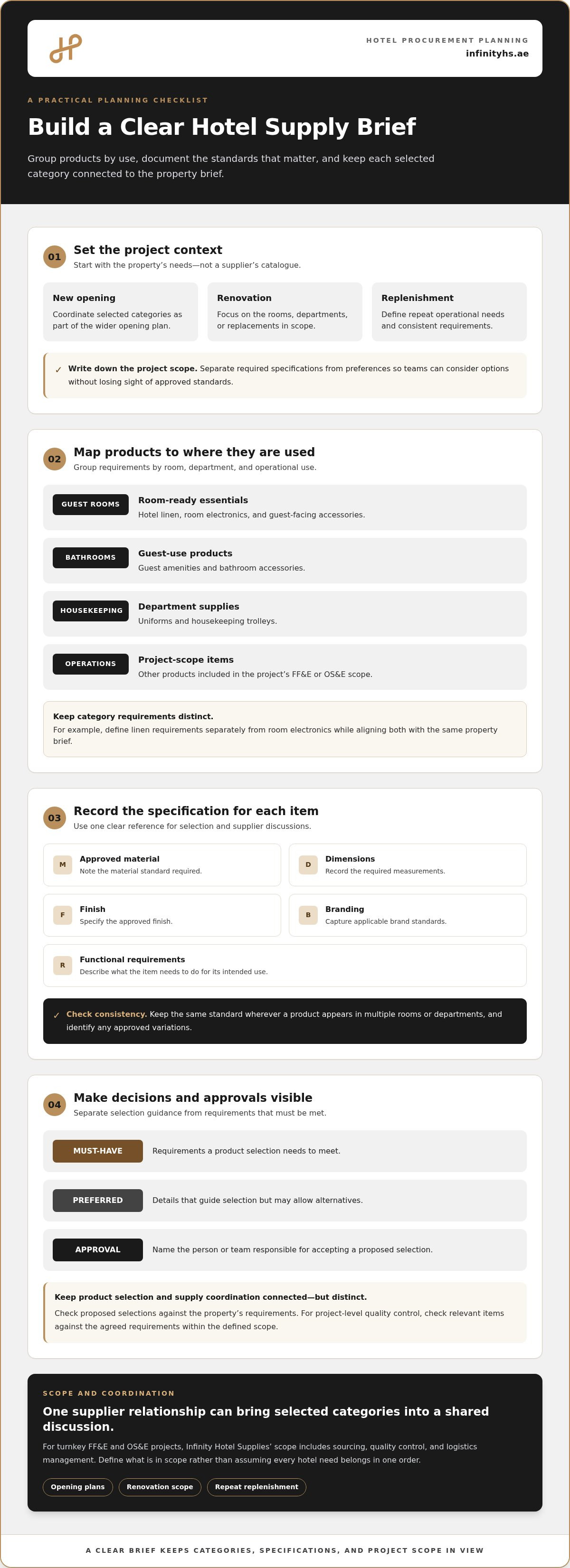
Start with how products will be used, not with a supplier’s category list. Mapping needs by space or department helps teams see which products belong together and where specifications must stay consistent. Depending on the property and project scope, a supply plan might include:
- Guest rooms: hotel linen, room electronics, and guest-facing accessories.
- Bathrooms: guest amenities and bathroom accessories.
- Housekeeping: uniforms and housekeeping trolleys.
- Property operations: other items included in the project’s FF&E or OS&E scope.
These categories serve different purposes, even when one supplier relationship covers several of them. Define linen requirements separately from room electronics, for example, while ensuring both align with the same property brief. Infinity Hotel Supplies offers hotel linen alongside amenities, room electronics, uniforms, housekeeping trolleys, and other hospitality products.
When does one-stop sourcing make sense?
For a new property, teams may need to coordinate selected categories as part of a larger opening plan. A renovation may focus on specific rooms, departments, or replacements, while routine replenishment centres on repeat operational needs. In each case, one supplier relationship can bring related requirements into a shared discussion. The right scope depends on the work the property needs to complete.
A broad catalogue alone doesn’t show how well a supplier supports the project. Look for a clear link between the requested categories and the project brief: which items are in scope, how requirements are documented, and how communication is coordinated across those items. For turnkey FF&E and OS&E projects, Infinity Hotel Supplies’ scope includes sourcing, quality control, and logistics management. Define the project scope clearly rather than assuming every hotel need belongs in one order.
For hotel operators and developers, the practical test is straightforward: can the supplier help coordinate the selected categories while keeping each requirement visible? Defining that fit at the outset gives the next stages of planning a clearer foundation.
How to Align Hotel Supply Categories and Specifications
A clear property brief turns a product list into a coordinated set of requirements. Group needs by room, department, and operational use, then record which details must stay consistent across categories. This gives hotel teams and suppliers a shared reference for discussing product selection, scope, and quality control without treating every item as interchangeable.
Begin with the property type and project stage, such as a new opening, renovation, or replenishment. Then outline room requirements and operational needs. Separate must-have specifications from preferences: required dimensions or branding standards belong in the first group, while preferred finishes or acceptable alternatives can sit in the second. This helps teams weigh options without losing sight of approved standards.
Build a clear category and specification brief
For each relevant item, record the approved material, dimensions, finish, branding, and functional requirements. Keep the same standard wherever a product appears in multiple rooms or departments, and identify any approved variations. A concise brief makes it easier to compare proposed selections with the property’s requirements and gives project discussions a consistent point of reference.
- Must-have: requirements that a selection needs to meet.
- Preferred: details that guide selection but may allow alternatives.
- Approval: the person or team responsible for accepting a proposed selection.
This structure also clarifies an important distinction: choosing a product is not the same as coordinating supply. Product selection asks whether an item suits its intended use and brand standard. Supplier coordination connects selected categories to the project brief, while project-level quality control checks relevant items against agreed requirements within the defined scope. Hotel management also brings purchasing, inventory, and operations together, as outlined in Hotel management and supply chain functions.
Coordinate room, bathroom, and operational supplies
Categories serve different purposes, so align them through shared property standards rather than assuming they should all be purchased together. Linen supports room readiness; guest amenities serve bathroom and in-room use; room electronics meet functional needs; accessories contribute to the room setup. Include only the categories relevant to the property and project.
For example, a room refresh might require a specified linen range while leaving electronics unchanged. A separate bathroom update may focus on guest amenities, with its own approved branding and use requirements. Recording decisions by room or department helps teams see what changes, what stays, and which standards apply to each category.
A one stop hotel supply company can support this process when its role is tied to the brief and selected categories. Infinity Hotel Supplies works with hotel linen, amenities, room electronics, and other hospitality categories. A well-organised brief gives teams a practical starting point for aligning those requirements. Outline the project scope and priorities before sourcing begins.
How to Compare One-Stop Hotel Supply Companies
A long catalogue can show category breadth, but it doesn’t prove that products will be coordinated around a hotel’s requirements. Compare suppliers by how clearly their proposed categories connect to the property brief, how specifications are handled, and how responsibilities are defined. The goal isn’t to find one supplier for every possible need. It’s to identify where a coordinated relationship fits the project and where a distinct specialist may be more suitable.
This approach also addresses a common concern: that using one supplier limits choice. Catalogue size alone can’t answer that. Focus on whether the supplier can support the categories in scope while keeping the property’s requirements visible. Judge a specialist requirement on its relevance to the project, not on how many unrelated products appear in a catalogue.
What should buyers assess beyond catalogue breadth?
Use the same criteria to review each supplier’s proposed role. A practical comparison should connect category fit, approved specifications, quality control, and project communication. For sourcing and turnkey project work, assess quality control against the stated scope rather than assuming a broad product range means every item follows the same process.
| Assessment area | Evidence of coordination | Potential gap |
|---|---|---|
| Category fit | Relevant products are mapped to the property brief and project scope. | Categories are listed without showing how they relate to the requirements. |
| Specification alignment | Approved requirements can be tracked against the proposed selections. | Product options are presented without a clear link to the property standards. |
| Quality control | The described checks relate to the sourcing or project scope. | Quality is described only in general terms, without a clear connection to the work. |
| Project communication | Roles, updates, and decisions are clear across the categories being sourced. | It’s unclear who coordinates related items or records changes. |
How does a one-stop model compare with separate suppliers?
A one-stop model may bring selected categories into a shared supplier relationship. Separate suppliers may provide focused expertise for distinct requirements. Neither approach is automatically cheaper or more effective; the right structure depends on project scope, product fit, and the coordination the hotel team needs to manage.
Compare the practical workload: how many communication touchpoints will the project involve, where will specification records sit, and who is responsible for each category? With multiple suppliers, teams may need to coordinate separate discussions and keep records aligned. With one supplier handling several categories, teams still need clear responsibilities and item-level requirements. A one stop hotel supply company is a stronger fit when it supports relevant categories without obscuring those boundaries.
For Infinity Hotel Supplies’ turnkey FF&E and OS&E project scope, sourcing, quality control, and logistics management are included. Make the comparison project-specific: match the categories and coordination needs to the scope, then assess how clearly the work is organised.
Plan Hotel Procurement for Openings, Renovations, and Replenishment
A clear procurement plan starts before product selections are made. Define the project, the categories involved, and how the team will review decisions. This gives operators, developers, and suppliers a shared reference as requirements move from an initial brief to coordinated action. A one stop hotel supply company should have a role that reflects the agreed scope, not an assumed list of needs.
Project type shapes the plan. A new opening may involve requirements across guest rooms and operating departments. A renovation may focus on selected spaces, replacements, or updates to existing standards. Routine replenishment is different again: it centres on repeat items and the property’s established requirements. Keep these workstreams distinct, even when some categories overlap.
Prepare the project brief before sourcing
Record the property type, project stage, departments involved, required categories, and approved specifications. Then identify dependencies, such as guest-room products that need to align with the room standard and operational supplies needed in the same areas. Set review points for product details, approvals, and changes before sourcing decisions progress.
- Project brief: Define the property, spaces, teams, and intended scope.
- Category scope: Separate opening or renovation requirements from routine replenishment.
- Specifications: Keep approved requirements linked to each relevant category.
- Review points: Assign responsibility for reviewing selections and recording decisions.
This record helps prevent a project-wide request from being mistaken for a repeat order, or a replenishment list from becoming an unplanned renovation scope. It also gives the team a reference for tracking decisions and identifying which requirements have changed.
Keep procurement coordinated through project stages
Once the brief is set, use it to guide sourcing discussions, reviews, and project communication. Keep the current version accessible to the people responsible for category decisions, and note changes alongside the relevant item or area. This creates a clear record of what the team has agreed, without relying on informal updates.
For openings, connect category decisions to the spaces and departments they serve. During renovations, document which areas are affected so the team can distinguish new requirements from existing standards. For replenishment, retain approved product references and order details as a working record. At each stage, define who reviews selections, who records approvals, and how updates reach the relevant team members.
Teams planning a new property can explore additional opening-project considerations and turnkey operating supplies and equipment packages designed for hotel launches to streamline coordination across all departments.
A disciplined brief gives your team a stronger foundation for coordinating supply decisions at each project stage.
Why Work with Infinity Hotel Supplies in Dubai and Beyond?
Choosing a hospitality supplier is a decision about fit as much as product range. Infinity Hotel Supplies is a Dubai-based supplier founded in 2014, supporting hotels across the GCC and Middle East and working globally. Its offices in the UAE, China, and the United Kingdom give the company an international presence for hotel projects with regional or broader sourcing needs.
For operators and developers, the practical value lies in matching the supplier’s scope to the property brief. A room refresh may focus on selected categories, while a new property may require a wider set of FF&E and OS&E solutions. The right scope reflects the project, rather than requiring every category to come from one company.
A broad hospitality supply scope for regional projects
Infinity Hotel Supplies’ hospitality supply categories include hotel linen, amenities, room electronics, uniforms, accessories, and FF&E and OS&E solutions. These categories serve different spaces and operational needs, so a hotel can consider them individually or as part of a wider project scope. A property may need room electronics for guest rooms, uniforms for relevant teams, or amenities for guest use. The brief determines which categories belong in the plan.
For hotels across the GCC, Middle East, and Africa, a Dubai-based supplier offers a regional point of connection, while the company’s offices and global reach support international work. In turnkey FF&E and OS&E projects, the scope includes sourcing, quality control, and logistics management. These activities provide a defined basis for aligning project support with the hotel’s requirements, while recognising that each property has different needs.
For broader context on how international hotel supply can relate to project needs, see this global hotel procurement guide. It offers a wider perspective to help frame the questions a property team may bring to a supplier discussion.
Discuss your hotel supply requirements
Prepare a concise brief that identifies the property type, whether the work involves an opening, renovation, or replenishment, and the product categories relevant to the project. Note any approved specifications or brand requirements that should guide the plan. This keeps the scope focused and helps identify which parts of Infinity Hotel Supplies’ supply range fit the project.
A one stop hotel supply company should support a clear conversation about categories and project scope, not make the project feel larger than it is. Infinity Hotel Supplies brings a Dubai base and global reach to hotel supply across the GCC, Middle East, and Africa. Shape the discussion around the needs and standards of your property.
Turn Your Supply Priorities into a Clear Next Step
Strong hotel supply decisions start with a defined scope, clear product requirements, and coordination that fits the project. Use those priorities to decide where a one stop hotel supply company could support your property, while keeping the discussion focused on your actual needs.
Choose the next decision that needs attention, whether it concerns an upcoming opening, a renovation, or routine supply planning. A focused brief gives your team a practical foundation for moving forward.
Share your hotel supply requirements with Infinity Hotel Supplies to discuss the categories and project scope that fit your property.
Frequently Asked Questions
Is a one-stop hotel supply company suitable for a hotel opening?
Yes, when the supplier’s role matches the categories and project requirements. For example, a hotel team might coordinate guest-room electronics and amenities while keeping other specialist needs separate. Before sourcing begins, identify decision-makers, approval steps, and how the team will record changes. This helps keep the opening plan organised without assuming a single supplier must handle every item.
Can one hotel supplier provide both FF&E and OS&E?
Yes. Infinity Hotel Supplies offers both FF&E and OS&E solutions, including turnkey project support. The terms cover different groups of hotel requirements, so define what each includes in your project rather than treating them as interchangeable labels. Then map relevant categories to the property brief. This makes it clearer which requirements sit within the project scope and which need separate consideration.
How do hotels manage quality when sourcing several product categories?
Set category-specific review and sign-off points, and keep a record of decisions. For instance, document who approves a proposed item, what reference or sample informed the decision, and how any change is recorded. At receipt, compare delivered items with the approved project records and note discrepancies for follow-up. These steps help maintain oversight across categories without assuming one quality check suits every product.
What should a hotel include in a supply brief?
Alongside the property type and project scope, include the site location, departments involved, requested quantities where known, and the date items are needed for operational use. Identify who can approve selections and who should receive project updates. If the hotel has reference images, existing product records, or approved samples, include those too. These details help frame a focused discussion without requiring every specification to be final at the outset.
Can a one-stop hotel supplier support ongoing replenishment?
A hotel can plan repeat supply needs with a supplier that serves the relevant categories. For smoother reordering, keep a current record of the item previously approved, its intended use, and the quantity required for the next order. Note any changes to the property’s needs rather than assuming a past selection still fits. This approach is useful for routine requirements such as linen or guest amenities, where consistency matters to daily operations.
Does one-stop hotel sourcing mean every item comes from one manufacturer?
No. “One-stop” describes a coordinated supplier relationship, not necessarily a single manufacturer. A supplier may handle several product categories, while the items themselves may have different sources. For hotel buyers, the useful questions are whether sourcing and project scope are clearly defined and whether each selected item can be assessed against its own requirements. This distinction can preserve choice while keeping coordination needs visible.
What information should I provide when requesting a hotel supply discussion?
Share the property location, project stage, categories you want to discuss, and the main goal, such as opening preparation, a room update, or repeat supply. Include estimated quantities or room coverage if available, plus any existing brand or product references. For projects in the GCC, Middle East, or Africa, state the destination clearly. A concise outline gives the discussion a practical starting point and keeps it focused on relevant requirements.

Article by
Infinity Editorial Team
With deep expertise in hospitality product FF&E and OS&E across the Middle East and Africa, Infinity Editorial Team brings insights from Infinity Hotel Supplies, helping developers, hoteliers, and homeowners transform spaces from empty shells to fully furnished, design-ready environments.
Disclaimer
The content published by Infinity Editorial Team is intended for informational purposes only. All articles, guides, and insights are based on industry knowledge and experience in hospitality FF&E and OS&E supply across the Middle East and Africa. Infinity Hotel Supplies does not guarantee specific outcomes and recommends consulting a qualified professional for project-specific requirements.


