

A minibar that looks suitable in a product listing can create extra work once it reaches guest rooms. Choosing a hotel minibar supplier in UAE involves more than comparing product photos or headline features. Room dimensions, guest expectations and daily operating routines all affect whether an option fits your property.
A clear purchasing brief helps suppliers respond to the same requirements and lets your team compare proposals on a like-for-like basis. This guide explains how to define the scope, assess room fit and operational needs, and review supplier offers. The steps apply to hotel projects across the UAE, the wider GCC, the Middle East and Africa.
It also covers how to coordinate minibar decisions with wider room-supply planning, including room electronics and OS&E. That coordination helps keep equipment choices connected to room layouts and hotel operations, from the initial brief through to room planning.
Key Takeaways
- Define the minibar equipment in scope separately from contents, replenishment and daily room operations.
- Review room layouts, guest use and service expectations before setting essential requirements and preferences.
- Compare each hotel minibar supplier in UAE using the same criteria, and leave unstated proposal details blank.
- Use a purchasing brief to document property context, room scope, requirements and requested documentation.
- Align minibar planning with wider room-supply decisions, including Room Electronics and OS&E.
Hotel minibar supplier in UAE: define the property's buying requirement
A minibar decision starts with the room and service model, not a product listing. Before approaching a hotel minibar supplier in UAE, define what the equipment needs to do, which rooms it will serve, and who will manage its contents and daily operation. A shared brief gives suppliers a clear basis for responding and helps your team compare proposals consistently.
Keep four related decisions distinct: minibar equipment, the drinks or snacks offered, replenishment, and guest-facing service. A proposal may cover one part or several. The general Minibar overview provides background on the product and common operating models, but your property's requirements should determine the scope.
Hotel minibar procurement means defining and sourcing equipment for specified guest rooms, while recording related responsibilities such as contents, replenishment, delivery, coordination and daily operation separately. This makes it easier to see what a proposal includes and what remains the hotel's responsibility.
What does a hotel minibar supplier provide?
Start by separating equipment from service. An equipment offer may describe the proposed unit and its stated specifications. Stocking and replenishment cover which items go into rooms and how they are refreshed. Day-to-day operations may include checking contents, handling guest requests or recording consumption. Different parties may handle these tasks, so don’t assume one offer covers them all.
Read each proposal as a scope document. Record product details separately from delivery, coordination, installation or project responsibilities, and include only services the proposal expressly states. If a detail is absent, mark it as unstated rather than filling the gap with an assumption. This makes the comparison more reliable.
Which property requirements should shape the brief?
Describe the property type, the minibar’s intended role in guest rooms, service expectations and rooms in scope. A minibar intended as a limited convenience for select suites may call for a different brief from one planned across several room categories. Note whether the project covers new rooms, a refurbishment or an update to existing rooms, and identify differences between room types.
Next, document what each room can accommodate. Review the layout, planned furniture, available space and relevant electrical constraints with the teams responsible for room design and facilities. Include the operational owner, such as housekeeping or food and beverage, alongside procurement and project stakeholders. Their input clarifies who will manage contents, replenishment, guest queries and equipment coordination once the rooms are in use.
- Property type and guest-room role
- Room categories and rooms included in the project
- Layout, furniture and electrical constraints
- Equipment requirements, separate from contents and replenishment
- Operational owner and purchasing or project stakeholders
For wider room planning, consider how minibar requirements relate to other guest-room equipment and supplies. Keeping categories distinct in the brief helps teams coordinate decisions without blending separate scopes or responsibilities.
How to assess hotel minibar requirements before requesting proposals
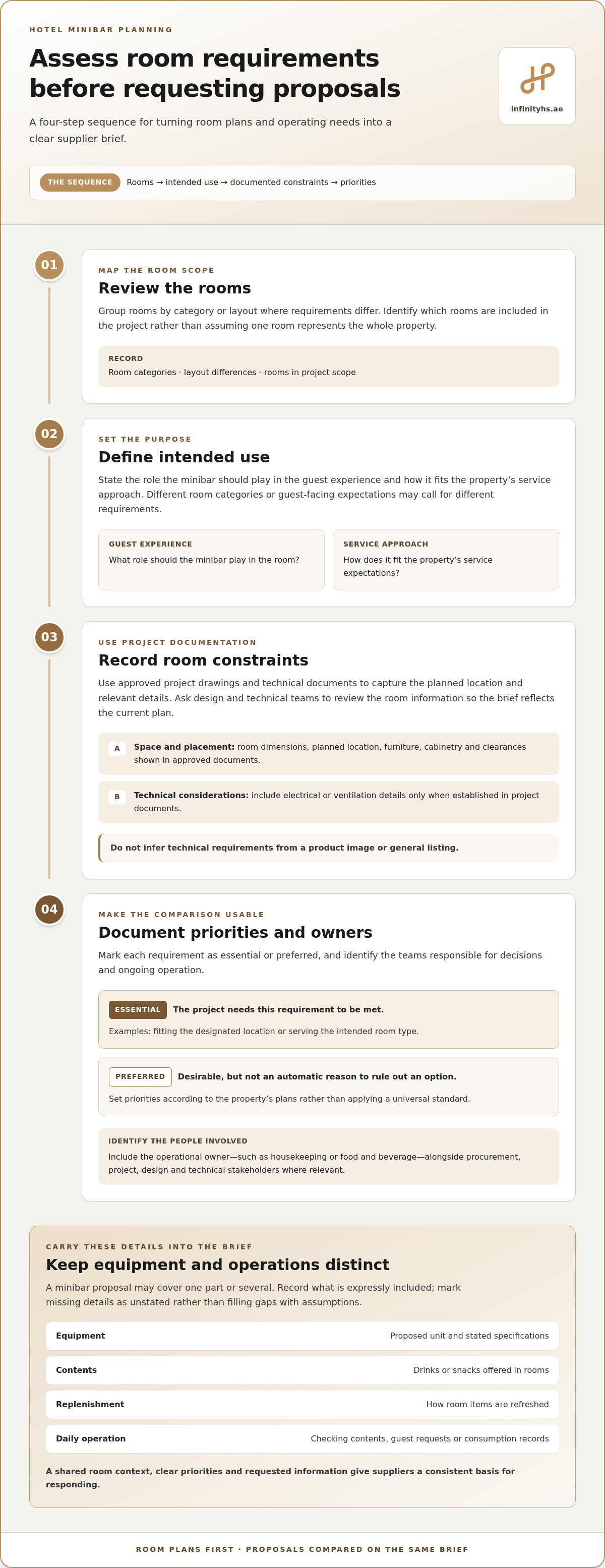
A useful assessment turns room plans and operating needs into a brief suppliers can answer. Work through the steps in order: review the rooms, define the minibar’s intended role, record documented constraints, then separate essential requirements from preferences. This helps your team avoid choosing from a product listing before deciding what the rooms and operations actually require.
An essential requirement is one the project needs to meet, such as fitting the designated location or serving the intended room type. A preference is desirable and can inform the comparison, but does not automatically rule out an option. Set priorities according to the property’s plans rather than applying a universal standard.
- Review the rooms. Group rooms by category or layout where requirements differ, and identify which rooms fall within the project.
- Define intended use. State the role the minibar should play in the guest experience and how it fits the property’s service approach.
- Record constraints. Use approved project drawings and technical documents to capture room dimensions, planned location, furniture details, and applicable electrical or ventilation considerations.
- Document priorities. Mark each requirement as essential or preferred, and note the teams responsible for decisions and ongoing operation.
A complete brief improves proposal comparisons because each supplier receives the same room context, priorities and requested information.
Map room layouts and installation constraints
Record where the minibar is planned and what surrounds it. Note relevant cabinetry, furniture and clearances shown in approved project documents. Include electrical or ventilation considerations only when those details are established in the project documents. Don’t infer technical requirements from a product image or general listing. Ask the design and technical teams to review the room information so the brief reflects the current plan.
If room types differ, document those differences instead of assuming one layout represents the whole property. A minibar location in a room with built-in cabinetry may have different space constraints from an open furniture arrangement. Give suppliers a consistent picture of the rooms in scope without prescribing specifications the project team has not set.
Set operational and guest-experience priorities
Agree on what matters most for the property: guest convenience, room presentation or fit with established operations. These priorities can coexist, but ranking them helps the team make decisions when proposals vary. For example, a property may prioritise a discreet appearance in one room category while giving operational access greater weight in another.
Document responsibilities around the equipment as separate decisions. State who selects contents, manages replenishment, prepares rooms and handles ongoing operation. Include purchasing, room setup, housekeeping, food and beverage, and technical stakeholders where relevant. This makes handoffs visible before proposals arrive and prevents equipment sourcing from being mistaken for a contents or service plan.
Once the assessment is recorded, your team can share a clear basis for supplier responses and coordinate related room-supply decisions. Keep the brief available to teams responsible for room electronics and OS&E planning so each workstream can align with the documented room requirements.
Compare hotel minibar suppliers in the UAE with consistent criteria
When proposals arrive, assess them with a shared comparison framework. A product listing may focus on equipment, while a proposal may also describe documentation, sourcing, logistics or project coordination. Separate these elements in your review so a detailed product description doesn’t make the overall scope appear more complete than it is.
Compare the stated product information with the property’s documented room requirements. Don’t assume a feature shown in one listing is standard across other models or relevant to every room. If a proposal doesn’t state a detail, leave the field blank. This makes missing information visible without turning an assumption into a supplier commitment.
| Comparison criterion | Proposal A | Proposal B | Proposal C |
|---|---|---|---|
| Offered model and identifying details | |||
| Stated capacity and dimensions | |||
| Stated power and operating details | |||
| Fit with documented room requirements | |||
| Equipment scope and exclusions | |||
| Documentation supplied | |||
| Delivery and project coordination stated | |||
| Other responsibilities explicitly covered |
Compare product information against room use
Review capacity, dimensions, power information and operating details only when the proposal states them. Then assess whether they suit the specific room use and approved plans. For example, compare the stated dimensions with the furniture arrangement for the room category in scope, and consider capacity against the minibar’s intended role. Treat specifications in other suppliers’ listings as examples, not universal requirements, and record the model associated with each set of details.
Separate proposal scope from supplier claims
For each hotel minibar supplier in UAE, note which sourcing, quality-control, logistics and coordination tasks the proposal explicitly covers. Keep specific project commitments separate from general marketing statements. Apply the same approach to documentation, warranties, compliance statements, delivery timing and after-sales support: record what the proposal states, and leave fields blank when it doesn’t. A useful comparison reflects the actual offer.
Local presence and regional reach are distinct factors that may inform how your team works with a supplier, but neither alone proves product quality or project suitability. For hotel projects in the UAE, GCC, Middle East and Africa, consider these factors alongside the stated model information, scope, documentation and fit with the property’s requirements. Before selecting a proposal, review material gaps with the relevant project stakeholders and record how the final choice aligns with the hotel’s priorities.
Prepare a UAE hotel minibar purchasing brief that suppliers can answer
A request-ready brief gives each hotel minibar supplier in UAE the same property context, room scope and response fields. It also helps your team distinguish equipment proposals from plans for minibar contents or ongoing replenishment. Keep the brief concise, attach relevant approved project documents, and ask suppliers to respond against the same criteria.
Information to include in the request
Set out the property type, project context, intended minibar use, room categories and rooms in scope. Refer to approved room plans for dimensions and constraints, and label essential requirements separately from preferences. List the product information and supporting documents your team needs to review each response. State known project constraints and identify who will make purchasing and room-setup decisions.
Use this template as a starting point:
- Property and project: Property type, project stage, intended use and relevant context.
- Room scope: Room categories, rooms included, approved plans and documented layout or technical constraints.
- Equipment requirements: Required fit and product information, with essentials and preferences clearly marked.
- Equipment versus service: Specify whether the request covers minibar equipment, contents selection, replenishment, guest-facing service or a combination. Name the party responsible for each item.
- Requested documentation: Identify the product details and project documents required for internal review.
- Stakeholders: List the teams responsible for purchasing, room setup, technical review and ongoing operation.
Ask each supplier to complete a response matrix instead of returning an unstructured description. For every field, request a direct answer or a note that the information was not provided.
- Specifications: Offered model, stated dimensions, capacity, power information and operating details.
- Scope: Equipment included, exclusions and any stated responsibility for contents or replenishment.
- Sourcing: Sourcing information explicitly described in the proposal.
- Quality control: Quality-control steps or documentation expressly stated.
- Logistics and coordination: Delivery details and project coordination responsibilities included in the response.
How to review responses and make a decision
Compare each answer against the same brief and record omissions without filling gaps with assumptions. Assess product fit against documented room requirements, then review proposal clarity and coordination scope. A response may describe a suitable model yet leave responsibilities or project details unclear. Keep those as separate decision points for the relevant stakeholders.
Use the completed brief and response matrix as the record for internal review. For a broader view of how purchasing decisions connect across hotel supply categories, refer to Hospitality Procurement Solutions: A Strategic Guide for 2026. Infinity Hotel Supplies supports wider hotel supply planning through its Room Electronics and OS&E categories.
A clear, shared brief gives your hotel team a practical starting point for its next room-supply planning discussion.
Coordinate minibar decisions with wider hotel room supply planning
A minibar belongs within the guest-room plan, alongside furniture, room electronics, amenities and operating procedures. Coordinating these workstreams gives design, technical and operations teams a shared view of how decisions affect the room as a whole. Keep each category’s scope distinct, then identify where teams need to align on layouts, responsibilities or project timing.
Coordinate related room-supply categories
Consider room electronics and OS&E requirements alongside the minibar plan, especially when the same room layouts or project teams are involved. For example, a refurbishment schedule may bring several guest-room categories into review at once. A coordinated workstream helps teams track those decisions together while retaining separate requirements and ownership for each category.
Infinity Hotel Supplies provides Room Electronics and OS&E as part of its hotel-supply offering. These categories can be considered alongside the wider room plan, while minibar equipment decisions remain a distinct scope. This supports coordination without assuming that one category includes another.
Discuss broader hotel supply requirements with Infinity Hotel Supplies
Infinity Hotel Supplies is a Dubai-based hospitality supplier founded in 2014. Its offices in the UAE, China and the United Kingdom support global sourcing and quality control. The company provides customized solutions and turnkey hotel supply solutions, including Room Electronics and OS&E. Its wider product range also includes hotel linens, guest amenities, uniforms, lighting and leather essentials.
For a hotel team, the practical next step is to map related room-supply needs, assign decision owners and note where information must pass between workstreams. A shared project view can help keep guest-room requirements aligned while preserving clear boundaries between equipment, contents and operating responsibilities.
Use that coordinated view to frame discussions about wider hotel supply requirements and the room categories your property is planning.
Move from a clear brief to coordinated room planning
Use the minibar project to strengthen how your hotel evaluates guest-room decisions over time. After rooms are in use, gather feedback from guests and operational teams to identify what works well and what may need attention in a future refresh.
That learning can inform later room updates, helping your team make choices with a clearer understanding of guest experience and daily use. Treat each project as an opportunity to improve the next one.
Consider which guest-room improvement your team wants to plan next.
Take the next step with confidence.
Frequently Asked Questions
What should a hotel minibar supplier in the UAE include in a proposal?
A proposal should identify the offered model, its stated specifications, the equipment included and any exclusions. It should also describe the documentation and project coordination it covers, such as delivery arrangements if these are part of the offer. For example, if two models are proposed for different room types, the response should show which model applies to each. Keep unstated details open rather than treating them as commitments.
How do hotels decide which minibar specifications suit their rooms?
Hotels should match each stated specification to the intended room use and approved room information. Compare the proposed unit’s documented dimensions with the space shown in the current room plan, then review capacity and operating details against the minibar’s intended role. If room categories differ, assess each separately instead of assuming one model or specification suits every room.
Is minibar equipment supply the same as minibar stocking and replenishment?
No. Equipment supply concerns the unit, while stocking and replenishment concern the items placed in it and how they are refreshed. A hotel can make the distinction clear with a responsibility record: equipment sourcing belongs to one scope, while contents selection and room checks belong to named operational teams. This helps prevent gaps at handover, especially when purchasing and daily room operations involve different departments.
Can hotel minibars be included in a wider room-supply project?
Yes. Minibar decisions can be coordinated within a broader room-supply project, provided the equipment scope remains clear. For example, a room schedule can track minibar decisions alongside other guest-room categories, with a named owner and status for each. This lets design, technical and operations teams coordinate dependencies without assuming that one category’s supplier is responsible for every item in the room.
What information should a hotel include when requesting minibar proposals?
Include the property and project context, room categories in scope, intended use and relevant approved plans. State which product details and documents your team needs for review, and identify known constraints or decisions that are still open. Also specify whether the request concerns equipment only or includes contents, replenishment or guest-facing service. Attach the correct plan version so responses refer to the same room information.
How can hotel teams compare minibar suppliers consistently?
Use one comparison sheet and the same fields for every response. Record the offered model, stated specifications, included scope, documentation and coordination details. Mark each requirement as addressed, requiring clarification or not stated. This makes omissions visible without filling them with assumptions. If proposals use different terms for similar details, preserve each supplier’s wording and have the relevant team review the comparison before deciding.
What should hotels consider when coordinating minibar equipment with room design?
Use the latest approved room drawings and note their revision so reviewers know which layout a proposal reflects. Compare the proposed location with the documented furniture or cabinetry plan, and record applicable electrical or ventilation details only when established by project documents. If the room design changes, flag which minibar decisions may need review. This keeps product assessment tied to the actual room plan rather than an outdated layout.
Planning a hotel project in the UAE, GCC, Middle East or Africa? Explore Infinity Hotel Supplies’ Room Electronics, OS&E, hotel linens and guest amenities to coordinate the room-supply categories your property needs.

Article by
Infinity Editorial Team
With deep expertise in hospitality product FF&E and OS&E across the Middle East and Africa, Infinity Editorial Team brings insights from Infinity Hotel Supplies, helping developers, hoteliers, and homeowners transform spaces from empty shells to fully furnished, design-ready environments.
Disclaimer
The content published by Infinity Editorial Team is intended for informational purposes only. All articles, guides, and insights are based on industry knowledge and experience in hospitality FF&E and OS&E supply across the Middle East and Africa. Infinity Hotel Supplies does not guarantee specific outcomes and recommends consulting a qualified professional for project-specific requirements.


