

What if the biggest risk in a hotel fit-out isn’t a limited product range, but unclear responsibility between suppliers? A hotel FF&E solutions provider should help bring furniture, fixtures, and equipment into a coherent project scope, while keeping its relationship to OS&E and daily hotel operations clear.
That distinction matters. When design decisions, product sourcing, and operating supplies sit in separate workstreams, coordination gaps can affect consistency and readiness. The right partner depends not only on what’s in a catalogue, but on how well its offering aligns with the project’s needs. Infinity Hotel Supplies brings together FF&E and OS&E solutions alongside lighting, guest amenities, room electronics, linens, and housekeeping equipment.
This guide explains what FF&E covers, how it differs from OS&E, and which practical criteria can help you assess project fit. It also compares a coordinated hospitality supply partner with a purchasing platform, so hotel teams in the GCC, Middle East, and Africa can identify a useful next step with greater confidence.
Key Takeaways
- Clarify how FF&E differs from OS&E to define what your hotel project needs and where each category supports operations.
- A hotel FF&E solutions provider should align product sourcing with the project scope, while coordination responsibilities should be clearly defined.
- Compare project agencies, purchasing platforms, and hotel-managed sourcing by scope ownership, coordination needs, and recurring purchasing requirements.
- Build a concise project brief that records required categories, property areas, approval roles, and key constraints before assessing fit.
- Explore how Infinity Hotel Supplies’ hospitality product categories and turnkey approach can support hotel projects in the GCC, Middle East, and Africa.
What Does a Hotel FF&E Solutions Provider Actually Do?
A hotel FF&E solutions provider sources furniture, fixtures, and equipment in line with a defined project scope. The role is to help translate a hotel’s requirements into a considered product schedule with clear responsibilities. Depending on the project, this may involve coordinating categories across guest rooms or public areas. The agreed scope should state which products and activities are included.
These decisions shape the guest experience and the property’s readiness to operate. A mismatch between specified items, room layouts, and operational needs can create extra coordination work or leave teams without the products they planned around. The hotel remains responsible for setting requirements, approving selections, and upholding its brand standards. A provider works within that framework rather than replacing the hotel’s decision-making role.
To see how FF&E and OS&E fit together in a hotel project, watch this overview:
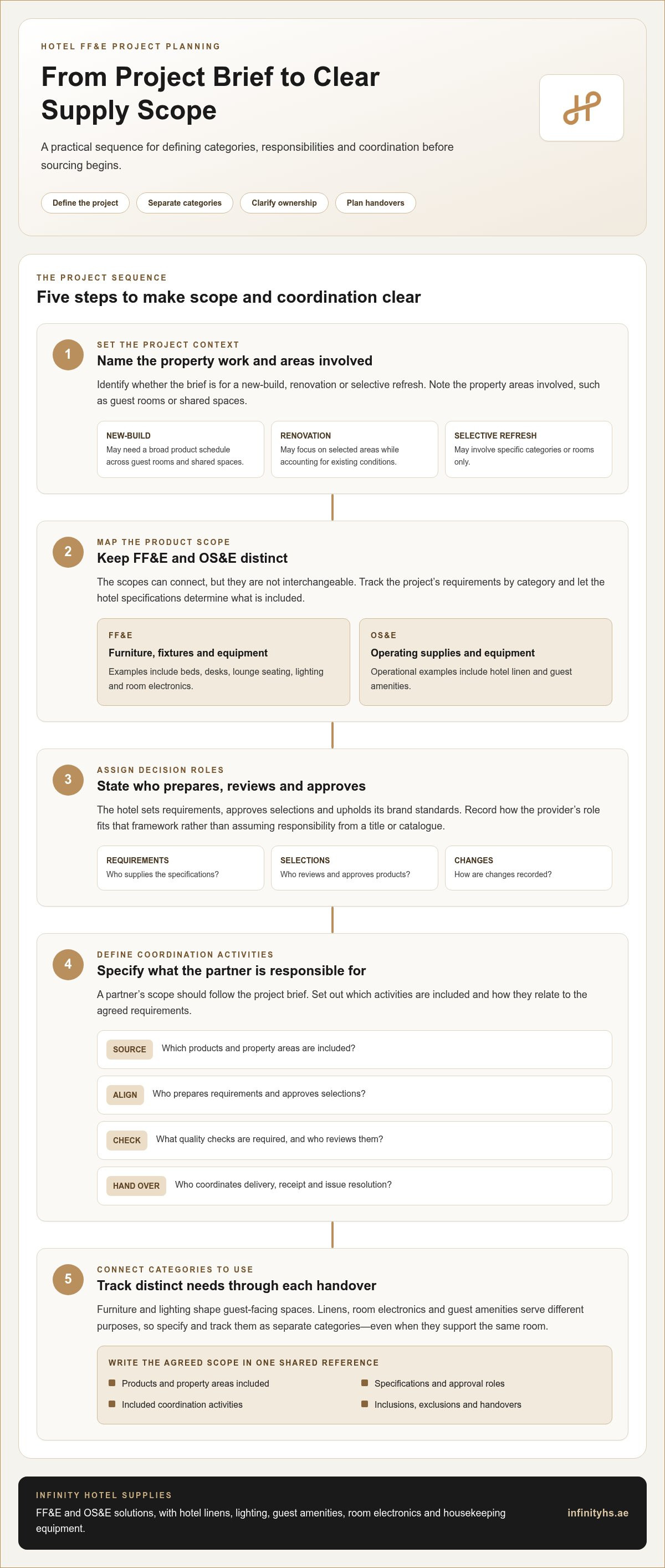
A clear scope helps the hotel and its supply partner understand where coordination begins and ends. It should identify:
- Which products and property areas are included.
- Who supplies specifications, reviews selections, and gives final approval.
- Which coordination activities are included, such as sourcing, quality control, or logistics.
Don’t infer responsibilities from a provider’s title or catalogue. Setting them out early helps teams manage handovers and keep decisions connected to the project brief.
What does FF&E mean in a hotel project?
FF&E means furniture, fixtures, and equipment. Furniture may include beds, desks, or lounge seating; fixtures can include lighting or other items attached to a space; and equipment may include room electronics. The hotel’s specifications determine which products belong in scope. For example, hotel room electronics may be relevant to guest rooms, while other projects may focus on different areas or categories.
How is FF&E different from OS&E?
OS&E means operating supplies and equipment used to support hotel operations. Hotel linen and guest amenities are examples of operational categories, while FF&E generally covers the furnishings, fixtures, and equipment specified for the property. The scopes can connect, but they aren’t interchangeable. A project may coordinate both while tracking their requirements separately.
With these boundaries defined, map which coordination activities a project partner can support and which decisions remain with the hotel team.
Which Hotel FF&E Services Can a Project Partner Coordinate?
A partner’s scope should follow the project brief, not assumptions about what every FF&E provider handles. Product sourcing connects specified categories to the project. Other coordination activities may include reviewing requirements, arranging quality control, managing logistics, and aligning handovers. State these responsibilities clearly in the agreed scope.
Before sourcing begins, set out who prepares specifications, who approves product selections, how changes are recorded, and who receives or checks items at each handover. These details connect the hotel team, design stakeholders, and suppliers. The Role of hotel FF&E companies is closely tied to guest experience and operational efficiency, but the exact contribution varies by project and agreement.
Match provider scope to openings, renovations, and refreshes
A new-build may require a broad product schedule across guest rooms and shared spaces. A renovation may focus on selected areas while accounting for existing conditions, and a selective refresh may involve only specific categories or rooms. Project scale, property requirements, and hotel priorities shape the brief. Documenting inclusions, exclusions, approvals, and responsibilities gives stakeholders a shared reference.
Connect product categories to the guest and operating environment
Furniture and lighting influence how guest-facing spaces look and function. Linens, room electronics, and guest amenities serve distinct purposes, so specify and track them as separate categories even when they support the same room. For example, a brief can define room technology needs separately from bedding and amenities. Hotel room electronics are one category within this broader supply picture.
Use a scope table to identify which activities need coordination and resolve handovers before work proceeds:
| Activity | Project relevance | Resolve with the hotel team |
|---|---|---|
| Product sourcing | Connects specified categories to the project brief. | Which products and property areas are included? |
| Specification alignment | Helps keep selections consistent with stated requirements. | Who prepares requirements and approves selections? |
| Quality control | Defines how product checks relate to agreed expectations. | What checks are required, and who reviews them? |
| Logistics and handovers | Clarifies how products move between project stages and responsible teams. | Who coordinates delivery, receipt, and issue resolution? |
For a hotel team, the practical value of a hotel FF&E solutions provider depends on how clearly its role connects product categories with these responsibilities. Infinity Hotel Supplies provides FF&E and OS&E solutions alongside hotel linens, lighting, guest amenities, and room electronics. Hotels shaping a project brief can share their project requirements to discuss a tailored approach.
How Do You Compare an FF&E Provider, Agency, and Procurement Platform?
The main difference is how each model handles the work around purchasing. A project agency may coordinate a defined FF&E scope; a platform primarily supports purchasing workflows; and a hotel-managed model keeps sourcing decisions within the hotel team. These approaches can overlap, so compare actual responsibilities rather than relying on labels. The right fit depends on the project scope, available hotel resources, and procurement requirements.
| Model | Project fit | Scope ownership | Coordination needs | Recurring purchasing |
|---|---|---|---|---|
| Project-based agency or partner | May suit an opening, renovation, or coordinated property project. | Responsibilities are agreed for the project, including which categories and activities are covered. | Can coordinate defined sourcing and project activities, with hotel approvals and handovers specified. | May be less central if the immediate need is ongoing routine purchasing. |
| Purchasing platform | May suit repeat purchasing workflows across operational needs. | The hotel generally sets purchasing requirements; the platform supports the workflow. | Hotel teams still need to manage project-specific specifications, approvals, and coordination unless separately assigned. | Can support recurring purchasing processes. |
| Hotel-managed sourcing | May fit teams with internal capacity and established supplier relationships. | The hotel retains direct control of sourcing and decisions. | Internal stakeholders coordinate requirements, supplier communication, approvals, and handovers. | Can work where the hotel team manages ongoing needs directly. |
A platform can help organize purchasing, but it doesn’t automatically take on project services such as aligning a property-specific scope or coordinating responsibilities between stakeholders. Likewise, not every opening or renovation needs a full-service agency arrangement. A hotel may combine models, for example using internal teams to approve selections while assigning a partner defined sourcing or coordination tasks.
When does a project-based FF&E partner make sense?
A project-based partner may be useful when an opening, renovation, or property-wide initiative has connected requirements across areas or product categories. Agreeing who handles sourcing, coordination, approvals, and handovers can reduce ambiguity between teams. The hotel can still control its requirements and brand decisions. Define the support the project needs rather than assuming every activity belongs in the partner’s scope.
When might a procurement platform or internal team fit better?
Recurring purchases are a distinct use case from coordinating a defined fit-out. A platform can support purchasing workflows, while an internal team may prefer to retain purchasing control and established supplier relationships. Account for the work that remains with hotel staff, including setting requirements and managing project-specific approvals, rather than treating a purchasing tool as a substitute for every project responsibility.
To compare options, map each required task to an owner, then identify gaps between the project team, suppliers, and purchasing systems. A hotel FF&E solutions provider is a stronger fit when its agreed role matches the project’s actual needs, not simply because it offers a broad catalogue. Discuss your hotel project with Infinity to explore a tailored approach to hotel supply requirements.
What Should Hotels Assess Before Selecting an FF&E Partner?
A clear selection process starts with the hotel’s needs, not a provider’s catalogue. Define the project, make responsibilities visible, and assess whether the partner’s capabilities fit the property location and sourcing approach. A concise brief gives hotel stakeholders a shared basis for comparing project fit and identifying gaps before work begins.
- Define the requirements. Record the property type, project stage, areas in scope, and product categories required. Distinguish FF&E from related operating supplies so the brief reflects what the project actually covers.
- Map the scope. Note design requirements, brand standards, project constraints, and the activities for which support is needed. Separate product sourcing from coordination responsibilities such as quality control and logistics.
- Assign decision-making. Identify who prepares requirements, reviews selections, gives approvals, and handles changes or handovers. Clear ownership helps prevent unresolved decisions from moving between teams.
- Assess regional fit. Consider the project location and sourcing footprint, then align quality control and logistics responsibilities with the agreed scope. Account for the hotel’s regional context without assuming every market or project has identical needs.
Build a clear hotel FF&E project brief
Use the brief to capture property type, project stage, guest-facing and operational areas, and required product categories. Include relevant design direction and brand standards, along with named approval roles and decision steps. Mark each point as confirmed or open, so teams can distinguish agreed requirements from selections or procurement decisions that still need resolution. This gives the hotel and its partner a practical reference for scope discussions.
- Property and project: property type, location, opening, renovation, or refresh.
- Scope: areas and categories required, plus inclusions and exclusions.
- Governance: decision-makers, approvers, and change-handling responsibilities.
- Constraints: known project conditions and unresolved decisions.
Assess sourcing coordination for GCC and regional projects
For a project in the GCC, Middle East, or Africa, consider how the property location and sourcing footprint affect communication, quality control, and logistics handovers. Define each responsibility in the scope, identify its owner, and establish how information moves between the hotel team and relevant suppliers. Infinity Hotel Supplies is based in Dubai, with offices in the UAE, China, and the UK, and has global sourcing and quality control capabilities. These points provide useful context when assessing regional alignment alongside your project’s specific requirements.
For additional procurement-planning context, consult the existing hospitality procurement solutions guide. Assess a hotel FF&E solutions provider against the project brief and agreed responsibilities, not a generic checklist alone. The more clearly the hotel records its needs and decision process, the easier it is to establish a practical basis for collaboration.
How Infinity Hotel Supplies Supports Hotel FF&E Projects
Infinity Hotel Supplies is a Dubai-based hospitality supplier operating since 2014. Its one-stop approach brings together hotel product categories and turnkey solutions, with tailored options for project requirements. For a hotel team assessing a hotel FF&E solutions provider, the practical question is how the available categories relate to the project scope, from guest-facing spaces to operational needs.
Infinity’s offering spans furniture, lighting, FF&E solutions, and OS&E solutions, alongside hotel linens, room electronics, and guest amenities. These categories can support different parts of a property brief without making them interchangeable. The hotel defines its requirements and approvals; a clear scope connects relevant product categories to the intended areas and use.
A coordinated range of hotel supply categories
For guestrooms, a project brief may bring together furniture and lighting with linens, room electronics, and guest amenities. Public areas may have different furniture and lighting requirements, while operating teams may need categories such as OS&E, hotel uniforms, and housekeeping equipment. The mix depends on the property and project. Mapping categories to spaces helps teams see where requirements overlap and where separate approvals may be needed.
Hotel linens support guest comfort and are selected with durability and easy maintenance in mind. A brief can specify which property areas require linen and how those needs relate to the wider room schedule. Infinity’s hotel linen range supports hotel supply plans that include linen requirements.
Room electronics and guest amenities serve distinct guestroom functions, so listing them separately can make responsibilities and selections easier to manage. Furniture and lighting contribute to how guest and public spaces are equipped. A coordinated product range lets project teams consider these needs together while keeping category-specific requirements clear.
Dubai-based support with global sourcing capabilities
Infinity has offices in the UAE, China, and the United Kingdom. The company has global sourcing and quality control capabilities to support hotel supply requirements across markets. Regional fit still depends on the property location, sourcing footprint, specified categories, and agreed coordination responsibilities. Setting these details out in the brief helps align the hotel’s expectations with the partner’s role.
As a hospitality-focused supplier, Infinity combines its product categories with tailored solutions and turnkey offerings. This gives hotel teams a connected starting point for considering FF&E alongside related operating supplies, while keeping the project’s particular scope in focus. Share the property context, areas involved, required categories, and key decisions so the discussion can focus on your project rather than a generic catalogue.
Turn Your Project Brief into a Clear Next Step
Give your project brief a practical purpose beyond documenting requirements: use it to guide the first conversation and identify the decisions that need to happen next. Select a lead stakeholder to bring together property priorities, approval roles, and open choices. This keeps discussions focused and helps the hotel team judge whether a hotel FF&E solutions provider can align its contribution with the project’s needs.
From there, shape a working scope that can evolve as the project develops. Separate immediate priorities from decisions that can be made later, and make ownership visible so the right people can respond at each stage. A thoughtful start creates a stronger basis for coordination, whether the project covers a defined area or a wider hotel supply requirement.
Share your hotel project scope with Infinity Hotel Supplies to discuss a tailored approach.
With a clear brief and the right stakeholders involved, your next project conversation can begin with purpose and move forward with confidence.
Frequently Asked Questions
Is a hotel FF&E solutions provider the same as an interior designer?
No. An interior designer typically develops the look and spatial concept, while a hotel FF&E solutions provider focuses on coordinating specified product sourcing and related activities within an agreed scope. The roles can connect, but they aren’t interchangeable. For a hotel in the GCC, define who owns design decisions, who translates approved selections into product requirements, and who gives final sign-off. This keeps design intent and supply decisions aligned.
Can an FF&E solutions provider support both hotel openings and renovations?
Yes. A provider can support either type of project, with the scope shaped by the property’s needs. An opening may involve furnishing a new property, while a renovation might cover selected rooms or shared spaces. Identify what will remain, what will change, and which decisions need approval. In the Middle East or Africa, recording the property location and project conditions in the brief helps frame coordination requirements.
What should a hotel include in an FF&E request for proposal?
Include the property and project stage, areas covered, required categories, design or brand requirements, and the decision-makers responsible for approvals. State which coordination activities the project needs and how updates, changes, and handovers will be managed. Separate agreed requirements from open questions. For a GCC project, identify the target property location and relevant project-specific requirements, so respondents can address the same brief rather than make different assumptions.
Does hotel FF&E procurement include OS&E?
Not automatically. FF&E and OS&E are distinct scopes, though a hotel can plan them together when the project calls for both. For example, a room schedule might address furnishings separately from operating supplies needed by hotel teams. State whether OS&E is included, handled through a separate workstream, or outside the request. That clarity helps the hotel compare responses consistently and reduces the risk of overlooking operational needs during project planning.
Can one supplier provide products for different hotel departments?
Yes, a hospitality supplier with a broad product range may support requirements across guest areas and hotel operations. Infinity Hotel Supplies serves hotels with categories spanning FF&E, OS&E, linens, room electronics, amenities, uniforms, lighting, and housekeeping equipment. For a hotel group in the GCC, organizing requirements by department helps teams see where categories connect while keeping each department’s specifications and approvals distinct.
How can hotels assess an FF&E provider without relying on unsupported claims?
Assess the proposed scope in writing. Compare product categories, defined responsibilities, approval points, quality-control activities, and logistics handovers against the hotel’s brief. Look for specific descriptions of who does what, rather than broad promises about seamless delivery or superior results. Use the hotel’s own project criteria to evaluate proposals consistently, including how well each response addresses the property’s location and requirements in the GCC, Middle East, or Africa.

Article by
Infinity Editorial Team
With deep expertise in hospitality product FF&E and OS&E across the Middle East and Africa, Infinity Editorial Team brings insights from Infinity Hotel Supplies, helping developers, hoteliers, and homeowners transform spaces from empty shells to fully furnished, design-ready environments.
Disclaimer
The content published by Infinity Editorial Team is intended for informational purposes only. All articles, guides, and insights are based on industry knowledge and experience in hospitality FF&E and OS&E supply across the Middle East and Africa. Infinity Hotel Supplies does not guarantee specific outcomes and recommends consulting a qualified professional for project-specific requirements.


